
Introduction
The Internet of Things (IoT) has moved from experimental pilots to mission-critical infrastructure across industries such as manufacturing, healthcare, logistics, utilities, retail, and smart cities. As organizations deploy hundreds, thousands, or even millions of connected devices, the challenge shifts from connecting devices to managing them securely, reliably, and at scale. This is where IoT Device Management Platforms become essential.
An IoT Device Management Platform provides a centralized system to provision, monitor, update, secure, and troubleshoot connected devices throughout their lifecycle. Without such platforms, organizations face fragmented visibility, inconsistent firmware updates, increased security risks, and rising operational costs.
Real-world use cases include remote firmware updates for industrial sensors, monitoring medical devices in hospitals, managing smart meters in utilities, tracking connected fleets, and overseeing consumer IoT products in the field. When selecting a platform, buyers should evaluate scalability, device provisioning, OTA updates, security controls, integrations, analytics, and long-term operational costs.
Best for:
IoT Device Management Platforms are ideal for IoT architects, DevOps teams, IT operations, product managers, and engineering leaders in startups, SMBs, mid-market companies, and large enterprises operating connected devices at scale.
Not ideal for:
Organizations running very small, static IoT deployments, experimental prototypes, or single-device setups may find these platforms overly complex. In such cases, lightweight device SDKs or custom solutions may be sufficient.
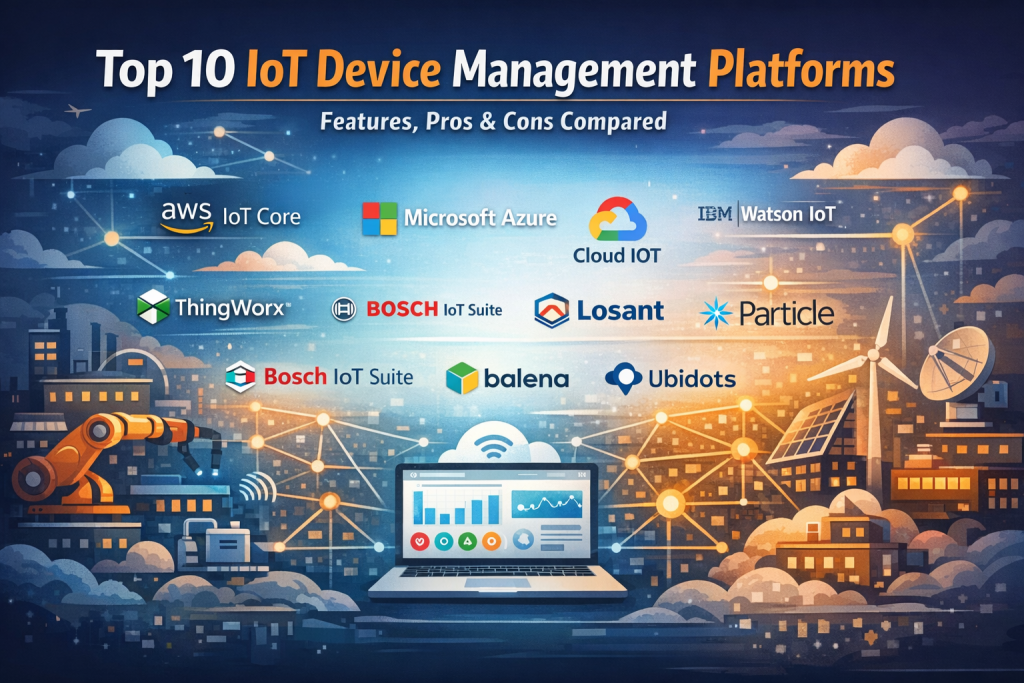
Top 10 IoT Device Management Platforms Tools
1 — AWS IoT Core
Short description:
AWS IoT Core is a cloud-native platform for securely connecting, managing, and scaling IoT devices within the AWS ecosystem. It is designed for enterprises building large-scale, production-grade IoT systems.
Key features:
- Secure device authentication and provisioning
- Device shadows for state synchronization
- OTA firmware and configuration updates
- Rules engine for real-time data routing
- Deep integration with cloud analytics and AI services
- Fine-grained access control policies
Pros:
- Extremely scalable and reliable
- Strong ecosystem and service integrations
- Mature tooling for enterprise deployments
Cons:
- Steep learning curve for beginners
- Costs can grow quickly at scale
- Strong dependency on a single cloud ecosystem
Security & compliance:
Encryption in transit and at rest, IAM integration, audit logs, SOC 2, ISO, GDPR support.
Support & community:
Extensive documentation, large developer community, enterprise-grade support plans.
2 — Microsoft Azure IoT Hub
Short description:
Azure IoT Hub enables bi-directional communication and centralized device management, particularly well-suited for organizations already invested in the Microsoft cloud ecosystem.
Key features:
- Secure device-to-cloud communication
- Device twins for configuration management
- Automatic device provisioning service
- OTA updates and lifecycle management
- Integration with analytics and digital twins
- Hybrid and edge computing support
Pros:
- Strong enterprise and hybrid capabilities
- Excellent integration with Microsoft tools
- Scales well for industrial use cases
Cons:
- Complex setup for smaller teams
- Interface can feel overwhelming
- Cost optimization requires planning
Security & compliance:
Enterprise-grade encryption, role-based access control, ISO, SOC 2, GDPR.
Support & community:
Comprehensive documentation, enterprise support, active technical community.
3 — Google Cloud IoT (Device Management Services)
Short description:
Google’s IoT device management offerings focus on secure connectivity and large-scale data ingestion with strong analytics and machine learning capabilities.
Key features:
- Secure device authentication
- Scalable device registry
- Data ingestion pipelines
- Integration with analytics and AI
- Event-driven architecture
- Flexible APIs
Pros:
- Excellent data analytics capabilities
- Highly scalable cloud infrastructure
- Clean API-driven design
Cons:
- Smaller IoT ecosystem compared to competitors
- Less out-of-the-box device tooling
- Requires strong cloud expertise
Security & compliance:
Encryption, IAM policies, audit logging, GDPR and ISO alignment.
Support & community:
Good documentation, strong cloud community, enterprise support available.
4 — IBM Watson IoT Platform
Short description:
IBM Watson IoT Platform combines device management with advanced analytics and AI, making it suitable for regulated and industrial environments.
Key features:
- Device lifecycle and fleet management
- Secure connectivity and authentication
- Predictive analytics and AI insights
- Asset monitoring and alerts
- Integration with enterprise systems
- Industry-specific accelerators
Pros:
- Strong analytics and AI capabilities
- Well-suited for regulated industries
- Enterprise-grade reliability
Cons:
- Higher cost structure
- Longer implementation cycles
- Less developer-friendly UI
Security & compliance:
Strong encryption, audit logging, ISO, SOC 2, industry compliance support.
Support & community:
Enterprise support, professional services, moderate community presence.
5 — PTC ThingWorx
Short description:
ThingWorx is an industrial IoT platform focused on device management, digital twins, and operational intelligence for manufacturing and industrial IoT.
Key features:
- Industrial device connectivity
- Device lifecycle management
- Digital twin modeling
- Predictive maintenance tools
- Visualization dashboards
- Integration with PLM systems
Pros:
- Excellent for industrial IoT
- Strong visualization and modeling
- Designed for complex assets
Cons:
- Expensive licensing
- Requires specialized expertise
- Less suitable for consumer IoT
Security & compliance:
Enterprise security controls, encryption, role-based access, compliance varies.
Support & community:
Strong enterprise support, limited open community.
6 — Bosch IoT Suite
Short description:
Bosch IoT Suite is a modular platform designed for industrial and enterprise IoT device management with strong European compliance alignment.
Key features:
- Device provisioning and management
- OTA firmware updates
- Device monitoring and diagnostics
- Modular microservice architecture
- Cloud-agnostic deployment options
- Edge integration support
Pros:
- Flexible and modular design
- Strong industrial focus
- Suitable for hybrid deployments
Cons:
- Smaller ecosystem
- Limited third-party integrations
- Requires technical expertise
Security & compliance:
Strong encryption, GDPR alignment, enterprise security standards.
Support & community:
Professional documentation, enterprise support, smaller community.
7 — Losant
Short description:
Losant is a developer-friendly IoT platform focused on rapid application development and device management for mid-market organizations.
Key features:
- Visual workflow engine
- Device state and attribute management
- OTA updates
- Real-time monitoring
- Application enablement tools
- REST and MQTT APIs
Pros:
- Easy to use and configure
- Fast time-to-value
- Strong application focus
Cons:
- Limited extreme-scale deployments
- Fewer industrial features
- Smaller global footprint
Security & compliance:
Encryption, role-based access, compliance varies by deployment.
Support & community:
Good documentation, responsive support, growing community.
8 — Particle
Short description:
Particle provides an end-to-end IoT device management and connectivity platform, ideal for hardware startups and product teams.
Key features:
- Device provisioning and fleet management
- OTA firmware updates
- Secure connectivity management
- Integrated hardware ecosystem
- Real-time diagnostics
- Developer-friendly tooling
Pros:
- Excellent developer experience
- Simplifies hardware-to-cloud workflows
- Strong OTA capabilities
Cons:
- Less flexible for non-Particle hardware
- Higher cost for large fleets
- Limited enterprise customization
Security & compliance:
Encrypted communications, device authentication, compliance varies.
Support & community:
Strong documentation, active developer community, commercial support.
9 — Balena
Short description:
Balena specializes in managing IoT devices running containerized applications, making it popular for edge computing use cases.
Key features:
- Container-based device management
- Fleet-wide OTA updates
- Edge application orchestration
- Device health monitoring
- Multi-architecture support
- Open-source foundations
Pros:
- Excellent for edge and container workloads
- Flexible and developer-centric
- Open ecosystem
Cons:
- Less traditional IoT analytics
- Requires container expertise
- Not ideal for simple sensor networks
Security & compliance:
Secure OS, encrypted updates, compliance varies by deployment.
Support & community:
Strong open-source community, commercial support options.
10 — Ubidots
Short description:
Ubidots is a lightweight IoT device management and data visualization platform focused on fast deployment and ease of use.
Key features:
- Device connectivity and management
- OTA configuration updates
- Real-time dashboards
- Event alerts and triggers
- API-driven integration
- Cloud-based analytics
Pros:
- Simple and intuitive interface
- Fast setup
- Cost-effective for SMBs
Cons:
- Limited advanced device lifecycle features
- Not ideal for very large fleets
- Basic enterprise controls
Security & compliance:
Encryption, basic access controls, compliance varies.
Support & community:
Good onboarding resources, responsive support, smaller community.
Comparison Table
| Tool Name | Best For | Platform(s) Supported | Standout Feature | Rating |
|---|---|---|---|---|
| AWS IoT Core | Large enterprises | Cloud | Massive scalability | N/A |
| Azure IoT Hub | Enterprise & hybrid | Cloud / Edge | Enterprise integration | N/A |
| Google Cloud IoT | Data-driven IoT | Cloud | Analytics & ML | N/A |
| IBM Watson IoT | Regulated industries | Cloud | AI-driven insights | N/A |
| PTC ThingWorx | Industrial IoT | Cloud / On-prem | Digital twins | N/A |
| Bosch IoT Suite | Industrial enterprises | Cloud / Hybrid | Modular architecture | N/A |
| Losant | Mid-market teams | Cloud | Visual workflows | N/A |
| Particle | Hardware startups | Cloud | End-to-end IoT | N/A |
| Balena | Edge computing | Cloud / Edge | Container management | N/A |
| Ubidots | SMBs & pilots | Cloud | Ease of use | N/A |
Evaluation & Scoring of IoT Device Management Platforms
| Criteria | Weight | Notes |
|---|---|---|
| Core features | 25% | Provisioning, OTA, monitoring |
| Ease of use | 15% | UI, onboarding |
| Integrations & ecosystem | 15% | Cloud, analytics, APIs |
| Security & compliance | 10% | Encryption, audits |
| Performance & reliability | 10% | Scalability, uptime |
| Support & community | 10% | Docs, support |
| Price / value | 15% | Cost vs capabilities |
Which IoT Device Management Platforms Tool Is Right for You?
- Solo users & startups: Look for simplicity and fast setup
- SMBs: Balance cost, usability, and core lifecycle features
- Mid-market: Prioritize integrations and scalability
- Enterprises: Focus on security, compliance, and global scale
- Budget-conscious: Lightweight platforms with predictable pricing
- Premium needs: Enterprise-grade platforms with advanced analytics
- Security-sensitive industries: Strong compliance and audit controls
Frequently Asked Questions (FAQs)
- What is an IoT Device Management Platform?
A system for provisioning, monitoring, updating, and securing connected devices at scale. - Why is OTA updating important?
It allows remote firmware and configuration updates without physical access. - Are these platforms cloud-only?
Most are cloud-based, but some support hybrid and edge deployments. - How do they improve security?
Through encryption, authentication, access control, and audit logging. - Can small businesses use them?
Yes, many platforms offer SMB-friendly plans and features. - Do they support multiple device types?
Most support heterogeneous fleets with different protocols. - What skills are required to manage them?
Typically IoT, cloud, networking, and security knowledge. - How do costs scale?
Costs often grow with device count, data volume, and features used. - Are open-source options available?
Some platforms are open-source or built on open components. - What is the biggest mistake buyers make?
Choosing based only on price without considering scalability and security.
Conclusion
IoT Device Management Platforms are the backbone of any serious IoT deployment. They ensure devices remain secure, updated, observable, and manageable throughout their lifecycle. While some platforms excel at massive enterprise scale and compliance, others focus on developer experience, edge computing, or rapid deployment.
The most important takeaway is that there is no single “best” platform for everyone. The right choice depends on your device scale, industry requirements, security needs, integration ecosystem, and long-term growth plans. By aligning platform capabilities with real operational needs, organizations can unlock the true value of their IoT investments.

Find Trusted Cardiac Hospitals
Compare heart hospitals by city and services — all in one place.
Explore Hospitals
