
Introduction
Machine Learning Platforms are comprehensive software environments that help individuals and organizations build, train, deploy, monitor, and scale machine learning models efficiently. Instead of stitching together multiple tools for data preparation, model training, deployment, and monitoring, these platforms provide an integrated ecosystem that supports the entire ML lifecycle.
In today’s data-driven world, machine learning is no longer limited to research labs. It powers recommendation engines, fraud detection systems, medical diagnostics, demand forecasting, personalization engines, predictive maintenance, and autonomous systems. As datasets grow larger and models become more complex, using ad-hoc scripts or standalone libraries is no longer sufficient. Machine Learning Platforms solve this by offering automation, collaboration, governance, and scalability.
When choosing a machine learning platform, users should evaluate:
- Model development capabilities (AutoML, custom training, notebooks)
- Scalability and performance
- Integration with existing data sources and tools
- Deployment and MLOps features
- Security, compliance, and governance
- Ease of use vs flexibility
- Pricing and long-term value
Best for:
Machine Learning Platforms are ideal for data scientists, ML engineers, AI researchers, analytics teams, startups, enterprises, and regulated industries that need reliable, scalable, and repeatable ML workflows.
Not ideal for:
They may be excessive for simple analytics tasks, very small datasets, or teams that only require basic statistical models where lightweight libraries or spreadsheets are sufficient.
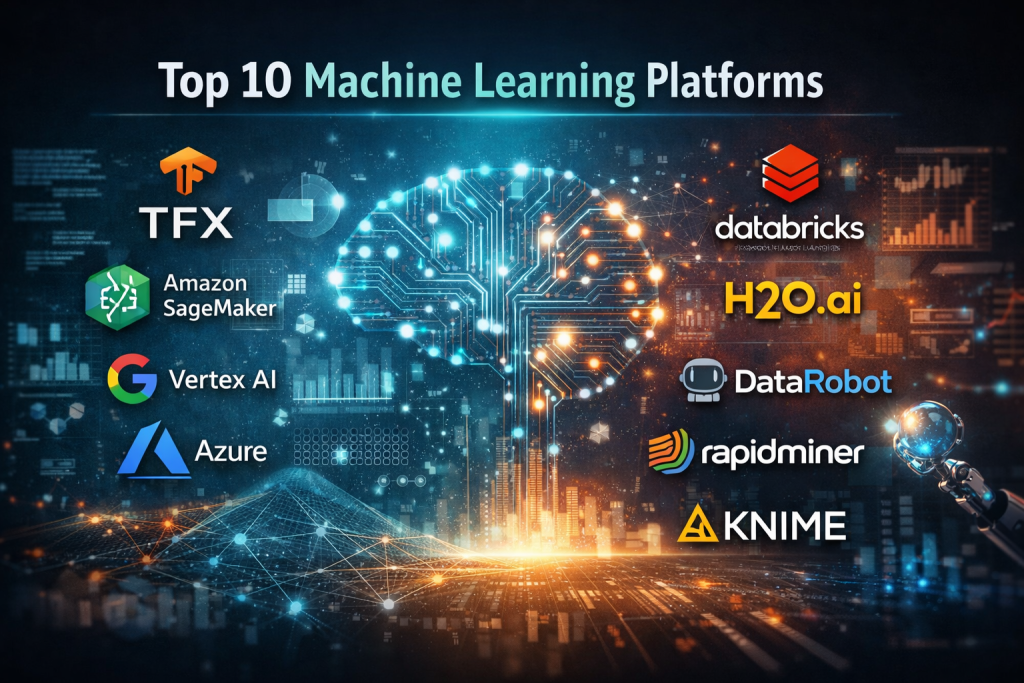
Top 10 Machine Learning Platforms Tools
1 — TensorFlow Extended (TFX)
Short description:
TFX is an end-to-end machine learning platform designed to deploy production-ready TensorFlow models at scale. It is widely used by teams building robust ML pipelines.
Key features:
- End-to-end ML pipeline orchestration
- Data validation and schema enforcement
- Model training and evaluation automation
- Scalable deployment support
- Integration with TensorFlow ecosystem
- Metadata tracking for experiments
Pros:
- Strong production-grade reliability
- Excellent for large-scale ML workflows
Cons:
- Steep learning curve
- Less flexible outside TensorFlow ecosystem
Security & compliance:
Varies depending on deployment environment
Support & community:
Extensive documentation, strong open-source community, enterprise backing available
2 — Amazon SageMaker
Short description:
Amazon SageMaker is a fully managed machine learning platform that enables data scientists and developers to build, train, and deploy models at scale in the cloud.
Key features:
- Built-in algorithms and AutoML
- Managed notebooks and training jobs
- One-click model deployment
- MLOps and monitoring tools
- Scalable infrastructure
- Deep integration with cloud services
Pros:
- Highly scalable and reliable
- Strong enterprise-grade tooling
Cons:
- Pricing can be complex
- Cloud lock-in concerns
Security & compliance:
SOC 2, ISO, GDPR, HIPAA support depending on configuration
Support & community:
Enterprise support, detailed documentation, large user base
3 — Google Vertex AI
Short description:
Vertex AI is a unified machine learning platform that combines data engineering, data science, and ML engineering workflows into one environment.
Key features:
- Unified model training and deployment
- AutoML and custom model support
- Integrated feature store
- Model monitoring and drift detection
- Scalable infrastructure
- Notebook-based development
Pros:
- Strong automation capabilities
- Excellent performance for large datasets
Cons:
- Complex for beginners
- Requires cloud expertise
Security & compliance:
GDPR, ISO, SOC 2, HIPAA-ready environments
Support & community:
Strong documentation, enterprise support available
4 — Microsoft Azure Machine Learning
Short description:
Azure Machine Learning is a cloud-based platform for managing the entire ML lifecycle, from experimentation to production deployment.
Key features:
- Visual ML designer and code-first workflows
- AutoML capabilities
- Model registry and versioning
- MLOps and CI/CD integration
- Hybrid and on-prem support
- Scalable compute options
Pros:
- Flexible for both beginners and experts
- Strong enterprise integration
Cons:
- UI complexity
- Learning curve for advanced features
Security & compliance:
SOC 2, ISO, GDPR, HIPAA supported
Support & community:
Enterprise-grade support, extensive documentation
5 — Databricks Machine Learning
Short description:
Databricks Machine Learning combines data engineering, analytics, and ML into a unified platform built around collaborative notebooks.
Key features:
- Collaborative notebooks
- Integrated MLflow for experiment tracking
- Scalable data processing
- Feature store support
- End-to-end MLOps
- Strong big data integration
Pros:
- Excellent for data-heavy workloads
- Strong collaboration features
Cons:
- Pricing may be high
- Requires data engineering knowledge
Security & compliance:
SOC 2, GDPR, ISO support varies by deployment
Support & community:
Active community, enterprise support available
6 — H2O.ai
Short description:
H2O.ai focuses on AutoML and interpretable machine learning, making advanced ML accessible to both technical and non-technical users.
Key features:
- Automated machine learning
- Model interpretability tools
- Open-source core
- Enterprise-grade extensions
- Support for multiple algorithms
- Scalable deployment
Pros:
- Easy to use
- Strong focus on explainability
Cons:
- Limited deep learning support
- Enterprise features can be costly
Security & compliance:
Varies; enterprise deployments support compliance needs
Support & community:
Strong community, enterprise support available
7 — DataRobot
Short description:
DataRobot is an enterprise AutoML platform designed to accelerate model development and deployment with minimal manual effort.
Key features:
- Automated feature engineering
- Model selection and tuning
- Explainability dashboards
- MLOps and monitoring
- Enterprise deployment options
- Governance and audit tools
Pros:
- Rapid model development
- Strong governance capabilities
Cons:
- Expensive for small teams
- Less flexibility for custom research
Security & compliance:
SOC 2, GDPR, HIPAA-ready
Support & community:
Enterprise-grade support, onboarding assistance
8 — RapidMiner
Short description:
RapidMiner is a visual data science and machine learning platform focused on ease of use and low-code workflows.
Key features:
- Drag-and-drop ML pipelines
- Automated data preparation
- Model validation tools
- Deployment options
- Collaboration features
- Integration with databases
Pros:
- Beginner-friendly
- Fast prototyping
Cons:
- Limited flexibility for advanced ML
- Performance constraints on large datasets
Security & compliance:
Varies by deployment
Support & community:
Good documentation, professional support available
9 — KNIME Analytics Platform
Short description:
KNIME is an open-source analytics and machine learning platform emphasizing visual workflows and extensibility.
Key features:
- Visual workflow editor
- Extensive plugin ecosystem
- Integration with Python and R
- Model deployment options
- Data preprocessing tools
- Open-source core
Pros:
- Flexible and extensible
- Strong community
Cons:
- UI can feel dated
- Scaling requires enterprise edition
Security & compliance:
Varies; enterprise edition supports governance
Support & community:
Active community, commercial support available
10 — IBM Watson Studio
Short description:
IBM Watson Studio provides tools for building, training, and deploying AI models with strong emphasis on governance and compliance.
Key features:
- Integrated notebooks
- AutoAI capabilities
- Model lifecycle management
- Governance and audit trails
- Hybrid deployment
- Enterprise-grade security
Pros:
- Strong governance features
- Suitable for regulated industries
Cons:
- Higher cost
- Slower innovation pace
Security & compliance:
SOC 2, ISO, GDPR, HIPAA supported
Support & community:
Enterprise support, structured onboarding
Comparison Table
| Tool Name | Best For | Platform(s) Supported | Standout Feature | Rating |
|---|---|---|---|---|
| TensorFlow Extended | Production ML pipelines | Cloud, On-prem | End-to-end pipelines | N/A |
| Amazon SageMaker | Scalable enterprise ML | Cloud | Managed infrastructure | N/A |
| Google Vertex AI | Unified ML workflows | Cloud | AutoML + custom ML | N/A |
| Azure Machine Learning | Hybrid ML environments | Cloud, Hybrid | Visual + code workflows | N/A |
| Databricks ML | Data-heavy ML teams | Cloud | MLflow integration | N/A |
| H2O.ai | AutoML and explainability | Cloud, On-prem | Interpretable models | N/A |
| DataRobot | Rapid enterprise ML | Cloud | Automated modeling | N/A |
| RapidMiner | Low-code ML | Desktop, Cloud | Visual pipelines | N/A |
| KNIME | Open-source ML workflows | Desktop, Server | Plugin ecosystem | N/A |
| IBM Watson Studio | Regulated industries | Cloud, Hybrid | Governance tools | N/A |
Evaluation & Scoring of Machine Learning Platforms
| Tool | Core Features (25%) | Ease of Use (15%) | Integrations (15%) | Security (10%) | Performance (10%) | Support (10%) | Price/Value (15%) | Total |
|---|---|---|---|---|---|---|---|---|
| SageMaker | 9 | 7 | 9 | 9 | 9 | 8 | 7 | High |
| Vertex AI | 9 | 7 | 8 | 9 | 9 | 8 | 7 | High |
| Azure ML | 8 | 8 | 9 | 9 | 8 | 8 | 7 | High |
| Databricks ML | 9 | 7 | 8 | 8 | 9 | 8 | 6 | High |
| DataRobot | 8 | 9 | 7 | 9 | 8 | 9 | 5 | Medium |
Which Machine Learning Platforms Tool Is Right for You?
- Solo users: Open-source or low-code platforms like KNIME or H2O.ai
- SMBs: AutoML-focused tools for faster results
- Mid-market: Flexible platforms balancing cost and scalability
- Enterprise: Cloud-native platforms with strong governance
Budget-conscious: Open-source or modular platforms
Premium solutions: Enterprise cloud platforms
Feature depth vs ease of use: AutoML vs code-first tools
Integration needs: Consider data sources and existing stack
Security requirements: Choose platforms with strong compliance support
Frequently Asked Questions (FAQs)
1. What is a machine learning platform?
A machine learning platform is software that supports the full ML lifecycle, from data preparation to deployment.
2. Do I need coding skills to use ML platforms?
Some platforms are low-code, while others require strong programming knowledge.
3. Are cloud ML platforms secure?
Yes, most offer enterprise-grade security when configured correctly.
4. What is AutoML?
AutoML automates model selection, tuning, and training.
5. Can ML platforms scale to big data?
Yes, enterprise platforms are designed for large-scale workloads.
6. Are open-source platforms reliable?
Yes, but production support may require enterprise editions.
7. How important is MLOps?
Critical for monitoring, versioning, and maintaining models.
8. Can I deploy models on-premises?
Some platforms support hybrid or on-prem deployments.
9. Are these platforms expensive?
Costs vary widely depending on features and scale.
10. What mistakes should buyers avoid?
Choosing tools without considering long-term scalability and governance.
Conclusion
Machine Learning Platforms play a critical role in turning data into actionable intelligence. They simplify complex workflows, enable collaboration, and ensure models can be deployed and maintained reliably at scale. While some platforms excel in automation, others shine in flexibility or governance.
The most important takeaway is that there is no single best machine learning platform for everyone. The right choice depends on your team size, technical expertise, budget, compliance needs, and long-term goals. By carefully evaluating these factors, organizations can select a platform that delivers real, sustainable value from machine learning.

Find Trusted Cardiac Hospitals
Compare heart hospitals by city and services — all in one place.
Explore Hospitals