
Introduction
Master Data Management (MDM) tools are specialized platforms designed to create, manage, govern, and synchronize critical business data—such as customers, products, suppliers, locations, and employees—across an organization. This “master data” serves as a single source of truth, ensuring that all systems, teams, and processes rely on consistent, accurate, and up-to-date information.
MDM is important because modern organizations operate across multiple applications, databases, and cloud platforms, which often leads to duplicate, inconsistent, or conflicting data. Poor master data quality directly impacts reporting accuracy, customer experience, regulatory compliance, and operational efficiency.
Real-world use cases include:
- Creating a unified customer view across CRM, ERP, and marketing systems
- Standardizing product data for e-commerce, supply chain, and analytics
- Improving compliance reporting in regulated industries
- Supporting mergers and acquisitions by consolidating data sources
When choosing an MDM tool, organizations should evaluate:
- Domain coverage (customer, product, supplier, multi-domain)
- Data modeling flexibility
- Data quality, matching, and deduplication
- Governance workflows and stewardship
- Integration and scalability
- Security and compliance readiness
Best for:
MDM tools are best suited for data-driven organizations, including mid-market and enterprise companies, data governance teams, IT leaders, analytics teams, and industries like healthcare, finance, retail, manufacturing, and telecommunications.
Not ideal for:
MDM tools may be excessive for very small teams, early-stage startups, or single-system environments where data lives in one application and lightweight data cleanup or ETL tools are sufficient.
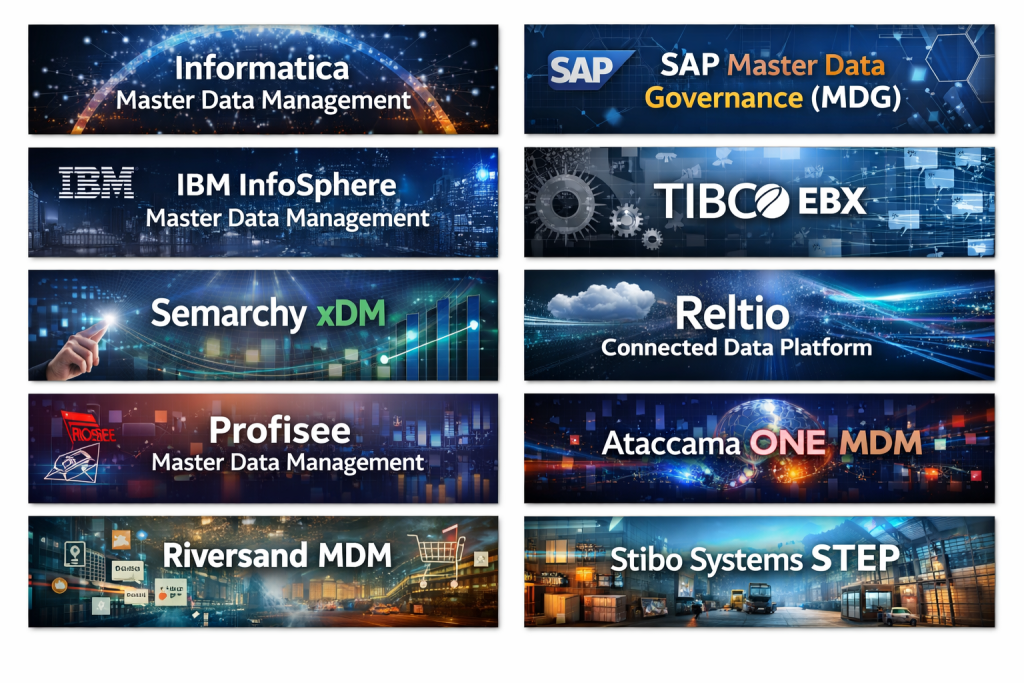
Top 10 Master Data Management (MDM) Tools
1 — Informatica Master Data Management
Short description:
A comprehensive, enterprise-grade MDM platform designed for large organizations managing complex, multi-domain master data at scale.
Key features:
- Multi-domain MDM (customer, product, supplier, reference data)
- Advanced data matching and survivorship rules
- Built-in data quality and enrichment
- Workflow-driven data governance and stewardship
- Cloud-native and on-prem deployment options
- Strong integration with analytics and data platforms
Pros:
- Extremely powerful and scalable
- Industry-leading data quality and matching
- Trusted by large global enterprises
Cons:
- High cost of ownership
- Steep learning curve for new users
- Implementation often requires expert support
Security & compliance:
Enterprise-grade security, encryption, role-based access, audit logs, GDPR support, SOC-aligned controls.
Support & community:
Strong enterprise support, professional services, extensive documentation, large global user base.
2 — SAP Master Data Governance (MDG)
Short description:
An MDM solution tightly integrated with SAP ecosystems, optimized for organizations running SAP ERP and S/4HANA.
Key features:
- Centralized governance for SAP master data
- Predefined data models for core domains
- Workflow-based approvals and validations
- Deep integration with SAP ERP and analytics
- Rule-based data validation
- Change tracking and auditability
Pros:
- Seamless fit for SAP-centric environments
- Strong governance and compliance features
- Reliable enterprise performance
Cons:
- Limited flexibility outside SAP stack
- Customization can be complex
- High licensing and implementation cost
Security & compliance:
SAP security framework, role-based access, audit trails, GDPR readiness.
Support & community:
Robust enterprise support, SAP partner ecosystem, extensive official documentation.
3 — IBM InfoSphere Master Data Management
Short description:
A highly configurable MDM platform for complex, high-volume data environments requiring advanced customization.
Key features:
- Multi-domain and industry-specific MDM
- Advanced entity resolution and matching
- Flexible data modeling
- Hybrid cloud and on-prem support
- High-performance transaction processing
- Integration with IBM analytics and AI tools
Pros:
- Extremely flexible and powerful
- Suitable for large, complex data ecosystems
- Strong performance at scale
Cons:
- Complex setup and configuration
- Requires skilled technical teams
- Higher operational overhead
Security & compliance:
Strong enterprise security, encryption, auditing, GDPR and industry compliance support.
Support & community:
Enterprise-grade IBM support, detailed documentation, smaller community compared to SAP/Informatica.
4 — TIBCO EBX
Short description:
A governance-focused MDM and reference data management platform emphasizing collaboration and business stewardship.
Key features:
- Multi-domain MDM and reference data management
- Business-friendly UI for data stewards
- Workflow and approval management
- Versioning and change history
- Flexible data modeling
- Integration via APIs and connectors
Pros:
- Excellent governance and stewardship capabilities
- Strong collaboration features
- More business-user friendly than many enterprise tools
Cons:
- Less advanced matching compared to top-tier tools
- Limited out-of-the-box analytics
- Requires customization for complex use cases
Security & compliance:
Role-based access, audit logs, GDPR support, enterprise security controls.
Support & community:
Solid vendor support, good documentation, moderate community presence.
5 — Semarchy xDM
Short description:
A modern, agile MDM platform focused on rapid deployment and flexibility for mid-market and enterprise organizations.
Key features:
- Multi-domain MDM
- Low-code configuration
- Embedded data quality and matching
- Workflow-driven governance
- Cloud and on-prem deployment
- Strong API and integration capabilities
Pros:
- Faster implementation than traditional MDM tools
- Good balance between power and usability
- Competitive pricing for its capabilities
Cons:
- Smaller ecosystem compared to major vendors
- Advanced scenarios may need customization
- Less brand recognition in some regions
Security & compliance:
Enterprise security, encryption, role-based controls, GDPR compliance.
Support & community:
Responsive vendor support, growing user community, clear documentation.
6— Reltio Connected Data Platform
Short description:
A cloud-native MDM platform built for real-time, API-driven, and analytics-ready master data management.
Key features:
- SaaS-based, cloud-native architecture
- Real-time data synchronization
- Multi-domain master data management
- Built-in entity resolution
- Graph-based data relationships
- API-first integration model
Pros:
- No infrastructure management required
- Excellent for digital and cloud-first businesses
- Scales well with real-time use cases
Cons:
- SaaS-only deployment may not suit all organizations
- Pricing can scale quickly with data volume
- Limited offline or on-prem flexibility
Security & compliance:
Cloud security standards, encryption, SSO, GDPR readiness, SOC-aligned controls.
Support & community:
Strong customer success model, modern documentation, growing enterprise adoption.
7 — Profisee Master Data Management
Short description:
An MDM solution designed for organizations using Microsoft data platforms, especially SQL Server and cloud analytics.
Key features:
- Multi-domain MDM
- Native integration with Microsoft data ecosystem
- Configurable data governance workflows
- Matching and survivorship rules
- Power BI and analytics alignment
- Flexible deployment options
Pros:
- Excellent fit for Microsoft-centric environments
- Lower learning curve for SQL-based teams
- Competitive pricing
Cons:
- Less advanced for non-Microsoft stacks
- Smaller partner ecosystem
- Limited prebuilt industry models
Security & compliance:
Role-based access, encryption, audit logging, GDPR support.
Support & community:
Good vendor support, improving documentation, moderate community.
8 — Ataccama ONE MDM
Short description:
An AI-driven MDM platform combining data quality, governance, and master data management in a single solution.
Key features:
- AI-assisted data quality and matching
- Multi-domain MDM
- Metadata-driven architecture
- Governance workflows
- Cloud and hybrid deployment
- Integrated profiling and monitoring
Pros:
- Strong data quality and AI capabilities
- Unified data management platform
- Modern UI and automation features
Cons:
- AI features may require tuning
- Implementation complexity for large environments
- Smaller global footprint than legacy vendors
Security & compliance:
Enterprise-grade security, GDPR compliance, audit logs, access controls.
Support & community:
Strong vendor support, growing community, improving learning resources.
9 — Riversand MDM (Syndigo)
Short description:
A product-centric MDM platform focused on commerce, product information, and digital shelf accuracy.
Key features:
- Product and supplier MDM
- Digital shelf analytics
- Data syndication and enrichment
- Workflow-based governance
- Cloud-native platform
- Strong retail and CPG focus
Pros:
- Excellent for product and commerce data
- Strong enrichment and syndication features
- Designed for fast-moving retail environments
Cons:
- Limited for non-product domains
- Less flexible for customer-centric MDM
- Niche focus may limit broader use cases
Security & compliance:
Standard enterprise security, encryption, role-based controls.
Support & community:
Industry-focused support, strong retail user base, moderate documentation.
10 — Stibo Systems STEP
Short description:
A robust MDM and product master platform used heavily in retail, manufacturing, and supply chain environments.
Key features:
- Product and supplier master data management
- Workflow-driven governance
- Data syndication and publishing
- Flexible data modeling
- Integration with ERP and commerce platforms
- Multi-language and regional support
Pros:
- Strong product data management capabilities
- Reliable and mature platform
- Proven in global retail operations
Cons:
- Less suitable for customer-centric MDM
- UI can feel dated
- Implementation requires planning
Security & compliance:
Enterprise security features, audit logs, GDPR readiness.
Support & community:
Strong vendor support, industry-focused community, comprehensive documentation.
Comparison Table
| Tool Name | Best For | Platform(s) Supported | Standout Feature | Rating |
|---|---|---|---|---|
| Informatica MDM | Large enterprises | Cloud, On-prem | Industry-leading data quality | N/A |
| SAP MDG | SAP-centric organizations | On-prem, Cloud | Native SAP integration | N/A |
| IBM InfoSphere MDM | Complex environments | Cloud, On-prem | Extreme flexibility | N/A |
| TIBCO EBX | Governance-first teams | Cloud, On-prem | Business stewardship | N/A |
| Semarchy xDM | Agile MDM deployments | Cloud, On-prem | Fast implementation | N/A |
| Reltio | Cloud-first companies | SaaS | Real-time MDM | N/A |
| Profisee | Microsoft ecosystem users | Cloud, On-prem | Microsoft-native | N/A |
| Ataccama ONE | Data quality-driven MDM | Cloud, Hybrid | AI-powered automation | N/A |
| Riversand | Retail & CPG | Cloud | Product-centric MDM | N/A |
| Stibo Systems | Product data management | Cloud, On-prem | Retail & supply chain focus | N/A |
Evaluation & Scoring of Master Data Management (MDM) Tools
| Tool | Core Features (25%) | Ease of Use (15%) | Integrations (15%) | Security (10%) | Performance (10%) | Support (10%) | Price / Value (15%) | Total Score |
|---|---|---|---|---|---|---|---|---|
| Informatica MDM | 24 | 10 | 14 | 9 | 9 | 9 | 8 | 83 |
| SAP MDG | 22 | 9 | 13 | 9 | 9 | 9 | 7 | 78 |
| IBM InfoSphere | 23 | 8 | 13 | 9 | 9 | 8 | 7 | 77 |
| Semarchy xDM | 20 | 13 | 12 | 8 | 8 | 8 | 12 | 81 |
| Reltio | 21 | 14 | 13 | 9 | 9 | 8 | 10 | 84 |
Which Master Data Management (MDM) Tool Is Right for You?
- Solo users or very small teams: MDM may be unnecessary; consider lighter data tools.
- SMBs: Look for faster deployment, lower cost, and ease of use (Semarchy, Profisee).
- Mid-market: Balance governance and agility (Ataccama, TIBCO EBX).
- Enterprise: Prioritize scalability, compliance, and robustness (Informatica, SAP, IBM).
Budget-conscious vs premium:
Premium tools deliver depth and scale, while mid-tier tools provide strong value with faster ROI.
Feature depth vs ease of use:
Highly configurable platforms offer power but demand skilled teams.
Integration and scalability:
Cloud-first organizations benefit from SaaS MDM, while regulated industries may need hybrid or on-prem.
Security and compliance:
Healthcare, finance, and global enterprises should prioritize auditability and governance.
Frequently Asked Questions (FAQs)
1. What problem does MDM solve?
It eliminates inconsistent, duplicate, and unreliable master data across systems.
2. Is MDM the same as data governance?
No. MDM manages master data; governance defines rules and ownership.
3. How long does MDM implementation take?
Anywhere from weeks to months, depending on complexity.
4. Do small companies need MDM?
Usually not, unless data complexity grows quickly.
5. Is cloud MDM secure?
Yes, when enterprise security and compliance controls are in place.
6. What is multi-domain MDM?
Managing multiple master data types in one platform.
7. Does MDM replace data warehouses?
No. It complements analytics platforms.
8. Can MDM improve customer experience?
Yes, by ensuring consistent and accurate customer data.
9. What skills are needed for MDM?
Data modeling, governance, and integration skills.
10. What is the biggest MDM mistake?
Treating it as a purely technical project instead of a business initiative.
Conclusion
Master Data Management tools play a critical role in building trustworthy, consistent, and governed enterprise data. The right MDM platform can significantly improve analytics accuracy, operational efficiency, regulatory compliance, and customer experience.
There is no universal “best” MDM tool. The ideal choice depends on your organization’s size, data domains, technical ecosystem, governance maturity, and budget. Enterprises may prioritize scalability and robustness, while mid-sized organizations may value agility and faster time-to-value.
By clearly defining your data strategy and evaluation criteria, you can select an MDM tool that delivers long-term business value and supports sustainable data-driven growth.

Find Trusted Cardiac Hospitals
Compare heart hospitals by city and services — all in one place.
Explore Hospitals
This article offers a clear and practical comparison of the top Master Data Management (MDM) tools, making it easier for readers to understand how each platform supports data consistency, centralization, and governance across enterprise systems. The breakdown of key features, strengths, and limitations helps both beginners and experienced professionals evaluate tools based on their specific needs—such as scalability, data modeling capabilities, integration support, and ease of implementation. By focusing on real-world use cases and practical differences rather than just listing names, this post serves as a valuable reference for anyone looking to choose the right MDM solution to improve data quality and streamline operations. Great resource for making informed decisions in data management!