
Introduction
Machine Learning has moved far beyond experiments and prototypes. Today, organizations deploy ML models into real-world production systems that impact customers, revenue, and operations. This is where MLOps Platforms come in.
MLOps (Machine Learning Operations) platforms provide the tools, workflows, and governance needed to manage the full lifecycle of machine learning models—from data preparation and training to deployment, monitoring, and continuous improvement. They bridge the gap between data science and IT/DevOps, ensuring that ML systems are reliable, scalable, and secure.
MLOps platforms are important because ML models are not static. Data drifts, models degrade, regulations change, and business requirements evolve. Without proper operational tooling, even the best models can fail in production.
Real-world use cases
- Deploying fraud detection models in banking with real-time monitoring
- Managing recommendation engines for e-commerce platforms
- Scaling computer vision models in healthcare imaging
- Governing ML workflows in regulated industries like insurance and pharma
What to look for when choosing an MLOps platform
- End-to-end lifecycle support (training → deployment → monitoring)
- Integration with existing data, cloud, and DevOps stacks
- Scalability and performance in production environments
- Strong security, governance, and compliance features
- Ease of use for both data scientists and engineers
Best for
MLOps platforms are ideal for data scientists, ML engineers, platform engineers, DevOps teams, and AI leaders working in mid-size to large organizations, startups scaling ML, and enterprises operating in finance, healthcare, retail, manufacturing, and SaaS industries.
Not ideal for
They may be overkill for solo researchers, academic projects, or small teams running occasional experiments without production deployment needs. In such cases, lightweight experiment-tracking tools or notebook-based workflows may be sufficient.
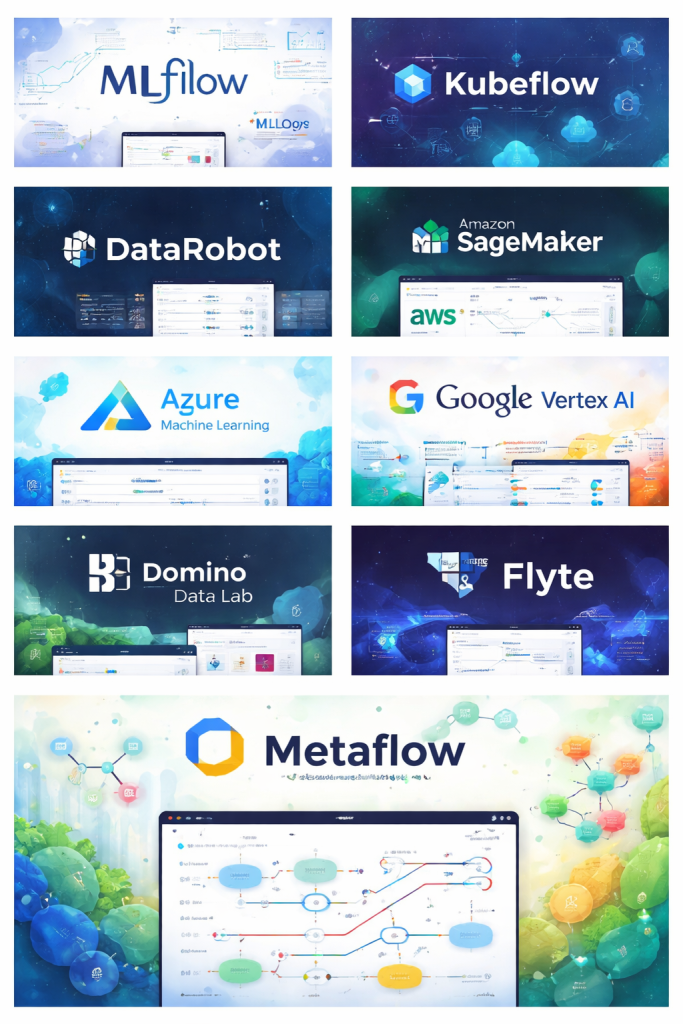
Top 10 MLOps Platforms Tools
1 — MLflow
Short description
MLflow is an open-source MLOps platform focused on experiment tracking, model management, and reproducibility. It is widely adopted by data science teams and integrates well with many ML frameworks.
Key features
- Experiment tracking and metrics logging
- Model registry with versioning
- Reproducible ML runs
- Framework-agnostic support
- Deployment to multiple serving environments
- Integration with cloud and on-prem systems
Pros
- Open source and widely trusted
- Easy to adopt for existing ML workflows
- Large ecosystem and integrations
Cons
- Limited native monitoring features
- Requires additional tooling for full MLOps
- UI can feel basic for large teams
Security & compliance
Basic authentication, encryption support; compliance depends on deployment setup.
Support & community
Strong documentation, active open-source community, enterprise support available via vendors.
2 — Kubeflow
Short description
Kubeflow is an open-source MLOps platform built on Kubernetes, designed for scalable and cloud-native ML workflows.
Key features
- Kubernetes-native ML pipelines
- Distributed training support
- Model serving with autoscaling
- Notebook-based experimentation
- Integration with cloud providers
- Extensible architecture
Pros
- Highly scalable and flexible
- Ideal for Kubernetes-first organizations
- Strong open-source backing
Cons
- Steep learning curve
- Complex setup and maintenance
- Requires Kubernetes expertise
Security & compliance
Supports Kubernetes RBAC, encryption, and enterprise security controls.
Support & community
Strong community, extensive documentation, enterprise support via cloud vendors.
3 — DataRobot MLOps
Short description
DataRobot MLOps focuses on deploying, monitoring, and governing ML models at enterprise scale with automation and explainability.
Key features
- Automated model deployment
- Model monitoring and drift detection
- Explainability and fairness checks
- Governance workflows
- Multi-cloud support
- CI/CD integration
Pros
- Enterprise-grade monitoring
- Strong governance capabilities
- Suitable for regulated industries
Cons
- Premium pricing
- Less flexibility for custom workflows
- Vendor-centric ecosystem
Security & compliance
SOC 2, GDPR support, audit logs, SSO, role-based access control.
Support & community
Enterprise onboarding, dedicated support teams, professional services.
4 — Amazon SageMaker
Short description
Amazon SageMaker is a fully managed MLOps platform within the AWS ecosystem, covering the entire ML lifecycle.
Key features
- Managed training and deployment
- Built-in algorithms and frameworks
- Model monitoring and bias detection
- Scalable inference endpoints
- Tight AWS integration
- Automation pipelines
Pros
- Deep cloud integration
- Highly scalable and reliable
- Broad feature coverage
Cons
- Vendor lock-in
- Complex pricing structure
- Learning curve for non-AWS users
Security & compliance
AWS-level security, encryption, IAM, compliance certifications.
Support & community
Extensive documentation, enterprise AWS support, large user base.
5 — Azure Machine Learning
Short description
Azure Machine Learning provides a comprehensive MLOps platform integrated with Microsoft’s cloud and DevOps ecosystem.
Key features
- End-to-end ML lifecycle management
- Automated ML capabilities
- Model deployment and monitoring
- Integration with Azure DevOps
- Responsible AI tools
- Scalable compute
Pros
- Strong enterprise tooling
- Good governance and monitoring
- Seamless Microsoft stack integration
Cons
- Azure-centric
- Can be complex for beginners
- Cost management requires attention
Security & compliance
Enterprise-grade security, GDPR, ISO, SOC compliance.
Support & community
Strong enterprise support, good documentation, active community.
6 — Google Vertex AI
Short description
Vertex AI is Google Cloud’s unified MLOps platform for building, deploying, and scaling ML models.
Key features
- Unified training and deployment
- AutoML and custom models
- Feature store
- Model monitoring and explainability
- Pipeline orchestration
- Scalable serving
Pros
- Advanced AI capabilities
- Strong data and pipeline tooling
- High scalability
Cons
- Google Cloud lock-in
- Pricing complexity
- Requires GCP familiarity
Security & compliance
Google Cloud security standards, encryption, compliance certifications.
Support & community
Enterprise support, solid documentation, growing community.
7 — Domino Data Lab
Short description
Domino is an enterprise MLOps platform designed to enable collaboration, reproducibility, and governance for data science teams.
Key features
- Collaborative workspaces
- Reproducible experiments
- Model deployment pipelines
- Governance and audit trails
- Hybrid and multi-cloud support
- Resource management
Pros
- Strong collaboration features
- Enterprise-ready governance
- Flexible deployment options
Cons
- High cost
- Heavy platform footprint
- More complex than lightweight tools
Security & compliance
SOC 2, GDPR, SSO, audit logging.
Support & community
Enterprise onboarding, dedicated support, smaller community.
8 — Weights & Biases
Short description
Weights & Biases focuses on experiment tracking, visualization, and collaboration for ML teams.
Key features
- Experiment tracking and dashboards
- Hyperparameter tuning visualization
- Model versioning
- Collaboration tools
- Lightweight integration
- Cloud and on-prem options
Pros
- Excellent UX
- Fast setup
- Strong visualization
Cons
- Limited deployment features
- Requires other tools for full MLOps
- Pricing can scale quickly
Security & compliance
SSO, encryption, compliance varies by plan.
Support & community
Active community, strong documentation, responsive support.
9 — Flyte
Short description
Flyte is an open-source workflow automation platform built for ML and data pipelines at scale.
Key features
- Strong workflow orchestration
- Versioned pipelines
- Scalable execution
- Cloud-native architecture
- Type-safe pipelines
- Extensible design
Pros
- Excellent for complex pipelines
- Scales well
- Open-source flexibility
Cons
- Requires engineering expertise
- Less user-friendly UI
- Smaller ecosystem
Security & compliance
Depends on infrastructure; supports RBAC and encryption.
Support & community
Growing open-source community, improving documentation.
10 — Metaflow
Short description
Metaflow is a human-centric MLOps framework focused on simplicity and productivity for data scientists.
Key features
- Python-first workflows
- Experiment tracking
- Versioned data artifacts
- Scalable execution
- Easy local-to-cloud transition
- Lightweight orchestration
Pros
- Simple and intuitive
- Great for rapid iteration
- Minimal overhead
Cons
- Limited enterprise governance
- Smaller ecosystem
- Fewer built-in monitoring tools
Security & compliance
Varies by deployment environment.
Support & community
Good documentation, moderate community, limited enterprise support.
Comparison Table
| Tool Name | Best For | Platform(s) Supported | Standout Feature | Rating |
|---|---|---|---|---|
| MLflow | Experiment tracking & registry | Cloud, On-prem | Open-source flexibility | N/A |
| Kubeflow | Kubernetes-native ML | Kubernetes | Cloud-native pipelines | N/A |
| DataRobot MLOps | Enterprise governance | Cloud, Hybrid | Model monitoring & governance | N/A |
| Amazon SageMaker | AWS-centric teams | Cloud | Fully managed lifecycle | N/A |
| Azure ML | Microsoft ecosystem | Cloud | Enterprise DevOps integration | N/A |
| Google Vertex AI | Advanced AI workloads | Cloud | Unified ML platform | N/A |
| Domino Data Lab | Regulated enterprises | Cloud, Hybrid | Collaboration & governance | N/A |
| Weights & Biases | Experiment tracking | Cloud, On-prem | Visualization & UX | N/A |
| Flyte | Complex pipelines | Cloud, Kubernetes | Workflow orchestration | N/A |
| Metaflow | Data scientist productivity | Cloud, Local | Simplicity | N/A |
Evaluation & Scoring of MLOps Platforms
| Tool | Core Features (25%) | Ease of Use (15%) | Integrations (15%) | Security (10%) | Performance (10%) | Support (10%) | Price/Value (15%) | Total |
|---|---|---|---|---|---|---|---|---|
| MLflow | 22 | 13 | 14 | 7 | 8 | 8 | 14 | 86 |
| Kubeflow | 23 | 8 | 15 | 8 | 9 | 7 | 12 | 82 |
| DataRobot | 24 | 14 | 13 | 9 | 9 | 9 | 10 | 88 |
| SageMaker | 25 | 12 | 15 | 9 | 10 | 9 | 9 | 89 |
| Azure ML | 24 | 13 | 14 | 9 | 9 | 9 | 10 | 88 |
| Vertex AI | 24 | 12 | 14 | 9 | 10 | 8 | 10 | 87 |
| Domino | 23 | 11 | 13 | 9 | 8 | 9 | 9 | 82 |
| W&B | 20 | 14 | 12 | 7 | 8 | 8 | 11 | 80 |
| Flyte | 21 | 9 | 12 | 7 | 9 | 7 | 13 | 78 |
| Metaflow | 19 | 15 | 10 | 6 | 8 | 7 | 14 | 79 |
Which MLOps Platforms Tool Is Right for You?
- Solo users & startups: MLflow, Metaflow, Weights & Biases
- SMBs & growing teams: MLflow + cloud services, Azure ML
- Mid-market: Vertex AI, SageMaker, Domino
- Enterprise & regulated industries: DataRobot, Azure ML, Domino
Budget-conscious teams should prioritize open-source tools.
Premium buyers benefit from managed platforms with governance.
Choose feature depth if operating at scale; choose ease of use for faster adoption.
Ensure security and compliance align with industry regulations.
Frequently Asked Questions (FAQs)
1. What is an MLOps platform?
An MLOps platform manages the end-to-end lifecycle of ML models in production.
2. Do I need MLOps for small projects?
Not always. Simple projects may work without full MLOps tooling.
3. Is MLOps only for enterprises?
No. Startups also benefit as soon as models reach production.
4. Open-source or managed MLOps?
Open-source offers flexibility; managed platforms reduce operational burden.
5. How long does implementation take?
From days for simple setups to months for enterprise rollouts.
6. Are MLOps platforms expensive?
Costs vary widely depending on scale and vendor.
7. Do they support CI/CD?
Most modern platforms integrate with CI/CD pipelines.
8. How do they handle model drift?
Through monitoring, alerts, and retraining workflows.
9. Can I use multiple MLOps tools together?
Yes, many teams combine tracking, orchestration, and deployment tools.
10. What is the biggest mistake teams make?
Ignoring monitoring and governance after deployment.
Conclusion
MLOps platforms have become essential for turning machine learning into reliable, scalable, and trustworthy production systems. While the tools differ in philosophy, complexity, and cost, the fundamentals remain the same: automation, observability, collaboration, and governance.
There is no single “best” MLOps platform for everyone. The right choice depends on your team size, technical maturity, budget, regulatory needs, and long-term ML strategy. By clearly defining your requirements and understanding the strengths and trade-offs of each platform, you can confidently select the solution that enables your ML initiatives to succeed in the real world.

Find Trusted Cardiac Hospitals
Compare heart hospitals by city and services — all in one place.
Explore Hospitals
