
Introduction
Model Explainability Tools are specialized platforms and libraries designed to make machine learning and AI models understandable to humans. As models become more complex—especially deep learning and ensemble systems—their decision-making processes often turn into “black boxes.” Explainability tools help uncover why a model made a particular prediction, which features influenced it most, and how trustworthy those predictions really are.
Explainability is no longer optional. It is critical for regulatory compliance, ethical AI, model debugging, and stakeholder trust. Industries such as healthcare, finance, insurance, and government increasingly require transparent AI systems that can be audited and justified. Without explainability, teams risk biased outcomes, regulatory violations, and poor business decisions.
Key real-world use cases include:
- Explaining credit approval or rejection decisions
- Auditing models for bias and fairness
- Debugging underperforming ML models
- Supporting regulatory and compliance reviews
- Building trust with non-technical stakeholders
When choosing a Model Explainability Tool, users should evaluate:
- Supported model types (ML, DL, tabular, NLP, CV)
- Local vs global explanations
- Visualization quality
- Integration with ML pipelines
- Performance and scalability
- Security and compliance readiness
Best for:
Data scientists, ML engineers, AI researchers, compliance teams, risk analysts, and enterprises deploying AI in regulated or high-impact environments.
Not ideal for:
Teams running very simple statistical models, hobby projects with minimal risk, or environments where interpretability is not required and performance alone matters.
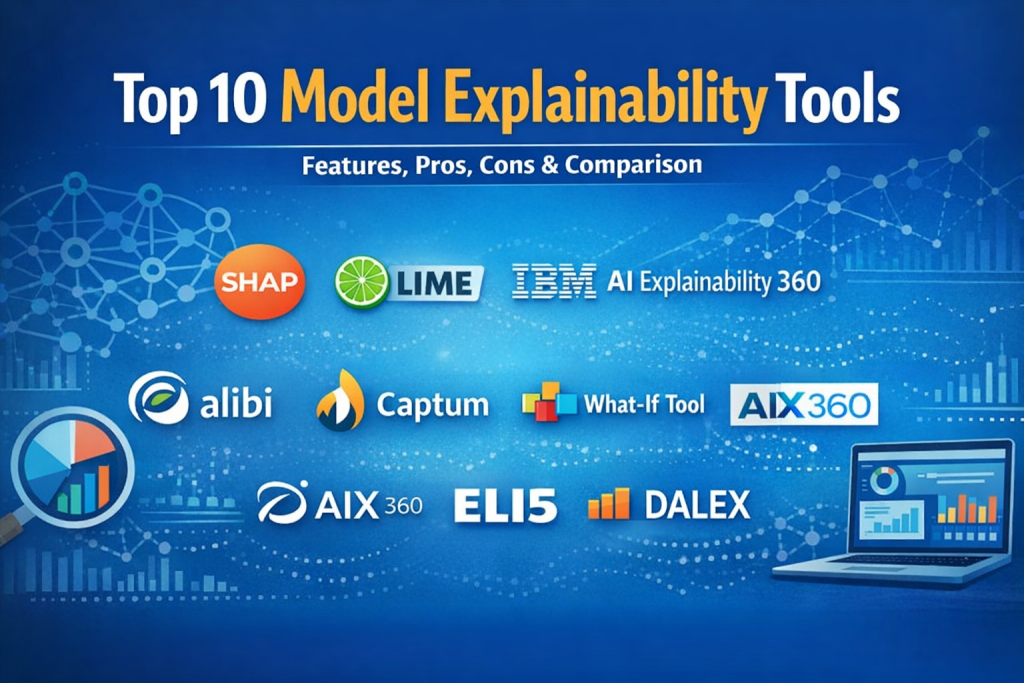
Top 10 Model Explainability Tools
1 — SHAP
Short description:
A widely used explainability framework based on game theory, ideal for understanding feature contributions in ML and deep learning models.
Key features:
- Shapley value–based explanations
- Local and global interpretability
- Supports tree, linear, and deep models
- Rich visualizations
- Strong theoretical foundation
- Works with popular ML frameworks
Pros:
- Highly accurate explanations
- Industry-standard methodology
- Broad model compatibility
Cons:
- Can be computationally expensive
- Steep learning curve for beginners
Security & compliance: Varies / N/A (library-level)
Support & community:
Extensive documentation, large open-source community, strong academic backing.
2 — LIME
Short description:
A lightweight tool that explains individual predictions by approximating models locally with interpretable surrogates.
Key features:
- Model-agnostic explanations
- Local interpretability
- Works with text, image, and tabular data
- Simple conceptual approach
- Fast setup
Pros:
- Easy to understand explanations
- Flexible across model types
Cons:
- Less stable explanations
- Not ideal for global insights
Security & compliance: Varies / N/A
Support & community:
Good documentation, strong academic adoption, active user base.
3 — IBM AI Explainability 360
Short description:
An open-source toolkit offering a broad range of explainability and fairness algorithms for enterprise AI systems.
Key features:
- Multiple explainability algorithms
- Fairness and bias metrics
- Model-agnostic and model-specific methods
- Integration with enterprise ML stacks
- Research-grade implementations
Pros:
- Comprehensive toolkit
- Strong enterprise credibility
Cons:
- Complex setup
- Requires ML expertise
Security & compliance: Enterprise-ready, compliance-oriented design
Support & community:
Well-documented, enterprise support options, academic and industry users.
4 — InterpretML
Short description:
A framework focused on glass-box models and interpretable machine learning, backed by strong research foundations.
Key features:
- Explainable boosting machines
- Global and local explanations
- High-performance interpretable models
- Visualization dashboards
- Compatible with popular ML tools
Pros:
- Strong balance of accuracy and transparency
- Excellent for regulated environments
Cons:
- Smaller ecosystem
- Less focus on deep learning
Security & compliance: Varies / N/A
Support & community:
Good documentation, research-driven community, enterprise interest growing.
5 — Alibi
Short description:
An open-source library providing explanation methods for black-box and deep learning models.
Key features:
- Counterfactual explanations
- Anchor explanations
- Works with deep learning models
- Model-agnostic methods
- Scalable design
Pros:
- Advanced explanation techniques
- Strong deep learning support
Cons:
- Steeper learning curve
- Fewer visualization options
Security & compliance: Varies / N/A
Support & community:
Active open-source community, solid documentation.
6 — Captum
Short description:
A PyTorch-native interpretability library designed for deep learning practitioners.
Key features:
- Gradient-based attribution
- Layer and neuron analysis
- Integrated with PyTorch
- Supports vision, text, and tabular data
- High performance
Pros:
- Excellent for deep learning
- Seamless PyTorch integration
Cons:
- Limited to PyTorch
- Less beginner-friendly
Security & compliance: Varies / N/A
Support & community:
Strong PyTorch ecosystem support, active contributors.
7 — What-If Tool
Short description:
An interactive visual tool for exploring model behavior without writing code.
Key features:
- Visual scenario analysis
- Feature importance comparison
- Bias and fairness exploration
- Model-agnostic
- User-friendly UI
Pros:
- Great for non-technical users
- No-code exploration
Cons:
- Limited automation
- Not ideal for large-scale pipelines
Security & compliance: Varies / N/A
Support & community:
Good documentation, widely used in education and demos.
8 — AIX360
Short description:
A research-oriented toolkit offering diverse explainability approaches across ML and DL models.
Key features:
- Multiple explanation families
- Symbolic and rule-based methods
- Black-box and white-box support
- Enterprise-focused design
- Research-grade algorithms
Pros:
- Broad methodological coverage
- Strong theoretical grounding
Cons:
- Less polished UX
- Requires expertise
Security & compliance: Enterprise-aligned
Support & community:
Research-driven community, detailed documentation.
9 — Eli5
Short description:
A simple interpretability library focused on explaining classic ML models in human-readable terms.
Key features:
- Feature weight explanations
- Text-friendly outputs
- Supports linear and tree models
- Lightweight design
- Easy integration
Pros:
- Very easy to use
- Great for quick insights
Cons:
- Limited advanced methods
- Not suitable for deep learning
Security & compliance: Varies / N/A
Support & community:
Moderate community, good beginner documentation.
10 — DALEX
Short description:
A model-agnostic framework for explaining predictive models with strong statistical grounding.
Key features:
- Unified explanation interface
- Model comparison tools
- Visual diagnostics
- Works across ML models
- Focus on reproducibility
Pros:
- Consistent explanations
- Strong statistical foundation
Cons:
- Smaller ecosystem
- Less enterprise tooling
Security & compliance: Varies / N/A
Support & community:
Academic and practitioner support, good documentation.
Comparison Table
| Tool Name | Best For | Platform(s) Supported | Standout Feature | Rating |
|---|---|---|---|---|
| SHAP | Enterprise ML teams | Python | Shapley-based accuracy | N/A |
| LIME | Rapid local explanations | Python | Model-agnostic simplicity | N/A |
| IBM AI Explainability 360 | Regulated industries | Python | Compliance-ready toolkit | N/A |
| InterpretML | Transparent ML models | Python | Glass-box models | N/A |
| Alibi | Advanced DL explainability | Python | Counterfactuals | N/A |
| Captum | PyTorch users | Python | Deep learning attribution | N/A |
| What-If Tool | Business users | Web | No-code analysis | N/A |
| AIX360 | Research & enterprise | Python | Diverse explanation methods | N/A |
| Eli5 | Beginners | Python | Human-readable outputs | N/A |
| DALEX | Model comparison | Python | Unified explanations | N/A |
Evaluation & Scoring of Model Explainability Tools
| Tool | Core Features (25%) | Ease of Use (15%) | Integrations (15%) | Security (10%) | Performance (10%) | Support (10%) | Price/Value (15%) | Total |
|---|---|---|---|---|---|---|---|---|
| SHAP | 23 | 11 | 13 | 7 | 9 | 8 | 13 | 84 |
| LIME | 18 | 14 | 12 | 6 | 8 | 7 | 14 | 79 |
| IBM AIX360 | 24 | 10 | 14 | 9 | 8 | 9 | 12 | 86 |
| InterpretML | 22 | 12 | 12 | 7 | 9 | 8 | 13 | 83 |
| Captum | 21 | 9 | 11 | 6 | 10 | 8 | 12 | 77 |
Which Model Explainability Tool Is Right for You?
- Solo users & researchers: LIME, Eli5, DALEX
- SMBs: SHAP, InterpretML
- Mid-market: Alibi, Captum
- Enterprise & regulated industries: IBM AI Explainability 360, AIX360
Budget-conscious: Open-source tools like SHAP and LIME
Premium & compliance-driven: Enterprise-grade toolkits
Choose deeper features for regulated environments; prioritize ease of use for fast experimentation.
Frequently Asked Questions (FAQs)
- Why is model explainability important?
It builds trust, ensures compliance, and helps detect bias and errors. - Are explainability tools mandatory for AI compliance?
In many regulated industries, yes or strongly recommended. - Do these tools affect model performance?
No, they analyze models without altering predictions. - Can explainability tools detect bias?
Some tools include fairness and bias metrics. - Are they suitable for deep learning models?
Yes, tools like SHAP, Captum, and Alibi excel here. - Do they support real-time systems?
Some methods can be computationally heavy. - Are these tools open source?
Most listed tools are open source. - Can non-technical users use them?
Visual tools make this possible. - Do they replace human judgment?
No, they support better decision-making. - What is the biggest mistake teams make?
Using explanations without validating their assumptions.
Conclusion
Model Explainability Tools play a crucial role in making AI systems transparent, trustworthy, and compliant. From lightweight libraries for experimentation to enterprise-ready toolkits for regulated environments, the ecosystem offers solutions for every need.
The most important factors are clarity, reliability, integration, and compliance alignment. There is no universal “best” tool—only the one that best fits your use case, team skill level, and risk profile. Choosing wisely ensures AI systems that not only perform well but are also understood and trusted.

Find Trusted Cardiac Hospitals
Compare heart hospitals by city and services — all in one place.
Explore Hospitals
This article offers a very practical and thorough overview of the top model explainability tools, which is incredibly valuable for data scientists and ML engineers focused on building transparent, interpretable AI systems. By breaking down key capabilities—such as support for feature attribution, built-in visualizations, framework compatibility, and ease of integration—alongside clear pros and cons, it helps readers evaluate tools not just on popularity but on how well they fit their specific workflow needs. Explainability is becoming essential for debugging models, building trust with stakeholders, and ensuring regulatory compliance, and this structured comparison makes it much easier to choose the right solution for both research and production environments.