
Introduction
Machine learning models do not fail suddenly — they slowly lose accuracy, reliability, and trust as real-world data changes. This phenomenon, known as model drift, is one of the biggest hidden risks in production AI systems. Model Monitoring & Drift Detection Tools exist to continuously track model behavior, data quality, and prediction performance after deployment.
These tools help teams detect data drift, concept drift, prediction bias, performance degradation, and anomalies before they impact business outcomes. Without monitoring, even well-trained models can silently produce incorrect results, leading to financial losses, compliance issues, or reputational damage.
Why Model Monitoring & Drift Detection Matters
- Production data often changes faster than training data
- Business decisions depend on model predictions
- Regulatory environments demand transparency and auditability
- Manual checks are not scalable for modern ML systems
Real-World Use Cases
- Fraud detection models adapting to new fraud patterns
- Recommendation systems tracking shifting user behavior
- Healthcare models ensuring patient safety
- Credit scoring systems maintaining fairness and compliance
- Demand forecasting models adjusting to seasonality changes
What to Look for When Choosing a Tool
When evaluating model monitoring tools, users should consider:
- Drift detection accuracy and explainability
- Ease of integration with ML pipelines
- Support for multiple model types
- Alerting and observability capabilities
- Security, compliance, and governance features
- Scalability and cost efficiency
Best for:
Model Monitoring & Drift Detection Tools are best suited for data scientists, ML engineers, MLOps teams, AI product managers, regulated industries, and organizations deploying ML models in production. They are particularly valuable for mid-sized to enterprise companies in finance, healthcare, retail, insurance, and SaaS.
Not ideal for:
These tools may not be necessary for early-stage prototypes, academic experiments, or one-off ML models that are not deployed in production. Teams with very limited ML usage or rule-based systems may find simpler logging solutions sufficient.
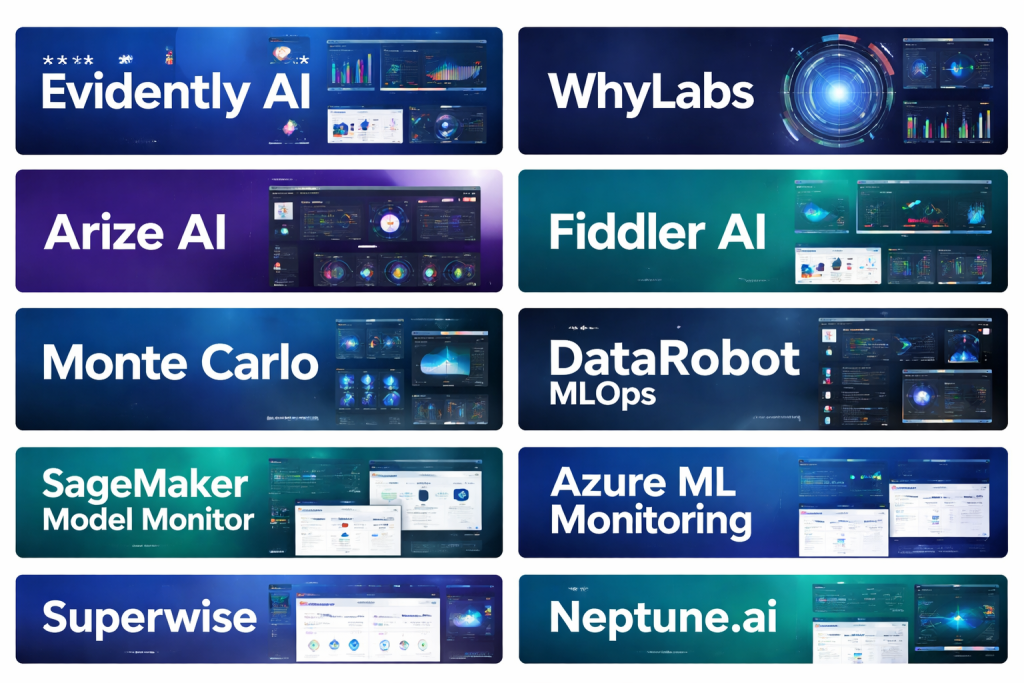
Top 10 Model Monitoring & Drift Detection Tools
1 — Evidently AI
Short description:
An open-source and enterprise-ready tool designed to monitor data drift, model performance, and ML quality metrics in production.
Key features:
- Data drift and concept drift detection
- Interactive dashboards and reports
- Statistical tests for feature monitoring
- Model performance tracking
- Integrates with MLOps workflows
- Supports batch and streaming data
Pros:
- Strong open-source foundation
- Transparent statistical methods
- Highly customizable reports
Cons:
- Requires technical setup
- UI less polished than commercial tools
Security & compliance:
Varies by deployment environment
Support & community:
Active open-source community, documentation available, enterprise support options
2 — WhyLabs
Short description:
A production ML observability platform focused on detecting data drift, data quality issues, and anomalies at scale.
Key features:
- Automated drift detection
- Data quality monitoring
- Model health dashboards
- Alerting and anomaly detection
- Lightweight logging agents
- Scales to large datasets
Pros:
- Designed for high-volume data
- Minimal performance overhead
- Strong focus on observability
Cons:
- Limited model explainability features
- Advanced features require paid plans
Security & compliance:
SOC 2, GDPR-ready, encryption supported
Support & community:
Good documentation, enterprise support available
3 — Arize AI
Short description:
A full-featured ML observability platform designed for enterprise teams managing complex ML systems.
Key features:
- Data, prediction, and concept drift detection
- Model explainability and feature impact analysis
- Performance monitoring over time
- Root-cause analysis
- Scalable monitoring pipelines
- Integrates with major ML frameworks
Pros:
- Rich analytics and visualization
- Strong enterprise adoption
- Excellent explainability tooling
Cons:
- Higher learning curve
- Premium pricing for large-scale usage
Security & compliance:
SOC 2, GDPR, SSO, audit logs
Support & community:
Enterprise onboarding, strong customer support
4 — Fiddler AI
Short description:
An explainable AI and model monitoring platform focused on transparency, fairness, and regulatory compliance.
Key features:
- Drift detection and performance tracking
- Model explainability dashboards
- Bias and fairness analysis
- Compliance reporting
- Alerts for model degradation
- Supports structured and unstructured data
Pros:
- Excellent for regulated industries
- Strong interpretability features
- Compliance-ready reports
Cons:
- Primarily enterprise-focused
- Less flexible for lightweight use cases
Security & compliance:
SOC 2, GDPR, HIPAA support, audit logs
Support & community:
Enterprise-grade support, guided onboarding
5 — Monte Carlo
Short description:
A data observability platform that extends into ML monitoring by focusing on data reliability and drift detection.
Key features:
- Data drift and schema change detection
- Pipeline health monitoring
- Anomaly detection
- Root cause analysis
- Automated alerts
- Integrates with data stacks
Pros:
- Strong data reliability focus
- Useful for upstream ML pipelines
- Clear incident tracking
Cons:
- Less model-centric than competitors
- Limited ML-specific metrics
Security & compliance:
SOC 2, GDPR, enterprise security controls
Support & community:
Enterprise support, structured documentation
6 — DataRobot MLOps
Short description:
A comprehensive MLOps platform with built-in model monitoring, governance, and lifecycle management.
Key features:
- Automated model monitoring
- Drift detection and alerts
- Model governance workflows
- Performance benchmarking
- Bias and fairness checks
- End-to-end MLOps lifecycle
Pros:
- All-in-one MLOps solution
- Strong automation capabilities
- Enterprise-grade governance
Cons:
- High cost
- Vendor lock-in risk
Security & compliance:
SOC 2, GDPR, HIPAA, ISO support
Support & community:
Enterprise onboarding, premium support
7 — Amazon SageMaker Model Monitor
Short description:
A managed service for monitoring ML models deployed within cloud-based ML pipelines.
Key features:
- Data drift detection
- Model quality monitoring
- Automated baselines
- Integration with deployment workflows
- Scalable monitoring jobs
- Alerting through cloud services
Pros:
- Deep cloud ecosystem integration
- Scales easily
- Minimal infrastructure management
Cons:
- Limited to specific ecosystems
- Less visualization flexibility
Security & compliance:
ISO, SOC, GDPR, HIPAA (cloud-dependent)
Support & community:
Strong documentation, enterprise support available
8 — Azure Machine Learning Model Monitoring
Short description:
A model monitoring capability within a cloud-based ML platform, designed for enterprise ML teams.
Key features:
- Drift detection
- Dataset monitoring
- Performance tracking
- Integration with CI/CD
- Logging and alerting
- Supports multiple model types
Pros:
- Enterprise-friendly tooling
- Strong governance features
- Seamless platform integration
Cons:
- Complex configuration
- Less flexibility outside ecosystem
Security & compliance:
ISO, SOC, GDPR, HIPAA support
Support & community:
Extensive documentation, enterprise support
9 — Superwise
Short description:
An automated ML observability platform that detects model drift and performance issues in real time.
Key features:
- Automated drift detection
- Model health monitoring
- Alerts and notifications
- Feature-level diagnostics
- Real-time observability
- Scalable architecture
Pros:
- Low setup effort
- Strong automation
- Clear insights for ML teams
Cons:
- Smaller ecosystem
- Limited customization for advanced users
Security & compliance:
SOC 2, GDPR-ready
Support & community:
Responsive support, growing community
10 — Neptune.ai
Short description:
An experiment tracking and model monitoring platform designed for data science teams.
Key features:
- Model performance tracking
- Metadata logging
- Drift analysis
- Visualization dashboards
- Experiment comparison
- Integration with ML workflows
Pros:
- Strong experiment management
- Flexible logging
- Developer-friendly
Cons:
- Monitoring features less advanced
- Requires setup effort
Security & compliance:
Varies by deployment
Support & community:
Good documentation, active user base
Comparison Table
| Tool Name | Best For | Platform(s) Supported | Standout Feature | Rating |
|---|---|---|---|---|
| Evidently AI | Open-source monitoring | Cloud / On-prem | Transparent drift reports | N/A |
| WhyLabs | High-volume ML systems | Cloud | Scalable observability | N/A |
| Arize AI | Enterprise ML teams | Cloud | Deep root-cause analysis | N/A |
| Fiddler AI | Regulated industries | Cloud / On-prem | Explainability & fairness | N/A |
| Monte Carlo | Data reliability | Cloud | Pipeline observability | N/A |
| DataRobot MLOps | End-to-end MLOps | Cloud / On-prem | Automated governance | N/A |
| SageMaker Model Monitor | Cloud-native ML | Cloud | Managed monitoring | N/A |
| Azure ML Monitoring | Enterprise cloud ML | Cloud | CI/CD integration | N/A |
| Superwise | Automated monitoring | Cloud | Real-time drift detection | N/A |
| Neptune.ai | Experiment tracking | Cloud | ML metadata management | N/A |
Evaluation & Scoring of Model Monitoring & Drift Detection Tools
| Criteria | Weight |
|---|---|
| Core features | 25% |
| Ease of use | 15% |
| Integrations & ecosystem | 15% |
| Security & compliance | 10% |
| Performance & reliability | 10% |
| Support & community | 10% |
| Price / value | 15% |
Which Model Monitoring & Drift Detection Tool Is Right for You?
- Solo users: Prefer open-source or lightweight tools with minimal setup
- SMBs: Look for ease of use and cost-efficient SaaS platforms
- Mid-market: Balance automation, integrations, and observability depth
- Enterprise: Prioritize governance, compliance, scalability, and support
Budget-conscious teams: Open-source or modular tools
Premium solutions: Enterprise-grade platforms with full MLOps coverage
Feature depth vs ease: Advanced tools require more setup but deliver deeper insights
Integration needs: Match tools with your existing ML stack
Security requirements: Regulated industries should prioritize compliance-ready platforms
Frequently Asked Questions (FAQs)
1. What is model drift?
Model drift occurs when the statistical properties of data or predictions change over time.
2. Why is model monitoring important?
It prevents silent failures and ensures consistent model performance in production.
3. How often should drift be monitored?
Continuously for real-time systems; daily or weekly for batch models.
4. Are open-source tools reliable?
Yes, but they may require more setup and maintenance.
5. Do these tools support deep learning models?
Most modern tools support both classical ML and deep learning.
6. Is monitoring required for every ML model?
Only for models used in production or business-critical workflows.
7. How difficult is implementation?
Ranges from plug-and-play SaaS to custom integrations.
8. Do these tools impact performance?
Well-designed tools add minimal overhead.
9. Are these tools expensive?
Pricing varies from free open-source to enterprise subscriptions.
10. Can monitoring replace retraining?
No, monitoring informs when retraining is needed.
Conclusion
Model Monitoring & Drift Detection Tools are no longer optional — they are essential infrastructure for reliable AI systems. As models face constantly changing data, monitoring ensures accuracy, trust, compliance, and business continuity.
The best tool depends on your scale, industry, regulatory needs, and technical maturity. There is no universal winner. Organizations should focus on clear visibility, actionable insights, and sustainable operations rather than chasing feature checklists.
Choosing the right tool is about fit, not hype — and the right decision will protect your AI investments long after deployment.

Find Trusted Cardiac Hospitals
Compare heart hospitals by city and services — all in one place.
Explore Hospitals
This article gives a helpful and balanced overview of the top model monitoring and drift detection tools used in machine learning operations. By comparing key features, strengths, and limitations, it makes it easier for ML teams to choose platforms that help maintain model performance, detect drift early, and ensure reliability in production environments. Highlighting real‑world use cases and practical criteria like scalability, ease of integration, and alerting capabilities makes this a valuable read for both newcomers and experienced practitioners working with deployed models.