
Introduction
Patient Engagement Platforms are digital solutions designed to help healthcare organizations actively involve patients in their own care journey. These platforms go beyond basic communication by combining patient portals, messaging, education, reminders, remote monitoring, and feedback tools into a single, coordinated experience. Their primary goal is to improve health outcomes by encouraging patients to stay informed, connected, and proactive.
In today’s value-based and patient-centric healthcare environment, engagement is no longer optional. Poor engagement leads to missed appointments, low medication adherence, and unsatisfactory patient experiences. Modern Patient Engagement Platforms address these gaps by enabling two-way communication, personalized content delivery, virtual care interactions, and real-time data sharing between patients and providers.
Real-world use cases include appointment scheduling and reminders, pre- and post-visit education, chronic disease management, remote follow-ups, patient satisfaction surveys, and care plan adherence tracking.
When evaluating Patient Engagement Platforms, buyers should look at usability, integration with EHR/EMR systems, security and compliance, scalability, automation capabilities, mobile experience, and analytics. The right platform should enhance workflows for providers while remaining intuitive and accessible for patients.
Best for:
Patient Engagement Platforms are ideal for hospitals, multi-specialty clinics, telehealth providers, digital health startups, accountable care organizations (ACOs), and chronic care programs. They are especially valuable for care teams, patient experience leaders, IT administrators, and population health managers.
Not ideal for:
These platforms may be excessive for very small clinics with minimal digital workflows, single-provider practices without EHR systems, or organizations that only need basic SMS reminders rather than full engagement ecosystems.
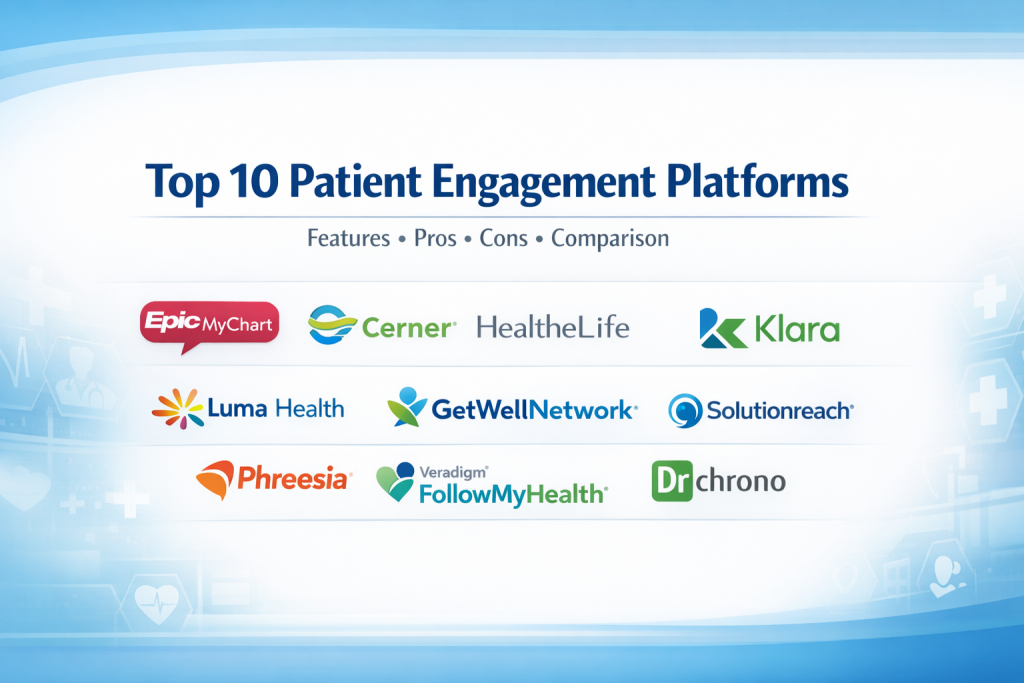
Top 10 Patient Engagement Platforms Tools
1 — Epic MyChart
Short description:
A widely adopted patient engagement and portal solution tightly integrated with the Epic EHR, designed for large hospitals and health systems.
Key features
- Secure patient portal with full health record access
- Appointment scheduling and visit summaries
- Two-way provider messaging
- Prescription refill requests
- Telehealth visit integration
- Mobile app support
- Care plan and education delivery
Pros
- Deep, seamless EHR integration
- High patient adoption rates
- Enterprise-grade reliability
Cons
- Limited flexibility outside Epic ecosystem
- Customization can be complex
Security & compliance: HIPAA, encryption at rest and in transit, audit logs, enterprise SSO
Support & community: Extensive documentation, formal onboarding, large enterprise user community
2 — Cerner HealtheLife
Short description:
A patient engagement platform focused on unifying patient data and experiences across Cerner-based healthcare environments.
Key features
- Centralized patient portal
- Secure messaging and notifications
- Results and visit summary access
- Telehealth support
- Health reminders and alerts
- Mobile-friendly interface
Pros
- Strong interoperability within Cerner ecosystem
- Clean patient experience
Cons
- Less flexible for non-Cerner users
- Feature expansion depends on Cerner roadmap
Security & compliance: HIPAA, GDPR support, role-based access
Support & community: Vendor-led support, structured training programs
3 — athenaCommunicator
Short description:
A communication-driven engagement tool built for ambulatory practices using athenahealth solutions.
Key features
- Automated appointment reminders
- Broadcast messaging
- Patient surveys and feedback
- Care gap outreach
- Campaign management tools
Pros
- Easy to deploy for existing athenahealth users
- Strong automation features
Cons
- Limited advanced care management tools
- Best suited to athenahealth ecosystem
Security & compliance: HIPAA-compliant communications
Support & community: Good onboarding, responsive customer support
4 — Klara
Short description:
A modern patient engagement platform emphasizing real-time communication and collaboration for outpatient clinics.
Key features
- Secure two-way messaging
- Centralized inbox for staff
- Automated reminders
- Digital intake forms
- Multilingual support
Pros
- Excellent usability for staff and patients
- Reduces phone call volume significantly
Cons
- Limited deep analytics
- Not a full patient portal replacement
Security & compliance: HIPAA, encrypted messaging
Support & community: Strong onboarding and hands-on support
5 — Luma Health
Short description:
An automation-first patient engagement platform focused on access, scheduling, and care coordination.
Key features
- Intelligent appointment scheduling
- Automated reminders and follow-ups
- Referral management
- Care gap outreach
- EHR integration layer
Pros
- Powerful automation capabilities
- Improves access and utilization
Cons
- Setup requires workflow planning
- Advanced features may increase cost
Security & compliance: HIPAA, SOC 2-aligned controls
Support & community: Dedicated success managers, structured training
6 — GetWellNetwork
Short description:
A comprehensive engagement solution widely used in inpatient and post-acute care settings.
Key features
- Personalized education pathways
- Bedside and mobile engagement
- Remote patient monitoring support
- Discharge and follow-up tools
- Experience analytics
Pros
- Strong inpatient engagement capabilities
- Evidence-based education content
Cons
- Less focused on small practices
- Implementation can be resource-intensive
Security & compliance: HIPAA, enterprise security frameworks
Support & community: Enterprise support, clinical best-practice resources
7 — Well Health
Short description:
A communication-centric engagement platform designed to modernize patient interactions across channels.
Key features
- SMS, voice, and email messaging
- Appointment reminders
- Review and feedback management
- Digital intake workflows
Pros
- Improves patient response rates
- Simple and fast deployment
Cons
- Limited clinical engagement tools
- Best for communication rather than full care management
Security & compliance: HIPAA-compliant messaging
Support & community: Responsive support, clear documentation
8 — Solutionreach
Short description:
A long-standing patient engagement platform focused on communication, reputation, and retention.
Key features
- Automated reminders
- Patient recall campaigns
- Online reputation management
- Surveys and feedback tools
Pros
- Proven reliability
- Strong patient communication features
Cons
- Interface feels dated to some users
- Limited advanced analytics
Security & compliance: HIPAA-aligned controls
Support & community: Large user base, established support resources
9 — PatientPop
Short description:
An engagement and growth platform combining patient experience tools with practice marketing capabilities.
Key features
- Online scheduling
- Digital intake forms
- Automated reminders
- Patient reviews and feedback
- Analytics dashboard
Pros
- Combines engagement and growth tools
- User-friendly interface
Cons
- Marketing focus may not suit all clinics
- Less depth in clinical engagement
Security & compliance: HIPAA, encrypted data handling
Support & community: Onboarding assistance, customer success teams
10— Phreesia
Short description:
A patient engagement platform specializing in digital intake, registration, and patient-reported outcomes.
Key features
- Digital check-in and intake
- Patient questionnaires
- Payment collection
- Data capture for analytics
- Multilingual support
Pros
- Excellent intake and registration experience
- Reduces front-desk workload
Cons
- Less comprehensive post-care engagement
- Hardware dependencies in some setups
Security & compliance: HIPAA, SOC 2
Support & community: Strong enterprise support, detailed training
Comparison Table
| Tool Name | Best For | Platform(s) Supported | Standout Feature | Rating |
|---|---|---|---|---|
| Epic MyChart | Large hospitals | Web, iOS, Android | Deep EHR integration | N/A |
| Cerner HealtheLife | Health systems | Web, Mobile | Unified patient data | N/A |
| athenaCommunicator | Ambulatory clinics | Web, Mobile | Automated outreach | N/A |
| Klara | Outpatient practices | Web, Mobile | Real-time messaging | N/A |
| Luma Health | Scheduling-heavy orgs | Web, Mobile | Workflow automation | N/A |
| GetWellNetwork | Inpatient care | Web, Mobile | Personalized education | N/A |
| Well Health | Communication-focused clinics | Web, Mobile | Multichannel messaging | N/A |
| Solutionreach | Patient retention | Web, Mobile | Recall campaigns | N/A |
| PatientPop | Practice growth | Web, Mobile | Engagement + marketing | N/A |
| Phreesia | Front-desk automation | Web, Kiosk | Digital intake | N/A |
Evaluation & Scoring of Patient Engagement Platforms
| Evaluation Criteria | Weight | Description |
|---|---|---|
| Core features | 25% | Breadth and depth of engagement capabilities |
| Ease of use | 15% | Simplicity for patients and staff |
| Integrations & ecosystem | 15% | EHR, telehealth, and third-party support |
| Security & compliance | 10% | Regulatory readiness and controls |
| Performance & reliability | 10% | Stability and scalability |
| Support & community | 10% | Training, documentation, and help |
| Price / value | 15% | ROI relative to cost |
Which Patient Engagement Platforms Tool Is Right for You?
- Solo users & small clinics: Simple, communication-focused platforms with quick deployment and low overhead work best.
- SMBs & mid-market: Look for automation, scheduling, and EHR integration to reduce staff workload.
- Enterprise organizations: Prioritize scalability, deep integrations, analytics, and compliance controls.
- Budget-conscious teams: Focus on core messaging and reminders before advanced features.
- Security-driven environments: Choose platforms with proven compliance frameworks and auditability.
Frequently Asked Questions (FAQs)
- What is a Patient Engagement Platform?
It is a digital solution that helps healthcare providers communicate, educate, and interact with patients throughout their care journey. - Do these platforms replace EHR systems?
No, they typically integrate with EHRs rather than replace them. - Are Patient Engagement Platforms secure?
Most leading platforms are HIPAA-compliant and use encryption and access controls. - Can small clinics use these tools?
Yes, many platforms are designed specifically for small and mid-sized practices. - Do patients need technical skills?
No, most tools are designed for ease of use with mobile-friendly interfaces. - Are mobile apps necessary?
Not always, but mobile access significantly improves patient adoption. - How long does implementation take?
It can range from days for simple tools to months for enterprise deployments. - Do these platforms support telehealth?
Many include or integrate with telehealth capabilities. - What is the biggest mistake buyers make?
Choosing tools without considering workflow fit and patient usability. - Are these platforms worth the investment?
When aligned with goals, they improve outcomes, satisfaction, and operational efficiency.
Conclusion
Patient Engagement Platforms play a critical role in modern healthcare by strengthening communication, improving adherence, and enhancing patient satisfaction. The most important factors when choosing a platform are alignment with clinical workflows, ease of use for patients, strong integrations, and robust security.
There is no single “best” Patient Engagement Platform for everyone. The right choice depends on organization size, budget, care model, and engagement goals. By carefully evaluating features, trade-offs, and long-term needs, healthcare organizations can select a solution that delivers meaningful, measurable impact.

Find Trusted Cardiac Hospitals
Compare heart hospitals by city and services — all in one place.
Explore Hospitals