
Introduction
Personal Knowledge Management (PKM) tools are designed to help individuals capture, organize, connect, and retrieve information over time. In an age where knowledge work dominates most professions, ideas, notes, research, meeting insights, and learning resources are constantly flowing in from multiple sources. Without a structured system, valuable knowledge is easily forgotten, duplicated, or lost.
PKM tools solve this problem by acting as a second brain—a trusted digital space where information is stored, connected, and reused. They are widely used for note-taking, research, learning, content creation, decision-making, and long-term thinking. Modern tools go beyond simple notes by supporting backlinks, graphs, tags, databases, and AI-assisted discovery.
When choosing a Personal Knowledge Management tool, users should evaluate how information is captured, how easily it can be retrieved, how well ideas connect, and how future-proof the system is. Key factors include usability, flexibility, offline access, integrations, security, and scalability as knowledge grows.
Best for:
PKM tools are ideal for students, researchers, writers, developers, consultants, founders, product managers, and lifelong learners. They benefit individuals, small teams, and even enterprises that rely on structured thinking and knowledge reuse across projects and roles.
Not ideal for:
Users who only need simple to-do lists, basic reminders, or short-term notes may find PKM tools excessive. In such cases, lightweight note or task apps can be more suitable.
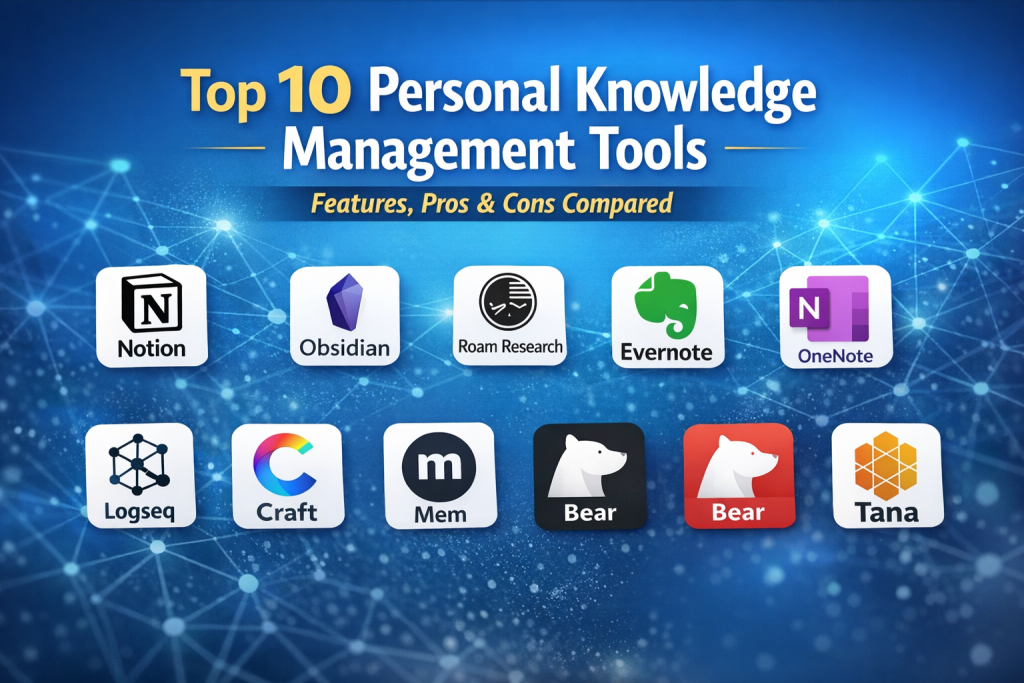
Top 10 Personal Knowledge Management Tools
1 — Notion
Short description:
Notion is an all-in-one workspace combining notes, databases, tasks, and knowledge bases, suitable for individuals and teams.
Key features:
- Flexible block-based editor
- Databases with filters, relations, and views
- Templates for notes, wikis, and workflows
- Real-time collaboration
- AI-assisted writing and summarization
- Cross-platform access
Pros:
- Extremely versatile and customizable
- Strong ecosystem for teams and documentation
Cons:
- Can feel complex for new users
- Offline experience is limited
Security & compliance:
SSO, encryption in transit and at rest, GDPR, SOC 2 (varies by plan)
Support & community:
Extensive documentation, active global community, enterprise support available
2 — Obsidian
Short description:
Obsidian is a local-first knowledge tool built around Markdown files and powerful backlinking.
Key features:
- Bi-directional linking
- Graph visualization of knowledge
- Local file storage
- Extensive plugin ecosystem
- Offline-first design
- Custom themes and workflows
Pros:
- Full data ownership
- Excellent for deep thinking and research
Cons:
- Steeper learning curve
- Collaboration requires setup
Security & compliance:
Local storage by default; encryption depends on sync method
Support & community:
Strong community plugins, active forums, clear documentation
3 — Roam Research
Short description:
Roam Research focuses on networked thinking using daily notes and backlinks.
Key features:
- Bi-directional links
- Daily notes workflow
- Block-level references
- Graph-based knowledge view
- Query-based note retrieval
Pros:
- Excellent for idea synthesis
- Encourages long-term thinking
Cons:
- Expensive for individuals
- Limited offline access
Security & compliance:
Encryption, GDPR compliance (limited enterprise controls)
Support & community:
Dedicated user community, moderate documentation
4 — Evernote
Short description:
Evernote is a long-standing note-taking platform focused on capture and organization.
Key features:
- Rich note editor
- Web clipping
- Tags and notebooks
- OCR for images
- Cross-device sync
Pros:
- Fast capture of information
- Reliable search capabilities
Cons:
- Less flexible for knowledge linking
- Pricing concerns for advanced users
Security & compliance:
Encryption, GDPR, enterprise controls available
Support & community:
Established documentation, customer support, business plans
5 — Microsoft OneNote
Short description:
Microsoft OneNote is a digital notebook tightly integrated with the Microsoft ecosystem.
Key features:
- Free-form note layout
- Section and page structure
- Handwriting and drawing support
- Office ecosystem integration
- Offline access
Pros:
- Familiar interface
- Strong enterprise adoption
Cons:
- Weak backlinking features
- Limited advanced PKM workflows
Security & compliance:
Enterprise-grade security, GDPR, ISO, SOC (via Microsoft)
Support & community:
Extensive enterprise support, tutorials, global user base
6 — Logseq
Short description:
Logseq is an open-source, privacy-focused PKM tool built around outlining and backlinks.
Key features:
- Markdown and Org-mode support
- Bi-directional links
- Local-first storage
- Knowledge graph view
- Task and journal system
Pros:
- Open-source and private
- Strong for researchers and developers
Cons:
- UI less polished
- Smaller plugin ecosystem
Security & compliance:
Local storage; compliance depends on sync choice
Support & community:
Growing open-source community, improving documentation
7 — Craft
Short description:
Craft is a beautifully designed document-based knowledge tool popular among creatives.
Key features:
- Block-based editing
- Backlinks and page sharing
- Offline-first on Apple devices
- Visual document design
- Collaboration support
Pros:
- Excellent user experience
- Strong for writing and publishing
Cons:
- Limited advanced databases
- Best on Apple platforms
Security & compliance:
Encryption, GDPR compliant
Support & community:
Responsive support, growing creative community
8 — Mem
Short description:
Mem is an AI-first PKM tool focused on automatic organization and recall.
Key features:
- AI-driven search
- Smart note connections
- Minimal manual organization
- Fast capture
- Cross-platform access
Pros:
- Low maintenance
- Powerful retrieval
Cons:
- Limited structural control
- Heavily AI-dependent
Security & compliance:
Encryption, GDPR (enterprise controls limited)
Support & community:
Good onboarding, smaller community
9 — Bear
Short description:
Bear is a minimalist Markdown note-taking app designed for writers.
Key features:
- Markdown support
- Tag-based organization
- Offline access
- Focus mode writing
- Apple ecosystem support
Pros:
- Clean and distraction-free
- Excellent for personal writing
Cons:
- No advanced backlinks
- Limited collaboration
Security & compliance:
Encryption, local storage options
Support & community:
Good documentation, loyal user base
10 — Tana
Short description:
Tana combines structured data with graph-based thinking.
Key features:
- Structured nodes and fields
- Graph-based knowledge view
- Powerful search queries
- Templates for thinking workflows
- Daily notes integration
Pros:
- Highly expressive knowledge modeling
- Strong for power users
Cons:
- Learning curve
- Limited mobile experience
Security & compliance:
Varies / N/A (early-stage platform)
Support & community:
Engaged early-adopter community, evolving documentation
Comparison Table
| Tool Name | Best For | Platform(s) Supported | Standout Feature | Rating |
|---|---|---|---|---|
| Notion | Teams & individuals | Web, Desktop, Mobile | Databases + flexibility | N/A |
| Obsidian | Deep thinkers | Desktop, Mobile | Local graph knowledge | N/A |
| Roam Research | Idea synthesis | Web | Networked thought | N/A |
| Evernote | Information capture | Web, Desktop, Mobile | Web clipping | N/A |
| OneNote | Enterprise users | Desktop, Mobile | Office integration | N/A |
| Logseq | Privacy-focused users | Desktop, Mobile | Open-source graph | N/A |
| Craft | Writers & creatives | Desktop, Mobile | Visual documents | N/A |
| Mem | AI-driven users | Web, Mobile | Smart recall | N/A |
| Bear | Writers | Mobile, Desktop | Minimal Markdown | N/A |
| Tana | Power users | Web | Structured graph | N/A |
Evaluation & Scoring of Personal Knowledge Management Tools
| Criteria | Weight | Score (Avg) |
|---|---|---|
| Core features | 25% | High |
| Ease of use | 15% | Medium-High |
| Integrations & ecosystem | 15% | Medium |
| Security & compliance | 10% | Medium |
| Performance & reliability | 10% | High |
| Support & community | 10% | Medium |
| Price / value | 15% | Medium-High |
Which Personal Knowledge Management Tool Is Right for You?
- Solo users: Obsidian, Bear, Logseq
- SMBs: Notion, Craft, Mem
- Mid-market: Notion, OneNote
- Enterprise: OneNote, Notion
- Budget-conscious: Obsidian, Logseq, OneNote
- Premium experience: Craft, Roam Research
- Feature depth: Notion, Tana
- Ease of use: Bear, Mem
- Integrations: Notion, OneNote
- Security needs: Local-first tools or enterprise platforms
Frequently Asked Questions (FAQs)
1. What is a Personal Knowledge Management tool?
A system to capture, organize, and reuse knowledge over time.
2. Are PKM tools only for professionals?
No, students and lifelong learners also benefit greatly.
3. Is local storage better than cloud?
Local offers privacy; cloud offers convenience.
4. Do PKM tools replace task managers?
They complement but do not fully replace them.
5. Which tool is best for writing?
Bear and Craft are popular among writers.
6. Which tool is best for research?
Obsidian and Roam Research excel at research workflows.
7. Are PKM tools secure?
Security varies by tool and storage method.
8. Can teams use PKM tools?
Yes, especially Notion and OneNote.
9. Do I need backlinks?
Backlinks help connect ideas but are optional.
10. What is the biggest mistake users make?
Over-engineering systems instead of focusing on use.
Conclusion
Personal Knowledge Management tools are no longer optional for serious knowledge workers. They help preserve insights, connect ideas, and improve thinking over time. While each tool offers unique strengths, the most important factors are how well it fits your workflow, thinking style, and long-term goals.
There is no single “best” tool for everyone. The right choice depends on how you think, what you value—simplicity or power—and how your knowledge needs will evolve. Choose a tool that you will actually use consistently, and it will become one of your most valuable assets.

Find Trusted Cardiac Hospitals
Compare heart hospitals by city and services — all in one place.
Explore Hospitals