
Introduction
Public Transit Scheduling Tools are specialized software platforms designed to plan, optimize, and manage transit timetables for buses, metros, trams, rail, and multi-modal transportation systems. These tools help transit agencies balance passenger demand, vehicle availability, driver shifts, and regulatory constraints—while keeping services reliable and cost-effective.
In today’s cities, public transportation is under constant pressure from growing populations, traffic congestion, labor shortages, and sustainability goals. Manual scheduling or outdated systems often lead to missed trips, inefficient vehicle utilization, higher operating costs, and dissatisfied passengers. Modern scheduling tools use automation, optimization algorithms, and real-time data to solve these challenges.
Common real-world use cases include:
- Creating fixed or dynamic timetables for bus and rail networks
- Adjusting schedules during peak hours, events, or disruptions
- Managing driver duties, shifts, and labor compliance
- Coordinating multi-modal transit networks
- Improving on-time performance and passenger satisfaction
When choosing a Public Transit Scheduling Tool, buyers should evaluate:
- Depth of scheduling and optimization capabilities
- Ease of use for planners and dispatchers
- Integration with AVL, fare, and passenger information systems
- Scalability for growing networks
- Compliance with labor, safety, and data regulations
- Total cost of ownership and long-term value
Best for:
Public Transit Scheduling Tools are ideal for city transport authorities, regional transit agencies, municipal corporations, private bus operators, metro and rail operators, and mobility-as-a-service providers. They benefit planners, operations managers, dispatchers, and decision-makers who manage complex schedules at scale.
Not ideal for:
These tools may be unnecessary for very small operators with only a few vehicles, charter-only services with ad-hoc trips, or organizations that rely exclusively on third-party scheduling providers.
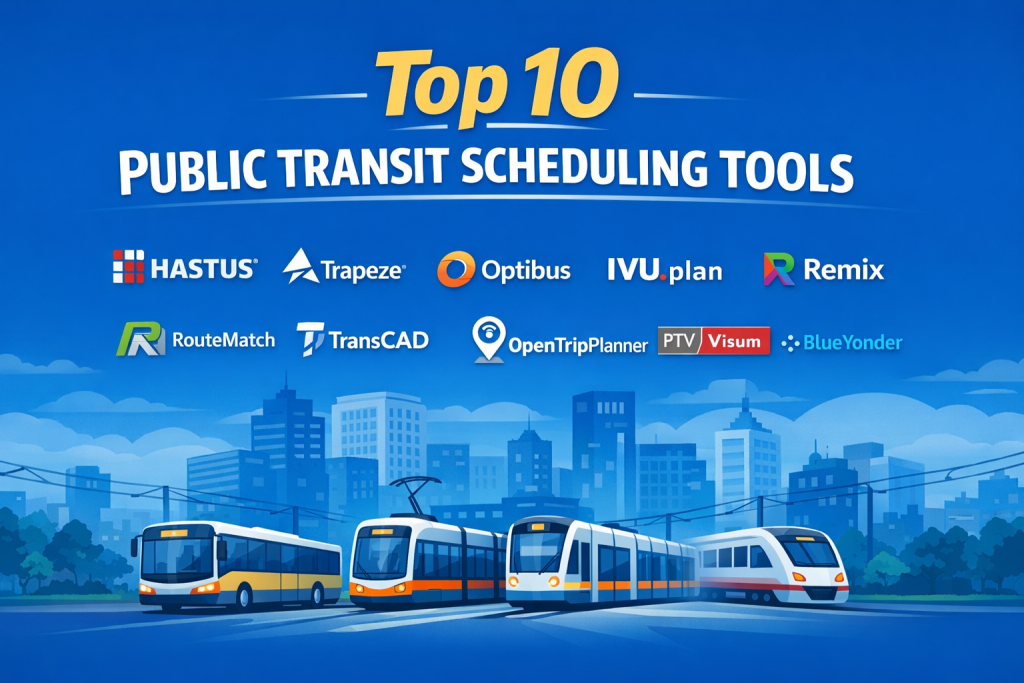
Top 10 Public Transit Scheduling Tools
1 — HASTUS
Short description:
A widely used enterprise-grade transit scheduling system designed for large and complex public transport networks.
Key features:
- Advanced timetable and vehicle scheduling
- Crew and duty scheduling with labor rule compliance
- Network-wide optimization algorithms
- Scenario modeling and “what-if” planning
- Multi-modal support (bus, rail, metro)
- Integration with real-time operations systems
Pros:
- Extremely powerful and proven at scale
- Handles highly complex networks effectively
- Strong compliance and optimization capabilities
Cons:
- Steep learning curve
- Higher implementation and licensing costs
Security & compliance:
SSO, role-based access, encryption, GDPR support
Support & community:
Strong enterprise support, detailed documentation, professional onboarding
2 — Trapeze Scheduling
Short description:
A comprehensive scheduling and planning solution for bus, rail, and paratransit operators.
Key features:
- Timetable and block scheduling
- Crew scheduling and rostering
- Demand-based service planning
- Cost modeling and performance analysis
- Integration with fleet and AVL systems
- Scenario planning tools
Pros:
- End-to-end transit planning coverage
- Highly configurable for different agencies
- Strong analytics and reporting
Cons:
- Interface can feel complex for new users
- Customization may require vendor support
Security & compliance:
Enterprise security, GDPR, audit controls
Support & community:
Global support network, training programs, strong enterprise adoption
3 — Optibus
Short description:
A modern, cloud-based transit scheduling platform focused on usability and optimization.
Key features:
- Automated timetable and vehicle scheduling
- Driver duty and shift planning
- Real-time data integration
- AI-driven optimization
- Collaborative planning environment
- Cloud deployment with fast updates
Pros:
- User-friendly interface
- Faster implementation compared to legacy tools
- Strong optimization results
Cons:
- Less suitable for extremely custom legacy workflows
- Ongoing subscription costs
Security & compliance:
Cloud security, encryption, GDPR, SOC-aligned controls
Support & community:
Responsive customer support, onboarding assistance, growing user community
4 — IVU.plan
Short description:
A robust planning and scheduling solution for public transport authorities and operators.
Key features:
- Network and timetable planning
- Vehicle and crew scheduling
- Cost and performance optimization
- Multi-modal planning support
- Scenario simulation tools
- Integration with operations platforms
Pros:
- Strong European transit expertise
- Reliable performance for large networks
- Comprehensive planning capabilities
Cons:
- Interface may feel traditional
- Configuration can be time-consuming
Security & compliance:
Enterprise security standards, GDPR compliance
Support & community:
Professional services, structured training, enterprise support
5 — Remix
Short description:
A collaborative transit planning and scheduling tool focused on rapid design and visualization.
Key features:
- Visual route and timetable planning
- Demand and ridership analysis
- Scenario comparison
- Stakeholder collaboration tools
- Integration with GIS and data platforms
- Cloud-based deployment
Pros:
- Highly visual and intuitive
- Excellent for early-stage planning
- Strong collaboration features
Cons:
- Less detailed crew scheduling
- Limited advanced optimization compared to enterprise tools
Security & compliance:
Cloud security, GDPR support
Support & community:
Good documentation, responsive support, active planning community
6 — RouteMatch Scheduling
Short description:
A scheduling platform designed for fixed-route, demand-response, and paratransit services.
Key features:
- Fixed-route and flexible scheduling
- Driver and vehicle assignment
- Demand-response optimization
- Compliance tracking
- Reporting and analytics
- Integration with dispatch systems
Pros:
- Flexible for mixed service models
- Strong paratransit capabilities
- Practical and operations-focused
Cons:
- UI is functional rather than modern
- Limited advanced AI optimization
Security & compliance:
Role-based access, encryption, compliance tools
Support & community:
Reliable customer support, onboarding assistance
7 — TransCAD
Short description:
A transportation planning and scheduling platform with strong GIS and modeling capabilities.
Key features:
- Route and schedule planning
- Demand forecasting
- Network modeling
- GIS-based analysis
- Performance evaluation tools
- Data visualization
Pros:
- Excellent spatial analysis
- Strong planning and forecasting
- Flexible modeling capabilities
Cons:
- Less focused on day-to-day operations
- Requires technical expertise
Security & compliance:
Standard enterprise security controls
Support & community:
Technical documentation, professional user base
8 — OpenTripPlanner (Enterprise Deployments)
Short description:
An open-source platform used for transit scheduling, routing, and journey planning.
Key features:
- Schedule-based routing
- Multi-modal trip planning
- GTFS data integration
- Customizable algorithms
- Open architecture
- Community-driven development
Pros:
- Highly flexible and customizable
- No licensing fees
- Strong global adoption
Cons:
- Requires in-house technical expertise
- Limited commercial support out-of-the-box
Security & compliance:
Varies / N/A (depends on deployment)
Support & community:
Active open-source community, developer documentation
9 — PTV Visum
Short description:
A strategic transport planning and scheduling solution for large-scale transit networks.
Key features:
- Network and timetable modeling
- Demand analysis
- Scenario simulation
- Performance forecasting
- Multi-modal planning
- Data-driven decision support
Pros:
- Strong strategic planning capabilities
- Highly detailed simulations
- Trusted by transport authorities
Cons:
- Not ideal for real-time operations
- Higher learning curve
Security & compliance:
Enterprise security standards
Support & community:
Professional support, training programs
10 — JDA / Blue Yonder Transportation Scheduling (Public Sector Adaptations)
Short description:
An advanced scheduling and optimization engine adapted for public transport use cases.
Key features:
- Advanced optimization algorithms
- Resource and capacity planning
- Scenario modeling
- Performance analytics
- Integration with enterprise systems
- Scalable architecture
Pros:
- Powerful optimization engine
- Scales well for large networks
- Strong analytics
Cons:
- Requires customization for transit-specific needs
- Enterprise-level pricing
Security & compliance:
SOC-aligned security, encryption, audit logs
Support & community:
Enterprise support, professional services
Comparison Table
| Tool Name | Best For | Platform(s) Supported | Standout Feature | Rating |
|---|---|---|---|---|
| HASTUS | Large transit authorities | On-prem / Hybrid | Deep optimization | N/A |
| Trapeze Scheduling | Multi-modal agencies | On-prem / Cloud | End-to-end planning | N/A |
| Optibus | Modern transit operators | Cloud | AI-driven scheduling | N/A |
| IVU.plan | Regional & national operators | On-prem / Cloud | Network-wide planning | N/A |
| Remix | Urban planners | Cloud | Visual planning | N/A |
| RouteMatch | Mixed service operators | Cloud / On-prem | Paratransit support | N/A |
| TransCAD | Transport analysts | Desktop | GIS modeling | N/A |
| OpenTripPlanner | Tech-driven agencies | Self-hosted | Open-source flexibility | N/A |
| PTV Visum | Strategic planners | Desktop / Server | Demand simulation | N/A |
| Blue Yonder | Enterprise networks | Cloud / Hybrid | Advanced optimization | N/A |
Evaluation & Scoring of Public Transit Scheduling Tools
| Criteria | Weight | Score (Avg) |
|---|---|---|
| Core features | 25% | High |
| Ease of use | 15% | Medium |
| Integrations & ecosystem | 15% | High |
| Security & compliance | 10% | Medium-High |
| Performance & reliability | 10% | High |
| Support & community | 10% | Medium-High |
| Price / value | 15% | Medium |
Which Public Transit Scheduling Tool Is Right for You?
- Solo or small operators: Lightweight or open-source solutions may be sufficient.
- SMBs and mid-market agencies: Cloud-based tools with faster deployment and lower upfront cost work best.
- Large enterprises: Full-featured enterprise platforms with advanced optimization and compliance are ideal.
- Budget-conscious buyers: Open-source or modular platforms reduce licensing costs.
- Premium seekers: Enterprise tools deliver deeper analytics and optimization.
- Integration-heavy environments: Choose tools with strong API and ecosystem support.
- Security-focused agencies: Prioritize platforms with proven compliance and audit controls.
Frequently Asked Questions (FAQs)
1. What is a Public Transit Scheduling Tool?
It is software used to design, manage, and optimize public transport timetables, vehicles, and crew schedules.
2. Do these tools support real-time changes?
Many modern platforms support real-time or near-real-time adjustments.
3. Are these tools suitable for buses and rail?
Yes, most support buses, rail, metro, and multi-modal networks.
4. How long does implementation take?
It ranges from weeks for cloud tools to months for enterprise deployments.
5. Are cloud solutions secure for public agencies?
Yes, when they follow industry security and compliance standards.
6. Can these tools reduce operating costs?
Yes, through optimized vehicle usage and labor planning.
7. Do they support labor law compliance?
Most enterprise tools include rule-based compliance engines.
8. Is training required?
Yes, especially for complex enterprise systems.
9. Can small cities use these tools?
Yes, especially modern cloud-based or modular solutions.
10. What is the biggest mistake buyers make?
Choosing tools based only on price rather than long-term scalability and usability.
Conclusion
Public Transit Scheduling Tools play a critical role in keeping cities moving efficiently and reliably. The right platform can improve punctuality, reduce costs, enhance workforce satisfaction, and elevate the passenger experience.
There is no single “best” tool for everyone. The ideal choice depends on network size, operational complexity, budget, integration needs, and regulatory requirements. By carefully evaluating features, usability, scalability, and long-term value, transit agencies can select a solution that supports both today’s operations and tomorrow’s growth.

Find Trusted Cardiac Hospitals
Compare heart hospitals by city and services — all in one place.
Explore Hospitals