
Introduction
Relevance Evaluation Toolkits are specialized platforms and frameworks designed to measure how well search engines, recommendation systems, ranking models, and AI-driven retrieval systems return results that truly match user intent. In modern data-driven products—especially those powered by machine learning, large language models, and semantic search—accuracy alone is not enough. What matters most is relevance: are users getting the right results, in the right order, at the right time?
These toolkits help teams evaluate ranking quality using metrics such as precision, recall, NDCG, MRR, and human judgment workflows. They are widely used in search, e-commerce, ad tech, enterprise knowledge bases, AI assistants, and RAG (Retrieval-Augmented Generation) pipelines.
Relevance evaluation is critical because poor relevance directly impacts user trust, engagement, conversion rates, and operational efficiency. Even small ranking improvements can produce significant business gains.
When choosing a Relevance Evaluation Toolkit, buyers should evaluate:
- Metric coverage and customization
- Support for offline and online evaluation
- Human-in-the-loop workflows
- Integration with ML pipelines
- Scalability, security, and governance
Best for:
Product managers, ML engineers, data scientists, search engineers, AI teams, and enterprises building or optimizing search, recommendation, or LLM-powered retrieval systems.
Not ideal for:
Teams with no ranking or retrieval component, static websites with minimal search needs, or organizations that only require basic analytics rather than relevance-based evaluation.
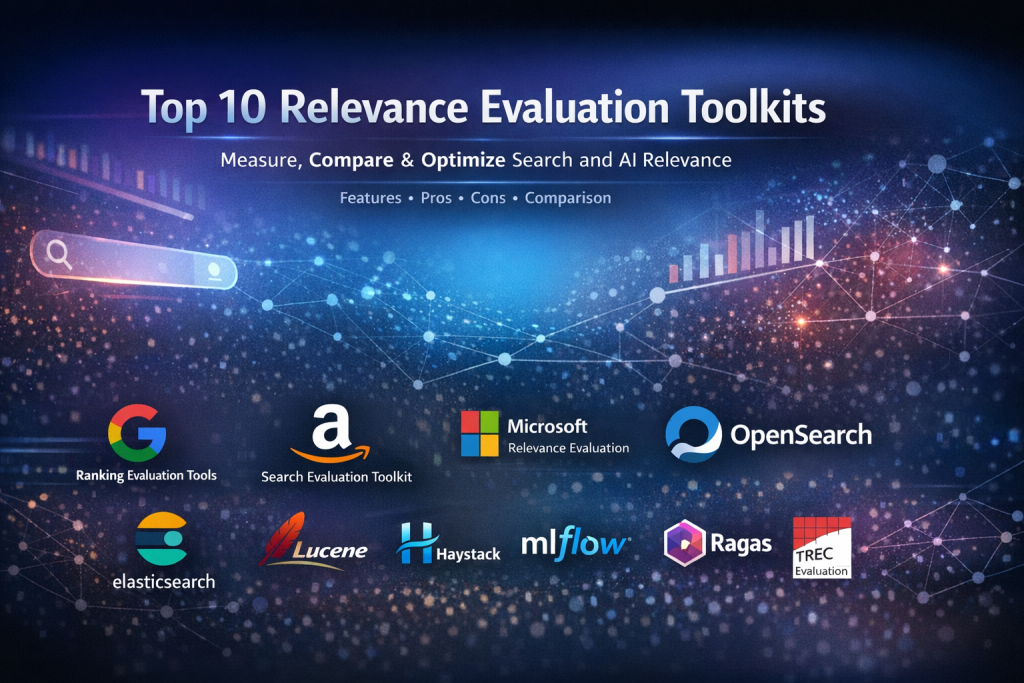
Top 10 Relevance Evaluation Toolkits Tools
1 — Google Open‑Source Ranking Evaluation Tools
Short description:
A collection of open-source utilities and research-backed methodologies used internally and externally to evaluate ranking quality at scale.
Key features
- Standard IR metrics (NDCG, Precision, Recall, MAP)
- Offline ranking evaluation pipelines
- Large-scale dataset handling
- Query–document relevance labeling
- Strong academic grounding
- Highly extensible for custom research
Pros
- Proven at massive scale
- Transparent and research-driven
Cons
- Requires strong technical expertise
- Limited UI and visualization
Security & compliance:
Varies / N/A (open-source)
Support & community:
Strong research community, documentation varies by project
2 — Amazon Search Evaluation Toolkit
Short description:
Internal-style relevance evaluation methodologies adapted for large-scale commerce and ranking systems.
Key features
- E-commerce–specific relevance metrics
- A/B ranking comparison frameworks
- Offline and online evaluation
- Judgment workflows for product relevance
- Bias and fairness analysis
- Scalable architecture
Pros
- Optimized for transactional relevance
- Handles massive catalogs well
Cons
- Limited public tooling
- Complex setup
Security & compliance:
SOC 2–aligned practices (enterprise-grade)
Support & community:
Enterprise-focused documentation, limited public community
3 — Microsoft Relevance Evaluation Framework
Short description:
A robust framework used across enterprise search, document retrieval, and AI-assisted discovery systems.
Key features
- Multi-metric relevance scoring
- Human labeling integration
- Experiment tracking
- Offline ranking simulations
- Deep Azure ecosystem support
- Enterprise-scale reliability
Pros
- Strong governance and auditability
- Excellent enterprise fit
Cons
- Azure-centric
- Higher operational overhead
Security & compliance:
SOC 2, ISO 27001, GDPR-ready
Support & community:
Enterprise support, strong documentation
4 — OpenSearch Relevance Evaluation
Short description:
An open-source relevance evaluation framework built into OpenSearch for search quality testing.
Key features
- Built-in ranking evaluation API
- Query relevance judgments
- Custom metric definitions
- Tight OpenSearch integration
- Lightweight deployment
- Transparent scoring logic
Pros
- Easy to adopt for OpenSearch users
- Fully open-source
Cons
- Limited beyond OpenSearch ecosystem
- Fewer visualization tools
Security & compliance:
Varies / N/A
Support & community:
Active open-source community
5 — Elasticsearch Ranking Evaluation
Short description:
A built-in toolkit for evaluating search relevance within Elasticsearch-powered systems.
Key features
- Ranking Evaluation API
- Predefined and custom metrics
- Query sets and judgments
- Offline relevance testing
- Developer-friendly integration
- Scalable architecture
Pros
- Native Elasticsearch support
- Mature and stable
Cons
- Requires Elasticsearch expertise
- Licensing considerations
Security & compliance:
SOC 2, GDPR, ISO standards supported
Support & community:
Strong documentation and enterprise support
6— Lucene Evaluation Framework
Short description:
A low-level evaluation framework used by researchers and engineers building custom search systems.
Key features
- Core IR evaluation metrics
- Fine-grained ranking analysis
- Custom relevance judgments
- Lightweight and fast
- Highly extensible
- Ideal for experimentation
Pros
- Extremely flexible
- Research-friendly
Cons
- No UI
- Steep learning curve
Security & compliance:
N/A (library-level tool)
Support & community:
Strong developer and academic community
7 — Haystack Evaluation Module
Short description:
An evaluation toolkit designed for NLP pipelines, semantic search, and RAG-based systems.
Key features
- Retriever and reader evaluation
- Semantic relevance scoring
- Dataset versioning
- LLM-friendly metrics
- Pipeline benchmarking
- Open-source extensibility
Pros
- Excellent for AI and RAG use cases
- Modern ML focus
Cons
- Smaller enterprise footprint
- Requires ML expertise
Security & compliance:
Varies / N/A
Support & community:
Active open-source and ML community
8 — MLflow Model Evaluation
Short description:
A general-purpose ML evaluation platform increasingly used for ranking and relevance experiments.
Key features
- Experiment tracking
- Custom evaluation metrics
- Model comparison
- Pipeline integration
- Reproducibility
- Scalable experimentation
Pros
- Flexible across ML use cases
- Strong ecosystem support
Cons
- Not relevance-specific by default
- Requires customization
Security & compliance:
Depends on deployment environment
Support & community:
Strong open-source community
9 — Ragas Evaluation Framework
Short description:
A modern toolkit focused on evaluating RAG systems and LLM-based retrieval relevance.
Key features
- Context relevance metrics
- Answer faithfulness scoring
- Retrieval quality analysis
- LLM-based evaluation
- Lightweight integration
- Rapid experimentation
Pros
- Purpose-built for RAG
- Fast to adopt
Cons
- Emerging ecosystem
- Limited enterprise tooling
Security & compliance:
Varies / N/A
Support & community:
Growing AI-focused community
10 — TREC Evaluation Toolkit
Short description:
A gold-standard benchmarking toolkit used in academic and industry IR evaluations.
Key features
- Standardized datasets
- Trusted evaluation metrics
- Reproducible benchmarks
- Long-term comparability
- Research-grade rigor
- Transparent scoring
Pros
- Highly credible benchmarks
- Industry-recognized
Cons
- Less product-oriented
- Minimal automation
Security & compliance:
N/A
Support & community:
Strong academic and research backing
Comparison Table
| Tool Name | Best For | Platform(s) Supported | Standout Feature | Rating |
|---|---|---|---|---|
| Google Ranking Tools | Large-scale search | Multi-platform | Research-grade metrics | N/A |
| Amazon Toolkit | E-commerce ranking | Cloud-native | Commerce relevance | N/A |
| Microsoft Framework | Enterprise search | Cloud / Enterprise | Governance & scale | N/A |
| OpenSearch Eval | Open-source search | OpenSearch | Native API | N/A |
| Elasticsearch Eval | Elasticsearch users | Elastic Stack | Built-in ranking tests | N/A |
| Lucene Framework | Custom search engines | JVM-based | Low-level control | N/A |
| Haystack Eval | NLP & RAG | Python | AI-first evaluation | N/A |
| MLflow Evaluation | ML pipelines | Cross-platform | Experiment tracking | N/A |
| Ragas | RAG systems | Python | LLM-based relevance | N/A |
| TREC Toolkit | Benchmarking | Platform-agnostic | Standard datasets | N/A |
Evaluation & Scoring of Relevance Evaluation Toolkits
| Criteria | Weight | Score Description |
|---|---|---|
| Core features | 25% | Metric coverage and customization |
| Ease of use | 15% | Learning curve and workflows |
| Integrations & ecosystem | 15% | ML, search, CI/CD compatibility |
| Security & compliance | 10% | Enterprise readiness |
| Performance & reliability | 10% | Scalability and consistency |
| Support & community | 10% | Documentation and help |
| Price / value | 15% | ROI and total cost |
Which Relevance Evaluation Toolkits Tool Is Right for You?
- Solo users & researchers: Open-source frameworks like Lucene, TREC, or Ragas
- SMBs: OpenSearch, Haystack, or MLflow-based setups
- Mid-market: Elasticsearch or hybrid MLflow + RAG tools
- Enterprise: Microsoft and Amazon-style frameworks
Budget-conscious teams benefit from open-source solutions.
Premium buyers gain governance, auditability, and scale.
Choose feature depth if relevance quality is mission-critical.
Choose ease of use for faster iteration.
Security-heavy industries should prioritize compliance-ready platforms.
Frequently Asked Questions (FAQs)
1. What is relevance evaluation?
It measures how accurately systems rank or retrieve information aligned with user intent.
2. Are relevance metrics different from accuracy?
Yes. Accuracy is binary, relevance considers ranking quality and usefulness.
3. Do I need human judgment?
For high-quality evaluation, human-in-the-loop workflows are strongly recommended.
4. Can these tools evaluate LLM-based systems?
Yes, especially RAG-focused frameworks like Haystack and Ragas.
5. Are open-source tools reliable?
Yes, but they require more setup and expertise.
6. What metrics matter most?
NDCG, Precision@K, Recall, and MRR are commonly used.
7. Can relevance evaluation be automated?
Partially. Human review is still critical for nuanced relevance.
8. How often should evaluation be done?
Continuously for production systems; at least per major model update.
9. Do these tools replace A/B testing?
No, they complement online testing.
10. What is the biggest mistake teams make?
Ignoring relevance drift over time.
Conclusion
Relevance Evaluation Toolkits play a foundational role in building trustworthy, high-performing search and AI systems. The right toolkit helps teams move beyond guesswork and make data-driven decisions about ranking quality.
There is no universal best solution. The ideal choice depends on scale, technical maturity, industry needs, and budget. By focusing on metrics, workflows, integration, and governance, teams can select a toolkit that delivers measurable impact and long-term value.

Find Trusted Cardiac Hospitals
Compare heart hospitals by city and services — all in one place.
Explore Hospitals
