
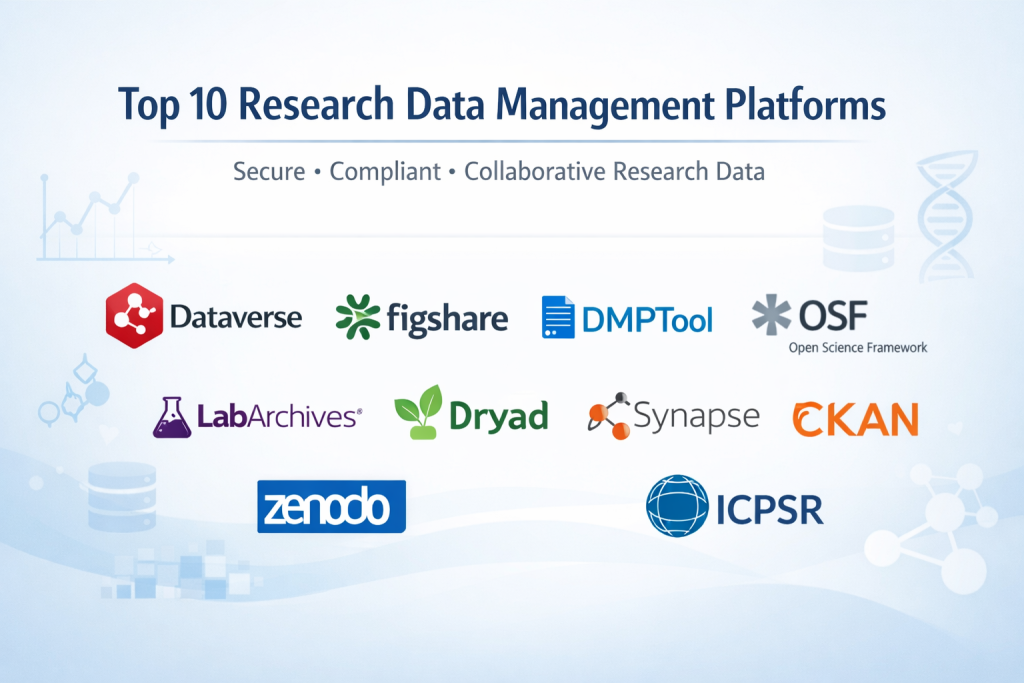
Introduction
Research Data Management Platforms (RDMPs) are specialized systems designed to help researchers, institutions, and organizations collect, organize, store, document, share, and preserve research data throughout its entire lifecycle. From early data creation to long-term archiving and reuse, these platforms bring structure, governance, and transparency to increasingly complex research workflows.
In today’s research landscape, data volumes are exploding. Universities, laboratories, healthcare institutions, and R&D-driven enterprises must comply with funder mandates, ensure data integrity, protect sensitive information, and enable collaboration across teams and borders. Manual storage methods or generic file-sharing tools are no longer sufficient.
Real-world use cases include:
- Managing grant-funded research data with compliance requirements
- Enabling reproducible science through metadata and version control
- Securely sharing datasets across multi-institution collaborations
- Long-term preservation of valuable or irreplaceable research outputs
When choosing a Research Data Management Platform, users should evaluate data lifecycle coverage, metadata standards support, security controls, integrations, scalability, usability, and total cost of ownership.
Best for:
Research Data Management Platforms are ideal for academic researchers, universities, research hospitals, government agencies, pharmaceutical R&D teams, and data-intensive enterprises that must manage structured and unstructured research data responsibly.
Not ideal for:
These platforms may be excessive for solo researchers with minimal datasets, short-term projects without compliance needs, or teams that only require basic cloud file storage.
Top 10 Research Data Management Platforms Tools
1 — Dataverse
Short description:
Dataverse is an open-source research data repository platform designed primarily for academic institutions and research organizations to share, preserve, and cite datasets.
Key features:
- Dataset publishing with persistent identifiers
- Rich metadata support (discipline-specific schemas)
- Versioning and data citation
- Access controls and embargo management
- Integration with institutional repositories
- Long-term preservation workflows
Pros:
- Strong academic adoption and credibility
- Excellent support for open science principles
Cons:
- Interface may feel dated to some users
- Requires institutional IT support for hosting
Security & compliance:
Encryption, access controls, GDPR-friendly; compliance varies by deployment.
Support & community:
Extensive documentation, strong global academic community, institutional support available.
2 — Figshare
Short description:
Figshare is a cloud-based platform that helps researchers store, publish, and showcase research outputs, including datasets, figures, and supplementary materials.
Key features:
- Cloud hosting with DOI assignment
- Dataset versioning and metrics
- Metadata enrichment tools
- Institutional portals
- Integration with publisher workflows
- Usage and citation analytics
Pros:
- Very user-friendly interface
- Strong visibility and discoverability features
Cons:
- Costs increase with storage needs
- Limited customization compared to self-hosted tools
Security & compliance:
SSO, encryption, GDPR compliance, ISO-aligned controls.
Support & community:
High-quality onboarding, responsive enterprise support, strong institutional adoption.
3 — DMPTool
Short description:
DMPTool focuses on helping researchers create, manage, and maintain compliant data management plans required by funding agencies.
Key features:
- Funder-specific DMP templates
- Collaborative plan editing
- Institutional customization
- Guidance and best-practice prompts
- Export and submission support
Pros:
- Excellent for grant compliance
- Free or low-cost for many institutions
Cons:
- Not a full data storage platform
- Limited post-project data lifecycle tools
Security & compliance:
Basic access controls; compliance depends on institutional setup.
Support & community:
Clear documentation, academic community support, limited enterprise services.
4 — Open Science Framework
Short description:
The Open Science Framework (OSF) is a collaborative platform designed to manage research projects, data, and workflows transparently.
Key features:
- Project-based data organization
- Integration with cloud storage services
- Version control and provenance tracking
- Pre-registration support
- Public and private project spaces
Pros:
- Strong support for reproducible research
- Integrates well with existing tools
Cons:
- Can feel complex for new users
- Limited advanced analytics
Security & compliance:
Encryption, access controls, GDPR-aware; HIPAA varies by configuration.
Support & community:
Active research community, good documentation, nonprofit-driven support.
5 — CKAN
Short description:
CKAN is an open-source data management system widely used for publishing, sharing, and discovering large datasets.
Key features:
- Dataset cataloging and metadata
- API-driven architecture
- Custom extensions and plugins
- Search and discovery tools
- Role-based access control
Pros:
- Highly customizable
- Strong open-data ecosystem
Cons:
- Requires technical expertise to deploy
- UI customization takes effort
Security & compliance:
Depends on hosting environment; supports encryption and access controls.
Support & community:
Large open-source community, professional support available via partners.
6 — LabArchives
Short description:
LabArchives combines electronic lab notebooks with data management capabilities for laboratory-based research teams.
Key features:
- Structured lab notebooks
- Data attachment and annotation
- Collaboration and sharing
- Audit trails and timestamps
- Integration with instruments
Pros:
- Excellent for wet-lab environments
- Easy adoption for scientists
Cons:
- Limited large-scale data repository features
- Less suited for non-lab research
Security & compliance:
SSO, encryption, audit logs, HIPAA-capable plans.
Support & community:
Strong onboarding, responsive support, active life-sciences user base.
7 — Dryad
Short description:
Dryad is a curated data repository focused on publishing datasets underlying scholarly publications.
Key features:
- Dataset curation and review
- DOI assignment
- Journal integrations
- Metadata quality checks
- Long-term preservation
Pros:
- High trust and credibility
- Strong publisher partnerships
Cons:
- Narrow scope (publication-focused)
- Less flexible for internal data management
Security & compliance:
Secure hosting, GDPR-aligned policies.
Support & community:
Professional curation team, limited customization support.
8 — Synapse
Short description:
Synapse is a collaborative platform for sharing, analyzing, and governing complex biomedical research data.
Key features:
- Data governance controls
- Collaborative analytics
- Provenance tracking
- Controlled data access
- API integrations
Pros:
- Excellent for regulated biomedical research
- Strong governance features
Cons:
- Steeper learning curve
- Less general-purpose
Security & compliance:
Encryption, access governance, GDPR and HIPAA-aligned environments.
Support & community:
Specialized support, active biomedical research community.
9 — Zenodo
Short description:
Zenodo is an open repository enabling researchers to share datasets, software, and publications openly.
Key features:
- Free dataset hosting
- DOI generation
- Versioning
- Open access support
- Simple upload workflows
Pros:
- No-cost entry point
- Strong open science alignment
Cons:
- Limited enterprise controls
- Not designed for sensitive data
Security & compliance:
Basic security, GDPR-aware, limited advanced compliance.
Support & community:
Community-driven support, extensive documentation.
10 — ICPSR
Short description:
ICPSR is a long-established repository specializing in social science research data archiving and preservation.
Key features:
- Curated social science datasets
- Metadata and documentation standards
- Restricted data access options
- Long-term preservation
Pros:
- High-quality curation
- Trusted by academic institutions
Cons:
- Limited to specific disciplines
- Less flexible for general research
Security & compliance:
Controlled access, encryption, GDPR-aware processes.
Support & community:
Strong institutional support, training resources, academic focus.
Comparison Table
| Tool Name | Best For | Platform(s) Supported | Standout Feature | Rating |
|---|---|---|---|---|
| Dataverse | Academic repositories | Web | Dataset citation & preservation | N/A |
| Figshare | Institutional research | Web | Visibility & analytics | N/A |
| DMPTool | Grant compliance | Web | Funder-aligned DMPs | N/A |
| OSF | Collaborative research | Web | Reproducibility tools | N/A |
| CKAN | Open data portals | Web, Self-hosted | Custom extensions | N/A |
| LabArchives | Lab-based teams | Web | Electronic lab notebooks | N/A |
| Dryad | Published datasets | Web | Curated data publishing | N/A |
| Synapse | Biomedical research | Web | Data governance | N/A |
| Zenodo | Open science | Web | Free DOI hosting | N/A |
| ICPSR | Social sciences | Web | Expert curation | N/A |
Evaluation & Scoring of Research Data Management Platforms
| Evaluation Criteria | Weight | Key Considerations |
|---|---|---|
| Core features | 25% | Data lifecycle coverage, metadata, versioning |
| Ease of use | 15% | Learning curve, UI clarity |
| Integrations & ecosystem | 15% | Tools, APIs, workflows |
| Security & compliance | 10% | Encryption, access control |
| Performance & reliability | 10% | Stability, uptime |
| Support & community | 10% | Documentation, help |
| Price / value | 15% | Cost vs benefits |
Which Research Data Management Platforms Tool Is Right for You?
- Solo users: Zenodo or DMPTool for lightweight needs
- SMBs & research groups: Figshare, OSF, LabArchives
- Mid-market institutions: Dataverse, CKAN
- Enterprise & regulated research: Synapse, ICPSR
Budget-conscious teams should prioritize open-source or community-supported tools, while premium solutions offer governance, support, and scalability. Balance feature depth vs usability, and always align the platform with security and compliance requirements.
Frequently Asked Questions (FAQs)
- What is a Research Data Management Platform?
A system that manages research data across its lifecycle, from creation to preservation. - Are these platforms mandatory for funded research?
Many funders require structured data management and sharing plans. - Do all platforms store data?
No, some focus on planning or collaboration rather than storage. - Are open-source tools reliable?
Yes, when supported by active communities and proper hosting. - Can sensitive data be stored securely?
Only platforms with strong governance and compliance controls should be used. - How long does implementation take?
From hours (cloud tools) to months (institutional deployments). - Do these platforms support metadata standards?
Most do, but supported schemas vary. - Is training required?
Often minimal, but enterprise platforms benefit from onboarding. - Can platforms integrate with analysis tools?
Many support APIs or external analytics integrations. - What is the biggest mistake buyers make?
Choosing tools without considering long-term scalability and compliance.
Conclusion
Research Data Management Platforms play a critical role in ensuring data integrity, compliance, collaboration, and long-term value of research outputs. The best platform is not universal—it depends on research domain, scale, security needs, and institutional goals. By carefully evaluating features, usability, integrations, and governance, organizations can select a solution that supports both today’s research and tomorrow’s discoveries.

Find Trusted Cardiac Hospitals
Compare heart hospitals by city and services — all in one place.
Explore Hospitals