
Introduction
Time Series Database Platforms are purpose-built data storage systems designed to handle time-stamped data efficiently. This type of data is generated continuously by systems such as servers, applications, IoT devices, sensors, financial markets, and monitoring tools. Unlike traditional relational databases, time series databases are optimized for high write throughput, fast queries over time ranges, and data aggregation at scale.
In today’s data-driven world, organizations rely heavily on real-time and historical insights. Whether it’s monitoring server health, tracking stock prices, analyzing user behavior, or managing industrial sensors, time series data plays a critical role. A well-chosen time series database enables faster analytics, better observability, and more accurate forecasting.
When evaluating Time Series Database Platforms, users should look at key criteria such as ingestion speed, query performance, scalability, retention policies, compression efficiency, integration with analytics tools, security, and cost-effectiveness. Ease of use and ecosystem support are also essential, especially for teams aiming to deploy and scale quickly.
Best for:
Time Series Database Platforms are ideal for DevOps engineers, SREs, data engineers, IoT architects, financial analysts, and product teams working in industries like technology, healthcare, manufacturing, finance, energy, telecom, and e-commerce. They benefit startups, SMBs, and enterprises that process large volumes of continuously generated data.
Not ideal for:
These platforms may not be suitable for simple CRUD-based applications, small static datasets, or use cases where relational joins and transactional integrity are the primary requirements. In such cases, traditional relational or document databases may be more appropriate.
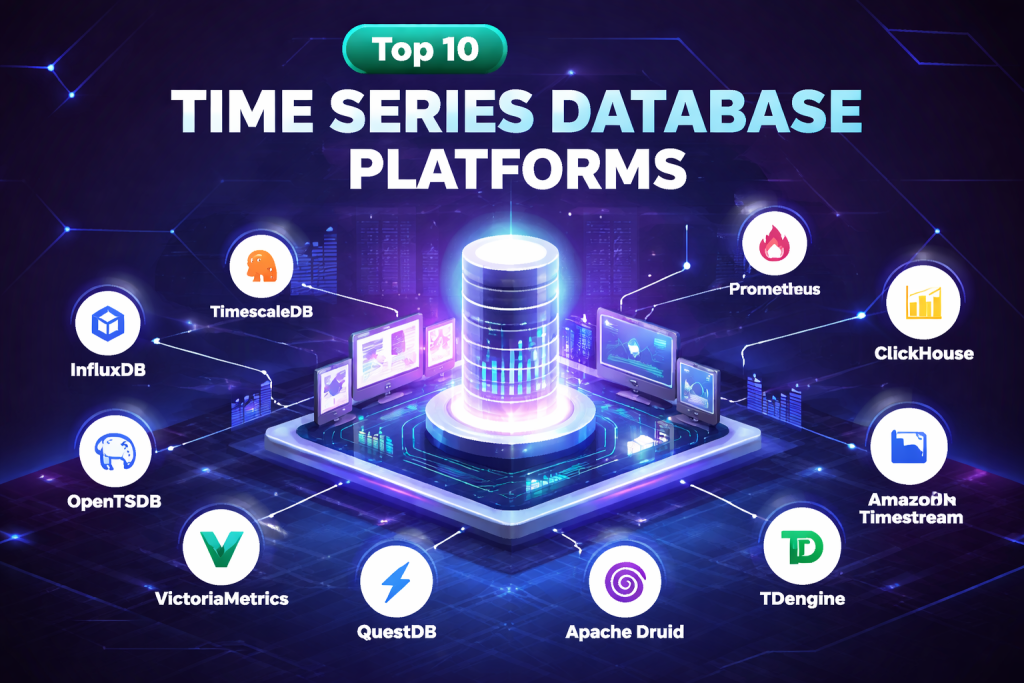
Top 10 Time Series Database Platforms Tools
1 — InfluxDB
Short description:
InfluxDB is a purpose-built time series database designed for high-speed ingestion and real-time analytics, widely used in monitoring, IoT, and observability use cases.
Key features:
- High-performance time series storage engine
- SQL-like query language optimized for time-based queries
- Native support for metrics, events, and traces
- Automatic data retention and downsampling
- Built-in compression for storage efficiency
- Integrations with monitoring and visualization tools
- Horizontal scalability options
Pros:
- Excellent performance for high write loads
- Strong ecosystem in observability and IoT
Cons:
- Advanced clustering features may require paid plans
- Learning curve for query language nuances
Security & compliance:
Encryption at rest and in transit, role-based access control, SSO support (enterprise), GDPR alignment.
Support & community:
Strong documentation, active open-source community, enterprise-grade support available.
2 — TimescaleDB
Short description:
TimescaleDB extends PostgreSQL to handle time series workloads, combining relational flexibility with time series performance.
Key features:
- Built on PostgreSQL with full SQL support
- Automatic partitioning via hypertables
- Advanced time-based aggregation functions
- Compression and data retention policies
- Works with existing PostgreSQL tools
- Supports joins, transactions, and schemas
- Scales vertically and horizontally
Pros:
- Familiar SQL environment
- Strong consistency and relational features
Cons:
- Scaling requires PostgreSQL expertise
- Performance tuning may be needed at scale
Security & compliance:
PostgreSQL-grade security, encryption, auditing, GDPR-ready, enterprise compliance options.
Support & community:
Excellent documentation, strong developer adoption, enterprise support available.
3 — Prometheus
Short description:
Prometheus is an open-source monitoring and alerting system designed for metrics-based time series data.
Key features:
- Pull-based metrics collection
- Powerful query language for metrics analysis
- Built-in alerting rules
- Efficient local storage
- Strong Kubernetes integration
- Label-based data model
- Real-time monitoring focus
Pros:
- De facto standard for cloud-native monitoring
- Simple and reliable architecture
Cons:
- Not designed for long-term historical storage
- Limited multi-node scalability
Security & compliance:
Basic authentication support, TLS encryption; compliance varies by deployment.
Support & community:
Very large open-source community, strong ecosystem, limited official enterprise support.
4 — OpenTSDB
Short description:
OpenTSDB is a distributed time series database built on top of a scalable storage layer, designed for massive datasets.
Key features:
- Horizontally scalable architecture
- REST APIs for data ingestion and queries
- Supports billions of data points
- Flexible tagging system
- Strong write performance
- Long-term data storage
- Open-source foundation
Pros:
- Handles very large datasets efficiently
- Proven in enterprise-scale environments
Cons:
- Operational complexity
- Requires underlying distributed storage setup
Security & compliance:
Depends on underlying infrastructure; encryption and access control vary.
Support & community:
Moderate community support, limited commercial backing.
5 — ClickHouse
Short description:
ClickHouse is a high-performance columnar database widely used for analytics, including time series and event data.
Key features:
- Columnar storage optimized for analytics
- Extremely fast query performance
- High compression rates
- Supports real-time data ingestion
- SQL-based querying
- Distributed cluster support
- Suitable for large-scale analytics
Pros:
- Exceptional query speed
- Cost-efficient at scale
Cons:
- Not purpose-built solely for time series
- Steeper learning curve for tuning
Security & compliance:
Role-based access control, encryption support; compliance depends on deployment.
Support & community:
Active open-source community, growing enterprise ecosystem.
6 — Amazon Timestream
Short description:
Amazon Timestream is a fully managed time series database optimized for IoT and operational applications.
Key features:
- Serverless and fully managed
- Automatic scaling and tiered storage
- Built-in time series functions
- Seamless integration with cloud services
- No infrastructure management
- Optimized cost model
- High availability
Pros:
- Minimal operational overhead
- Strong integration with cloud ecosystems
Cons:
- Vendor lock-in
- Limited flexibility compared to open systems
Security & compliance:
Encryption, IAM-based access control, SOC 2, ISO, GDPR alignment.
Support & community:
Enterprise-grade support, extensive documentation.
7 — VictoriaMetrics
Short description:
VictoriaMetrics is a high-performance, cost-effective time series database compatible with Prometheus.
Key features:
- High ingestion speed
- Efficient data compression
- Prometheus-compatible APIs
- Single-node and clustered deployments
- Long-term storage support
- Low resource usage
- Fast query execution
Pros:
- Lower storage and compute costs
- Simple deployment model
Cons:
- Smaller ecosystem compared to Prometheus
- Fewer built-in visualization options
Security & compliance:
TLS support, basic authentication; compliance varies by setup.
Support & community:
Active community, commercial support available.
8 — QuestDB
Short description:
QuestDB is an open-source time series database optimized for financial and high-frequency data.
Key features:
- High-speed ingestion using SQL
- Time-partitioned storage
- Low-latency queries
- Supports ANSI SQL
- Built-in REST and line protocol ingestion
- Focus on real-time analytics
- Open-source core
Pros:
- Excellent performance for financial data
- SQL-based querying
Cons:
- Smaller community
- Limited enterprise tooling
Security & compliance:
Basic security features; enterprise compliance varies.
Support & community:
Growing open-source community, improving documentation.
9 — Apache Druid
Short description:
Apache Druid is a real-time analytics database optimized for time-based event data and dashboards.
Key features:
- Real-time and batch ingestion
- Column-oriented storage
- Sub-second query performance
- Built-in indexing
- Time-based partitioning
- Horizontal scalability
- Strong analytics focus
Pros:
- Excellent for interactive analytics
- Scales well for large datasets
Cons:
- Complex architecture
- Operational overhead
Security & compliance:
Role-based access control, encryption support; compliance depends on configuration.
Support & community:
Strong open-source community, enterprise support options available.
10 — TDengine
Short description:
TDengine is a purpose-built time series database optimized for IoT and industrial data.
Key features:
- High ingestion throughput
- Native support for time-based queries
- Built-in data compression
- SQL-like query language
- Distributed architecture
- Edge and cloud deployment support
- Optimized for sensor data
Pros:
- Strong performance for IoT workloads
- Efficient storage model
Cons:
- Less mature ecosystem
- Limited third-party integrations
Security & compliance:
Encryption and authentication support; compliance varies.
Support & community:
Growing community, commercial support available.
Comparison Table
| Tool Name | Best For | Platform(s) Supported | Standout Feature | Rating |
|---|---|---|---|---|
| InfluxDB | Monitoring & IoT | Linux, Cloud, Containers | High ingestion speed | N/A |
| TimescaleDB | SQL-based analytics | Linux, Cloud | PostgreSQL compatibility | N/A |
| Prometheus | Cloud-native monitoring | Linux, Kubernetes | Metrics & alerting | N/A |
| OpenTSDB | Large-scale metrics | Distributed systems | Massive scalability | N/A |
| ClickHouse | Analytics workloads | Linux, Cloud | Fast analytical queries | N/A |
| Amazon Timestream | Managed time series | Cloud | Serverless architecture | N/A |
| VictoriaMetrics | Cost-efficient metrics | Linux, Cloud | High compression | N/A |
| QuestDB | Financial data | Linux, Cloud | Low-latency SQL | N/A |
| Apache Druid | Real-time analytics | Linux, Cloud | Sub-second queries | N/A |
| TDengine | IoT & sensors | Linux, Edge, Cloud | IoT optimization | N/A |
Evaluation & Scoring of Time Series Database Platforms
| Tool | Core Features (25%) | Ease of Use (15%) | Integrations (15%) | Security (10%) | Performance (10%) | Support (10%) | Price/Value (15%) | Total Score |
|---|---|---|---|---|---|---|---|---|
| InfluxDB | 23 | 13 | 14 | 9 | 9 | 8 | 12 | 88 |
| TimescaleDB | 24 | 14 | 14 | 9 | 9 | 9 | 13 | 92 |
| Prometheus | 22 | 13 | 15 | 7 | 8 | 9 | 15 | 89 |
| ClickHouse | 23 | 11 | 13 | 8 | 10 | 8 | 14 | 87 |
Which Time Series Database Platforms Tool Is Right for You?
- Solo users: Look for simplicity, low cost, and minimal setup
- SMBs: Balance performance, ease of use, and cost
- Mid-market: Focus on scalability and integrations
- Enterprise: Prioritize security, compliance, and support
Budget-conscious teams may prefer open-source tools, while premium solutions offer managed services and enterprise features. Choose based on scale, data volume, compliance needs, and team expertise.
Frequently Asked Questions (FAQs)
1. What is a time series database?
A database optimized for storing and querying time-stamped data efficiently.
2. How is it different from a relational database?
It is optimized for time-based writes and queries rather than transactions.
3. Are time series databases scalable?
Yes, most are designed for horizontal and vertical scaling.
4. Are they suitable for IoT data?
Yes, they are ideal for high-frequency sensor data.
5. Do they support SQL?
Many platforms offer SQL or SQL-like query languages.
6. Are they expensive?
Costs vary; open-source options are free, managed services cost more.
7. Can they handle real-time analytics?
Yes, many are optimized for real-time ingestion and querying.
8. What about long-term storage?
Most support retention policies and compression.
9. Are they secure?
Security features vary by platform and deployment.
10. Can they integrate with visualization tools?
Yes, most integrate well with dashboards and analytics tools.
Conclusion
Time Series Database Platforms are essential for organizations dealing with continuous, time-stamped data. They offer unmatched performance, scalability, and analytical capabilities compared to traditional databases. When choosing a platform, focus on data volume, query needs, operational complexity, security, and budget.
There is no single “best” time series database for everyone. The right choice depends on your specific use case, technical expertise, and long-term goals. By aligning tool capabilities with your requirements, you can unlock the full value of time series data and drive better decisions across your organization.

Find Trusted Cardiac Hospitals
Compare heart hospitals by city and services — all in one place.
Explore Hospitals
