Introduction
Trade finance platforms are specialized digital solutions designed to support, automate, and manage financial processes involved in domestic and international trade. These platforms help businesses, banks, and financial institutions manage instruments such as letters of credit, bank guarantees, supply chain finance, invoice discounting, and risk mitigation in a more transparent and efficient way.
In today’s globalized economy, trade transactions are becoming more complex due to multi-country regulations, currency risks, compliance requirements, and the need for faster settlements. Manual, paper-based trade finance processes are slow, error-prone, and expensive. Trade finance platforms solve these challenges by digitizing workflows, improving visibility, reducing operational risk, and ensuring regulatory compliance.
Real-world use cases include exporters securing payments, importers optimizing working capital, banks managing trade portfolios, and corporates gaining real-time insight into cash flow and counterparty risk.
When choosing a trade finance platform, users should evaluate functional coverage, ease of use, integration capabilities, security, compliance readiness, scalability, and overall value for money.
Best for:
Trade finance platforms are best suited for banks, financial institutions, multinational corporations, exporters, importers, logistics-heavy businesses, and supply chain–driven enterprises that manage high transaction volumes and cross-border trade.
Not ideal for:
These tools may not be suitable for very small businesses, local-only traders, or organizations with minimal trade activity, where basic accounting or invoicing tools may be sufficient.
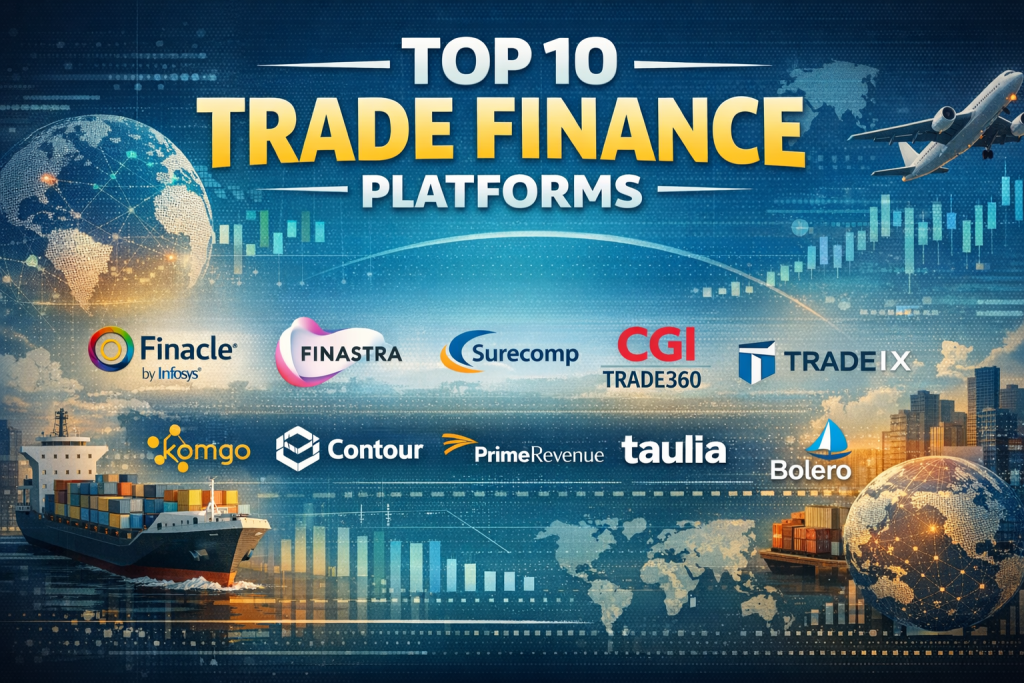
Top 10 Trade Finance Platforms Tools
1 — Finacle Trade Finance
Short description:
A comprehensive trade finance solution used by global banks to manage end-to-end trade lifecycle, from issuance to settlement.
Key features:
- End-to-end trade finance processing
- Letter of credit and guarantee management
- Multi-currency and multi-country support
- Workflow automation and approvals
- Regulatory and compliance reporting
- Integration with core banking systems
Pros:
- Extremely robust and scalable
- Trusted by tier-1 banks
Cons:
- Complex implementation
- High total cost of ownership
Security & compliance:
Strong encryption, role-based access, audit trails, regulatory compliance support
Support & community:
Enterprise-grade support, detailed documentation, professional onboarding
2 — Finastra Trade Innovation
Short description:
A modern, cloud-enabled trade finance platform designed for banks and financial institutions seeking agility and automation.
Key features:
- Digital trade finance workflows
- Letter of credit and collections management
- API-first architecture
- Cloud deployment options
- Real-time tracking and reporting
- Compliance and risk controls
Pros:
- Strong cloud capabilities
- Modular and flexible design
Cons:
- Requires skilled technical team
- Pricing not transparent
Security & compliance:
ISO-aligned security controls, encryption, audit logging
Support & community:
Strong enterprise support and implementation partners
3 — Surecomp
Short description:
A specialized trade finance software provider focused on digital trade processing and operational efficiency.
Key features:
- Trade finance lifecycle automation
- Letters of credit and guarantees
- Trade compliance checks
- Reporting and analytics
- Integration with banking platforms
- Scalable deployment models
Pros:
- Deep trade finance expertise
- Mature product suite
Cons:
- UI feels dated for some users
- Customization can take time
Security & compliance:
Enterprise-grade security, audit trails, compliance controls
Support & community:
Well-established support structure and global user base
4 — CGI Trade360
Short description:
A highly configurable trade finance platform for banks managing complex trade products and regulatory requirements.
Key features:
- End-to-end trade processing
- Strong compliance and risk modules
- Customizable workflows
- Multi-entity support
- Advanced reporting
- Core banking integrations
Pros:
- Highly configurable
- Strong compliance focus
Cons:
- Steep learning curve
- Longer deployment cycles
Security & compliance:
Robust access controls, audit logs, regulatory reporting
Support & community:
Enterprise consulting support and training programs
5 — TradeIX
Short description:
A blockchain-based trade finance platform focusing on transparency, traceability, and supply chain finance.
Key features:
- Distributed ledger technology
- Supply chain finance enablement
- Real-time data sharing
- Risk reduction through transparency
- Smart contract capabilities
Pros:
- High transparency
- Strong innovation focus
Cons:
- Blockchain adoption challenges
- Limited traditional banking features
Security & compliance:
Cryptographic security, distributed ledger controls
Support & community:
Smaller but active innovation-focused community
6 — Komgo
Short description:
A digital trade finance network connecting banks and corporates to streamline commodity trade finance.
Key features:
- Digital KYC sharing
- Secure document exchange
- Network-based trade processing
- Reduced duplication of effort
- Commodity trade focus
Pros:
- Strong network effects
- Reduces operational friction
Cons:
- Industry-specific focus
- Dependent on network adoption
Security & compliance:
Strong encryption, controlled data sharing, compliance-ready
Support & community:
Consortium-driven support and onboarding
7 — Contour
Short description:
A digital platform designed to streamline and digitize letters of credit between banks and corporates.
Key features:
- Digital LC issuance and processing
- Secure document handling
- Workflow transparency
- Reduced processing times
- Bank-to-bank collaboration
Pros:
- Faster LC cycles
- Reduced paperwork
Cons:
- Narrow functional scope
- Ecosystem-dependent
Security & compliance:
Enterprise security, encryption, audit logging
Support & community:
Consortium-based support model
8 — PrimeRevenue
Short description:
A leading supply chain finance platform helping buyers and suppliers optimize working capital.
Key features:
- Dynamic discounting
- Supplier onboarding tools
- Global payment support
- Analytics and reporting
- ERP integrations
Pros:
- Strong supplier adoption
- Proven ROI for enterprises
Cons:
- Focused mainly on SCF
- Pricing geared toward large enterprises
Security & compliance:
SOC-aligned controls, encryption, compliance reporting
Support & community:
Strong enterprise customer support
9 — Taulia
Short description:
A working capital and trade finance platform focused on early payments and supplier financing.
Key features:
- Early payment programs
- Supplier self-service portal
- ERP-native integrations
- Analytics dashboards
- Multi-funder support
Pros:
- Easy supplier onboarding
- Strong analytics
Cons:
- Limited traditional trade instruments
- Best suited for large buyers
Security & compliance:
Enterprise-grade security and compliance frameworks
Support & community:
Extensive documentation and enterprise support
10 — Bolero
Short description:
A long-standing digital trade documentation platform enabling secure exchange of trade documents.
Key features:
- Electronic bills of lading
- Secure document exchange
- Title transfer capabilities
- Legal framework support
- Trade digitization tools
Pros:
- Industry-recognized standards
- Strong legal backing
Cons:
- Limited analytics
- UI modernization needed
Security & compliance:
Strong encryption, legal compliance frameworks
Support & community:
Established user community and enterprise support
Comparison Table
| Tool Name | Best For | Platform(s) Supported | Standout Feature | Rating |
|---|---|---|---|---|
| Finacle Trade Finance | Tier-1 banks | Web / Enterprise | End-to-end banking coverage | N/A |
| Finastra Trade Innovation | Digital-first banks | Cloud / Web | API-first architecture | N/A |
| Surecomp | Global trade banks | Web / On-prem | Deep trade specialization | N/A |
| CGI Trade360 | Regulated institutions | Enterprise | Compliance configurability | N/A |
| TradeIX | Innovative finance teams | Cloud | Blockchain transparency | N/A |
| Komgo | Commodity trade | Web | Network-based KYC | N/A |
| Contour | LC-heavy banks | Web | Fast LC digitization | N/A |
| PrimeRevenue | Large enterprises | Cloud | Supply chain finance | N/A |
| Taulia | Buyer-led SCF | Cloud | Working capital optimization | N/A |
| Bolero | Document-heavy trade | Web | Digital title transfer | N/A |
Evaluation & Scoring of Trade Finance Platforms
| Tool | Core Features (25%) | Ease of Use (15%) | Integrations (15%) | Security (10%) | Performance (10%) | Support (10%) | Price/Value (15%) | Total |
|---|---|---|---|---|---|---|---|---|
| Finacle | 23 | 10 | 14 | 9 | 9 | 9 | 10 | 84 |
| Finastra | 22 | 12 | 14 | 9 | 9 | 8 | 11 | 85 |
| Surecomp | 21 | 11 | 13 | 9 | 8 | 8 | 11 | 81 |
| CGI Trade360 | 21 | 10 | 13 | 9 | 8 | 8 | 10 | 79 |
| TradeIX | 18 | 12 | 11 | 8 | 8 | 7 | 12 | 76 |
Which Trade Finance Platforms Tool Is Right for You?
- Solo users / small firms: Lightweight SCF or documentation-focused tools
- SMBs: Platforms offering modular pricing and ease of onboarding
- Mid-market companies: Balance between automation and integration depth
- Enterprises & banks: Full-suite platforms with compliance and scalability
Budget-conscious users should prioritize modular or cloud-native tools, while premium buyers may benefit from enterprise-grade suites.
If integration and scalability are critical, API-first platforms are ideal.
For regulated environments, security certifications and audit readiness are non-negotiable.
Frequently Asked Questions (FAQs)
- What is a trade finance platform?
A digital system that manages financing, documentation, and risk in trade transactions. - Who uses trade finance platforms?
Banks, exporters, importers, corporates, and supply chain partners. - Are trade finance platforms cloud-based?
Many modern solutions offer cloud or hybrid deployments. - Do these platforms replace banks?
No, they support and enhance banking trade operations. - How long does implementation take?
From weeks for cloud tools to months for enterprise platforms. - Are they secure?
Most offer enterprise-grade security, encryption, and audit trails. - Can they integrate with ERP systems?
Yes, many provide ERP and core banking integrations. - Are blockchain platforms better?
They improve transparency but may not suit all use cases. - What is the biggest benefit?
Reduced risk, faster processing, and better cash flow visibility. - What is a common mistake when choosing a platform?
Overbuying features without aligning to actual trade volume.
Conclusion
Trade finance platforms play a critical role in modern global commerce by reducing risk, improving transparency, and accelerating trade operations. The right solution depends on transaction complexity, regulatory needs, integration requirements, and budget.
There is no single “best” platform for everyone. Banks may prioritize depth and compliance, while corporates may focus on working capital optimization and ease of use. By clearly defining your needs and evaluating platforms against them, you can choose a solution that delivers long-term value and operational confidence.

Find Trusted Cardiac Hospitals
Compare heart hospitals by city and services — all in one place.
Explore Hospitals