
Introduction
Treasury Management Systems (TMS) are specialized software platforms designed to help organizations manage their cash, liquidity, financial risk, and treasury operations in a structured, secure, and efficient way. At their core, these systems give finance teams real-time visibility into cash positions, bank accounts, payments, debt, investments, and financial exposures across the organization.
In today’s business environment—where companies operate across multiple banks, currencies, and geographies—manual spreadsheets and fragmented tools are no longer sufficient. A robust Treasury Management System helps reduce financial risk, improve decision-making, automate repetitive tasks, and ensure compliance with internal controls and regulatory requirements.
Common real-world use cases include daily cash positioning, forecasting short- and long-term liquidity, managing debt and investments, handling intercompany loans, executing payments, monitoring FX and interest rate risk, and supporting audits with strong reporting and controls.
When choosing a Treasury Management System, users should evaluate cash management depth, forecasting accuracy, bank connectivity, automation capabilities, integration with ERP systems, security standards, scalability, and overall usability.
Best for:
Treasury Management Systems are ideal for mid-market and enterprise organizations, treasury teams, CFOs, finance controllers, multinational companies, capital-intensive industries, and organizations with complex cash flows, multiple bank relationships, or regulatory obligations.
Not ideal for:
Very small businesses, solo entrepreneurs, or companies with simple cash flows and limited banking complexity may find a full TMS excessive. In such cases, basic accounting software or lightweight cash management tools may be more practical and cost-effective.
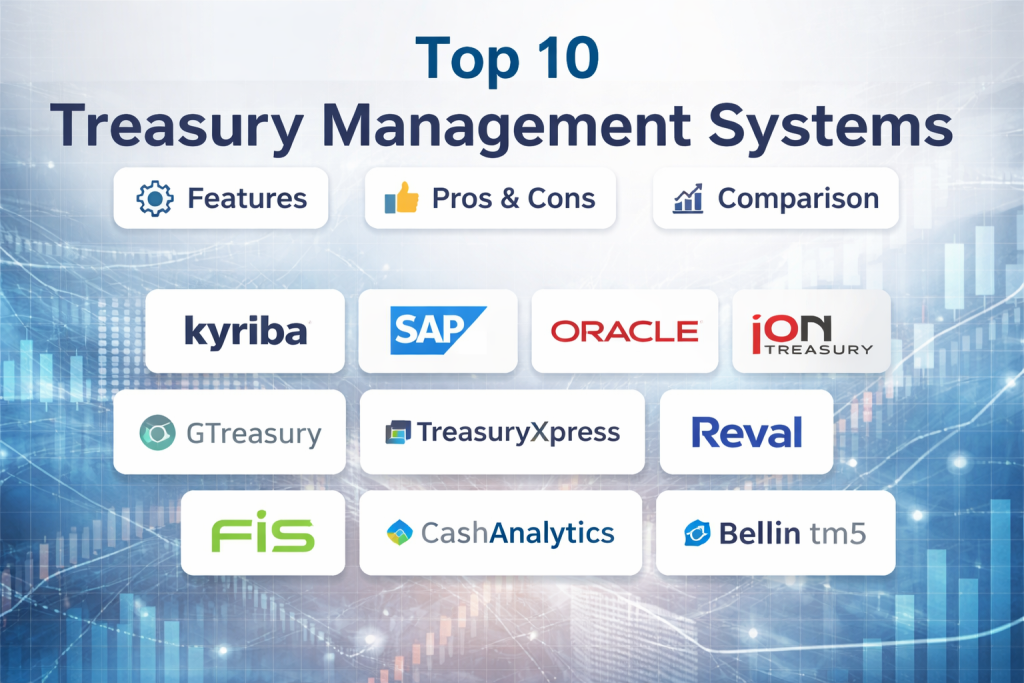
Top 10 Treasury Management Systems Tools
1 — Kyriba
Short description:
Kyriba is a market-leading cloud-based Treasury Management System designed for global enterprises that require advanced cash, liquidity, and risk management capabilities.
Key features:
- Global cash visibility and real-time cash positioning
- Advanced liquidity forecasting and scenario modeling
- FX risk management and hedging workflows
- Bank connectivity and payment automation
- Debt, investment, and intercompany loan management
- Fraud detection and treasury controls
Pros:
- Very strong cash forecasting and risk management tools
- Scales well for multinational organizations
- Mature platform with enterprise-grade controls
Cons:
- Implementation can be complex and time-consuming
- Higher cost compared to mid-market tools
Security & compliance:
SSO, encryption at rest and in transit, audit logs, SOC 2, GDPR compliance.
Support & community:
Dedicated enterprise support, structured onboarding, extensive documentation, strong professional services ecosystem.
2 — SAP Treasury and Risk Management
Short description:
SAP Treasury and Risk Management is an integrated treasury solution built into the SAP ecosystem, best suited for organizations already using SAP ERP.
Key features:
- Cash and liquidity management tightly integrated with SAP
- Treasury operations and transaction management
- Financial risk management (FX, interest rates, commodities)
- In-house banking and intercompany settlements
- Compliance and audit-ready reporting
- Centralized treasury governance
Pros:
- Deep integration with SAP ERP environments
- Highly configurable for complex enterprises
- Strong compliance and reporting capabilities
Cons:
- Steep learning curve
- Heavy implementation and reliance on SAP expertise
Security & compliance:
Enterprise-grade security, role-based access, audit trails, GDPR and ISO-aligned controls.
Support & community:
Global SAP support network, extensive partner ecosystem, large user community.
3 — Oracle Treasury Management (part of Oracle Cloud ERP)
Short description:
Oracle Treasury Management provides embedded treasury functionality within Oracle Cloud ERP for organizations seeking unified finance operations.
Key features:
- Real-time cash visibility and forecasting
- Bank statement reconciliation
- Payments and cash pooling support
- Risk management and exposure tracking
- Integration with Oracle financial modules
- Automated accounting entries
Pros:
- Seamless experience for Oracle ERP users
- Strong automation and reporting
- Cloud-native architecture
Cons:
- Limited flexibility outside the Oracle ecosystem
- Feature depth may lag best-of-breed TMS tools
Security & compliance:
Strong encryption, access controls, audit logs, GDPR and SOC-aligned standards.
Support & community:
Oracle enterprise support, detailed documentation, active customer base.
4 — ION Treasury (Wallstreet Suite)
Short description:
ION Treasury offers advanced treasury and risk solutions tailored for large and complex financial operations.
Key features:
- Cash and liquidity management
- Sophisticated risk analytics and derivatives handling
- Debt and investment management
- Multi-entity and multi-currency support
- Customizable workflows and reporting
- Strong audit and compliance controls
Pros:
- Extremely powerful for complex treasury environments
- Strong risk management depth
- Highly configurable
Cons:
- Less intuitive user interface
- Requires significant training and setup
Security & compliance:
Enterprise security controls, encryption, detailed audit trails, regulatory-ready features.
Support & community:
Dedicated account teams, professional services, enterprise-focused support.
5 — GTreasury
Short description:
GTreasury is a modern cloud-based Treasury Management System focused on usability, analytics, and scalability.
Key features:
- Cash positioning and forecasting
- Payments and bank connectivity
- Debt and investment management
- Treasury analytics and dashboards
- ERP integrations
- Automated controls and workflows
Pros:
- User-friendly interface compared to traditional TMS
- Strong analytics and reporting
- Flexible for mid-market and enterprise
Cons:
- Some advanced features require additional modules
- Pricing may increase with scale
Security & compliance:
SOC 2, encryption, role-based access, audit logs.
Support & community:
Responsive customer support, onboarding assistance, growing user community.
6 — TreasuryXpress
Short description:
TreasuryXpress is a configurable SaaS treasury platform suitable for companies transitioning from spreadsheets to a structured TMS.
Key features:
- Cash management and forecasting
- Bank connectivity and payment processing
- FX exposure tracking
- Intercompany loan management
- Flexible configuration options
- Reporting and dashboards
Pros:
- Faster implementation than large enterprise systems
- Good balance of features and usability
- Competitive pricing
Cons:
- Limited depth for very large global enterprises
- Smaller ecosystem compared to major vendors
Security & compliance:
Encryption, access controls, GDPR-aligned practices.
Support & community:
Direct vendor support, guided onboarding, solid documentation.
7 — Reval (now part of ION)
Short description:
Reval is a treasury and risk management solution designed for mid-to-large enterprises with strong forecasting and risk needs.
Key features:
- Cash and liquidity forecasting
- FX and interest rate risk management
- Hedge accounting support
- Bank connectivity
- Scenario analysis
- Audit-ready reporting
Pros:
- Strong forecasting and hedge accounting tools
- Cloud-based delivery
- Scales well for growing organizations
Cons:
- Interface can feel dated
- Advanced customization may require consultants
Security & compliance:
SSO, encryption, audit logs, regulatory reporting support.
Support & community:
Enterprise support model, professional services, training resources.
8 — FIS Treasury and Risk Manager
Short description:
FIS Treasury and Risk Manager is built for financial institutions and large corporates with complex treasury operations.
Key features:
- Enterprise cash and liquidity management
- Advanced risk modeling
- Payments and bank integration
- Regulatory compliance support
- Debt and investment tracking
- High-volume transaction processing
Pros:
- Designed for high complexity and scale
- Strong compliance and regulatory features
- Proven reliability
Cons:
- Less modern user experience
- High total cost of ownership
Security & compliance:
Strong financial-grade security, regulatory compliance frameworks, audit logs.
Support & community:
Enterprise-level support, financial industry expertise, long-standing user base.
9 — CashAnalytics
Short description:
CashAnalytics focuses primarily on cash forecasting and liquidity planning for treasury teams.
Key features:
- Short- and long-term cash forecasting
- Scenario planning and sensitivity analysis
- Integration with ERP and spreadsheets
- Forecast accuracy tracking
- Visual dashboards
- Collaborative workflows
Pros:
- Best-in-class forecasting accuracy
- Easy to adopt alongside existing systems
- Clear visual insights
Cons:
- Limited full TMS functionality
- Not a replacement for end-to-end treasury platforms
Security & compliance:
Standard SaaS security, encryption, access controls.
Support & community:
Responsive support, focused onboarding, smaller but engaged community.
10 — Bellin tm5
Short description:
Bellin tm5 is a modular treasury platform designed for mid-market and enterprise treasury teams.
Key features:
- Cash and liquidity management
- Payments and bank communication
- Risk management modules
- In-house banking support
- Modular architecture
- Reporting and analytics
Pros:
- Flexible modular design
- Suitable for international organizations
- Good balance of depth and usability
Cons:
- Some modules require separate licensing
- Interface may feel less modern
Security & compliance:
Encryption, role-based access, audit trails, GDPR alignment.
Support & community:
Regional support teams, documentation, implementation partners.
Comparison Table
| Tool Name | Best For | Platform(s) Supported | Standout Feature | Rating |
|---|---|---|---|---|
| Kyriba | Global enterprises | Cloud (Web) | Advanced liquidity forecasting | N/A |
| SAP Treasury | SAP-centric enterprises | Cloud / On-prem | Deep ERP integration | N/A |
| Oracle Treasury | Oracle ERP users | Cloud | Unified finance operations | N/A |
| ION Treasury | Complex treasury operations | Cloud / Hybrid | Advanced risk analytics | N/A |
| GTreasury | Mid-market to enterprise | Cloud | Usability + analytics | N/A |
| TreasuryXpress | Growing treasury teams | Cloud | Fast implementation | N/A |
| Reval | Risk-focused treasury | Cloud | Hedge accounting | N/A |
| FIS TRM | Financial institutions | Cloud / On-prem | Regulatory depth | N/A |
| CashAnalytics | Forecasting-focused teams | Cloud | Forecast accuracy | N/A |
| Bellin tm5 | Modular treasury needs | Cloud | Modular flexibility | N/A |
Evaluation & Scoring of Treasury Management Systems
| Evaluation Criteria | Weight | Description |
|---|---|---|
| Core features | 25% | Cash, liquidity, payments, risk, and reporting depth |
| Ease of use | 15% | User interface, learning curve, daily usability |
| Integrations & ecosystem | 15% | ERP, bank connectivity, APIs |
| Security & compliance | 10% | Controls, auditability, standards |
| Performance & reliability | 10% | Stability, uptime, scalability |
| Support & community | 10% | Vendor support, documentation |
| Price / value | 15% | Cost vs delivered value |
Which Treasury Management Systems Tool Is Right for You?
Choosing the right Treasury Management System depends on your organization’s size, complexity, and strategic priorities.
- Solo users / SMBs: Lightweight tools or accounting software with cash tracking may be sufficient. Full TMS platforms may be excessive.
- Mid-market companies: Look for cloud-based TMS solutions with strong cash forecasting, reasonable pricing, and faster implementation.
- Enterprises: Prioritize scalability, security, bank connectivity, risk management, and compliance—even if implementation is heavier.
Budget-conscious vs premium:
Mid-market tools often provide excellent value, while enterprise systems justify higher costs through depth and control.
Feature depth vs ease of use:
Advanced features often come with complexity. Balance power with usability based on team skills.
Integration & scalability:
ERP and bank integrations are critical for long-term success.
Security & compliance:
Highly regulated industries should prioritize auditability and compliance certifications.
Frequently Asked Questions (FAQs)
1. What is a Treasury Management System?
A Treasury Management System is software that helps manage cash, liquidity, payments, risk, and treasury operations centrally.
2. Who typically uses TMS software?
Treasury teams, CFOs, finance managers, and controllers in mid-to-large organizations.
3. How long does TMS implementation take?
It can range from a few weeks for SaaS tools to several months for enterprise platforms.
4. Is a TMS necessary if we already have an ERP?
ERPs handle accounting well, but TMS tools offer deeper cash and risk management.
5. Are Treasury Management Systems secure?
Most reputable vendors offer strong encryption, access controls, and audit logs.
6. Can TMS tools handle multiple currencies?
Yes, multi-currency support is a core feature of most TMS platforms.
7. Do small businesses need a TMS?
Usually not, unless they manage complex cash flows or multiple bank accounts.
8. How do TMS tools improve forecasting?
They consolidate data from multiple sources and apply scenario modeling.
9. What is bank connectivity in TMS?
It allows automated retrieval of bank statements and execution of payments.
10. What is the biggest mistake when choosing a TMS?
Overbuying complexity without considering usability and actual needs.
Conclusion
Treasury Management Systems play a critical role in modern financial operations by providing visibility, control, and strategic insight into cash and risk. The right system can transform treasury from a reactive function into a proactive, value-driving team.
There is no single “best” Treasury Management System for everyone. The ideal choice depends on your organization’s size, complexity, industry, budget, and long-term goals. By carefully evaluating features, usability, integrations, security, and support, finance leaders can select a solution that truly aligns with their treasury strategy and delivers lasting value.

Find Trusted Cardiac Hospitals
Compare heart hospitals by city and services — all in one place.
Explore Hospitals
This post is useful because treasury work is all about visibility and control—knowing where cash sits, what payments are coming, and what risks can hit liquidity. I liked that the comparison highlights practical features like cash positioning, bank connectivity, payment workflows, forecasting, FX management, and audit-ready controls. The pros and cons section also helps because some treasury management systems are designed for mid-size firms that need core cash reporting, while others are built for complex global setups with many banks, entities, and currencies. A smart tip is to check how strong the implementation support and bank integrations are, because even the best tool fails if data feeds are unstable. Testing with one bank account and one payment flow first can reduce rollout pain.