
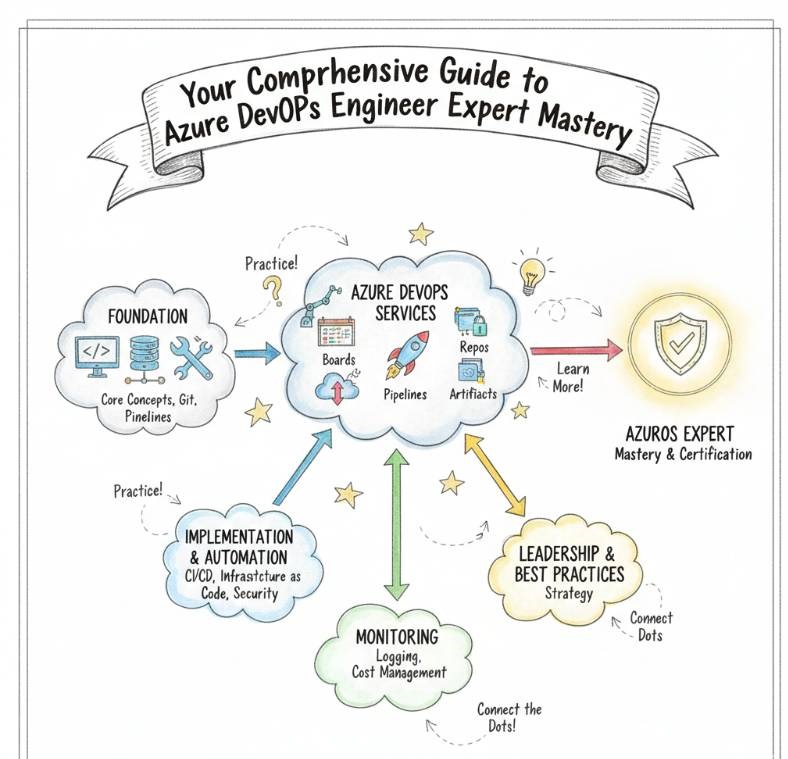
The landscape of software development is constantly shifting. Gone are the days when writing code and managing servers were two completely different jobs. Today, the most successful engineering teams are those that bridge this gap. This shift has placed the Azure DevOps Engineer Expert at the center of modern technology. For engineers and managers alike, understanding the depth of the Azure DevOps Engineer Expert (AZ-400) Training is no longer optional—it is a strategic necessity.
Whether you are based in India or working for a global enterprise, the demand for professionals who can design and implement robust delivery strategies is reaching new heights. This guide serves as a technical manual and a career roadmap. It explores how to master the tools, processes, and people-focused strategies required to lead high-performing teams in a cloud-first world.
Master Certification Overview
To navigate the complex world of certifications, it is helpful to see exactly where the AZ-400 stands. This certification is an expert-level credential, meaning it is designed for those who have already mastered the basics of cloud administration or development.
| Track | Level | Who it’s for | Prerequisites | Skills Covered | Recommended Order |
| DevOps | Expert | Working Engineers & Managers | AZ-104 or AZ-204 | CI/CD, Instrumentation, Site Reliability, Security | Take after Associate Level |
Azure DevOps Engineer Expert (AZ-400) Training
What it is
The Azure DevOps Engineer Expert (AZ-400) program is the pinnacle of Microsoft’s DevOps learning path. It focuses on the ability to design and implement strategies for collaboration, code, infrastructure, source control, security, compliance, continuous integration, testing, delivery, and monitoring. This training is not just about learning a specific tool like Azure Pipelines; it is about learning how to use the entire Microsoft Azure ecosystem—including GitHub—to deliver continuous value to users. It teaches you how to automate the “boring” parts of software so your team can focus on innovation.
Who should take it
This training is specifically tailored for working software engineers, system administrators, and technical managers. If you are already managing code in repositories or deploying applications to the cloud, this program will help you formalize your knowledge and move into a leadership role. It is ideal for those who want to transition from being a “builder” to being an “architect of delivery.” Managers who oversee engineering departments will find this training invaluable for understanding how to optimize their team’s speed and quality.
Skills you’ll gain
Mastering this curriculum provides a set of skills that are highly valued in the global market. You will move from understanding “how” to do things to understanding “why” they should be done in a certain way.
The training covers a broad range of technical and strategic domains:
- Instrumentation Strategy: You will learn how to set up logging and monitoring that doesn’t just show data but provides actual insights. This includes configuring crash report integration and directing logs to the right storage solutions.
- Site Reliability Engineering (SRE): You will gain the ability to develop an actionable alerting strategy and automate the inspection of health indicators to ensure your systems remain stable under pressure.
- Security and Compliance: A major focus is placed on “shifting left.” This means you will learn to integrate security checks, manage secrets, and handle sensitive data within your automation scripts.
- Source Control Management: You will master complex Git workflows, including branching strategies that support large-scale enterprise development without causing “merge hell.”
- Continuous Integration and Delivery: You will design pipelines that not only build and test code but also manage releases across multiple environments with automated gates and approvals.
Real-world projects you should be able to do
The true value of training lies in application. After completing this program, you should be capable of leading complex projects that directly impact a company’s bottom line.
A few examples of what you can achieve include:
- Designing an Enterprise CI/CD Pipeline: You can build a system where code is automatically tested, scanned for security vulnerabilities, and deployed to a staging environment the moment a developer submits a pull request.
- Implementing Infrastructure as Code (IaC): You will be able to write scripts (using ARM templates, Bicep, or Terraform) that spin up an entire data center in the cloud in minutes, ensuring that your Dev, Test, and Prod environments are identical.
- Automated Governance and Compliance: You can set up systems that automatically check if every resource in your cloud environment follows company policies, such as staying within a specific region or keeping costs under control.
- Disaster Recovery and High Availability: You will have the skills to design systems that can automatically failover to a different global region if a major outage occurs, ensuring zero downtime for users.
Preparation plan
Success in the AZ-400 requires a disciplined approach. Depending on your experience level, you can follow one of these structured paths:
- 7–14 Days (The Expert Sprint): If you are already working with Azure Pipelines and GitHub daily, use this time to fill in the gaps. Focus heavily on the “Security” and “Instrumentation” modules, as these are often overlooked in daily work. Spend your final days taking practice exams to get used to the question format.
- 30 Days (The Professional Path): This is the most common path for working engineers. Dedicate 10-15 hours a week. Spend the first two weeks focusing on CI/CD and Source Control. Use the third week for Infrastructure and Security, and the final week for SRE and Monitoring. Perform at least one hands-on lab for every module.
- 60 Days (The Comprehensive Journey): If you are new to some of the advanced Azure services, take your time. Spend the first 20 days mastering the prerequisite material (AZ-104 or AZ-204). Spend the next 30 days diving deep into the AZ-400 curriculum, and use the final 10 days for intensive review and mock testing.
Common mistakes
In my years of observing technical teams, I have seen many talented engineers fail the exam or struggle in projects because of a few common errors:
- Focusing Only on Azure DevOps: Many forget that GitHub is a massive part of the Microsoft ecosystem. You must be comfortable with GitHub Repos and GitHub Actions to be an expert.
- Neglecting the “Process” Side: DevOps is as much about people as it is about tools. Don’t skip the sections on Agile, Kanban, and team communication strategies.
- Lack of Hands-On Practice: Reading the documentation is not enough. You must build, break, and fix pipelines to understand the nuances of how these systems work in the real world.
- Underestimating Security: Security is no longer a separate phase; it is part of the code. Many candidates lose marks by not knowing how to manage service connections and vault secrets properly.
Best Next Certification After This
Once you have achieved the Azure DevOps Engineer Expert status, you should look to specialize or move into higher-level leadership. Based on the industry trends, these are the most logical next steps:
- DevSecOps Certified Professional (DSOCP): This allows you to dive even deeper into the world of automated security, making you an invaluable asset in an era of increasing cyber threats.
- SRE Certified Professional (SRECP): This is the perfect path if you enjoy the challenge of keeping massive, complex systems running smoothly and at high scale.
- Azure Solutions Architect Expert (AZ-305): If you want to move from implementing pipelines to designing the entire cloud architecture for an enterprise.
Choose Your Path: 6 Specialized Learning Tracks
The beauty of DevOps is that it branches into several specialized fields. Depending on your interest, you can follow one of these tracks after your initial training:
- DevOps Path: Focuses on the core lifecycle of software development, from planning to delivery, ensuring speed and quality.
- DevSecOps Path: Focuses on the “Security as Code” movement, ensuring that every piece of automation is secure by design.
- SRE Path: Focuses on the engineering of reliability. It combines software development skills with operational tasks to build ultra-stable systems.
- AIOps / MLOps Path: This is where operations meets Artificial Intelligence. It focuses on automating the deployment and monitoring of machine learning models.
- DataOps Path: This track applies DevOps principles to data management, ensuring that data pipelines are just as fast and reliable as software pipelines.
- FinOps Path: A crucial new field focused on the financial management of the cloud, ensuring that every dollar spent on cloud resources provides maximum value.
Role → Recommended Certifications Mapping
Choosing the right learning path depends on your current role and your long-term career goals. Here is a mapping to help you decide:
- DevOps Engineer: AZ-400 + Docker/Kubernetes Certification + Terraform Associate.
- SRE (Site Reliability Engineer): AZ-400 + SRE Certified Professional + Advanced Monitoring tools.
- Platform Engineer: AZ-400 + Certified Kubernetes Administrator (CKA) + Cloud Networking.
- Cloud Engineer: AZ-104 (Associate) + AZ-400 + Security Specialty.
- Security Engineer: AZ-400 + DevSecOps Certified Professional + Azure Security Engineer.
- Data Engineer: AZ-400 + DataOps Certified Professional + Azure Data Engineer.
- FinOps Practitioner: AZ-900 (Fundamentals) + AZ-400 + FinOps Certified Professional.
- Engineering Manager: AZ-900 + AZ-400 + DevOps Leader/Manager certification.
Why Choose DevOpsSchool?
Choosing where to train is just as important as the certification itself. Training should be more than just a series of videos; it should be an experience that prepares you for the challenges of a real job.
- Expert Mentorship: You are not just learning from a syllabus; you are learning from practitioners who have spent years in the industry. They share the “war stories” and real-world solutions that you won’t find in a textbook.
- Hands-On Environment: The focus is on doing. You get access to labs and environments where you can practice building complex pipelines and infrastructure without fear of breaking a real system.
- Updated Curriculum: The cloud changes every week. Our training is constantly updated to reflect the latest changes in Azure and GitHub, ensuring you are learning the most relevant skills.
- Career Support: Beyond the technical skills, we provide guidance on how to present your new expertise to the world, helping you stand out in the global job market.
Testimonials
“The hands-on labs were a game-changer for me. I moved from a developer role to a lead DevOps role within months.” — Amit
“I finally understood the ‘why’ behind SRE. The mentorship provided clarity that I couldn’t find in online documentation.” — Sarah
“Managing cloud costs was our biggest headache. The FinOps and DevOps training gave me the tools to fix it.” — Rajesh
Next Certifications to Take
After completing the Azure DevOps Engineer Expert (AZ-400) Training, it is wise to diversify your skills. Based on the latest industry insights, here are three directions you can take:
- Same Track (Specialization): Look into the Certified Kubernetes Administrator (CKA). Kubernetes is the standard for container orchestration and complements Azure DevOps perfectly.
- Cross-Track (Broadening Skills): Consider the AWS Certified DevOps Engineer – Professional. Mastering both major cloud providers makes you a “Multi-Cloud Expert,” which is a highly sought-after status.
- Leadership (Management): If you are moving into senior management, the Certified DevOps Leader (CDL) or PMP (Project Management Professional) can help you lead entire departments through digital transformations.
Top Institutions for Azure DevOps Expert (AZ-400) Training
When you are ready to invest in your future, these institutions provide the most comprehensive and high-quality training available today.
- DevOpsSchool: A global leader in DevOps education, offering instructor-led training that is deeply rooted in practical application and industry best practices.
- Cotocus: Known for its highly technical workshops and corporate training programs that help teams modernize their delivery pipelines.
- Scmgalaxy: A massive repository of knowledge and structured training programs that focus on the entire ecosystem of Software Configuration Management and DevOps.
- BestDevOps: Focuses on simplified, result-oriented training that helps engineers quickly transition into high-paying roles with confidence.
- DevSecOpsSchool: The premier choice for those who want to focus on the intersection of security and automation in the Azure cloud.
- SRESchool: Dedicated to the art and science of Site Reliability Engineering, helping professionals build systems that never fail.
- AIOpsSchool: Leading the way in training for the next generation of operations powered by Artificial Intelligence and Machine Learning.
- DataOpsSchool: Specializes in bringing the agility of DevOps to data-driven organizations through specialized data pipeline training.
- FinOpsSchool: The authority on cloud financial management, teaching you how to optimize every cent of your cloud budget.
FAQs on Azure DevOps Engineer Expert (AZ-400) Training
1. Is the AZ-400 exam hard?
It is considered one of the more difficult exams because it covers a vast range of topics, from coding and testing to infrastructure and monitoring. Success requires both broad knowledge and deep practical experience.
2. How much time should I spend on labs?
At least 50% of your study time should be spent in the lab. Setting up pipelines, managing Git repos, and deploying resources is the only way to truly understand the material.
3. Do I need to be a programmer to pass?
You don’t need to be a software developer, but you must be able to read and understand code. You will definitely need to write YAML for pipelines and scripts for automation.
4. Can I jump straight to AZ-400?
No. You must first have either the AZ-104 (Administrator) or AZ-204 (Developer) certification to be officially recognized as an Azure DevOps Engineer Expert.
5. How long is the training?
A typical comprehensive training program takes about 32 to 40 hours of instructor-led sessions, plus at least 40 to 60 hours of self-study and practice.
6. Does the certification expire?
Yes, it is valid for one year. Microsoft provides a free, unproctored online renewal assessment every year to keep your skills current with the latest cloud updates.
7. Is DevOps different from SRE?
They are related but different. DevOps is a culture and a set of practices for delivery. SRE is a specific way of implementing DevOps, focusing heavily on system reliability and uptime.
8. What is the value of this certification in the job market?
It is one of the top-paying certifications globally. It proves to employers that you have the skills to lead a team through a complete digital transformation.
9. Can I take the training online?
Yes, most top institutions offer instructor-led online sessions that allow you to interact with mentors and peers from anywhere in the world.
10. What is the biggest challenge in the AZ-400?
The biggest challenge is the breadth of the exam. You have to know everything from how to set up a Git repository to how to monitor a Kubernetes cluster.
11. Is GitHub Actions covered in the AZ-400?
Yes, GitHub Actions is now a core part of the syllabus. You must know how to build CI/CD pipelines using both Azure Pipelines and GitHub.
12. Will this training help me in a manager role?
Absolutely. It gives you the technical vocabulary and strategic understanding needed to oversee modern engineering projects and teams effectively.
13. What is the pass mark for the exam?
The passing score is 700 out of 1000. The questions are a mix of multiple-choice, case studies, and drag-and-drop.
14. Are there any prerequisites for the training itself?
While you can take the training at any time, it is highly recommended that you have a basic understanding of Azure services and at least one programming or scripting language.
15. How does this compare to AWS DevOps certification?
The core principles are the same, but the tools are different. AZ-400 is specific to the Microsoft ecosystem. Both are equally valuable depending on the cloud provider your company uses.
16. Can I get a job just with this certification?
A certification proves your knowledge, but projects prove your skill. Combining this certification with a strong portfolio of real-world projects is the best way to secure a top role.
17. How often is the exam updated?
Microsoft updates the exam content every few months to keep up with new features in Azure and GitHub. This is why it’s important to use the latest training materials.
18. What is “Instrumentation Strategy” in the context of AZ-400?
It refers to the process of adding code or tools to your application and infrastructure so you can collect logs, metrics, and traces to monitor health and performance.
19. Is Agile mentioned in the AZ-400?
Yes, understanding Agile methodologies, Scrum, and Kanban is essential, as Azure Boards is the tool used to manage these processes in the Azure ecosystem.
20. Why is “Compliance” so important in this training?
In large companies, every automated process must follow strict legal and security rules. The AZ-400 teaches you how to automate these checks so you are always “audit-ready.”
Conclusion
The path to becoming an Azure DevOps Engineer Expert is a journey that transforms not just your career, but your entire approach to technology. It is a commitment to excellence, automation, and continuous learning. By mastering the AZ-400, you position yourself as a leader who can navigate the complexities of modern cloud environments and lead teams toward a future of faster, safer, and more reliable software delivery. This isn’t just about a certificate on a wall; it’s about the deep capability to build the systems that the modern world relies on every single day. Whether you are just starting or looking to solidify years of practice, this training is the key to unlocking the next level of your professional journey. Take the step, invest in your skills, and become the expert that the industry needs.

Find Trusted Cardiac Hospitals
Compare heart hospitals by city and services — all in one place.
Explore Hospitals
Great guide on Azure DevOps Engineer Expert! The explanation of AZ-400 skills, CI/CD practices, and real-world implementation makes it very practical and easy to understand. Really helpful for anyone planning to prepare for this certification. 👍