
Introduction
Identity Governance & Administration (IGA) is a critical part of modern cybersecurity and identity management. At its core, IGA focuses on who has access to what, why they have it, and whether they should continue to have it. Unlike basic identity tools that only handle login or authentication, IGA provides deep visibility, control, and governance over user identities, roles, and access rights across an organization.
IGA is important because today’s businesses deal with thousands of identities—employees, contractors, partners, service accounts, and even bots—spread across cloud platforms, on-premise systems, and SaaS applications. Without governance, access quickly becomes messy, risky, and non-compliant.
Real-world use cases include automating joiner-mover-leaver processes, enforcing least-privilege access, running access certifications, supporting audits, and reducing insider threats.
When choosing an IGA solution, users should evaluate automation depth, access certification capabilities, integration coverage, scalability, compliance support, reporting quality, and ease of administration.
Best for:
IGA tools are best suited for mid-size to large organizations, regulated industries (finance, healthcare, government), IT security teams, IAM architects, compliance officers, and enterprises managing complex access environments.
Not ideal for:
IGA may be excessive for solo users, very small teams, or startups with minimal systems and low compliance requirements. In such cases, lightweight IAM or directory services may be sufficient.
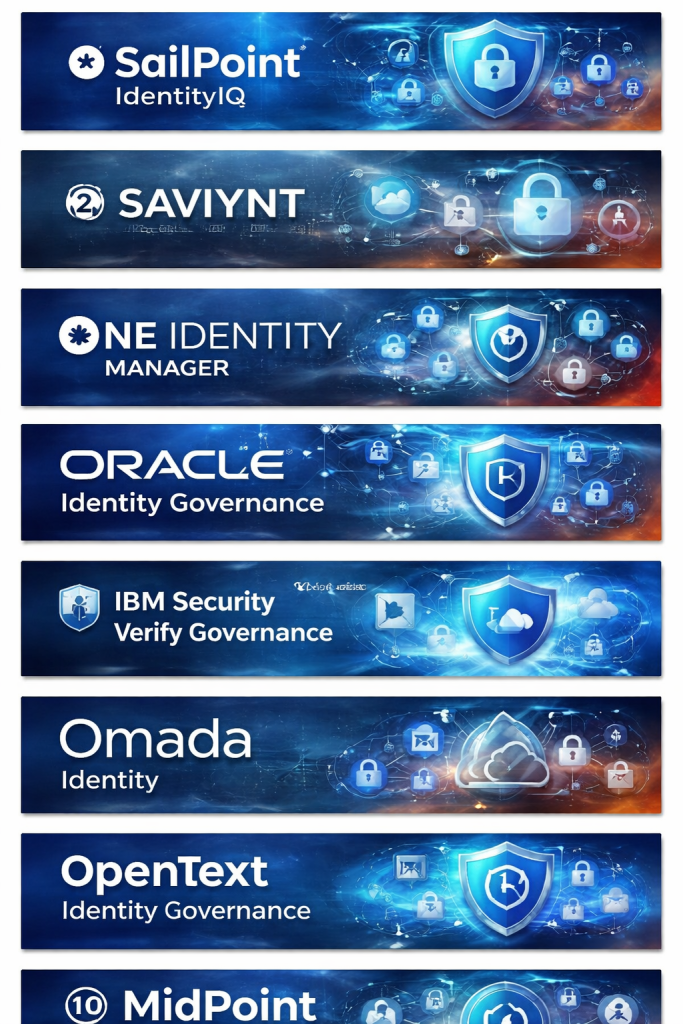
Top 10 Identity Governance & Administration (IGA) Tools
1 — SailPoint IdentityIQ
Short description:
A market-leading enterprise IGA platform designed for large organizations with complex identity and compliance needs.
Key features:
- Advanced access governance and certification campaigns
- Role modeling and role lifecycle management
- Joiner-mover-leaver automation
- Policy-based access controls
- Extensive application integrations
- Risk scoring and analytics
Pros:
- Extremely powerful and flexible
- Strong compliance and audit capabilities
Cons:
- Complex to implement and manage
- Higher cost and resource requirements
Security & compliance:
SSO, encryption, audit logs, SOC 2, ISO, GDPR, HIPAA support
Support & community:
Enterprise-grade support, extensive documentation, strong partner ecosystem
2 — Saviynt Enterprise Identity Cloud
Short description:
A modern, cloud-native IGA solution with strong governance for cloud, SaaS, and enterprise systems.
Key features:
- Cloud-first IGA architecture
- Access certifications and reviews
- Fine-grained role and entitlement management
- Risk-based access controls
- Integration with PAM and cloud platforms
Pros:
- Strong cloud and SaaS governance
- Unified IGA and access risk platform
Cons:
- UI can feel complex for new users
- Configuration requires expertise
Security & compliance:
SSO, encryption, audit logs, SOC 2, ISO, GDPR
Support & community:
Good enterprise support, growing community, solid onboarding
3 — One Identity Manager
Short description:
A comprehensive IGA solution suitable for hybrid and on-premise heavy environments.
Key features:
- Identity lifecycle management
- Role-based access governance
- IT Shop self-service access requests
- Compliance reporting
- Broad connector library
Pros:
- Flexible deployment options
- Strong role and policy engine
Cons:
- UI feels dated
- Setup can be time-consuming
Security & compliance:
SSO, encryption, audit trails, ISO, GDPR
Support & community:
Strong enterprise support, detailed documentation
4 — Oracle Identity Governance
Short description:
An enterprise-grade IGA platform tightly integrated with Oracle’s ecosystem.
Key features:
- Identity lifecycle automation
- Access certification workflows
- Role mining and management
- Strong reporting and analytics
- Integration with Oracle apps
Pros:
- Robust and scalable
- Ideal for Oracle-centric environments
Cons:
- Less flexible outside Oracle stack
- Complex licensing
Security & compliance:
SSO, encryption, audit logs, SOC, ISO, GDPR
Support & community:
Enterprise support, extensive documentation
5 — IBM Security Verify Governance
Short description:
A mature IGA solution focused on governance, compliance, and risk management.
Key features:
- Access reviews and certifications
- Role lifecycle management
- Policy enforcement
- Compliance reporting
- Hybrid deployment support
Pros:
- Strong governance capabilities
- Reliable enterprise performance
Cons:
- Interface not very modern
- Slower innovation pace
Security & compliance:
SSO, encryption, audit logs, SOC, ISO, GDPR
Support & community:
Enterprise-level support, solid documentation
6 — Microsoft Entra ID Governance
Short description:
Microsoft’s governance layer built into its identity platform, ideal for Microsoft-centric organizations.
Key features:
- Access reviews
- Entitlement management
- Privileged identity governance
- Deep Microsoft ecosystem integration
- Automation for lifecycle events
Pros:
- Seamless Microsoft integration
- Familiar UI for existing users
Cons:
- Limited outside Microsoft ecosystem
- Advanced features require premium plans
Security & compliance:
SSO, encryption, audit logs, ISO, GDPR
Support & community:
Strong documentation, large global community
7 — Omada Identity
Short description:
A focused IGA solution emphasizing simplicity and usability for mid-market and enterprises.
Key features:
- Identity lifecycle automation
- Access certification campaigns
- Role management
- Strong reporting
- Pre-built connectors
Pros:
- User-friendly interface
- Faster time to value
Cons:
- Less customizable than top-tier platforms
- Smaller ecosystem
Security & compliance:
SSO, encryption, audit logs, ISO, GDPR
Support & community:
Good customer support, growing user base
8 — Forgerock Identity Governance
Short description:
A governance module built into a broader identity platform for customer and workforce identities.
Key features:
- Access governance
- Identity lifecycle management
- Policy-driven access
- API-first design
- Cloud and hybrid support
Pros:
- Developer-friendly
- Strong identity platform integration
Cons:
- Governance depth less than pure-play IGA tools
- Requires tuning
Security & compliance:
SSO, encryption, audit logs, GDPR, ISO
Support & community:
Enterprise support, active developer community
9 — OpenText Identity Governance
Short description:
An IGA solution focused on compliance-driven organizations with complex audit needs.
Key features:
- Access reviews and certifications
- Identity lifecycle workflows
- Compliance dashboards
- Integration with OpenText ecosystem
- Risk analysis
Pros:
- Strong compliance focus
- Reliable reporting
Cons:
- UI can feel dated
- Smaller market presence
Security & compliance:
SSO, encryption, audit logs, ISO, GDPR
Support & community:
Enterprise support, adequate documentation
10 — MidPoint (Open-Source IGA)
Short description:
An open-source IGA platform for organizations wanting flexibility and control.
Key features:
- Identity lifecycle management
- Role-based access control
- Custom workflows
- Strong data modeling
- API support
Pros:
- Highly customizable
- No vendor lock-in
Cons:
- Requires in-house expertise
- Limited commercial support
Security & compliance:
Encryption, audit logs, varies by deployment
Support & community:
Active open-source community, paid support available
Comparison Table
| Tool Name | Best For | Platform(s) Supported | Standout Feature | Rating |
|---|---|---|---|---|
| SailPoint IdentityIQ | Large enterprises | Cloud, On-prem | Advanced governance | N/A |
| Saviynt | Cloud-first enterprises | Cloud | Risk-based access | N/A |
| One Identity Manager | Hybrid environments | Cloud, On-prem | IT Shop access model | N/A |
| Oracle IGA | Oracle ecosystems | Cloud, On-prem | Oracle integration | N/A |
| IBM Verify Governance | Regulated industries | Cloud, On-prem | Compliance depth | N/A |
| Microsoft Entra ID Gov | Microsoft users | Cloud | Native Microsoft tie-in | N/A |
| Omada Identity | Mid-market | Cloud, On-prem | Ease of use | N/A |
| Forgerock | Dev-centric orgs | Cloud, Hybrid | API-first design | N/A |
| OpenText IGA | Compliance-heavy orgs | On-prem, Hybrid | Audit reporting | N/A |
| MidPoint | Custom builds | On-prem, Cloud | Open-source flexibility | N/A |
Evaluation & Scoring of Identity Governance & Administration (IGA)
| Criteria | Weight | Description |
|---|---|---|
| Core features | 25% | Governance depth, certifications, lifecycle |
| Ease of use | 15% | Admin UI, workflows, learning curve |
| Integrations & ecosystem | 15% | Connectors and extensibility |
| Security & compliance | 10% | Standards, audit, controls |
| Performance & reliability | 10% | Stability at scale |
| Support & community | 10% | Documentation and help |
| Price / value | 15% | Cost vs benefits |
Which Identity Governance & Administration (IGA) Tool Is Right for You?
- Solo users & small teams: IGA is usually unnecessary; basic IAM tools are enough.
- SMBs: Look for simplified, faster-to-deploy tools like Omada or Microsoft Entra ID Governance.
- Mid-market: Balance governance depth with usability and cost.
- Enterprise: SailPoint, Saviynt, Oracle, or IBM offer the most complete capabilities.
Budget-conscious teams may consider open-source or bundled platforms, while premium buyers benefit from advanced analytics and compliance automation.
Choose feature depth if compliance and risk matter most, or ease of use if adoption speed is critical.
Ensure the tool integrates well with your existing stack and meets regulatory requirements.
Frequently Asked Questions (FAQs)
1. What is the main purpose of IGA?
To control, monitor, and audit who has access to what across systems.
2. Is IGA the same as IAM?
No. IGA focuses on governance and compliance, while IAM handles authentication and access.
3. Do small companies need IGA?
Usually not, unless they operate in regulated industries.
4. How long does IGA implementation take?
From weeks to several months depending on complexity.
5. Is cloud-based IGA secure?
Yes, when built with strong encryption and compliance controls.
6. Does IGA replace PAM?
No, they complement each other.
7. What is access certification?
A review process to confirm users still need their access.
8. Are open-source IGA tools reliable?
Yes, but they require skilled internal teams.
9. What are common mistakes when deploying IGA?
Over-customization and poor role design.
10. How do I measure IGA success?
Reduced access risk, faster audits, and fewer manual processes.
Conclusion
Identity Governance & Administration plays a vital role in securing modern organizations. It brings visibility, control, and accountability to identity and access management, helping reduce risk while supporting compliance.
The most important factors when choosing an IGA tool are governance depth, integration coverage, usability, and compliance support. There is no single “best” solution for everyone. The right choice depends on your organization’s size, industry, budget, and security maturity.
A thoughtful evaluation ensures that your IGA investment delivers long-term value, not just technical features.

Find Trusted Cardiac Hospitals
Compare heart hospitals by city and services — all in one place.
Explore Hospitals
This article offers a clear and practical overview of Identity Governance and Administration (IGA) solutions, explaining how these tools help organizations manage digital identities, enforce access policies, and maintain compliance across complex IT environments. By outlining key features such as access certification, role management, policy automation, and audit reporting, it provides readers with useful criteria for comparing different IGA platforms. The balanced discussion of pros and cons for each solution makes it easier for security and IT teams to evaluate options based on governance needs, scalability, and ease of integration. For organizations focused on strengthening identity controls and reducing risk related to excessive or unmanaged access, this comparison delivers valuable insights to support informed decision-making.