
Introduction
Security Information & Event Management (SIEM) is a foundational technology in modern cybersecurity operations. At its core, SIEM platforms collect, normalize, correlate, and analyze security-related data from across an organization’s IT environment—including servers, endpoints, applications, databases, firewalls, and cloud services. By bringing all security logs and events into a single, centralized system, SIEM enables organizations to detect threats, investigate incidents, and respond faster and more effectively.
SIEM has become critical because today’s attacks are stealthy, multi-stage, and fast-moving. Individual security tools often see only part of the picture. SIEM connects those dots, helping security teams identify suspicious patterns such as lateral movement, privilege escalation, insider threats, and compliance violations. In real-world scenarios, SIEM is widely used for threat detection, incident response, forensic analysis, and regulatory compliance reporting.
When evaluating SIEM solutions, users should look at factors such as log ingestion and scalability, detection accuracy, alert quality, correlation rules, integrations, usability, compliance support, and total cost of ownership. A strong SIEM should reduce noise while improving visibility, not overwhelm teams with alerts.
Best for:
Security analysts, SOC teams, CISOs, compliance officers, MSSPs, and IT teams in mid-sized to large organizations, especially in regulated industries like finance, healthcare, government, e-commerce, SaaS, and critical infrastructure.
Not ideal for:
Very small teams with minimal infrastructure, startups without compliance needs, or organizations seeking only basic log storage. In such cases, lightweight log management or XDR solutions may be more cost-effective.
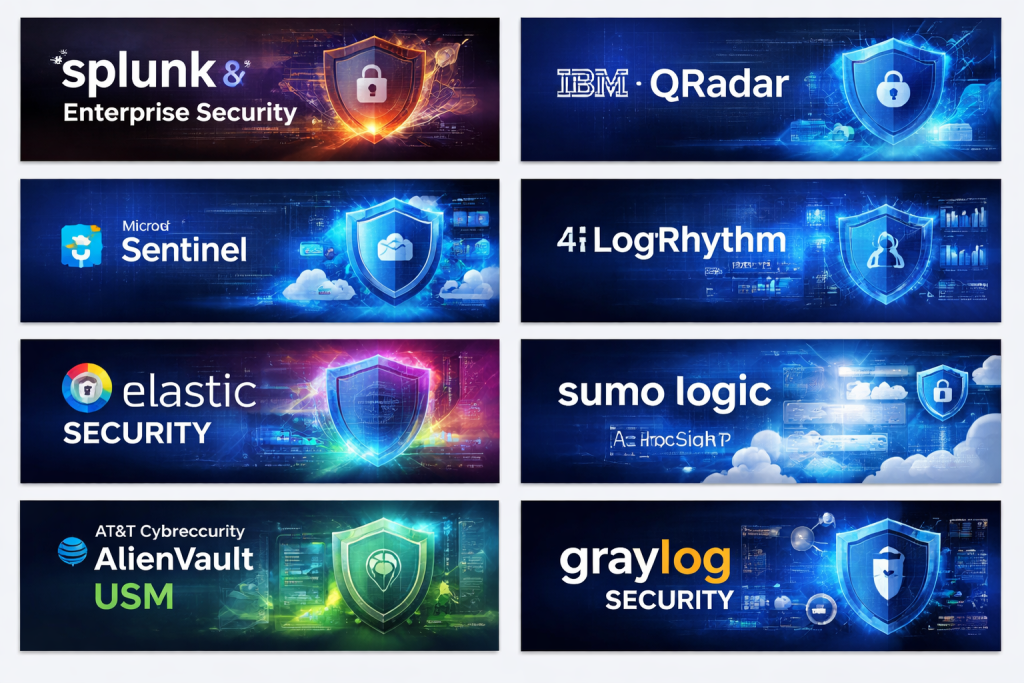
Top 10 Security Information & Event Management (SIEM) Tools
#1 — Splunk Enterprise Security
Short description:
A market-leading SIEM designed for large enterprises requiring deep visibility, advanced analytics, and highly customizable security operations.
Key features
- Advanced log aggregation and indexing at massive scale
- Real-time correlation and behavioral analytics
- Customizable dashboards and visualizations
- Threat intelligence integration and enrichment
- Automated incident workflows and response actions
- Powerful search language for deep investigations
Pros
- Extremely flexible and powerful analytics
- Strong ecosystem and third-party integrations
- Widely trusted by global enterprises
Cons
- High licensing and infrastructure costs
- Requires skilled personnel to manage and tune
Security & compliance
SSO, RBAC, encryption, audit logs, GDPR, SOC 2, ISO, HIPAA support
Support & community
Excellent documentation, strong enterprise support, large global community
#2 — IBM QRadar SIEM
Short description:
A mature SIEM platform focused on automated threat detection, correlation, and compliance reporting for complex environments.
Key features
- Real-time event correlation and offense prioritization
- Built-in compliance and reporting templates
- Network flow and behavioral analysis
- Integrated threat intelligence feeds
- Scalable on-prem and hybrid deployment options
Pros
- Strong detection accuracy and correlation
- Compliance-ready out of the box
- Stable and reliable for large SOCs
Cons
- User interface can feel dated
- Customization may require expert knowledge
Security & compliance
SOC 2, GDPR, HIPAA, ISO, audit trails, encryption
Support & community
Enterprise-grade IBM support, solid documentation, moderate community
#3 — Microsoft Sentinel
Short description:
A cloud-native SIEM built on a hyperscale data platform, ideal for organizations using modern cloud and hybrid infrastructures.
Key features
- Native integration with cloud workloads and identities
- Built-in analytics and machine learning detections
- Automated playbooks for incident response
- Scalable log ingestion and retention
- Strong visualization and dashboards
Pros
- Fully cloud-native and scalable
- Strong automation and AI-driven detections
- Easy integration with cloud ecosystems
Cons
- Costs can increase with high log volumes
- Best experience tied to specific cloud platforms
Security & compliance
Encryption, SSO, GDPR, SOC 2, ISO, HIPAA-ready
Support & community
Extensive documentation, strong vendor support, large user base
#4 — LogRhythm SIEM
Short description:
A balanced SIEM offering strong detection, compliance, and usability for mid-market to enterprise organizations.
Key features
- Centralized log management and analytics
- Prebuilt detection rules and compliance modules
- UEBA for insider threat detection
- Automated incident response workflows
- Intuitive dashboards and reporting
Pros
- Good balance of power and usability
- Strong compliance reporting
- Faster deployment than many competitors
Cons
- Limited flexibility compared to top-tier tools
- Scaling can become complex
Security & compliance
SOC 2, HIPAA, GDPR, ISO, encryption, audit logs
Support & community
Responsive support, good onboarding resources, growing community
#5 — Elastic Security (ELK SIEM)
Short description:
An open, flexible SIEM built on search and analytics technology, popular among engineering-driven security teams.
Key features
- Real-time log ingestion and search
- Advanced threat detection and correlation
- Highly customizable dashboards
- Open and extensible architecture
- Cloud, hybrid, and on-prem support
Pros
- Highly customizable and scalable
- Strong performance and search speed
- Open ecosystem
Cons
- Requires engineering expertise
- Limited out-of-the-box compliance templates
Security & compliance
Encryption, RBAC, audit logging, GDPR-ready
Support & community
Strong open-source community, optional enterprise support
#6 — ArcSight SIEM
Short description:
A long-standing enterprise SIEM known for deep correlation and large-scale deployments.
Key features
- Advanced correlation engine
- High-volume log processing
- Threat intelligence integration
- Custom rule creation
- Compliance reporting support
Pros
- Powerful correlation capabilities
- Proven in very large environments
Cons
- Steep learning curve
- Complex deployment and maintenance
Security & compliance
ISO, GDPR, SOC 2, audit trails, encryption
Support & community
Enterprise support available, smaller modern community
#7 — Sumo Logic Cloud SIEM
Short description:
A cloud-first SIEM designed for modern DevOps and SaaS-driven organizations.
Key features
- Cloud-native log analytics
- Real-time threat detection
- Integrated threat intelligence
- Automated incident workflows
- Strong visualization tools
Pros
- Easy to deploy and manage
- Scales well for cloud environments
- Intuitive user interface
Cons
- Less suitable for on-prem-heavy setups
- Advanced features cost extra
Security & compliance
SOC 2, GDPR, ISO, encryption, audit logs
Support & community
Good documentation, responsive support, growing ecosystem
#8 — Rapid7 InsightIDR
Short description:
A user-friendly SIEM with strong focus on visibility, detection, and fast deployment.
Key features
- Endpoint, user, and network visibility
- UEBA-driven threat detection
- Prebuilt dashboards and alerts
- Cloud-based deployment
- Integrated investigation tools
Pros
- Fast time to value
- Easy to use for small SOC teams
- Clear and actionable alerts
Cons
- Less customizable than enterprise SIEMs
- Limited advanced correlation
Security & compliance
GDPR, SOC 2, encryption, audit logs
Support & community
Excellent onboarding, strong customer support
#9 — AT&T Cybersecurity AlienVault USM
Short description:
An all-in-one SIEM and security operations platform for SMBs and mid-market organizations.
Key features
- Integrated SIEM, IDS, and vulnerability management
- Centralized log collection
- Threat intelligence feeds
- Simple dashboards and reporting
- Cloud and hybrid support
Pros
- All-in-one approach
- Affordable compared to enterprise SIEMs
- Easy to deploy
Cons
- Limited scalability for large enterprises
- Fewer advanced analytics features
Security & compliance
Basic compliance support, encryption, audit logs
Support & community
Active community, decent vendor support
#10 — Graylog Security
Short description:
A lightweight SIEM and log analysis platform ideal for organizations seeking flexibility and cost control.
Key features
- Centralized log management
- Custom alerts and streams
- Fast search and analysis
- Open and extensible architecture
- Flexible deployment models
Pros
- Cost-effective
- Simple and fast log analysis
- Good customization options
Cons
- Limited native advanced detection
- Compliance features are basic
Security & compliance
Varies / N/A depending on deployment
Support & community
Strong open-source community, optional enterprise support
Comparison Table
| Tool Name | Best For | Platform(s) Supported | Standout Feature | Rating |
|---|---|---|---|---|
| Splunk ES | Large enterprises | On-prem, Cloud, Hybrid | Advanced analytics | N/A |
| IBM QRadar | Regulated industries | On-prem, Hybrid | Correlation engine | N/A |
| Microsoft Sentinel | Cloud-first orgs | Cloud | Native scalability | N/A |
| LogRhythm | Mid-market SOCs | On-prem, Hybrid | Compliance readiness | N/A |
| Elastic Security | Engineering teams | Cloud, Hybrid | Search performance | N/A |
| ArcSight | Large SOCs | On-prem | Deep correlation | N/A |
| Sumo Logic | SaaS & DevOps | Cloud | Ease of use | N/A |
| Rapid7 InsightIDR | Small SOCs | Cloud | Fast deployment | N/A |
| AlienVault USM | SMBs | Cloud, Hybrid | All-in-one security | N/A |
| Graylog | Budget teams | On-prem, Cloud | Cost efficiency | N/A |
Evaluation & Scoring of Security Information & Event Management (SIEM)
| Evaluation Criteria | Weight | Description |
|---|---|---|
| Core features | 25% | Log ingestion, correlation, detection |
| Ease of use | 15% | UI, onboarding, learning curve |
| Integrations & ecosystem | 15% | Third-party and native integrations |
| Security & compliance | 10% | Compliance standards, audit support |
| Performance & reliability | 10% | Scalability and uptime |
| Support & community | 10% | Documentation and assistance |
| Price / value | 15% | Cost vs capabilities |
Which Security Information & Event Management (SIEM) Tool Is Right for You?
- Solo users or very small teams: Lightweight solutions or managed security services
- SMBs: AlienVault USM, Rapid7, Graylog
- Mid-market: LogRhythm, Sumo Logic, Elastic Security
- Enterprises: Splunk, IBM QRadar, ArcSight, Sentinel
Budget-conscious: Open or cloud-native tools with usage-based pricing
Premium solutions: Feature-rich enterprise SIEMs
Ease of use: Managed and cloud-native platforms
Deep control: Highly customizable and on-prem solutions
Frequently Asked Questions (FAQs)
1. What is the main purpose of a SIEM?
To centralize security data, detect threats, and support incident response and compliance.
2. Is SIEM only for large enterprises?
No, modern SIEMs also support SMBs through cloud-based and simplified deployments.
3. How long does SIEM implementation take?
Anywhere from days to months, depending on complexity and data volume.
4. Does SIEM replace other security tools?
No, it complements tools like EDR, firewalls, and NDR.
5. Is SIEM expensive?
Costs vary widely based on log volume, features, and deployment model.
6. Cloud vs on-prem SIEM—what’s better?
Cloud offers scalability and ease; on-prem offers control and customization.
7. What skills are needed to manage SIEM?
Security analysis, log management, and incident response expertise.
8. Can SIEM help with compliance?
Yes, SIEM is widely used for audits and regulatory reporting.
9. What is UEBA in SIEM?
User and Entity Behavior Analytics helps detect insider threats and anomalies.
10. What are common SIEM mistakes?
Over-ingesting logs, poor tuning, and ignoring alert fatigue.
Conclusion
Security Information & Event Management remains a cornerstone of cybersecurity strategy. The right SIEM provides visibility, context, and control—turning raw data into actionable security intelligence. While leading platforms offer impressive capabilities, no single solution is perfect for everyone.
The best SIEM depends on organization size, budget, infrastructure, compliance needs, and team maturity. By carefully evaluating features, usability, scalability, and long-term value, organizations can select a SIEM that strengthens their defenses and supports their security goals effectively.

Find Trusted Cardiac Hospitals
Compare heart hospitals by city and services — all in one place.
Explore Hospitals
This article gives a clear and helpful overview of Security Information and Event Management (SIEM) tools, showing how they centralize log collection, correlate events, and deliver real-time alerts to improve threat detection and compliance monitoring. By explaining key features such as analytics, dashboard reporting, incident management, and integration with other security systems, it provides useful insights for readers evaluating different SIEM platforms. The balanced pros and cons for each tool help security teams compare options based on performance, scalability, and ease of use. For organizations aiming to strengthen their security operations and gain better visibility into their environment, this comparison offers valuable guidance for choosing a SIEM solution that fits their needs.