
Introduction
Real-time analytics platforms are software systems designed to collect, process, analyze, and visualize data as it is generated, rather than hours or days later. Unlike traditional batch analytics, real-time analytics enables organizations to react instantly to events such as user actions, system failures, fraud attempts, operational bottlenecks, or market changes.
In today’s data-driven world, businesses generate massive streams of data from websites, mobile apps, IoT devices, financial transactions, sensors, logs, and customer interactions. The ability to analyze this data in real time has become a competitive necessity rather than a luxury. Real-time analytics helps companies detect issues early, personalize experiences instantly, improve operational efficiency, and make faster, smarter decisions.
Key real-world use cases include:
- Monitoring application and infrastructure performance
- Fraud detection and risk scoring
- Real-time personalization and recommendations
- Operational dashboards for logistics and supply chains
- Live business KPIs for sales, marketing, and finance
- IoT and sensor data analytics
- Cybersecurity monitoring and threat detection
What to look for when choosing a real-time analytics platform:
- Low-latency processing and high throughput
- Scalability to handle growing data volumes
- Ease of integration with existing data sources and tools
- Query performance for both streaming and historical data
- Security and compliance support
- Visualization and alerting capabilities
- Cost predictability and pricing transparency
Best for:
Real-time analytics platforms are ideal for product teams, data engineers, DevOps teams, security teams, digital marketers, and business leaders in startups, mid-sized companies, and large enterprises across industries such as SaaS, finance, healthcare, e-commerce, telecom, manufacturing, and logistics.
Not ideal for:
Organizations with small data volumes, infrequent reporting needs, or purely historical analysis requirements may not need real-time analytics. In such cases, traditional BI tools or batch-based data warehouses may be more cost-effective.
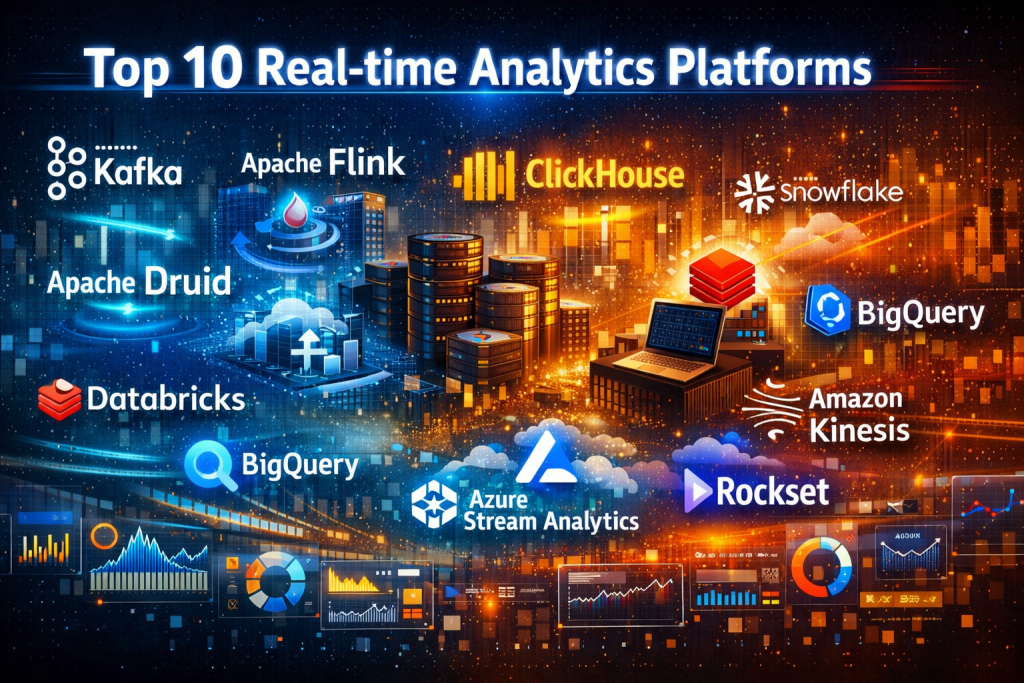
Top 10 Real-time Analytics Platforms Tools
1 — Apache Kafka + ksqlDB
Short description:
Apache Kafka is a distributed event streaming platform widely used for building real-time data pipelines. ksqlDB adds SQL-based stream processing on top of Kafka, making it powerful for event-driven analytics.
Key features:
- High-throughput, low-latency event streaming
- Distributed and fault-tolerant architecture
- SQL-based stream processing with ksqlDB
- Strong ecosystem of connectors and integrations
- Horizontal scalability across clusters
- Real-time data transformation and enrichment
Pros:
- Extremely scalable and battle-tested
- Strong open-source ecosystem and flexibility
- Ideal backbone for event-driven architectures
Cons:
- Operational complexity for self-managed deployments
- Requires engineering expertise to maintain
- Visualization and BI require external tools
Security & compliance:
Supports encryption in transit, authentication, authorization, audit logs; compliance varies by deployment.
Support & community:
Large global community, extensive documentation, enterprise support available via commercial vendors.
2 — Apache Flink
Short description:
Apache Flink is a stream processing framework designed for real-time analytics with strong state management and exactly-once processing guarantees.
Key features:
- True stream processing (not micro-batching)
- Stateful computations with fault tolerance
- Event-time processing and windowing
- Exactly-once semantics
- Scales across distributed clusters
- Works with Kafka and other streaming sources
Pros:
- Excellent for complex real-time analytics
- Strong consistency guarantees
- High performance for large-scale streams
Cons:
- Steep learning curve
- Limited built-in visualization
- Requires significant operational setup
Security & compliance:
Supports authentication, authorization, encryption; compliance depends on infrastructure.
Support & community:
Strong open-source community; enterprise support available from vendors.
3 — Apache Druid
Short description:
Apache Druid is a real-time analytics database optimized for fast aggregation queries on large volumes of event data.
Key features:
- Sub-second query latency
- Real-time and batch ingestion
- Column-oriented storage
- Time-series optimized architecture
- Built-in rollups and indexing
- Native SQL support
Pros:
- Extremely fast dashboards and queries
- Designed specifically for analytics workloads
- Good balance of performance and flexibility
Cons:
- Complex cluster architecture
- Limited transactional capabilities
- Requires tuning for optimal performance
Security & compliance:
Supports authentication, authorization, TLS; compliance varies by deployment.
Support & community:
Active open-source community; commercial support available.
4 — ClickHouse
Short description:
ClickHouse is a high-performance, columnar analytical database widely used for real-time and near-real-time analytics at scale.
Key features:
- Columnar storage engine
- Very fast analytical queries
- High compression ratios
- Real-time ingestion support
- SQL-based querying
- Horizontal scalability
Pros:
- Exceptional query performance
- Cost-effective at scale
- Strong for log and event analytics
Cons:
- Limited update/delete capabilities
- Requires careful schema design
- Not a full streaming engine by itself
Security & compliance:
Supports encryption, authentication, role-based access; compliance varies.
Support & community:
Growing community, good documentation, enterprise support available.
5 — Snowflake (Real-time Ingestion Use Cases)
Short description:
Snowflake is a cloud data platform increasingly used for near-real-time analytics through streaming ingestion pipelines.
Key features:
- Cloud-native architecture
- Separation of storage and compute
- Real-time data ingestion support
- Strong SQL analytics
- Auto-scaling compute
- Secure data sharing
Pros:
- Easy to use and manage
- Excellent performance for analytics
- Strong enterprise adoption
Cons:
- Not a pure real-time streaming engine
- Costs can grow with heavy usage
- Latency not always sub-second
Security & compliance:
Strong security posture, encryption, SOC 2, GDPR, HIPAA support.
Support & community:
Enterprise-grade support, strong documentation, large user base.
6 — Databricks (Structured Streaming)
Short description:
Databricks provides real-time analytics using Apache Spark Structured Streaming combined with lakehouse architecture.
Key features:
- Unified batch and streaming analytics
- Structured Streaming engine
- Lakehouse data model
- Scalable cloud infrastructure
- Advanced analytics and ML integration
- SQL and notebook-based workflows
Pros:
- Powerful analytics and machine learning capabilities
- Unified data platform
- Strong enterprise adoption
Cons:
- Higher cost for smaller teams
- Requires data engineering expertise
- Latency depends on configuration
Security & compliance:
Strong enterprise security, encryption, compliance certifications.
Support & community:
Strong enterprise support, active community, extensive learning resources.
7 — Google BigQuery (Streaming Analytics)
Short description:
BigQuery supports real-time analytics via streaming inserts and is widely used for large-scale analytical workloads.
Key features:
- Serverless architecture
- Streaming data ingestion
- High-performance SQL queries
- Built-in BI and visualization integrations
- Automatic scaling
- Strong integration with cloud services
Pros:
- Minimal operational overhead
- Excellent scalability
- Strong ecosystem integration
Cons:
- Streaming costs can add up
- Latency not always instant
- Limited customization of internals
Security & compliance:
Strong cloud security, encryption, GDPR and compliance support.
Support & community:
Enterprise support, extensive documentation, large user base.
8 — Amazon Kinesis Analytics
Short description:
Amazon Kinesis Analytics enables real-time data processing on streaming data using SQL or Apache Flink.
Key features:
- Real-time stream processing
- Native integration with AWS ecosystem
- SQL-based analytics
- Managed infrastructure
- Auto-scaling capabilities
- Low-latency processing
Pros:
- Deep AWS integration
- Managed service reduces ops burden
- Flexible analytics options
Cons:
- AWS lock-in
- Pricing complexity
- Limited outside AWS ecosystem
Security & compliance:
Strong cloud security, IAM integration, compliance certifications.
Support & community:
Enterprise support through cloud provider, solid documentation.
9 — Azure Stream Analytics
Short description:
Azure Stream Analytics is a fully managed real-time analytics service designed for event and IoT data streams.
Key features:
- Real-time event processing
- SQL-like query language
- Native Azure integration
- IoT and event hub support
- Low-latency insights
- Built-in output connectors
Pros:
- Easy to get started
- Strong for IoT use cases
- Fully managed service
Cons:
- Azure ecosystem dependency
- Limited advanced analytics
- Less flexible than open-source engines
Security & compliance:
Strong enterprise security, cloud compliance support.
Support & community:
Enterprise-grade support, solid documentation.
10 — Rockset
Short description:
Rockset is a real-time analytics database designed for fast queries on semi-structured data with low latency.
Key features:
- Real-time indexing
- SQL queries on streaming data
- Automatic indexing
- Low-latency analytics
- Cloud-native architecture
- Schema flexibility
Pros:
- Extremely fast query performance
- Minimal data modeling effort
- Strong developer experience
Cons:
- Premium pricing
- Less control over internals
- Not ideal for offline batch processing
Security & compliance:
Strong security, encryption, compliance certifications.
Support & community:
Good documentation, enterprise support, smaller community.
Comparison Table
| Tool Name | Best For | Platform(s) Supported | Standout Feature | Rating |
|---|---|---|---|---|
| Apache Kafka + ksqlDB | Event-driven architectures | Multi-platform | Streaming backbone | N/A |
| Apache Flink | Complex stream processing | Multi-platform | Exactly-once semantics | N/A |
| Apache Druid | Real-time dashboards | Multi-platform | Sub-second queries | N/A |
| ClickHouse | Log & event analytics | Multi-platform | Extreme performance | N/A |
| Snowflake | Cloud analytics | Cloud | Ease of use | N/A |
| Databricks | Unified analytics & ML | Cloud | Lakehouse model | N/A |
| BigQuery | Serverless analytics | Cloud | Auto-scaling | N/A |
| Amazon Kinesis Analytics | AWS streaming | Cloud | Managed Flink | N/A |
| Azure Stream Analytics | IoT analytics | Cloud | SQL-based streams | N/A |
| Rockset | Low-latency apps | Cloud | Real-time indexing | N/A |
Evaluation & Scoring of Real-time Analytics Platforms
| Criteria | Weight | Key Considerations |
|---|---|---|
| Core features | 25% | Streaming, querying, ingestion |
| Ease of use | 15% | Setup, learning curve |
| Integrations & ecosystem | 15% | Data sources, tools |
| Security & compliance | 10% | Encryption, certifications |
| Performance & reliability | 10% | Latency, uptime |
| Support & community | 10% | Docs, help, ecosystem |
| Price / value | 15% | Cost vs capabilities |
Which Real-time Analytics Platforms Tool Is Right for You?
- Solo users or startups: Look for managed platforms with minimal setup and predictable pricing.
- SMBs: Balance ease of use with scalability; cloud-managed solutions are often ideal.
- Mid-market: Focus on integration, performance, and cost optimization.
- Enterprise: Prioritize scalability, security, compliance, and ecosystem maturity.
Budget-conscious teams should prefer open-source or pay-as-you-go tools, while premium users may value managed services and enterprise support.
If feature depth matters more than simplicity, stream processing engines are ideal. If ease of use is critical, managed analytics databases are better.
Frequently Asked Questions (FAQs)
1. What is real-time analytics?
It is the ability to analyze data immediately as it is generated, enabling instant insights and actions.
2. How is it different from batch analytics?
Batch analytics processes data periodically, while real-time analytics processes it continuously.
3. Do real-time analytics platforms require streaming data?
Most do, but some support near-real-time ingestion from micro-batches.
4. Are real-time analytics platforms expensive?
Costs vary widely depending on data volume, processing needs, and platform choice.
5. Can small businesses use real-time analytics?
Yes, especially with managed and cloud-based platforms.
6. What skills are required?
Typically data engineering, SQL, and system design knowledge.
7. Are these platforms secure?
Most offer strong security features; compliance depends on configuration.
8. Can real-time analytics replace BI tools?
They often complement rather than replace traditional BI.
9. What is the biggest implementation mistake?
Overengineering without clear use cases.
10. How long does implementation take?
From days for managed tools to months for complex self-managed systems.
Conclusion
Real-time analytics platforms have become essential for organizations that need instant visibility, faster decision-making, and proactive responses. From open-source streaming engines to fully managed cloud services, the ecosystem offers a wide range of choices.
The most important factors when choosing a platform are latency, scalability, ease of integration, security, and cost alignment with your needs. There is no universal “best” tool—only the best fit for your specific use cases, team skills, and business goals.
By clearly defining your requirements and evaluating platforms against them, you can select a real-time analytics solution that delivers lasting value and measurable impact.

Find Trusted Cardiac Hospitals
Compare heart hospitals by city and services — all in one place.
Explore Hospitals
