
Introduction
Speech Recognition Platforms are software systems that convert spoken language into written text or actionable commands using advanced machine learning and artificial intelligence. Over the past decade, these platforms have evolved from basic dictation tools into highly accurate, real-time engines capable of understanding accents, context, domain-specific terminology, and even speaker intent.
Their importance has grown rapidly due to the rise of voice assistants, call centers, remote work, healthcare documentation, accessibility needs, and conversational AI applications. Businesses now rely on speech recognition to automate workflows, improve customer experience, reduce manual effort, and unlock insights from voice data at scale.
Real-world use cases include:
- Call center transcription and sentiment analysis
- Voice-enabled virtual assistants and chatbots
- Medical dictation and clinical documentation
- Meeting transcription and productivity tools
- Voice commands for apps, vehicles, and smart devices
When choosing a Speech Recognition Platform, users should evaluate accuracy, language support, real-time vs batch processing, customization, integrations, security, compliance, scalability, and pricing. Ease of integration and long-term reliability are just as critical as raw transcription accuracy.
Best for:
Speech Recognition Platforms are ideal for product teams, AI/ML engineers, healthcare providers, call center operators, SaaS companies, enterprises, accessibility solution builders, and media organizations that work heavily with voice data.
Not ideal for:
They may be unnecessary for small teams with minimal audio data, text-only workflows, or use cases where manual transcription is sufficient or cheaper.
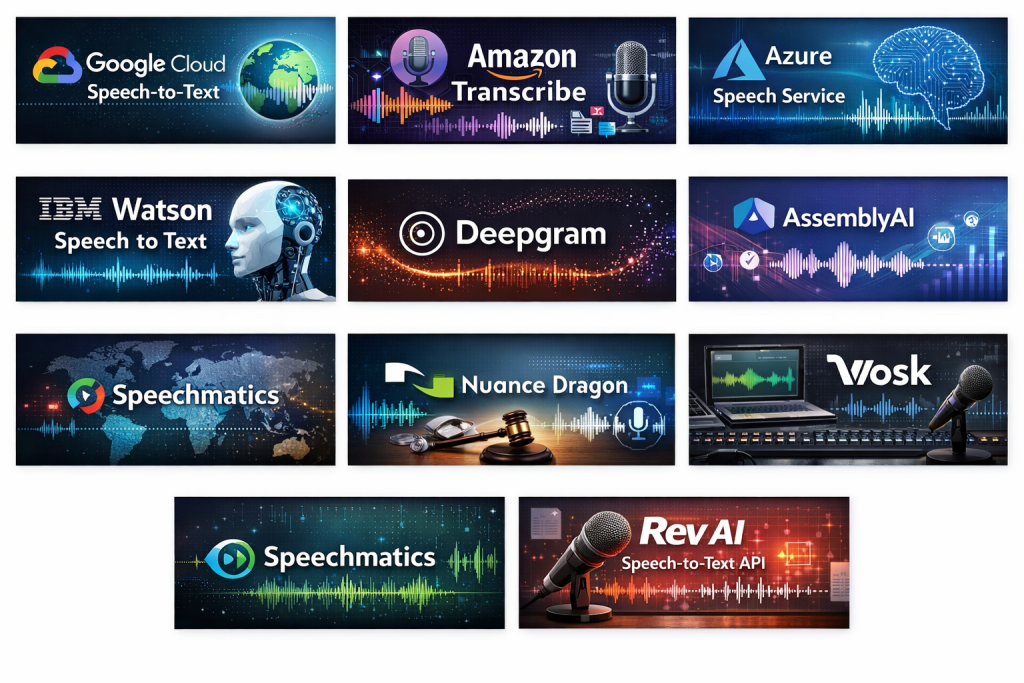
Top 10 Speech Recognition Platforms Tools
1 — Google Cloud Speech-to-Text
Short description:
A highly scalable, AI-driven speech recognition service designed for developers and enterprises needing high accuracy across many languages and environments.
Key features:
- Real-time and batch speech recognition
- Supports 100+ languages and dialects
- Automatic punctuation and formatting
- Speaker diarization
- Noise-robust transcription models
- Domain-specific models (medical, call center)
- Streaming recognition APIs
Pros:
- Very high accuracy across diverse accents
- Excellent scalability and performance
- Strong AI research backing
Cons:
- Pricing can grow quickly at scale
- Requires technical expertise to integrate
- Limited control over underlying models
Security & compliance:
Encryption at rest and in transit, IAM, audit logs, GDPR, HIPAA (varies by configuration)
Support & community:
Extensive documentation, strong developer community, enterprise support available
2— Amazon Transcribe
Short description:
A cloud-based speech recognition service optimized for customer service, media, and analytics-driven applications.
Key features:
- Real-time and batch transcription
- Custom vocabulary support
- Speaker identification
- Call analytics features
- Automatic language detection
- Integration with other AWS services
Pros:
- Deep integration with AWS ecosystem
- Good accuracy for conversational audio
- Flexible customization options
Cons:
- AWS dependency
- Configuration complexity for beginners
- UI is developer-centric
Security & compliance:
Encryption, IAM, audit trails, GDPR, HIPAA, SOC 2
Support & community:
Strong documentation, large user base, enterprise AWS support plans
3 — Microsoft Azure Speech Service
Short description:
A comprehensive speech platform offering transcription, translation, and voice synthesis for enterprise applications.
Key features:
- Speech-to-text and text-to-speech
- Custom speech models
- Real-time translation
- Speaker recognition
- Noise suppression
- Edge deployment options
Pros:
- Strong enterprise compliance
- Customizable acoustic and language models
- Works well with Microsoft ecosystem
Cons:
- UI and pricing complexity
- Learning curve for advanced features
- Some features region-dependent
Security & compliance:
Encryption, Azure AD SSO, GDPR, ISO, SOC 2, HIPAA
Support & community:
Extensive documentation, enterprise-grade support, strong enterprise adoption
4 — IBM Watson Speech to Text
Short description:
An enterprise-focused speech recognition platform emphasizing customization and governance.
Key features:
- Real-time and batch transcription
- Custom language models
- Speaker labels
- Keyword spotting
- Domain-specific tuning
- On-prem and cloud options
Pros:
- Strong governance and transparency
- Customization depth
- On-prem deployment flexibility
Cons:
- Interface feels dated
- Smaller ecosystem compared to hyperscalers
- Slower innovation pace
Security & compliance:
Encryption, audit logs, GDPR, HIPAA, ISO, SOC 2
Support & community:
Good documentation, enterprise support, smaller community presence
5 — Deepgram
Short description:
A developer-friendly speech recognition platform focused on speed, accuracy, and real-time streaming.
Key features:
- Ultra-low latency transcription
- Custom model training
- Streaming and batch APIs
- Punctuation and formatting
- Language and accent optimization
- Analytics-ready output
Pros:
- Extremely fast transcription
- Developer-first design
- Competitive pricing for scale
Cons:
- Smaller brand recognition
- Limited non-developer UI
- Fewer out-of-the-box tools
Security & compliance:
Encryption, SOC 2, GDPR (varies by plan)
Support & community:
High-quality docs, responsive support, growing developer community
6 — AssemblyAI
Short description:
An AI-powered speech recognition and audio intelligence platform aimed at modern application builders.
Key features:
- High-accuracy speech-to-text
- Speaker diarization
- Content moderation
- Topic detection and summarization
- Automatic chaptering
- Real-time APIs
Pros:
- Rich audio intelligence features
- Simple API experience
- Strong innovation pace
Cons:
- Not ideal for non-technical users
- Fewer enterprise governance tools
- Limited on-prem options
Security & compliance:
Encryption, GDPR, SOC 2 (plan-dependent)
Support & community:
Good documentation, active support, growing startup ecosystem
7 — Speechmatics
Short description:
A language-agnostic speech recognition platform focused on accuracy and fairness across accents.
Key features:
- Accent-robust transcription
- 50+ languages supported
- Real-time and batch processing
- On-prem and cloud deployment
- No language-specific tuning required
Pros:
- Strong accent and dialect handling
- Transparent AI approach
- Flexible deployment models
Cons:
- Smaller ecosystem
- Limited advanced analytics features
- Less brand awareness
Security & compliance:
Encryption, GDPR, ISO, enterprise security controls
Support & community:
Good enterprise support, solid documentation, smaller community
8 — Nuance Dragon (Microsoft)
Short description:
A leading speech recognition solution for professional dictation, especially in healthcare and legal industries.
Key features:
- Highly accurate dictation
- Medical and legal vocabularies
- Voice commands and macros
- Offline recognition
- User-specific learning
Pros:
- Exceptional dictation accuracy
- Industry-specific optimization
- Strong productivity gains
Cons:
- Limited API-based scalability
- Primarily desktop-focused
- Premium pricing
Security & compliance:
HIPAA, encryption, enterprise security standards
Support & community:
Strong professional support, training resources, limited developer community
9— Vosk
Short description:
An open-source speech recognition engine designed for offline and embedded applications.
Key features:
- Offline speech recognition
- Lightweight models
- Multiple language support
- Works on edge devices
- Open-source flexibility
Pros:
- No vendor lock-in
- Offline capability
- Cost-effective
Cons:
- Lower accuracy than cloud AI
- Requires technical setup
- Limited support options
Security & compliance:
Varies / N/A (self-managed)
Support & community:
Open-source community, limited formal support
10 — Rev AI
Short description:
A speech recognition API designed for developers needing fast, reliable transcription with human-level formatting.
Key features:
- High-accuracy transcription
- Real-time and asynchronous APIs
- Speaker labeling
- Punctuation and timestamps
- Media-friendly formats
Pros:
- Consistent output quality
- Simple API integration
- Media and podcast friendly
Cons:
- Limited customization
- Fewer AI analytics features
- Pricing higher than open-source
Security & compliance:
Encryption, GDPR, SOC 2
Support & community:
Good documentation, responsive support, moderate community size
Comparison Table
| Tool Name | Best For | Platform(s) Supported | Standout Feature | Rating |
|---|---|---|---|---|
| Google Cloud Speech-to-Text | Large-scale AI apps | Cloud | Multi-language accuracy | N/A |
| Amazon Transcribe | AWS-based workloads | Cloud | Call analytics | N/A |
| Azure Speech Service | Enterprise solutions | Cloud / Edge | Custom models | N/A |
| IBM Watson STT | Regulated industries | Cloud / On-prem | Governance & control | N/A |
| Deepgram | Real-time apps | Cloud | Ultra-low latency | N/A |
| AssemblyAI | Audio intelligence | Cloud | Summarization & insights | N/A |
| Speechmatics | Global accents | Cloud / On-prem | Accent robustness | N/A |
| Nuance Dragon | Medical dictation | Desktop / Enterprise | Domain accuracy | N/A |
| Vosk | Offline use cases | On-device | Open-source | N/A |
| Rev AI | Media transcription | Cloud | Clean formatting | N/A |
Evaluation & Scoring of Speech Recognition Platforms
| Criteria | Weight | Notes |
|---|---|---|
| Core features | 25% | Accuracy, real-time support, customization |
| Ease of use | 15% | APIs, UI, onboarding |
| Integrations & ecosystem | 15% | Cloud, tools, workflows |
| Security & compliance | 10% | Standards and governance |
| Performance & reliability | 10% | Latency and uptime |
| Support & community | 10% | Docs, enterprise support |
| Price / value | 15% | Cost vs capability |
Which Speech Recognition Platforms Tool Is Right for You?
- Solo users: Desktop dictation tools like Nuance Dragon or lightweight APIs
- SMBs: AssemblyAI, Deepgram, or Rev AI for fast deployment
- Mid-market: Azure Speech, Amazon Transcribe for balance of control and scale
- Enterprise: Google, Azure, IBM for compliance, governance, and global scale
Budget-conscious users may prefer open-source or usage-based APIs, while premium users benefit from custom models, analytics, and enterprise SLAs. Integration complexity, data sensitivity, and future scalability should guide the final choice.
Frequently Asked Questions (FAQs)
1. How accurate are modern speech recognition platforms?
Most leading platforms achieve very high accuracy, especially with clean audio and domain-specific tuning.
2. Can these tools handle accents and dialects?
Yes, but performance varies. Some platforms specialize in accent robustness.
3. Are speech recognition platforms secure?
Enterprise tools support encryption and compliance, but configuration matters.
4. Do I need machine learning expertise?
Basic use does not, but advanced customization benefits from ML knowledge.
5. Can they work in real time?
Yes, most top platforms support real-time streaming transcription.
6. Are offline solutions available?
Yes, tools like Vosk and some enterprise products support offline use.
7. How do pricing models usually work?
Typically usage-based, billed per audio minute or hour.
8. Can I train custom vocabularies?
Many platforms support custom words and domain adaptation.
9. Are these tools suitable for healthcare?
Yes, especially platforms with HIPAA compliance and medical models.
10. What is the biggest mistake buyers make?
Choosing based only on accuracy without considering integration and cost.
Conclusion
Speech Recognition Platforms have become a core layer of modern digital experiences, powering everything from virtual assistants to clinical documentation and customer analytics. While accuracy is critical, the best platform is one that balances usability, scalability, security, integration, and long-term value.
There is no universal winner. The right choice depends on your industry, team size, technical expertise, compliance needs, and budget. By clearly defining your requirements and evaluating platforms holistically, you can select a solution that delivers lasting impact rather than short-term convenience.

Find Trusted Cardiac Hospitals
Compare heart hospitals by city and services — all in one place.
Explore Hospitals