
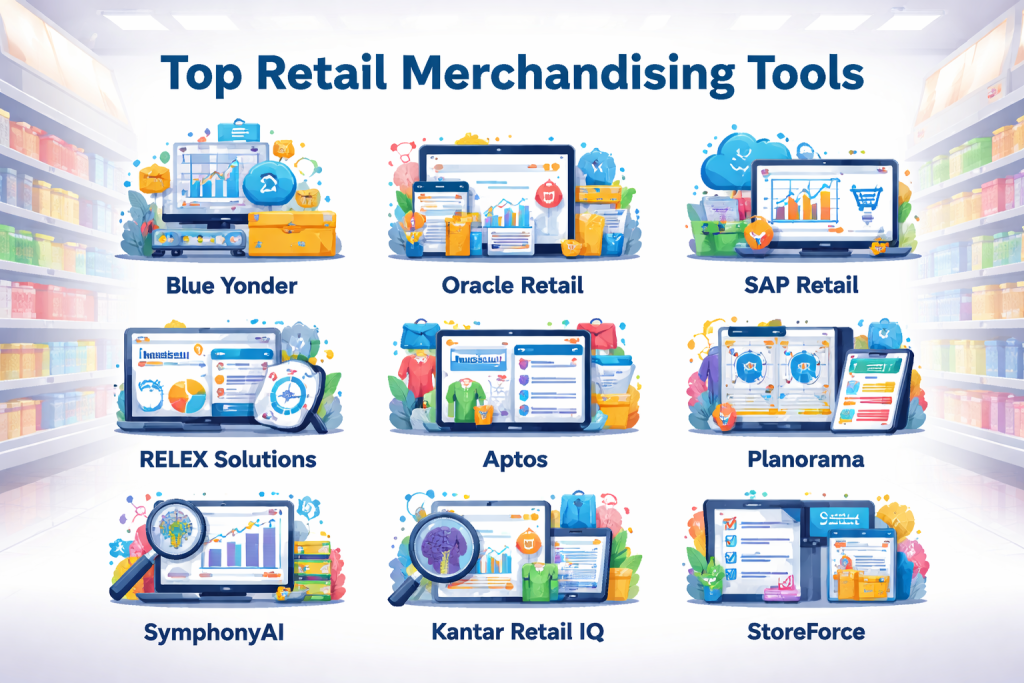
Introduction
Retail Merchandising Tools are specialized software platforms designed to help retailers plan, execute, analyze, and optimize how products are displayed, priced, promoted, and stocked across physical and digital sales channels. These tools sit at the intersection of data, consumer behavior, and visual presentation, enabling retailers to make smarter, faster, and more profitable merchandising decisions.
In today’s highly competitive retail environment, success is no longer driven by intuition alone. Retailers must respond quickly to changing consumer preferences, seasonal trends, supply chain fluctuations, and omnichannel demands. Retail merchandising tools help by transforming raw sales data, inventory metrics, and shopper insights into actionable strategies—such as which products to promote, where to place them, how much to stock, and at what price.
Real-world use cases include assortment planning, planogram optimization, pricing analysis, demand forecasting, promotional effectiveness tracking, visual merchandising execution, and store-level performance comparison.
When choosing a retail merchandising tool, buyers should evaluate factors such as feature depth, usability, scalability, integration with POS and ERP systems, analytics strength, security, and total cost of ownership.
Best for:
Retail Merchandising Tools are ideal for retail merchandisers, category managers, visual merchandising teams, retail planners, store operations leaders, and e-commerce managers. They are especially valuable for multi-store retailers, omnichannel brands, grocery chains, fashion retailers, consumer electronics sellers, and big-box retailers.
Not ideal for:
These tools may be unnecessary for very small shops with limited SKUs, single-location stores with simple inventory needs, or businesses that rely entirely on manual merchandising decisions without data-driven planning. In such cases, basic POS or inventory tools may be sufficient.
Top 10 Retail Merchandising Tools
1 — Blue Yonder Merchandising
Short description:
A powerful enterprise-grade merchandising and planning platform designed for large retailers managing complex assortments and supply chains.
Key features:
- Advanced demand forecasting and replenishment
- Assortment and category planning
- Pricing and promotion optimization
- AI-driven predictive analytics
- Omnichannel inventory visibility
- Scenario planning and simulations
- Integration with supply chain systems
Pros:
- Extremely robust and data-driven
- Ideal for large, complex retail operations
- Strong AI and predictive capabilities
Cons:
- High implementation and licensing costs
- Steep learning curve for new users
- Overkill for small retailers
Security & compliance:
Enterprise-grade security, role-based access, encryption, GDPR alignment, SOC 2 support.
Support & community:
Dedicated enterprise support, extensive documentation, professional services, and training programs.
2 — Oracle Retail Merchandising
Short description:
A comprehensive retail merchandising suite built for enterprise retailers requiring deep control over inventory, pricing, and assortment strategies.
Key features:
- Centralized merchandising operations
- Item, supplier, and inventory management
- Pricing and promotion control
- Financial and margin planning
- Multi-country and multi-currency support
- Integration with Oracle ecosystem
Pros:
- Highly scalable and reliable
- Strong financial and compliance controls
- Trusted by global retailers
Cons:
- Complex setup and customization
- Requires skilled IT resources
- Expensive for mid-sized retailers
Security & compliance:
Strong enterprise security, audit logs, GDPR, SOC, and ISO-aligned controls.
Support & community:
Formal enterprise support, Oracle University training, large professional user base.
3 — SAP Retail Merchandising
Short description:
An end-to-end retail merchandising solution integrated within the SAP ecosystem for large and global retailers.
Key features:
- Assortment and merchandise planning
- Pricing and promotion management
- Real-time inventory tracking
- Financial integration with ERP
- Omnichannel retail support
- Advanced analytics and reporting
Pros:
- Deep ERP integration
- Strong process standardization
- Suitable for complex global operations
Cons:
- Long implementation timelines
- Requires SAP expertise
- High total cost of ownership
Security & compliance:
Enterprise-grade security, role-based controls, GDPR, ISO, and compliance reporting.
Support & community:
Extensive documentation, certified consultants, strong enterprise user community.
4 — NielsenIQ Retail Measurement & Merchandising
Short description:
A data-driven merchandising and analytics platform focused on consumer behavior and retail performance insights.
Key features:
- Market share and category analytics
- Consumer demand insights
- Assortment optimization
- Promotion performance analysis
- Retail benchmarking
- Predictive sales modeling
Pros:
- Industry-leading data accuracy
- Strong insights for CPG and grocery
- Excellent trend analysis
Cons:
- Less operational execution focus
- Primarily analytics-driven
- Can be costly for smaller retailers
Security & compliance:
Strong data protection practices, GDPR compliance, controlled access.
Support & community:
Expert analyst support, detailed reports, enterprise-level onboarding.
5 — LEAFIO AI Merchandising Software
Short Description
LEAFIO AI merchandising software is an AI-powered retail merchandising platform covering the full end-to-end process — from store floor planning to planogram generation, in-store execution, and shelf analytics — designed for mid-to-large retail chains managing complex, multi-store environments.
Key Features
- AI-driven auto-planogram generation based on sales, demand forecasting, and ABC analysis
- Macro space management and store floor planning
- Store-specific planograms (per-store sales and stock data)
- Planogram compliance via AI image recognition
- Mobile app for in-store task execution and display monitoring
- Shelf efficiency analytics (heatmaps, sales per meter, category performance)
- Chain-wide bulk updates across up to 1,000 stores simultaneously
Pros
- Fast planogram generation — up to 4× faster than manual
- Covers the entire merchandising workflow in one platform
- Scales easily from pilot (one category/region) to full chain rollout
- Integrates with POS, ERP, and inventory systems via cloud APIs
Cons
- Primarily focused on visual merchandising; pricing/promotion optimization requires additional LEAFIO modules
- Best fit for brick-and-mortar retail; less relevant for pure e-commerce
Security & Compliance
Cloud-based platform with role-based access control, data encryption, and GDPR-aligned privacy practices. Dedicated security compliance page available at leafio.ai/security-compliance/.
Support & Community
Dedicated onboarding and implementation support, demo-first sales process, documented integrations, and a resource hub with guides, webinars, and a blog. Available in English, Spanish, Polish, Portuguese, and Turkish.
6 — Aptos Merchandising
Short description:
A flexible merchandising platform tailored for fashion, apparel, and specialty retail brands.
Key features:
- Merchandise lifecycle management
- Style, size, and color tracking
- Allocation and replenishment
- Pricing and markdown management
- Omnichannel inventory visibility
- Cloud-based deployment
Pros:
- Fashion-focused features
- Modern user interface
- Good omnichannel support
Cons:
- Less suitable for grocery or FMCG
- Limited advanced AI capabilities
- Smaller ecosystem
Security & compliance:
Standard cloud security, encryption, GDPR compliance.
Support & community:
Good documentation, customer success teams, fashion retail-focused support.
7 — Planorama (Planogram Software)
Short description:
A visual merchandising and planogram tool designed to optimize shelf space and in-store execution.
Key features:
- Planogram creation and visualization
- Space and shelf optimization
- Compliance tracking
- Store-specific layouts
- Performance reporting
- Collaboration tools
Pros:
- Excellent for visual merchandising
- Easy-to-use design tools
- Improves in-store consistency
Cons:
- Limited inventory planning features
- Requires complementary systems
- Primarily focused on physical stores
Security & compliance:
Standard SaaS security, access controls, GDPR-ready.
Support & community:
User guides, training resources, responsive customer support.
8 — SymphonyAI Retail Merchandising
Short description:
An AI-driven merchandising platform combining analytics, planning, and execution capabilities.
Key features:
- AI-powered assortment planning
- Promotion optimization
- Real-time performance analytics
- Demand sensing
- Integration with POS systems
- Scenario-based planning
Pros:
- Strong AI and automation
- Real-time insights
- Flexible deployment options
Cons:
- AI models require clean data
- Learning curve for advanced features
- Premium pricing
Security & compliance:
Enterprise security standards, encryption, GDPR compliance.
Support & community:
Dedicated enterprise support, training programs, analytics experts.
9 — Kantar Retail IQ
Short description:
A strategic merchandising and retail intelligence platform focused on market and shopper insights.
Key features:
- Shopper behavior analysis
- Category and assortment insights
- Retail performance benchmarking
- Trend forecasting
- Strategic planning tools
- Market intelligence reports
Pros:
- Strong strategic insights
- Trusted global research base
- Useful for long-term planning
Cons:
- Limited operational execution tools
- Less real-time data
- Not designed for daily merchandising tasks
Security & compliance:
Data governance controls, GDPR compliance, secure access.
Support & community:
Analyst-led support, reports, and strategic advisory services.
10 — StoreForce Retail Merchandising
Short description:
A store-level execution and merchandising performance management platform.
Key features:
- Task-based merchandising execution
- Visual compliance tracking
- Store performance dashboards
- Workforce alignment
- Photo audits
- Real-time reporting
Pros:
- Excellent store execution focus
- Improves compliance and consistency
- Easy adoption for store teams
Cons:
- Limited planning and forecasting
- Requires integration with planning tools
- Best as a complementary solution
Security & compliance:
Standard SaaS security, GDPR-aligned data handling.
Support & community:
Hands-on onboarding, responsive support, retail operations focus.
Comparison Table
| Tool Name | Best For | Platform(s) Supported | Standout Feature | Rating |
|---|---|---|---|---|
| Blue Yonder | Large enterprises | Cloud / On-prem | AI-driven forecasting | N/A |
| Oracle Retail | Global retailers | Cloud / On-prem | Financial-grade control | N/A |
| SAP Retail | ERP-centric retailers | Cloud / On-prem | Deep ERP integration | N/A |
| NielsenIQ | Data-driven merchandising | Cloud | Market intelligence | N/A |
| LEAFIO AI Merchandising Software | merchandising software | Cloud | Fast demand forecasting | N/A |
| Aptos | Fashion retail | Cloud | Style-level planning | N/A |
| Planorama | Visual merchandising | Cloud | Planogram design | N/A |
| SymphonyAI | AI-first retail | Cloud | Real-time AI insights | N/A |
| Kantar Retail IQ | Strategic planning | Cloud | Shopper insights | N/A |
| StoreForce | Store execution | Cloud | Task-based compliance | N/A |
Evaluation & Scoring of Retail Merchandising Tools
| Criteria | Weight | Description |
|---|---|---|
| Core features | 25% | Assortment, pricing, planning depth |
| Ease of use | 15% | User interface and learning curve |
| Integrations & ecosystem | 15% | POS, ERP, supply chain compatibility |
| Security & compliance | 10% | Data protection and standards |
| Performance & reliability | 10% | Speed, uptime, scalability |
| Support & community | 10% | Documentation and assistance |
| Price / value | 15% | ROI relative to cost |
Which Retail Merchandising Tool Is Right for You?
- Solo users & small retailers: Lightweight tools or POS-based merchandising features may be sufficient.
- SMBs: Cloud-first platforms with strong usability and moderate planning features offer the best balance.
- Mid-market retailers: Look for scalable tools with forecasting, assortment planning, and integration support.
- Enterprises: Choose comprehensive platforms with AI, compliance, and global scalability.
Budget-conscious teams should prioritize ease of use and quick ROI, while premium buyers may value AI depth and customization. Consider integration needs, future growth, and regulatory requirements before committing.
Frequently Asked Questions (FAQs)
- What is a retail merchandising tool?
It is software that helps retailers plan, analyze, and execute product assortment, pricing, and placement strategies. - Are these tools only for large retailers?
No. While many serve enterprises, several tools cater to SMBs and mid-sized retailers. - Do merchandising tools replace POS systems?
No. They complement POS systems by providing planning and analytics capabilities. - How long does implementation take?
It can range from weeks for cloud tools to several months for enterprise platforms. - Are cloud-based tools secure?
Most modern tools follow strong security and compliance standards. - Can these tools support omnichannel retail?
Yes, many are designed for both physical and digital channels. - Do I need technical expertise to use them?
User-friendly tools require minimal training; enterprise systems may need IT support. - How do these tools improve profitability?
By reducing stockouts, optimizing pricing, and improving product placement. - Are AI features necessary?
AI is helpful for forecasting and insights but not mandatory for all retailers. - What is the biggest mistake buyers make?
Choosing overly complex tools without matching their actual business needs.
Conclusion
Retail Merchandising Tools play a critical role in helping retailers stay competitive, data-driven, and customer-focused. From assortment planning and pricing optimization to visual merchandising and store execution, these platforms turn insight into action.
The most important takeaway is that there is no single “best” retail merchandising tool for everyone. The right choice depends on your company size, budget, operational complexity, industry, and long-term growth strategy. By carefully evaluating features, usability, integrations, and value, retailers can select a tool that not only supports today’s needs but also scales with tomorrow’s ambitions.

Find Trusted Cardiac Hospitals
Compare heart hospitals by city and services — all in one place.
Explore Hospitals
This article delivers a clear and practical comparison of leading retail merchandising tools — a category that’s vital for retailers striving to improve product visibility, optimize inventory, and create cohesive in‑store and online customer experiences. I appreciate how the guide highlights both core capabilities like planogram support, promotion management, analytics dashboards, and real‑time inventory syncing, and real‑world considerations such as ease of integration with POS/ERP systems, configurability, and scalability for businesses of different sizes. Laying out the pros and cons side‑by‑side helps retailers and merchandisers understand trade‑offs between advanced automation, usability, vendor support, and total cost of ownership. For anyone evaluating merchandising solutions to drive efficiency and boost sales performance, this structured comparison offers clear insights and practical decision‑support.