
Introduction
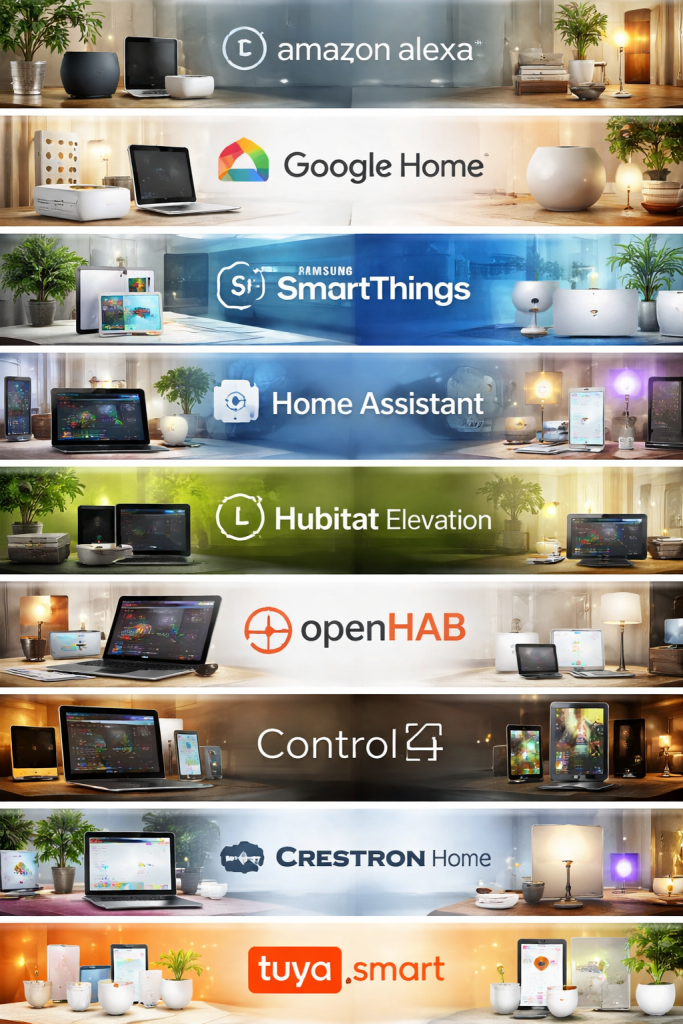
Smart Home Platforms are the central software ecosystems that connect, control, automate, and manage smart devices within a home or building. These platforms act as the “brain” of a smart home, allowing lights, thermostats, cameras, locks, speakers, sensors, and appliances to work together seamlessly through a single interface or automation logic.
Their importance has grown rapidly as homes become more connected and users demand convenience, energy efficiency, safety, and personalization. Instead of controlling each device through separate apps, smart home platforms unify everything—enabling voice control, automation routines, remote access, and intelligent decision-making.
Real-world use cases include:
- Automated lighting and climate control for energy savings
- Home security with cameras, motion sensors, and smart locks
- Voice-controlled entertainment and appliances
- Assisted living solutions for elderly or disabled users
- Smart energy management and monitoring
When choosing a smart home platform, users should evaluate:
- Device compatibility and ecosystem size
- Ease of setup and daily use
- Automation and customization capabilities
- Privacy, security, and data handling
- Scalability for future devices
- Cost and long-term value
Best for:
Smart Home Platforms benefit homeowners, renters, property managers, tech enthusiasts, families, hospitality businesses, real-estate developers, and enterprises managing connected buildings.
Not ideal for:
Users who prefer fully manual systems, homes with no internet access, or those seeking extremely simple, single-device solutions may not need a full smart home platform.
Top 10 Smart Home Platforms Tools
1 — Amazon Alexa
Short description:
Amazon Alexa is a voice-first smart home platform designed for consumers who want easy voice control and wide device compatibility across brands.
Key features:
- Voice control via Echo devices
- Large third-party device ecosystem
- Custom routines and automation
- Smart home groups and scenes
- Cloud-based intelligence
- Multi-room audio
- Skills marketplace
Pros:
- Extremely easy to use
- Massive device and brand support
- Affordable entry point
Cons:
- Heavy cloud dependence
- Privacy concerns for some users
Security & compliance:
Encryption in transit and at rest, account security controls, GDPR compliance (varies by region).
Support & community:
Extensive documentation, large global user community, strong customer support.
2 — Google Home (Google Nest)
Short description:
Google Home is a smart home platform focused on AI-driven intelligence, automation, and seamless integration with Google services.
Key features:
- Google Assistant voice control
- AI-powered automation suggestions
- Smart routines and household profiles
- Strong Nest device integration
- Cross-platform mobile apps
- Context-aware commands
Pros:
- Excellent voice recognition
- Strong automation intelligence
- Clean, intuitive interface
Cons:
- Limited advanced customization
- Best experience tied to Google ecosystem
Security & compliance:
Encrypted communications, Google account security, GDPR compliance.
Support & community:
High-quality documentation, active user forums, enterprise-grade infrastructure.
3 — Apple HomeKit
Short description:
Apple HomeKit is a privacy-focused smart home platform built for users deeply invested in the Apple ecosystem.
Key features:
- Secure local processing
- Home app central control
- Siri voice integration
- Automation and scenes
- Thread and Matter support
- End-to-end encryption
Pros:
- Strong privacy and security
- Reliable performance
- Elegant user experience
Cons:
- Smaller device ecosystem
- Higher hardware cost
Security & compliance:
End-to-end encryption, strong access controls, GDPR-aligned privacy standards.
Support & community:
Apple documentation, premium support, growing developer ecosystem.
4 — Samsung SmartThings
Short description:
Samsung SmartThings is a flexible smart home platform designed for users who want deep automation and broad device compatibility.
Key features:
- Multi-protocol support (Zigbee, Z-Wave, Wi-Fi)
- Advanced automation rules
- SmartThings hub integration
- Mobile and web dashboards
- Matter compatibility
- Custom scenes and routines
Pros:
- Highly customizable
- Wide device compatibility
- Strong automation logic
Cons:
- Setup can be complex
- Interface less polished than competitors
Security & compliance:
Encryption, account security controls, GDPR compliance varies by region.
Support & community:
Strong developer community, detailed documentation, enterprise-level backing.
5 — Home Assistant
Short description:
Home Assistant is an open-source smart home platform designed for advanced users who want full control and local processing.
Key features:
- Fully local control
- Open-source customization
- Powerful automation engine
- Supports thousands of devices
- No mandatory cloud dependency
- Custom dashboards
- Advanced scripting
Pros:
- Maximum flexibility
- Strong privacy
- No subscription required
Cons:
- Steep learning curve
- Requires technical knowledge
Security & compliance:
Varies / user-managed security, local encryption options.
Support & community:
Extremely active global community, extensive documentation, community plugins.
6 — Hubitat Elevation
Short description:
Hubitat Elevation is a local-first smart home platform focused on reliability and speed without cloud dependence.
Key features:
- Local automation processing
- Zigbee and Z-Wave support
- Advanced rule engine
- High performance
- Minimal latency
- Custom device drivers
Pros:
- Very fast and reliable
- Strong privacy
- No subscription fees
Cons:
- Less beginner-friendly
- Smaller ecosystem
Security & compliance:
Local processing, encrypted access, user-controlled security.
Support & community:
Good documentation, helpful community forums, responsive support.
7 — OpenHAB
Short description:
OpenHAB is an open-source, vendor-neutral smart home platform aimed at developers and advanced smart home users.
Key features:
- Open-source architecture
- Supports many protocols
- Advanced automation rules
- Cross-platform deployment
- Strong customization options
- Local and cloud hybrid support
Pros:
- Vendor neutrality
- Highly extensible
- Strong developer control
Cons:
- Complex setup
- Less polished UI
Security & compliance:
Varies by configuration, user-managed encryption.
Support & community:
Strong open-source community, extensive documentation.
8 — Control4
Short description:
Control4 is a premium smart home platform designed for luxury homes and professional installations.
Key features:
- Centralized whole-home control
- Professional installation
- Advanced audio-video integration
- Custom automation scenes
- Enterprise-grade reliability
- Touch panels and remotes
Pros:
- Extremely polished experience
- Highly reliable
- Ideal for large homes
Cons:
- High cost
- Dealer-dependent setup
Security & compliance:
Enterprise-grade security, encrypted communications.
Support & community:
Professional installer support, enterprise documentation.
9— Crestron Home
Short description:
Crestron Home is an enterprise-level smart home and building automation platform for high-end residential and commercial use.
Key features:
- Advanced building automation
- Custom programming
- Enterprise-grade hardware
- AV and lighting control
- High scalability
- Professional management tools
Pros:
- Unmatched scalability
- Extremely reliable
- Professional-grade control
Cons:
- Very expensive
- Not DIY-friendly
Security & compliance:
Enterprise security standards, encryption, audit controls.
Support & community:
Professional integrator support, enterprise documentation.
10 — Tuya Smart
Short description:
Tuya Smart is a cloud-based smart home platform powering thousands of white-label smart devices worldwide.
Key features:
- Massive device compatibility
- White-label platform support
- Cloud-based automation
- Voice assistant integration
- Global infrastructure
- App customization
Pros:
- Huge ecosystem
- Affordable devices
- Easy onboarding
Cons:
- Heavy cloud reliance
- Limited advanced automation
Security & compliance:
Cloud security controls, GDPR compliance varies by region.
Support & community:
Developer resources, manufacturer support, growing community.
Comparison Table
| Tool Name | Best For | Platform(s) Supported | Standout Feature | Rating |
|---|---|---|---|---|
| Amazon Alexa | Voice-first homes | iOS, Android, Cloud | Largest ecosystem | N/A |
| Google Home | AI-driven automation | iOS, Android, Cloud | Intelligent routines | N/A |
| Apple HomeKit | Privacy-focused users | iOS, macOS | End-to-end encryption | N/A |
| Samsung SmartThings | Custom automation | iOS, Android, Web | Multi-protocol support | N/A |
| Home Assistant | Power users | Cross-platform | Local control | N/A |
| Hubitat Elevation | Low-latency setups | Local hub | Cloud-free automation | N/A |
| OpenHAB | Developers | Cross-platform | Vendor neutrality | N/A |
| Control4 | Luxury homes | Proprietary | Professional integration | N/A |
| Crestron Home | Enterprises | Proprietary | Massive scalability | N/A |
| Tuya Smart | Budget ecosystems | iOS, Android | White-label support | N/A |
Evaluation & Scoring of Smart Home Platforms
| Criteria | Weight | Avg Score (1–5) | Weighted Score |
|---|---|---|---|
| Core features | 25% | 4.5 | 1.125 |
| Ease of use | 15% | 4.2 | 0.63 |
| Integrations & ecosystem | 15% | 4.6 | 0.69 |
| Security & compliance | 10% | 4.0 | 0.40 |
| Performance & reliability | 10% | 4.3 | 0.43 |
| Support & community | 10% | 4.4 | 0.44 |
| Price / value | 15% | 4.1 | 0.62 |
| Total | 100% | — | 4.33 / 5 |
Which Smart Home Platforms Tool Is Right for You?
- Solo users & beginners: Amazon Alexa, Google Home
- Privacy-focused households: Apple HomeKit, Hubitat
- Tech enthusiasts: Home Assistant, OpenHAB
- SMBs & property managers: Samsung SmartThings, Tuya
- Luxury homes & enterprises: Control4, Crestron
Budget-conscious users should prioritize platforms with wide compatibility and no subscriptions. Premium users may value reliability, customization, and professional installation.
Frequently Asked Questions (FAQs)
1. What is a smart home platform?
It is a system that connects and controls multiple smart devices through one interface.
2. Do I need a hub for smart home platforms?
Some platforms require hubs, others are cloud-based or hybrid.
3. Are smart home platforms secure?
Security varies by platform; encryption and local control improve safety.
4. Can I mix brands?
Yes, most platforms support multiple device brands.
5. Do these platforms require subscriptions?
Many do not, but some advanced features may.
6. What is Matter?
Matter is a new standard improving device interoperability.
7. Which platform is best for privacy?
Apple HomeKit and Home Assistant are strong choices.
8. Can smart homes work offline?
Local-first platforms can function offline.
9. Are smart home platforms scalable?
Yes, especially enterprise-grade solutions.
10. What is the biggest mistake buyers make?
Not checking device compatibility before purchasing.
Conclusion
Smart Home Platforms are essential for creating connected, intelligent, and efficient living spaces. The right platform simplifies daily life, improves security, and enables automation tailored to individual needs.
There is no single “best” smart home platform for everyone. The ideal choice depends on budget, technical comfort, privacy expectations, ecosystem preference, and long-term scalability. By carefully evaluating features, integrations, and real-world requirements, users can select a platform that delivers lasting value and a truly smart home experience.

Find Trusted Cardiac Hospitals
Compare heart hospitals by city and services — all in one place.
Explore Hospitals
This comparison of smart home platforms is a very informative and practical resource for anyone working to build an integrated and efficient smart ecosystem at home. The way the article breaks down key features, strengths, and limitations for each platform makes it much easier to understand how they differ in terms of device compatibility, automation capabilities, security, and ease of use. Having the pros and cons presented clearly side by side helps readers make confident decisions when choosing the right smart home platform that fits their lifestyle and technology setup.