
Introduction
Clinical research generates enormous volumes of sensitive, complex data—from patient demographics and lab results to adverse events and protocol deviations. A Clinical Data Management System (CDMS) is the backbone that ensures this data is accurate, complete, auditable, and regulatory-ready throughout the clinical trial lifecycle.
Modern CDMS platforms help research teams design electronic case report forms (eCRFs), validate and clean data in real time, manage queries, and prepare datasets for analysis and regulatory submission. As trials become more decentralized, data sources multiply (EDC, ePRO, wearables, labs), making centralized data governance essential.
When evaluating CDMS tools, buyers should focus on data integrity, usability, scalability, interoperability, security, and compliance. The right CDMS reduces cycle times, minimizes errors, improves collaboration, and supports faster, more confident decision-making.
Best for:
Clinical research organizations (CROs), pharmaceutical and biotech companies, medical device firms, academic research centers, and healthcare innovators running regulated clinical studies—from early phase to post-marketing.
Not ideal for:
Teams running non-regulated observational research, small academic projects with minimal data complexity, or organizations that only need basic survey tools without validation, audit trails, or regulatory rigor.
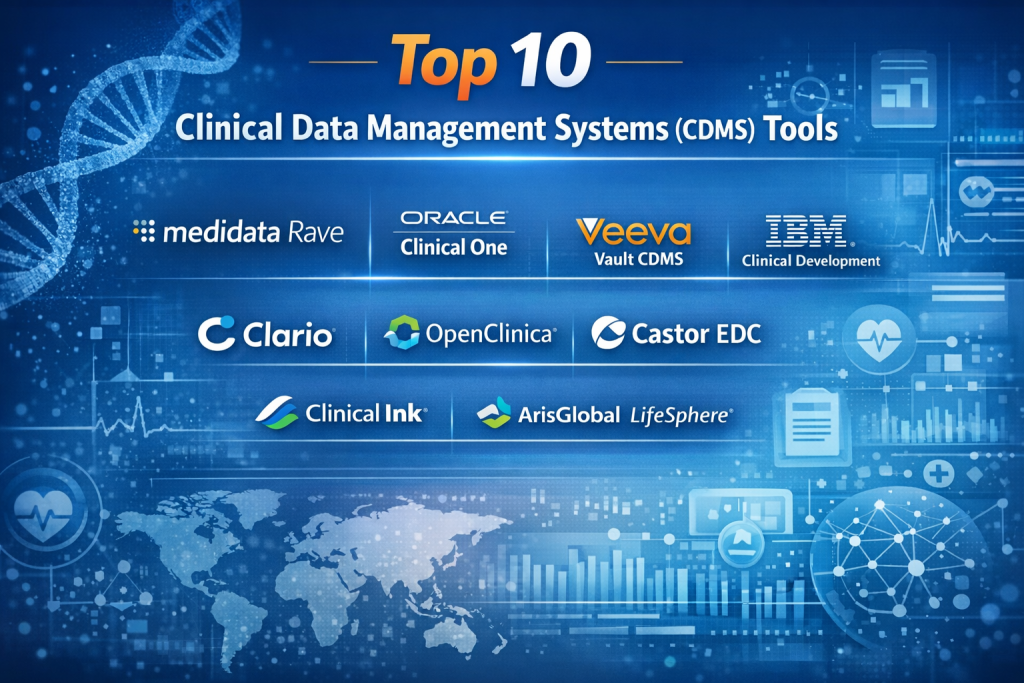
Top 10 Clinical Data Management Systems (CDMS) Tools
1 — Medidata Rave
Short description:
A market-leading enterprise CDMS widely used in global, complex clinical trials. Designed for large sponsors and CROs managing multi-site, multi-country studies.
Key features
- Advanced eCRF design and validation rules
- Real-time data cleaning and query management
- Centralized monitoring and risk-based analytics
- Strong integration with CTMS, ePRO, and labs
- Role-based access and granular permissions
- Scalable architecture for global trials
Pros
- Industry-trusted and regulator-friendly
- Extremely robust for complex trials
Cons
- High cost and longer implementation time
- Steeper learning curve for small teams
Security & compliance: SOC 2, GDPR, HIPAA support, encryption, audit trails
Support & community: Enterprise onboarding, extensive documentation, global support teams
2 — Oracle Clinical One
Short description:
An integrated CDMS within Oracle’s clinical ecosystem, suitable for large, data-intensive trials requiring deep analytics and scalability.
Key features
- Unified CDMS and EDC experience
- Automated edit checks and discrepancy management
- Strong analytics and reporting
- High-volume data handling
- Tight integration with Oracle CTMS and safety tools
Pros
- Powerful performance at scale
- Backed by Oracle’s infrastructure
Cons
- Premium pricing
- Less flexible UI compared to newer platforms
Security & compliance: Enterprise-grade security, GDPR, HIPAA, audit logging
Support & community: Strong enterprise support, structured training programs
3 — Veeva Vault CDMS
Short description:
A modern, cloud-native CDMS built on the Veeva Vault platform, popular among life-science companies seeking unified clinical operations.
Key features
- Cloud-based eCRF and data workflows
- Seamless integration with Vault CTMS and eTMF
- Configurable data models
- Real-time collaboration
- Strong regulatory readiness
Pros
- Clean, modern interface
- Excellent ecosystem integration
Cons
- Best value when used within Veeva suite
- Customization requires planning
Security & compliance: GDPR, HIPAA, ISO-aligned controls, audit trails
Support & community: High-quality documentation, dedicated customer success
4 — IBM Clinical Development
Short description:
A CDMS focused on data quality, AI-assisted insights, and predictive analytics for clinical development teams.
Key features
- AI-driven data validation
- Advanced dashboards and reporting
- Risk-based monitoring support
- Scalable cloud deployment
- Integration with analytics tools
Pros
- Strong analytics and insights
- Reliable enterprise performance
Cons
- UI can feel technical
- Smaller ecosystem than peers
Security & compliance: Enterprise security, GDPR support, audit trails
Support & community: Professional support, solid technical documentation
5 — Clario
Short description:
Combines CDMS with endpoint data expertise, particularly strong in imaging, cardiac, and eCOA data.
Key features
- Centralized clinical data hub
- Multi-source data ingestion
- Data standardization tools
- Real-time quality checks
- Global trial support
Pros
- Excellent for complex endpoint data
- Strong scientific expertise
Cons
- Less flexible as a standalone CDMS
- Enterprise-focused pricing
Security & compliance: GDPR, HIPAA, ISO-aligned practices
Support & community: Dedicated project teams, global service model
6 — OpenClinica
Short description:
A flexible CDMS offering both open-source and enterprise editions, widely used in academic and mid-size trials.
Key features
- eCRF design and validation
- Query and discrepancy management
- Open standards support
- Cloud and self-hosted options
- Cost-effective licensing
Pros
- Budget-friendly
- Transparent and flexible
Cons
- UI less polished than premium tools
- Advanced analytics are limited
Security & compliance: GDPR, audit trails, role-based access
Support & community: Active community, enterprise support available
7 — Castor EDC
Short description:
A user-friendly CDMS ideal for academic, investigator-initiated, and mid-scale clinical studies.
Key features
- Intuitive eCRF builder
- Real-time validations
- API and integration support
- Audit logs and version control
- Rapid study setup
Pros
- Very easy to use
- Fast onboarding
Cons
- Limited advanced analytics
- Less suitable for very large trials
Security & compliance: GDPR, HIPAA support, encrypted data
Support & community: Responsive support, clear documentation
8 — REDCap
Short description:
A widely adopted academic CDMS for secure data capture, especially in universities and hospitals.
Key features
- Secure web-based data capture
- eCRFs and surveys
- Role-based permissions
- Data export tools
- Large global user base
Pros
- Free for eligible institutions
- Extremely popular in academia
Cons
- Not built for large commercial trials
- Limited workflow automation
Security & compliance: Varies by host institution
Support & community: Massive community, extensive guides
9 — Clinical Ink
Short description:
A CDMS with strong emphasis on digital source data and decentralized trial workflows.
Key features
- Direct data capture from sites
- eSource and eCRF unification
- Mobile-friendly interfaces
- Real-time monitoring
- Reduced transcription errors
Pros
- Strong for decentralized trials
- Improves data accuracy
Cons
- Niche focus
- Smaller ecosystem
Security & compliance: GDPR, HIPAA, audit trails
Support & community: Dedicated implementation teams
10— ArisGlobal LifeSphere
Short description:
An integrated life-sciences platform offering CDMS alongside safety and regulatory modules.
Key features
- Unified clinical data workflows
- Automation for data cleaning
- Regulatory submission readiness
- Scalable cloud infrastructure
- Integration with safety systems
Pros
- Strong end-to-end vision
- Good automation features
Cons
- UI can feel complex
- Best suited for enterprise use
Security & compliance: GDPR, ISO-aligned controls, audit logs
Support & community: Enterprise-level support and training
Comparison Table
| Tool Name | Best For | Platform(s) Supported | Standout Feature | Rating |
|---|---|---|---|---|
| Medidata Rave | Large global trials | Cloud | Industry-leading robustness | N/A |
| Oracle Clinical One | Enterprise sponsors | Cloud | Scalability & analytics | N/A |
| Veeva Vault CDMS | Life-science orgs | Cloud | Unified Vault ecosystem | N/A |
| IBM Clinical Development | Data-driven teams | Cloud | AI-assisted insights | N/A |
| Clario | Endpoint-heavy trials | Cloud | Specialized data expertise | N/A |
| OpenClinica | Academic & mid-size | Cloud / Self-hosted | Flexibility & cost | N/A |
| Castor EDC | Investigator-led studies | Cloud | Ease of use | N/A |
| REDCap | Academic research | Web-based | Community adoption | N/A |
| Clinical Ink | Decentralized trials | Cloud / Mobile | Direct data capture | N/A |
| ArisGlobal LifeSphere | Enterprise life sciences | Cloud | End-to-end platform | N/A |
Evaluation & Scoring of Clinical Data Management Systems (CDMS)
| Criteria | Weight | Evaluation Focus |
|---|---|---|
| Core features | 25% | eCRFs, validation, queries, exports |
| Ease of use | 15% | Learning curve, UI clarity |
| Integrations & ecosystem | 15% | CTMS, eTMF, labs, APIs |
| Security & compliance | 10% | Encryption, audit trails, standards |
| Performance & reliability | 10% | Stability, scalability |
| Support & community | 10% | Onboarding, docs, responsiveness |
| Price / value | 15% | ROI relative to features |
Which Clinical Data Management Systems (CDMS) Tool Is Right for You?
- Solo users & academics: Look for simplicity and affordability (REDCap, Castor EDC).
- SMBs & mid-market: Balance usability and compliance (OpenClinica, Castor).
- Enterprise sponsors: Prioritize scalability and integrations (Medidata, Oracle, Veeva).
- Budget-conscious teams: Consider open or flexible licensing.
- Highly regulated trials: Focus on auditability and validation readiness.
- Decentralized studies: Choose tools with mobile and eSource capabilities.
Frequently Asked Questions (FAQs)
1. What is a CDMS used for?
To collect, validate, clean, and manage clinical trial data in a compliant manner.
2. Is CDMS the same as EDC?
EDC is a core component; CDMS covers broader data workflows and governance.
3. Do small trials need a CDMS?
Yes, if data integrity and auditability are required.
4. How long does implementation take?
From days for simple tools to months for enterprise platforms.
5. Are CDMS tools cloud-based?
Most modern systems are cloud-native.
6. What regulations do CDMS tools support?
Commonly GDPR, HIPAA, and audit trail requirements.
7. Can CDMS integrate with labs and wearables?
Yes, many support multi-source integrations.
8. Is training required?
Basic tools need minimal training; enterprise tools require structured onboarding.
9. What is the biggest buying mistake?
Overbuying complexity or underestimating compliance needs.
10. Is there a “best” CDMS?
No—fit depends on trial size, budget, and regulatory scope.
Conclusion
Clinical Data Management Systems are foundational to trustworthy, efficient clinical research. The best CDMS ensures data quality, regulatory confidence, and operational efficiency—but the “right” choice depends on your study design, scale, and resources. By focusing on usability, compliance, and integration needs, teams can select a platform that supports better science and faster outcomes—without unnecessary complexity.

Find Trusted Cardiac Hospitals
Compare heart hospitals by city and services — all in one place.
Explore Hospitals