
Introduction
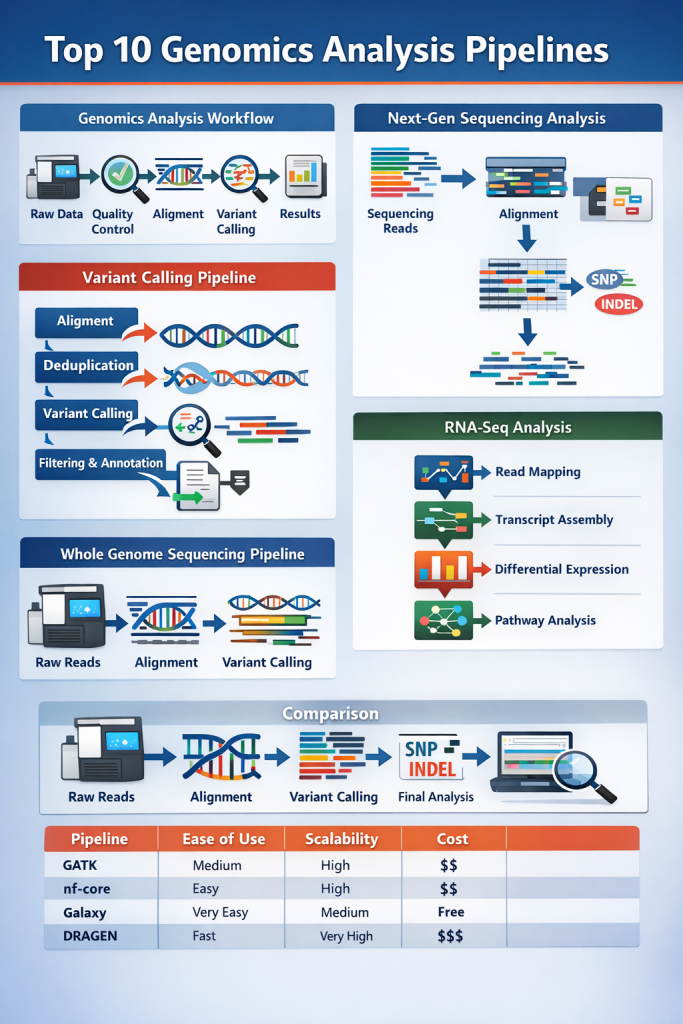
Genomics Analysis Pipelines are structured, automated workflows designed to process raw sequencing data into meaningful biological insights. They handle complex steps such as quality control, read alignment, variant calling, annotation, and interpretation—tasks that would otherwise be time-consuming, error-prone, and difficult to reproduce. As sequencing technologies become faster and more affordable, the volume of genomic data has exploded, making robust pipelines essential rather than optional.
These pipelines play a critical role across research, clinical diagnostics, drug discovery, agriculture, and population genomics. From identifying disease-causing variants to tracking pathogen outbreaks and enabling precision medicine, genomics pipelines help transform massive datasets into actionable outcomes. Modern solutions also emphasize reproducibility, scalability, security, and compliance, especially in regulated environments.
When evaluating Genomics Analysis Pipelines, users should focus on workflow flexibility, supported data types, scalability, ease of use, integration with cloud or HPC environments, security controls, and community or vendor support. The right pipeline accelerates discovery while reducing operational friction and technical risk.
Best for:
Genomics Analysis Pipelines are ideal for bioinformaticians, computational biologists, clinical geneticists, pharma R&D teams, academic researchers, and biotech companies working with NGS, WGS, WES, RNA-seq, or metagenomics data.
Not ideal for:
They may be excessive for very small labs with minimal sequencing output, teams without any bioinformatics capability, or projects requiring only simple, one-off analyses, where lightweight tools or outsourced services may be more practical.
Top 10 Genomics Analysis Pipelines Tools
1 — GATK (Genome Analysis Toolkit)
Short description:
A widely adopted genomics analysis framework focused on high-accuracy variant discovery. Commonly used in research and clinical genomics.
Key features:
- Best-practice workflows for germline and somatic variant calling
- Robust quality control and recalibration steps
- Supports WGS and WES data
- Highly reproducible pipeline design
- Optimized for large-scale datasets
- Extensive documentation and examples
Pros:
- Gold standard for variant analysis
- Strong scientific validation
- Highly configurable for advanced users
Cons:
- Steep learning curve for beginners
- Resource-intensive for large datasets
Security & compliance:
Varies / N/A (depends on deployment environment)
Support & community:
Large global community, excellent documentation, active forums, enterprise support available via partners
2 — nf-core Pipelines
Short description:
A community-driven collection of standardized, peer-reviewed genomics pipelines built on Nextflow.
Key features:
- Reproducible and versioned workflows
- Broad coverage (RNA-seq, ChIP-seq, WGS, metagenomics)
- Containerized execution
- Cloud and HPC compatibility
- Strong quality assurance standards
- Transparent pipeline development
Pros:
- Extremely reproducible
- Strong community governance
- Rapid adoption of best practices
Cons:
- Requires workflow engine knowledge
- Customization can be complex
Security & compliance:
Varies / N/A (inherits infrastructure security)
Support & community:
Very active open-source community, detailed docs, Slack and GitHub support
3 — Galaxy
Short description:
A web-based platform enabling accessible genomics analysis without deep programming expertise.
Key features:
- Intuitive graphical interface
- Hundreds of integrated bioinformatics tools
- Workflow creation and sharing
- Data provenance tracking
- Supports many omics data types
- Public and private deployment options
Pros:
- Beginner-friendly
- Strong emphasis on reproducibility
- Minimal coding required
Cons:
- Performance can lag for very large datasets
- Limited customization for advanced users
Security & compliance:
Varies / N/A (self-hosted deployments can be secured)
Support & community:
Large academic community, extensive tutorials, training materials available
4— Seven Bridges
Short description:
A commercial, cloud-native genomics analysis platform designed for regulated and large-scale environments.
Key features:
- Visual and code-based workflow design
- Scalable cloud execution
- Integrated data management
- Collaborative analysis environment
- Audit trails and version control
- Clinical-grade analytics
Pros:
- Enterprise-ready
- Excellent scalability
- Strong compliance posture
Cons:
- Premium pricing
- Vendor dependency
Security & compliance:
Supports encryption, audit logs, GDPR, HIPAA, ISO standards
Support & community:
Professional onboarding, enterprise support, strong documentation
5 — DNAnexus
Short description:
A secure, cloud-based genomics platform supporting research and clinical pipelines at scale.
Key features:
- End-to-end genomics workflow management
- Cloud scalability
- Collaboration and data sharing
- Workflow automation
- Integrated analysis apps
- Strong compliance controls
Pros:
- Highly secure
- Scales well for enterprise use
- Robust collaboration features
Cons:
- Less flexible for custom pipelines
- Higher cost for small teams
Security & compliance:
SOC 2, HIPAA, GDPR, encryption, audit logging
Support & community:
Enterprise-level support, onboarding services, documentation
6 — Nextflow
Short description:
A workflow orchestration engine widely used to build portable and scalable genomics pipelines.
Key features:
- Workflow versioning
- Cloud and HPC support
- Container and conda integration
- Highly scalable execution
- Strong reproducibility
- Language-agnostic tool integration
Pros:
- Extremely flexible
- Strong ecosystem
- Excellent scalability
Cons:
- Requires scripting skills
- No built-in UI
Security & compliance:
Varies / N/A
Support & community:
Active developer community, detailed documentation, commercial support available
7 — Snakemake
Short description:
A Python-based workflow management system for reproducible genomics and bioinformatics pipelines.
Key features:
- Simple rule-based workflow definitions
- Native Python integration
- Supports HPC and cloud
- Automatic dependency resolution
- Version control friendly
- Lightweight setup
Pros:
- Easy to learn for Python users
- Highly transparent workflows
- Flexible design
Cons:
- Less enterprise tooling
- Limited GUI options
Security & compliance:
Varies / N/A
Support & community:
Strong academic adoption, good documentation, community forums
8 — BaseSpace Sequence Hub
Short description:
A genomics analysis environment tightly integrated with sequencing instruments and cloud analytics.
Key features:
- Seamless data ingestion from sequencers
- Prebuilt analysis pipelines
- Cloud-based storage and compute
- Collaboration features
- App ecosystem
- Automated reporting
Pros:
- Easy instrument integration
- Minimal setup required
- Reliable performance
Cons:
- Limited customization
- Vendor-centric ecosystem
Security & compliance:
Encryption, GDPR, HIPAA support
Support & community:
Vendor support, documentation, onboarding assistance
9 — Terra
Short description:
A collaborative, cloud-native platform for large-scale biomedical data analysis.
Key features:
- Workspace-based collaboration
- Workflow execution at scale
- Data sharing and access controls
- Supports standardized pipelines
- Interactive analysis environments
- Versioned workflows
Pros:
- Designed for large research consortia
- Strong collaboration tools
- Scales well
Cons:
- Requires cloud expertise
- Less suitable for small labs
Security & compliance:
Encryption, access controls, GDPR-aligned
Support & community:
Research-focused community, documentation, institutional support
10 — CLC Genomics Workbench
Short description:
A commercial desktop and server-based solution offering end-to-end genomics analysis with a visual interface.
Key features:
- Graphical workflow design
- Variant analysis and visualization
- RNA-seq and metagenomics support
- Integrated reporting
- Plugin ecosystem
- Local and server deployment
Pros:
- User-friendly UI
- Strong visualization tools
- Suitable for non-coders
Cons:
- Licensing cost
- Limited scalability compared to cloud-native tools
Security & compliance:
Varies / N/A (depends on deployment)
Support & community:
Vendor documentation, training, professional support
Comparison Table
| Tool Name | Best For | Platform(s) Supported | Standout Feature | Rating |
|---|---|---|---|---|
| GATK | Clinical & research variant analysis | Linux, Cloud | Variant calling accuracy | N/A |
| nf-core | Standardized research pipelines | Cloud, HPC | Community-validated workflows | N/A |
| Galaxy | Beginner-friendly analysis | Web, Local | No-code workflows | N/A |
| Seven Bridges | Enterprise genomics | Cloud | Compliance-ready pipelines | N/A |
| DNAnexus | Secure clinical research | Cloud | Security & collaboration | N/A |
| Nextflow | Custom scalable pipelines | Cloud, HPC | Portability & scalability | N/A |
| Snakemake | Python-centric workflows | Local, HPC | Simplicity & transparency | N/A |
| BaseSpace | Sequencer-centric labs | Cloud | Instrument integration | N/A |
| Terra | Large consortia | Cloud | Collaborative workspaces | N/A |
| CLC Genomics | Visual genomics analysis | Desktop, Server | GUI-driven workflows | N/A |
Evaluation & Scoring of Genomics Analysis Pipelines
| Tool | Core Features (25%) | Ease of Use (15%) | Integrations (15%) | Security (10%) | Performance (10%) | Support (10%) | Price/Value (15%) | Total Score |
|---|---|---|---|---|---|---|---|---|
| GATK | 9 | 6 | 7 | 6 | 8 | 8 | 7 | 7.5 |
| nf-core | 8 | 7 | 8 | 6 | 8 | 9 | 9 | 8.1 |
| Galaxy | 7 | 9 | 6 | 6 | 6 | 8 | 8 | 7.4 |
| Seven Bridges | 9 | 8 | 8 | 9 | 9 | 8 | 6 | 8.2 |
| DNAnexus | 8 | 7 | 8 | 9 | 8 | 8 | 6 | 7.9 |
Which Genomics Analysis Pipelines Tool Is Right for You?
- Solo users & small labs: Galaxy, Snakemake, CLC Genomics Workbench
- SMBs & academic groups: nf-core, Nextflow, GATK
- Mid-market & enterprise: Seven Bridges, DNAnexus, Terra
- Budget-conscious teams: Open-source pipelines with HPC or cloud credits
- Compliance-driven organizations: DNAnexus or Seven Bridges
- Maximum flexibility: Nextflow or Snakemake
Frequently Asked Questions (FAQs)
1. What is a genomics analysis pipeline?
It is an automated workflow that converts raw sequencing data into analyzed, interpretable results.
2. Do I need programming skills?
Not always. Tools like Galaxy and CLC offer graphical interfaces, while others require scripting.
3. Are these pipelines suitable for clinical use?
Some are, but clinical deployment requires validation, compliance, and regulatory alignment.
4. Can pipelines run on the cloud?
Yes. Many modern pipelines are cloud-native or cloud-compatible.
5. How important is reproducibility?
Critical. Reproducibility ensures consistent results across runs and environments.
6. Are open-source tools reliable?
Yes, many are industry-standard and heavily peer-reviewed.
7. What datasets are supported?
Most support WGS, WES, RNA-seq, and metagenomics.
8. How do I choose between Nextflow and Snakemake?
Choose based on team skills and infrastructure preferences.
9. Are these tools scalable?
Cloud-based and workflow-oriented tools scale extremely well.
10. What is the biggest mistake buyers make?
Choosing complexity over usability or ignoring long-term scalability.
Conclusion
Genomics Analysis Pipelines are foundational to modern biological research and precision medicine. The right solution can dramatically improve accuracy, speed, and reproducibility while reducing operational burden. There is no single best tool for everyone—the optimal choice depends on your data volume, technical expertise, compliance needs, and budget. By carefully aligning pipeline capabilities with real-world requirements, teams can unlock the full potential of genomic data and accelerate meaningful discoveries.

Find Trusted Cardiac Hospitals
Compare heart hospitals by city and services — all in one place.
Explore Hospitals