
Introduction
Social Commerce Platforms are digital tools that allow businesses to sell products and services directly through social media channels. Instead of redirecting users to a traditional eCommerce website, these platforms enable discovery, engagement, and checkout within social environments where customers already spend a significant amount of their time. The result is a more seamless, conversational, and impulse-friendly buying experience.
Social commerce has become increasingly important as consumer behavior shifts toward mobile-first, community-driven, and influencer-led purchasing. Buyers now expect frictionless purchasing journeys, social proof through reviews and creators, and personalized recommendations delivered in real time. For brands, this means higher conversion rates, shorter sales cycles, and stronger customer relationships.
Common real-world use cases include:
- Selling products via Instagram Shops, Facebook Shops, or TikTok videos
- Influencer-driven product launches and live shopping events
- Conversational commerce using chat and messaging
- Community-based selling through social groups and brand advocates
When choosing a social commerce platform, users should evaluate ease of integration with social networks, checkout experience, analytics and attribution, scalability, security, and total cost of ownership.
Best for:
Social Commerce Platforms are ideal for DTC brands, online retailers, creators, influencers, SMBs, and enterprise brands in fashion, beauty, electronics, lifestyle, and consumer goods that rely on social discovery and engagement.
Not ideal for:
They may be unnecessary for pure B2B companies, highly regulated offline-only businesses, or organizations with long, complex procurement cycles where social channels play a minimal role.
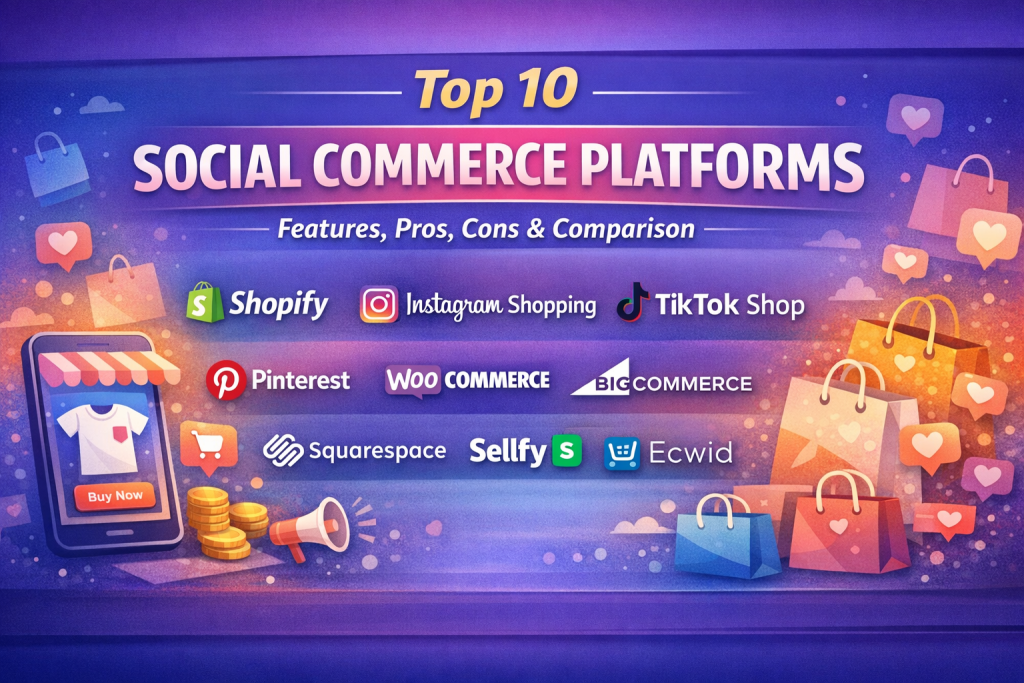
Top 10 Social Commerce Platforms Tools
1 — Shopify
Short description:
A leading commerce platform that integrates deeply with social media to enable in-app shopping and social storefronts.
Key features:
- Native integrations with major social networks
- Unified product catalog and inventory sync
- Social checkout and shoppable posts
- Influencer and affiliate selling tools
- Advanced analytics and reporting
- App marketplace for customization
Pros:
- Easy to set up and scale
- Strong ecosystem and integrations
Cons:
- Transaction fees on some plans
- Advanced features can increase costs
Security & compliance:
SSL encryption, PCI-DSS compliance, GDPR support
Support & community:
Extensive documentation, large community, 24/7 support on higher plans
2 — Instagram Shopping
Short description:
A native shopping solution that allows brands to sell products directly through Instagram posts, stories, and reels.
Key features:
- Shoppable posts and stories
- Product tagging in reels
- In-app checkout (region dependent)
- Creator and influencer tagging
- Mobile-optimized discovery
- Insights via Meta analytics
Pros:
- Massive built-in audience
- Strong visual storytelling
Cons:
- Limited customization
- Dependent on Meta policies
Security & compliance:
Meta security infrastructure, GDPR compliance
Support & community:
Help center documentation, limited direct support
3 — Facebook Shops
Short description:
A customizable storefront within Facebook that enables direct product discovery and messaging-based selling.
Key features:
- Custom storefronts
- Messenger-based commerce
- Product catalog sync
- Paid and organic discovery
- Cross-platform Meta integration
- Order management tools
Pros:
- Strong social targeting
- Works well with ads
Cons:
- Limited branding flexibility
- Platform dependency
Security & compliance:
Meta security standards, GDPR support
Support & community:
Knowledge base, advertiser support channels
4 — TikTok Shop
Short description:
A fast-growing social commerce solution enabling creators and brands to sell directly through short-form videos.
Key features:
- In-video product links
- Live shopping events
- Creator affiliate marketplace
- Algorithm-driven discovery
- Integrated fulfillment options
- Performance analytics
Pros:
- High engagement rates
- Strong creator economy
Cons:
- Still evolving features
- Regional availability limits
Security & compliance:
Standard encryption, regional compliance varies
Support & community:
Creator resources, limited enterprise support
5 — Pinterest Shopping
Short description:
A visual discovery platform that enables product discovery and shopping through pins and curated boards.
Key features:
- Shoppable pins
- Product catalogs
- Visual search and recommendations
- Evergreen content visibility
- Brand storefronts
- Conversion insights
Pros:
- Long content lifespan
- Strong intent-based discovery
Cons:
- Smaller audience than Meta
- Limited real-time engagement
Security & compliance:
GDPR compliant, standard data protection
Support & community:
Documentation, advertiser support
6 — WooCommerce
Short description:
An open-source commerce plugin that extends WordPress sites with social commerce integrations.
Key features:
- Social media extensions
- Customizable storefronts
- Open-source flexibility
- Large plugin ecosystem
- Ownership of data
- Multi-channel selling
Pros:
- Highly customizable
- No mandatory platform fees
Cons:
- Requires technical setup
- Maintenance overhead
Security & compliance:
Depends on hosting and plugins, GDPR capable
Support & community:
Large open-source community, paid support options
7 — BigCommerce
Short description:
A scalable eCommerce platform designed for fast-growing brands with strong multi-channel selling capabilities.
Key features:
- Native social channel integrations
- Headless commerce support
- Built-in SEO tools
- Enterprise-grade performance
- Multi-storefront support
- Advanced APIs
Pros:
- No transaction fees
- Strong scalability
Cons:
- Learning curve for beginners
- Higher pricing tiers
Security & compliance:
SOC 2, PCI-DSS, GDPR compliant
Support & community:
24/7 support, partner ecosystem
8 — Squarespace
Short description:
An all-in-one website and commerce platform with built-in social selling capabilities.
Key features:
- Shoppable social posts
- Built-in design templates
- Inventory management
- Mobile-optimized checkout
- Basic analytics
- Easy setup
Pros:
- Excellent design quality
- Beginner-friendly
Cons:
- Limited advanced commerce features
- Fewer integrations
Security & compliance:
SSL encryption, GDPR support
Support & community:
Email support, knowledge base
9 — Sellfy
Short description:
A simple platform designed for creators to sell products directly via social channels.
Key features:
- Digital and physical product sales
- Social media checkout links
- Subscription products
- Built-in marketing tools
- Pay-what-you-want pricing
- Analytics dashboard
Pros:
- Simple and fast setup
- Affordable pricing
Cons:
- Limited enterprise features
- Basic customization
Security & compliance:
Standard encryption, GDPR support
Support & community:
Email support, creator resources
10 — Ecwid
Short description:
A lightweight commerce solution that integrates seamlessly with social media and existing websites.
Key features:
- Social selling integrations
- Multi-language support
- Mobile management app
- Inventory sync
- Omnichannel selling
- Flexible embedding
Pros:
- Easy integration
- Works with existing sites
Cons:
- Limited advanced analytics
- Fewer enterprise tools
Security & compliance:
PCI-DSS, GDPR compliant
Support & community:
Knowledge base, live chat on paid plans
Comparison Table
| Tool Name | Best For | Platform(s) Supported | Standout Feature | Rating |
|---|---|---|---|---|
| Shopify | Growing DTC brands | Web, Social, Mobile | App ecosystem | N/A |
| Instagram Shopping | Visual brands | Mobile | Shoppable content | N/A |
| Facebook Shops | Social advertisers | Web, Mobile | Messenger commerce | N/A |
| TikTok Shop | Creator-led sales | Mobile | Viral discovery | N/A |
| Pinterest Shopping | Inspiration-driven sales | Web, Mobile | Visual search | N/A |
| WooCommerce | Custom WordPress sites | Web | Open-source flexibility | N/A |
| BigCommerce | Enterprise brands | Web, Headless | Scalability | N/A |
| Squarespace | Designers & SMBs | Web | Design simplicity | N/A |
| Sellfy | Creators | Web | Digital product focus | N/A |
| Ecwid | Existing websites | Web, Social | Easy embedding | N/A |
Evaluation & Scoring of Social Commerce Platforms
| Criteria | Weight | Description |
|---|---|---|
| Core features | 25% | Social selling, checkout, analytics |
| Ease of use | 15% | Setup, UI, learning curve |
| Integrations & ecosystem | 15% | Social networks, APIs |
| Security & compliance | 10% | Data protection standards |
| Performance & reliability | 10% | Speed and uptime |
| Support & community | 10% | Help and resources |
| Price / value | 15% | Cost vs benefits |
Which Social Commerce Platforms Tool Is Right for You?
- Solo users & creators: Simple tools with fast setup and low cost
- SMBs: Platforms with built-in integrations and automation
- Mid-market: Balance of customization and scalability
- Enterprise: Advanced APIs, compliance, and multi-store support
Budget-conscious users should focus on ease of use and pricing, while premium buyers may prioritize analytics, integrations, and performance. Scalability and security become critical as transaction volumes grow.
Frequently Asked Questions (FAQs)
- What is social commerce?
It is the practice of selling directly through social media platforms. - Do I need a website for social commerce?
Not always; many platforms offer in-app checkout. - Is social commerce secure?
Most platforms use industry-standard encryption and compliance measures. - Can small businesses benefit?
Yes, especially those targeting mobile and social audiences. - Does social commerce replace eCommerce sites?
It complements rather than replaces traditional sites. - Are there transaction fees?
Fees vary by platform and plan. - Which industries benefit most?
Fashion, beauty, lifestyle, and consumer goods. - How scalable are these platforms?
Scalability depends on the tool and pricing tier. - Do these platforms support influencers?
Many offer creator and affiliate tools. - What is the biggest mistake to avoid?
Choosing a platform without considering long-term growth.
Conclusion
Social Commerce Platforms have transformed how brands connect with customers by merging shopping with social interaction. The most important factors when choosing a platform are audience alignment, ease of use, scalability, security, and value for money. There is no single best solution for everyone—the right choice depends on your business size, goals, and social strategy. By understanding your needs and evaluating tools carefully, you can build a social commerce presence that drives sustainable growth.

Find Trusted Cardiac Hospitals
Compare heart hospitals by city and services — all in one place.
Explore Hospitals