
Introduction
Supply Chain Management (SCM) Suites are integrated software platforms designed to plan, execute, and optimize end-to-end supply chain operations—from demand forecasting and procurement to manufacturing, logistics, and fulfillment. In today’s volatile markets, organizations face disruptions from fluctuating demand, geopolitical risks, supplier instability, and rising customer expectations. SCM suites help companies respond faster, reduce costs, and improve service levels by turning fragmented processes into a single, data-driven operating model.
Modern SCM suites combine advanced planning, real-time visibility, analytics, and automation. They are widely used across industries such as manufacturing, retail, healthcare, automotive, aerospace, and consumer goods. Typical use cases include demand forecasting, inventory optimization, supplier collaboration, production scheduling, logistics planning, and risk mitigation.
When choosing an SCM suite, buyers should evaluate functional depth, usability, integration capabilities, scalability, security, and total cost of ownership. Equally important is how well the platform aligns with industry-specific workflows and the organization’s digital maturity.
Best for:
Operations leaders, supply chain planners, procurement teams, logistics managers, CIOs, and executives at mid-market to enterprise organizations with complex, multi-node supply chains across manufacturing, retail, distribution, pharmaceuticals, and automotive sectors.
Not ideal for:
Solo operators, micro-businesses, or companies with very simple supply chains that can be managed using basic ERP modules or spreadsheets without advanced planning or collaboration needs.
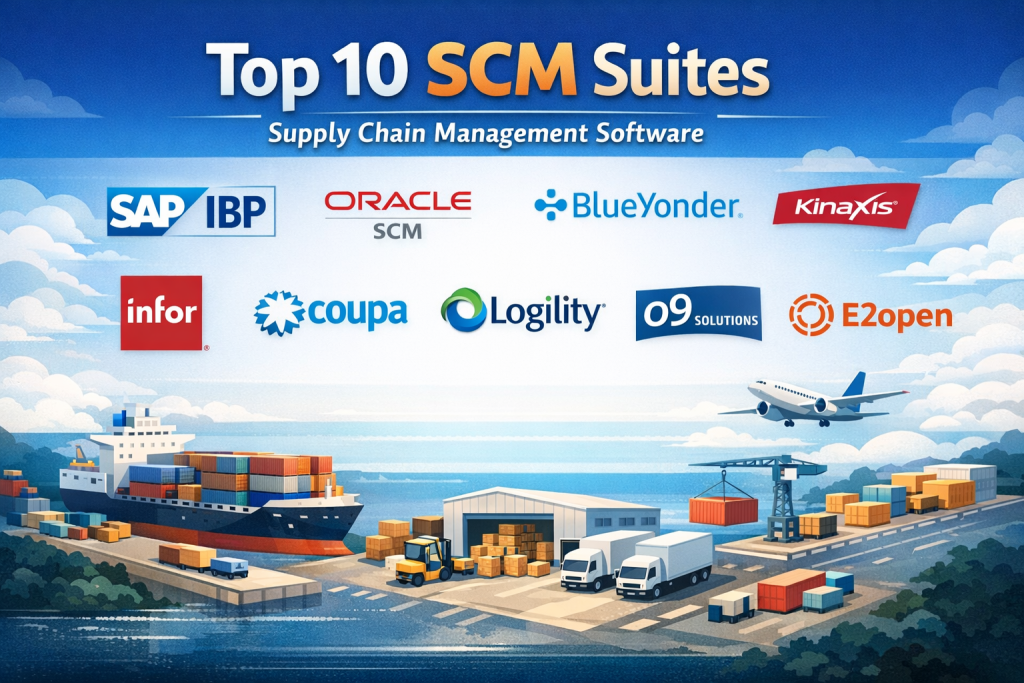
Top 10 SCM (Supply Chain Management) Suites Tools
1 — SAP Integrated Business Planning (SAP IBP)
Short description:
A comprehensive cloud-based planning suite for large enterprises needing advanced demand, supply, and inventory planning tightly integrated with SAP ERP ecosystems.
Key features:
- Demand, supply, and inventory planning
- Sales & operations planning (S&OP)
- Scenario modeling and simulations
- Real-time analytics with in-memory computing
- Integration with SAP S/4HANA
- Collaborative planning workflows
Pros:
- Deep enterprise-grade planning capabilities
- Strong real-time analytics and scalability
Cons:
- High implementation cost
- Requires skilled SAP resources
Security & compliance:
Enterprise-grade security, SSO, encryption, GDPR, ISO standards.
Support & community:
Extensive documentation, global enterprise support, large SAP user community.
2 — Oracle SCM Cloud
Short description:
An end-to-end cloud SCM suite covering planning, manufacturing, logistics, and procurement for global enterprises.
Key features:
- Demand and supply planning
- Manufacturing and maintenance management
- Transportation and warehouse management
- AI-driven insights
- Native Oracle ERP integration
- Global trade compliance
Pros:
- Broad functional coverage
- Strong analytics and AI capabilities
Cons:
- Complex configuration
- Premium pricing
Security & compliance:
SOC 2, GDPR, ISO, encryption, role-based access.
Support & community:
Enterprise-level support, strong documentation, Oracle partner ecosystem.
3 — Blue Yonder
Short description:
An AI-driven SCM platform focused on demand forecasting, replenishment, and retail supply chain optimization.
Key features:
- AI-based demand forecasting
- Inventory optimization
- Retail and manufacturing planning
- End-to-end visibility
- Scenario planning
- Cloud-native architecture
Pros:
- Excellent AI forecasting accuracy
- Strong retail and consumer goods focus
Cons:
- Less suitable for very small firms
- Implementation complexity
Security & compliance:
Enterprise security, GDPR, encryption.
Support & community:
Strong industry expertise, enterprise support, growing community.
4 — Kinaxis RapidResponse
Short description:
A leading concurrent planning platform enabling rapid scenario analysis and real-time supply chain decision-making.
Key features:
- Concurrent demand and supply planning
- What-if scenario modeling
- Real-time visibility
- Rapid response to disruptions
- Cloud-based architecture
- Strong analytics
Pros:
- Fast decision-making
- Excellent for volatile supply chains
Cons:
- Focused mainly on planning
- Premium pricing tier
Security & compliance:
SSO, encryption, GDPR, ISO standards.
Support & community:
High-quality documentation, strong enterprise support.
5 — Manhattan Associates
Short description:
A best-of-breed SCM suite specializing in warehouse management, transportation, and omnichannel fulfillment.
Key features:
- Warehouse management system (WMS)
- Transportation management (TMS)
- Order management
- Omnichannel fulfillment
- Labor management
- Cloud-native platform
Pros:
- Industry-leading WMS and TMS
- Strong retail and logistics capabilities
Cons:
- Limited upstream planning
- Higher cost for full suite
Security & compliance:
SOC 2, GDPR, encryption, access controls.
Support & community:
Strong enterprise support, active logistics community.
6 — Infor Supply Chain
Short description:
A flexible SCM suite designed for manufacturing-heavy industries with strong industry-specific workflows.
Key features:
- Demand and supply planning
- Manufacturing execution
- Inventory and procurement management
- Industry-specific templates
- Cloud deployment options
- ERP integration
Pros:
- Strong manufacturing focus
- Industry-tailored solutions
Cons:
- UI can feel dated
- Customization may be required
Security & compliance:
Enterprise security, GDPR, ISO.
Support & community:
Good documentation, global enterprise support.
#7 — Coupa Supply Chain
Short description:
A spend-centric SCM platform emphasizing supplier collaboration, procurement, and supply chain risk management.
Key features:
- Supplier collaboration
- Spend analytics
- Risk management
- Inventory visibility
- Cloud-native architecture
- Strong procurement integration
Pros:
- Excellent supplier visibility
- Strong financial integration
Cons:
- Limited advanced planning
- Best when paired with other tools
Security & compliance:
SOC 2, GDPR, encryption, audit logs.
Support & community:
Strong onboarding, active procurement community.
8 — Logility
Short description:
A planning-focused SCM suite offering demand, inventory, and supply optimization for mid-market and enterprises.
Key features:
- Demand planning
- Inventory optimization
- S&OP
- Scenario analysis
- Cloud and hybrid deployment
- Analytics dashboards
Pros:
- Balanced feature set
- Easier adoption than heavy enterprise suites
Cons:
- Less extensive execution modules
- Smaller ecosystem
Security & compliance:
Standard enterprise security, GDPR.
Support & community:
Responsive support, solid documentation.
9 — o9 Solutions
Short description:
An AI-powered enterprise planning platform unifying supply chain, finance, and demand planning.
Key features:
- Integrated business planning
- AI and machine learning models
- Digital twin simulations
- Real-time analytics
- Cloud-native architecture
- Cross-functional planning
Pros:
- Strong AI and simulation capabilities
- Unified planning approach
Cons:
- Requires change management
- Higher implementation effort
Security & compliance:
Enterprise security, GDPR, encryption.
Support & community:
Growing enterprise customer base, strong vendor support.
10 — E2open
Short description:
A connected supply chain platform focused on global visibility, logistics, and multi-enterprise collaboration.
Key features:
- Global supply chain visibility
- Logistics and trade compliance
- Supplier collaboration
- Risk monitoring
- Cloud-based network
- Analytics and alerts
Pros:
- Strong multi-party visibility
- Excellent logistics coverage
Cons:
- Planning depth is moderate
- UI learning curve
Security & compliance:
SOC 2, GDPR, encryption.
Support & community:
Enterprise support, strong logistics network ecosystem.
Comparison Table
| Tool Name | Best For | Platform(s) Supported | Standout Feature | Rating |
|---|---|---|---|---|
| SAP IBP | Large enterprises | Cloud | Real-time planning | N/A |
| Oracle SCM Cloud | Global enterprises | Cloud | End-to-end SCM | N/A |
| Blue Yonder | Retail & CPG | Cloud | AI forecasting | N/A |
| Kinaxis | Volatile supply chains | Cloud | Concurrent planning | N/A |
| Manhattan Associates | Logistics-heavy orgs | Cloud | Best-in-class WMS | N/A |
| Infor SCM | Manufacturing | Cloud / Hybrid | Industry focus | N/A |
| Coupa | Procurement-led SCM | Cloud | Supplier visibility | N/A |
| Logility | Mid-market planning | Cloud / Hybrid | Ease of use | N/A |
| o9 Solutions | Integrated planning | Cloud | Digital twin | N/A |
| E2open | Global logistics | Cloud | Multi-enterprise visibility | N/A |
Evaluation & Scoring of SCM (Supply Chain Management) Suites
| Criteria | Weight | Average Score |
|---|---|---|
| Core features | 25% | High |
| Ease of use | 15% | Medium |
| Integrations & ecosystem | 15% | High |
| Security & compliance | 10% | High |
| Performance & reliability | 10% | High |
| Support & community | 10% | Medium |
| Price / value | 15% | Medium |
Which SCM (Supply Chain Management) Suites Tool Is Right for You?
- Solo users & SMBs: Lightweight planning tools or ERP modules may suffice.
- Mid-market firms: Look for balance—Logility, Infor, or Blue Yonder.
- Enterprises: SAP, Oracle, Kinaxis, or o9 for scale and complexity.
- Budget-conscious: Focus on modular pricing and phased rollouts.
- Premium needs: Enterprise suites with AI, digital twins, and global support.
- Security-sensitive industries: Prioritize strong compliance and audit controls.
Frequently Asked Questions (FAQs)
1. What is an SCM suite?
An SCM suite is an integrated platform that manages planning, sourcing, manufacturing, logistics, and fulfillment.
2. How long does implementation take?
Typically 3–12 months depending on scope and complexity.
3. Are SCM suites cloud-based?
Most modern solutions are cloud-native, with some hybrid options.
4. Do SCM tools replace ERP systems?
No, they usually complement ERP systems with advanced capabilities.
5. Is AI important in SCM software?
Yes, AI improves forecasting, risk detection, and scenario planning.
6. Are these tools secure?
Most enterprise SCM suites meet high security and compliance standards.
7. What industries benefit most?
Manufacturing, retail, healthcare, automotive, and logistics.
8. Can SCM suites handle global operations?
Yes, many are designed for multi-country, multi-currency operations.
9. Are they customizable?
Most offer configuration options, though deep customization may increase cost.
10. What is the biggest mistake buyers make?
Choosing overly complex tools without matching organizational readiness.
Conclusion
SCM (Supply Chain Management) Suites have become mission-critical platforms for organizations navigating complex, global supply chains. The right solution improves visibility, resilience, and decision-making while reducing costs and operational risk. There is no universal “best” tool—success depends on aligning features, scale, budget, and industry needs. By carefully evaluating capabilities, usability, and long-term value, organizations can select an SCM suite that delivers sustainable competitive advantage.

Find Trusted Cardiac Hospitals
Compare heart hospitals by city and services — all in one place.
Explore Hospitals
This is a really useful comparison of supply chain management suites! I appreciate how the article breaks down the key features and gives honest pros and cons — it makes it so much easier to compare tools without getting overwhelmed. Whether you’re focused on planning, inventory, or end‑to‑end visibility, this guide highlights what matters most and helps readers make a more informed choice. Great, practical overview!