
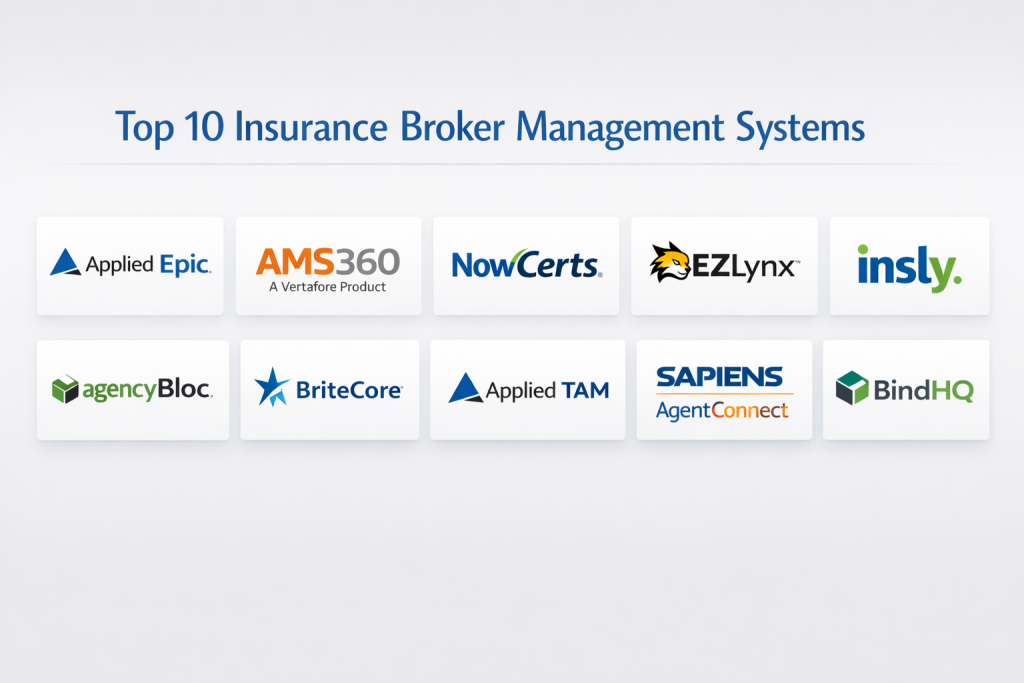
Introduction
Insurance Broker Management Systems (IBMS) are specialized software platforms designed to help insurance brokers and agencies manage their end-to-end operations more efficiently. These systems bring together policy management, client relationship management, commission tracking, renewals, compliance, reporting, and integrations into a single, centralized platform. In an industry driven by accuracy, speed, and trust, IBMS tools play a critical role in reducing manual work and operational risk.
As insurance portfolios grow more complex and regulatory expectations increase, brokers need more than spreadsheets or generic CRM tools. A modern Insurance Broker Management System helps brokers handle multi-carrier policies, automate renewals, track commissions accurately, maintain audit-ready records, and deliver a consistent client experience across channels.
Real-world use cases include managing thousands of active policies, tracking producer commissions, automating reminders for renewals and compliance, onboarding new clients faster, and gaining real-time visibility into revenue performance.
When choosing an IBMS, buyers should evaluate core functionality, ease of use, integrations with carriers and accounting tools, security and compliance readiness, scalability, and total cost of ownership. The right system should support both today’s workflows and future growth.
Best for:
Insurance brokers, independent agencies, MGA/wholesalers, commercial and personal lines brokers, and multi-location insurance firms seeking operational efficiency, compliance readiness, and scalable growth.
Not ideal for:
Solo agents with very low policy volumes, firms that rely exclusively on carrier portals, or organizations that only need a lightweight CRM without policy or commission management.
Top 10 Insurance Broker Management Systems Tools
1 — Applied Epic
Short description:
A comprehensive, enterprise-grade broker management system designed for mid-market and large insurance agencies handling complex commercial and personal lines.
Key features:
- Centralized policy and client management
- Advanced commission and revenue tracking
- Carrier connectivity and downloads
- Automated renewals and document workflows
- Custom reporting and analytics
- Accounting system integrations
Pros:
- Extremely feature-rich for complex broker operations
- Strong ecosystem and carrier integrations
Cons:
- Steep learning curve for new users
- Higher cost compared to SMB-focused tools
Security & compliance:
SSO support, role-based access, audit logs, encryption, SOC-aligned controls.
Support & community:
Enterprise onboarding, dedicated account managers, extensive documentation, large user community.
2 — AMS360
Short description:
A well-established agency management system for insurance brokers seeking structured workflows and compliance-ready processes.
Key features:
- Policy lifecycle management
- Client and prospect tracking
- Accounting and commission management
- Carrier download support
- Reporting dashboards
- Workflow automation
Pros:
- Mature, industry-proven platform
- Strong accounting and compliance features
Cons:
- Interface feels dated for some users
- Customization can be limited
Security & compliance:
Encryption, access controls, audit trails, regulatory compliance support.
Support & community:
Formal training programs, documentation, enterprise support options.
3 — NowCerts
Short description:
A modern, cloud-based broker management system focused on usability and affordability for growing agencies.
Key features:
- Policy and client management
- Automated renewals and reminders
- Commission tracking
- Built-in CRM
- Document management
- Real-time dashboards
Pros:
- Intuitive and easy to adopt
- Competitive pricing for SMBs
Cons:
- Limited deep enterprise customization
- Fewer legacy carrier integrations
Security & compliance:
Data encryption, role-based access, GDPR-aligned practices.
Support & community:
Responsive customer support, onboarding assistance, active user feedback loops.
4 — EZLynx
Short description:
An all-in-one platform combining agency management, comparative rating, and CRM for independent insurance brokers.
Key features:
- Policy and customer management
- Comparative rater integration
- Marketing and sales automation
- Commission tracking
- Document storage
- Analytics and reporting
Pros:
- Strong sales and marketing features
- Unified ecosystem reduces tool sprawl
Cons:
- Reporting depth can vary by module
- Scaling costs increase with usage
Security & compliance:
Encryption, access controls, compliance-friendly data handling.
Support & community:
Training resources, support desk, broker-focused learning materials.
5 — Insly
Short description:
A flexible broker management system suitable for brokers, MGAs, and insurers managing policy administration digitally.
Key features:
- Policy administration and endorsements
- Quotation and underwriting workflows
- Commission and billing management
- Broker and agent portals
- API-driven integrations
- Multi-currency support
Pros:
- Highly configurable platform
- Strong API and automation capabilities
Cons:
- Configuration requires planning
- Less suited for very small agencies
Security & compliance:
Encryption, audit logs, GDPR compliance, configurable access controls.
Support & community:
Professional onboarding, technical documentation, partner ecosystem.
6 — AgencyBloc
Short description:
A broker management system focused primarily on health, life, and benefits insurance agencies.
Key features:
- Policy and member management
- Commission tracking
- CRM and pipeline management
- Compliance tracking
- Reporting and analytics
- Carrier data imports
Pros:
- Strong fit for health and benefits brokers
- Purpose-built compliance features
Cons:
- Limited applicability for P&C-heavy agencies
- UI less flexible for customization
Security & compliance:
HIPAA-aware controls, encryption, access management.
Support & community:
Industry-focused support, training sessions, knowledge base.
7 — BriteCore
Short description:
A modern, cloud-native platform supporting brokers, MGAs, and insurers with configurable workflows.
Key features:
- Policy and claims management
- Broker and agent portals
- Billing and invoicing
- Workflow automation
- API-first architecture
- Analytics and reporting
Pros:
- Scalable and future-ready
- Strong automation capabilities
Cons:
- Implementation effort can be significant
- More suitable for mid-market and enterprise users
Security & compliance:
Encryption, role-based security, audit logging, SOC-aligned practices.
Support & community:
Enterprise support, implementation partners, technical documentation.
8 — Applied TAM
Short description:
A traditional agency management system designed for established brokerages with long-standing workflows.
Key features:
- Policy and client records
- Accounting and commissions
- Carrier downloads
- Reporting tools
- Document management
Pros:
- Proven stability and reliability
- Deep accounting functionality
Cons:
- Legacy UI and user experience
- Less cloud-native than newer tools
Security & compliance:
Access controls, audit trails, compliance-ready architecture.
Support & community:
Vendor support, documentation, long-term user base.
9 — Sapiens AgentConnect
Short description:
A digital broker and agent management platform focused on distribution efficiency and compliance.
Key features:
- Agent onboarding and lifecycle management
- Policy distribution workflows
- Commission management
- Digital portals
- Reporting and analytics
Pros:
- Strong distribution and compliance focus
- Enterprise-grade scalability
Cons:
- Overkill for small agencies
- Configuration complexity
Security & compliance:
Enterprise security, encryption, audit logs, regulatory support.
Support & community:
Enterprise onboarding, dedicated support teams, documentation.
10 — BindHQ
Short description:
A cloud-based agency management system aimed at modern brokers seeking simplicity and speed.
Key features:
- Policy and client management
- Automated renewals
- Commission tracking
- Built-in CRM
- Document storage
- Reporting dashboards
Pros:
- Clean, modern user interface
- Faster onboarding and adoption
Cons:
- Limited advanced enterprise features
- Smaller ecosystem
Security & compliance:
Encryption, role-based access, standard compliance practices.
Support & community:
Responsive support, onboarding assistance, growing user base.
Comparison Table
| Tool Name | Best For | Platform(s) Supported | Standout Feature | Rating |
|---|---|---|---|---|
| Applied Epic | Large & complex agencies | Web, Cloud | Deep carrier integrations | N/A |
| AMS360 | Compliance-driven brokers | Web | Accounting strength | N/A |
| NowCerts | SMB insurance agencies | Cloud | Ease of use | N/A |
| EZLynx | Sales-focused brokers | Cloud | Comparative rating | N/A |
| Insly | MGAs & digital brokers | Cloud | API-driven flexibility | N/A |
| AgencyBloc | Health & benefits brokers | Cloud | Compliance tools | N/A |
| BriteCore | Mid-market & enterprise | Cloud | Workflow automation | N/A |
| Applied TAM | Legacy brokerages | Web | Stability | N/A |
| Sapiens AgentConnect | Enterprise distribution | Cloud | Agent lifecycle mgmt | N/A |
| BindHQ | Modern SMB agencies | Cloud | Fast adoption | N/A |
Evaluation & Scoring of Insurance Broker Management Systems
| Criteria | Weight | Description |
|---|---|---|
| Core features | 25% | Policy, client, commission, renewals |
| Ease of use | 15% | UI, learning curve, adoption speed |
| Integrations & ecosystem | 15% | Carriers, accounting, APIs |
| Security & compliance | 10% | Access control, audits, standards |
| Performance & reliability | 10% | Stability and uptime |
| Support & community | 10% | Documentation and help |
| Price / value | 15% | ROI vs cost |
Which Insurance Broker Management Systems Tool Is Right for You?
- Solo users & small agencies: Look for affordability, simplicity, and fast onboarding.
- SMBs: Balance feature depth with usability and integration options.
- Mid-market & enterprise: Prioritize scalability, compliance, and customization.
- Budget-conscious teams: Focus on cloud-native tools with modular pricing.
- Premium buyers: Invest in platforms with deep analytics and automation.
- Integration-heavy environments: Choose API-first systems.
- Compliance-driven sectors: Ensure audit logs and regulatory support are strong.
Frequently Asked Questions (FAQs)
1. What is an Insurance Broker Management System?
It is software that helps brokers manage policies, clients, commissions, renewals, and compliance in one place.
2. Is IBMS different from a CRM?
Yes. IBMS includes CRM features but also policy, carrier, and commission management.
3. How long does implementation take?
It can range from a few weeks for SMB tools to several months for enterprise platforms.
4. Are cloud-based systems secure?
Most modern IBMS platforms use encryption, access controls, and audits.
5. Can these tools handle multiple carriers?
Yes, carrier integrations are a core feature of most IBMS solutions.
6. Do small agencies really need IBMS?
If policy volume and compliance needs grow, IBMS quickly becomes essential.
7. How important is commission tracking?
Extremely important for revenue accuracy and broker trust.
8. What are common implementation mistakes?
Poor data migration planning and lack of user training.
9. Are these systems customizable?
Many offer configuration, but customization depth varies by tool.
10. Can IBMS scale with agency growth?
Yes, but choosing the right platform early avoids costly migrations later.
Conclusion
Insurance Broker Management Systems have become essential infrastructure for modern insurance brokers. They improve efficiency, reduce risk, enhance compliance, and provide visibility into business performance. While some platforms excel at enterprise-scale complexity and others shine in usability and affordability, there is no single “best” system for everyone.
The right choice depends on agency size, product mix, compliance needs, integration requirements, and budget. By carefully evaluating your workflows and future growth plans, you can select an Insurance Broker Management System that delivers long-term value and operational confidence.

Find Trusted Cardiac Hospitals
Compare heart hospitals by city and services — all in one place.
Explore Hospitals
Insurance broker management systems help agencies manage clients, policies, renewals, and daily business operations. Handling multiple customers and insurance records can become difficult without proper software. These platforms bring important information together in one place. They help brokers track policy details, manage claims, monitor renewals, and maintain customer records. Automation can also reduce repetitive work and save valuable time. Better reporting helps teams understand business performance and make informed decisions. Choosing the right system depends on integration, security, automation, reporting, and ease of use. A suitable platform can improve workflow management and support better customer service.
Insurance broker management systems help agencies organize client information, policies, renewals, and daily workflows in one place. When comparing solutions, I think policy tracking, automated reminders, commission management, and integration with insurer systems are important features to consider. Reporting tools and centralized customer records can also help brokers provide more consistent service and reduce administrative work. Choosing the right platform can improve productivity, simplify policy management, and strengthen client relationships.
Insurance broker management systems are specialized, but this article makes them easy to understand. I appreciate the focus on client relationship features and commission tracking. Brokers will find this guide extremely practical.
One point I’d add is that the “right” IBMS often depends less on the longest feature list and more on how well it fits an agency’s existing carrier, accounting, and document workflows. Before committing, teams should run a small pilot using real policy, commission, and renewal data, because weak data migration and insufficient staff training are among the most common implementation failures. It’s also worth distinguishing configuration from customization: a platform like Insly may offer strong API-driven flexibility, but that value only materializes if the agency has the internal ownership and process discipline to maintain it. For smaller teams, prioritizing adoption speed and reliable commission reconciliation can deliver faster ROI than chasing advanced analytics features too early. This kind of practical validation would make the comparison even more actionable for brokers weighing short-term usability against long-term scalability.
Insurance broker management systems help agencies streamline daily operations, manage client information, and track policies more efficiently. Features such as commission tracking, renewal reminders, reporting, and customer relationship management can save time and reduce manual work. I believe brokers should compare platforms based on ease of use, integration capabilities, automation, and scalability. Strong reporting and organized client records can also support better decision-making. Choosing the right system helps insurance agencies improve productivity and deliver a smoother customer experience.
Insurance broker management systems should make daily work easier without creating extra steps for staff. One important area to check is how smoothly the system connects client records, policy renewals, claims, and commission tracking. I would also suggest testing how quickly brokers can find a client’s complete history when handling queries. Better data access and timely renewal alerts can help reduce missed follow-ups and improve client service.
Insurance broker management systems should make it easier to understand the complete relationship between a client, their policies, and the different parties involved in servicing those policies. For example, one client may have several policies handled by different insurers, renewal dates, and commission arrangements. If this information is scattered across separate records, brokers can easily miss opportunities or overlook important service obligations. I would pay attention to how these platforms handle household and business account relationships, policy-level communication history, and commission reconciliation. Another useful capability is generating a consolidated client view without losing the individual details of each policy. This can help brokerage teams manage their portfolios more consistently as their customer base grows.
Insurance broker management systems help streamline policy administration, client relationship management, renewals, commission tracking, and claims coordination. By centralizing customer information and automating routine workflows, these platforms enable brokers to reduce administrative workloads and provide more consistent service to policyholders. When comparing solutions, important factors include integration with insurer systems, reporting capabilities, commission management, document handling, data security, and scalability. Choosing the right system can improve operational efficiency, strengthen client relationships, and help insurance agencies manage their growing portfolios with greater accuracy and transparency.
Migrating from a legacy broker management system can create unexpected challenges when historical policy records, commission schedules, and carrier data don’t align with the new platform. Running parallel workflows during the transition can help agencies detect reconciliation errors before they affect clients or revenue.
Insurance brokers often handle many clients, policies, renewals, and claims at the same time, so keeping everything organized is essential. I think automatic renewal reminders and a clear view of each client’s policy history can help prevent missed opportunities and improve customer service. It is also useful to check how easily the system connects with insurers and handles document sharing. A well-organized platform can save brokers time and help them build stronger relationships with clients.
Insurance broker management systems help brokers manage clients, policies, renewals, claims, and daily tasks. A useful system should keep customer records accurate and make policy details easy to find. Renewal reminders can help teams follow up on time. Reporting tools can also show sales activity and service workload. When comparing platforms, review insurer integrations, document handling, commission tracking, and access controls. Staff should be able to learn routine tasks quickly. The right system can reduce admin work, improve client follow-up, and keep brokerage operations more organized.
Insurance broker management systems help agencies coordinate policy administration, client records, renewals, commissions, and carrier communications from a centralized workspace. Automated renewal reminders, commission reconciliation, and document management can reduce administrative errors while improving service consistency. Integration with insurer portals and customer relationship management tools also gives brokers better visibility into their portfolios and more time to focus on client relationships.
One practical issue with broker management systems is reconciling records when carrier downloads, accounting entries, and policy changes arrive at different times. Even small mismatches can create incorrect commission balances or leave renewal records out of sync. Teams should define which system owns each data field and set up exception reports for unresolved differences. Regular reconciliation tests using real-world edge cases can catch problems before month-end closing. This helps brokers maintain reliable records without depending on staff to spot every mismatch manually.
Insurance broker management systems are most effective when they connect client records, policy renewals, commission tracking, and claims communication in one workflow. Automated renewal reminders and accurate policy data help brokers reduce missed deadlines while giving clients more consistent service. Strong reporting and secure access controls also make it easier to track business performance and protect sensitive customer information as the brokerage grows.
Insurance broker management systems help agencies manage client information, policies, renewals, and daily operations in one place. When comparing platforms, I would focus on policy management, commission tracking, reporting, and integration with insurance providers. These features can reduce administrative work and improve client service. The right system should simplify workflows and help brokers manage their business more efficiently.
Centralizing multi-carrier policy administration, commission reconciliation, and renewal workflows within dedicated broker management platforms eliminates error-prone spreadsheets, ensuring accurate producer payouts and audit-ready compliance while driving scalable agency growth across diverse insurance lines.
Insurance agencies should examine how their management software controls access to sensitive customer and financial information as teams grow. Staff may need different levels of access depending on their roles, responsibilities, and client portfolios. Without well-defined permissions, employees could view records they do not need or change details that affect policy servicing and commissions. I would assess whether the system supports role-based access, detailed activity logs, periodic permission reviews, and alerts for unusual data exports. It is also important to verify how quickly administrators can revoke access when an employee leaves or changes roles. These controls help reduce internal security risks while making accountability easier during audits and customer disputes.
Insurance broker management systems are most effective when they connect client records, policy renewals, commission tracking, and claims follow-ups in one reliable workflow. Data accuracy is especially important because outdated policy details or missed renewal reminders can affect both customer trust and revenue. I would also prioritize integration with insurer portals and clear activity logs to reduce manual work and improve accountability. Before choosing a system, brokers should test how easily it handles their existing processes and future growth.
Transitioning from spreadsheets to a dedicated IBMS often exposes hidden gaps in historical data cleanliness during migration. Striking the right balance between robust compliance features and a user-friendly interface is crucial to ensure smooth team adoption. Having tools with strong multi-carrier integration and automated commission tracking truly transforms daily operational efficiency.
Insurance broker management systems are especially useful when a client has several policies with different renewal dates, insurers, and coverage terms. It helps when the platform highlights upcoming renewals and missing client documents while keeping communication records linked to the correct policy. This can reduce last-minute follow-ups and help brokers spot coverage gaps before a client needs to make a claim.
Insurance brokers need efficient systems to manage client relationships, policies, renewals, and claims without losing track of important details. This comparison offers a useful perspective on how automation, reporting, commission tracking, and customer management features can simplify daily operations. A valuable guide for brokerage firms looking to improve service quality, reduce administrative work, and make better-informed software decisions.