
Introduction
The Internet of Things (IoT) has moved far beyond smart homes and wearables. Today, industrial sensors, medical devices, smart meters, connected vehicles, and critical infrastructure all rely on IoT. While this connectivity unlocks efficiency and innovation, it also creates a massive and often overlooked attack surface. Traditional IT security tools are not designed to handle millions of low-power, heterogeneous, and often unmanaged devices.
IoT Security Platforms are purpose-built solutions that help organizations discover, monitor, protect, and manage connected devices throughout their lifecycle. These platforms focus on device identity, behavior monitoring, firmware integrity, secure communication, and compliance—areas where conventional endpoint security tools fall short.
Real-world use cases include:
- Preventing ransomware attacks on industrial control systems
- Securing medical IoT devices in hospitals
- Detecting rogue devices on enterprise and OT networks
- Protecting smart city infrastructure from sabotage
When evaluating IoT Security Platforms, buyers should look for device discovery accuracy, protocol awareness, scalability, real-time threat detection, compliance coverage, and ease of integration with existing IT and security tools.
Best for:
IoT Security Platforms are ideal for enterprises, manufacturers, healthcare providers, utilities, smart cities, and industrial organizations that operate large numbers of connected devices and need visibility, control, and compliance.
Not ideal for:
They may be unnecessary for very small deployments, consumer-only environments, or teams without dedicated security ownership, where simpler network security or cloud-native controls may suffice.
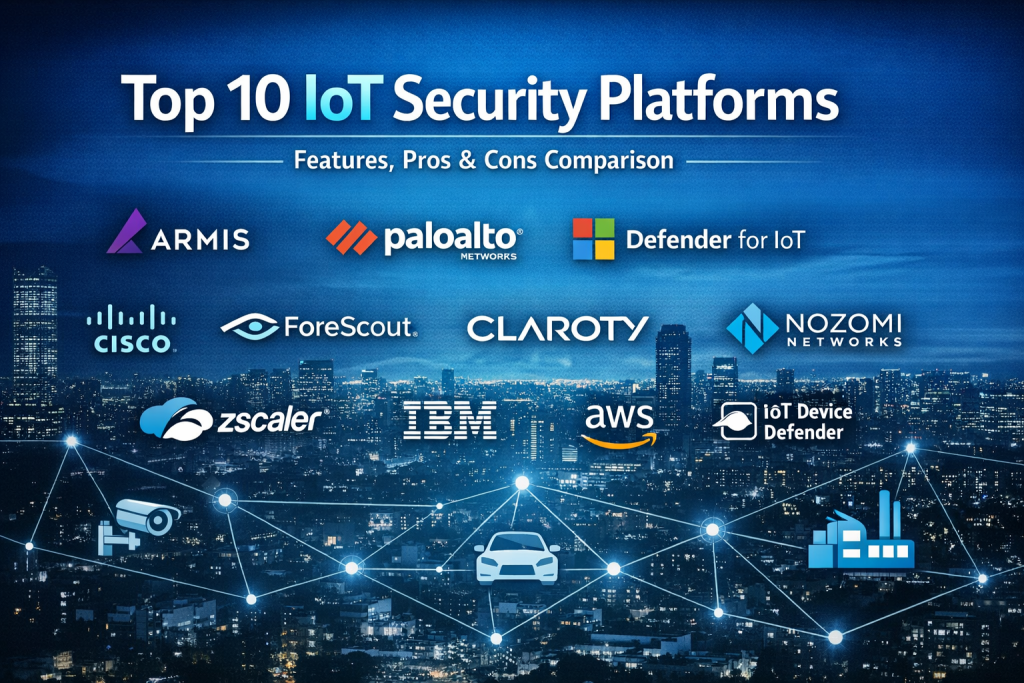
Top 10 IoT Security Platforms Tools
1 — Armis
Short description:
Armis provides agentless IoT and OT security with deep visibility into managed and unmanaged devices. It is widely used in healthcare, manufacturing, and critical infrastructure.
Key features:
- Agentless device discovery and classification
- Behavioral analytics with AI-driven threat detection
- Risk-based asset management
- Integration with SIEM, SOAR, and NAC tools
- Vulnerability identification and prioritization
- Continuous monitoring of unmanaged devices
Pros:
- Excellent visibility without deploying agents
- Strong healthcare and industrial coverage
Cons:
- Premium pricing
- Requires mature security operations for full value
Security & compliance:
Encryption, role-based access, audit logs, SOC 2, GDPR support
Support & community:
Enterprise-grade support, strong documentation, onboarding assistance
2 — Palo Alto Networks (IoT Security)
Short description:
An extension of Palo Alto Networks’ security ecosystem, this platform focuses on IoT visibility, Zero Trust enforcement, and threat prevention.
Key features:
- Device discovery via network traffic analysis
- Zero Trust policy enforcement
- Integration with firewalls and Cortex XDR
- Automated risk scoring
- Behavioral anomaly detection
- Centralized security management
Pros:
- Seamless integration with existing Palo Alto stack
- Strong threat intelligence
Cons:
- Best suited for Palo Alto customers
- Complex for smaller teams
Security & compliance:
SSO, encryption, audit logs, SOC 2, ISO-aligned controls
Support & community:
Global enterprise support, extensive training resources
3 — Microsoft Defender for IoT
Short description:
Microsoft Defender for IoT delivers agentless security for IoT and OT environments, tightly integrated with the Azure security ecosystem.
Key features:
- Passive network monitoring
- OT and ICS protocol awareness
- Threat detection with Microsoft intelligence
- Unified view with Microsoft Defender
- Risk-based recommendations
- Cloud and on-prem support
Pros:
- Strong Azure and Microsoft ecosystem integration
- Competitive enterprise pricing
Cons:
- Limited value outside Microsoft-centric environments
- Learning curve for OT teams
Security & compliance:
Encryption, RBAC, audit logs, SOC 2, GDPR, ISO
Support & community:
Enterprise support, extensive documentation, large user community
4 — Cisco IoT Threat Defense
Short description:
Cisco’s IoT Threat Defense focuses on device visibility and segmentation across enterprise and industrial networks.
Key features:
- Network-based device identification
- Behavioral anomaly detection
- Policy enforcement through network segmentation
- Integration with Cisco DNA and SecureX
- Centralized asset inventory
- Scalable cloud management
Pros:
- Ideal for Cisco-heavy environments
- Strong network-level controls
Cons:
- Less deep device-level analysis
- Dependent on Cisco infrastructure
Security & compliance:
Encryption, audit logging, SOC-aligned controls
Support & community:
Strong enterprise support, extensive partner ecosystem
5 — Forescout Platform
Short description:
Forescout provides real-time visibility and control for IoT, OT, and IT assets without agents.
Key features:
- Continuous device discovery
- Automated policy enforcement
- Network access control integration
- Risk scoring and vulnerability assessment
- OT and medical device visibility
- Integration with security tools
Pros:
- Excellent asset visibility
- Mature policy automation
Cons:
- Interface can feel complex
- Requires tuning for large deployments
Security & compliance:
SSO, encryption, audit logs, SOC 2, GDPR
Support & community:
Strong enterprise support, professional services available
6 — Claroty
Short description:
Claroty specializes in securing industrial IoT and OT environments with deep protocol inspection.
Key features:
- Industrial protocol awareness
- Asset discovery and mapping
- Threat detection for ICS
- Secure remote access
- Vulnerability management
- Compliance reporting
Pros:
- Best-in-class OT visibility
- Trusted in critical infrastructure
Cons:
- Narrower focus outside industrial use
- Higher cost
Security & compliance:
Encryption, audit logs, ISO, industry compliance support
Support & community:
Enterprise-focused support, strong industrial expertise
7 — Nozomi Networks
Short description:
Nozomi Networks provides advanced monitoring and threat detection for OT and IoT networks.
Key features:
- Passive asset discovery
- Behavioral and anomaly detection
- Threat intelligence integration
- Visualization of network flows
- Compliance dashboards
- Scalable architecture
Pros:
- Excellent threat detection accuracy
- Strong OT specialization
Cons:
- Less suitable for pure IT IoT
- Requires skilled operators
Security & compliance:
Encryption, audit logs, SOC-aligned controls
Support & community:
Enterprise support, focused OT community
8 — Zscaler IoT Security
Short description:
Zscaler extends its zero-trust cloud security model to IoT and unmanaged devices.
Key features:
- Zero Trust access for IoT devices
- Cloud-based policy enforcement
- Network segmentation
- Device risk profiling
- Integration with Zscaler ecosystem
- Global scalability
Pros:
- Cloud-native and scalable
- Strong zero-trust philosophy
Cons:
- Limited deep device inspection
- Works best within Zscaler stack
Security & compliance:
SSO, encryption, SOC 2, GDPR
Support & community:
Strong enterprise support, global presence
9 — IBM Security for IoT
Short description:
IBM offers IoT security as part of its broader enterprise security and analytics portfolio.
Key features:
- Device identity management
- Secure communication frameworks
- Analytics-driven threat detection
- Integration with IBM security tools
- Policy and compliance reporting
- Scalable enterprise architecture
Pros:
- Strong analytics and AI
- Enterprise-grade reliability
Cons:
- Less focused IoT UX
- Higher operational complexity
Security & compliance:
SOC 2, ISO, GDPR, audit logs
Support & community:
Enterprise support, extensive documentation
10 — AWS IoT Device Defender
Short description:
AWS IoT Device Defender focuses on monitoring and securing IoT devices deployed on AWS.
Key features:
- Device behavior auditing
- Cloud-native monitoring
- Integration with AWS services
- Automated alerts and mitigation
- Scalable device management
- Policy-based security checks
Pros:
- Deep AWS integration
- Highly scalable
Cons:
- Limited outside AWS
- Requires cloud expertise
Security & compliance:
Encryption, IAM, audit logs, SOC, ISO
Support & community:
Strong documentation, large cloud community
Comparison Table
| Tool Name | Best For | Platform(s) Supported | Standout Feature | Rating |
|---|---|---|---|---|
| Armis | Large enterprises, healthcare | Hybrid | Agentless visibility | N/A |
| Palo Alto Networks | Security-mature enterprises | Hybrid | Zero Trust IoT | N/A |
| Microsoft Defender for IoT | Azure-centric orgs | Cloud/On-prem | OT threat intelligence | N/A |
| Cisco IoT Threat Defense | Cisco environments | Network-based | Segmentation | N/A |
| Forescout | Asset-heavy enterprises | Hybrid | Real-time control | N/A |
| Claroty | Industrial/OT | On-prem/Hybrid | ICS expertise | N/A |
| Nozomi Networks | Critical infrastructure | Hybrid | OT threat detection | N/A |
| Zscaler IoT Security | Cloud-first orgs | Cloud | Zero Trust access | N/A |
| IBM Security for IoT | Large enterprises | Hybrid | Analytics & AI | N/A |
| AWS IoT Device Defender | AWS users | Cloud | Native scalability | N/A |
Evaluation & Scoring of IoT Security Platforms
| Criteria | Weight | Description |
|---|---|---|
| Core features | 25% | Device discovery, monitoring, threat detection |
| Ease of use | 15% | UI clarity, deployment, learning curve |
| Integrations & ecosystem | 15% | SIEM, SOAR, cloud, network tools |
| Security & compliance | 10% | Encryption, audits, certifications |
| Performance & reliability | 10% | Scalability and uptime |
| Support & community | 10% | Documentation, enterprise support |
| Price / value | 15% | Cost vs delivered value |
Which IoT Security Platforms Tool Is Right for You?
- Solo users / small teams: Cloud-native or simplified tools with minimal setup
- SMBs: Platforms with strong visibility and manageable cost
- Mid-market: Balanced solutions with automation and integrations
- Enterprise: Comprehensive, agentless platforms with OT and compliance depth
Budget-conscious teams should prioritize ease of deployment and core visibility, while regulated industries must focus on compliance, auditability, and reliability.
Frequently Asked Questions (FAQs)
- What makes IoT security different from endpoint security?
IoT devices often lack agents and traditional OS controls, requiring network-based and behavioral protection. - Do IoT security platforms support OT environments?
Many do, but only select tools specialize in industrial protocols and ICS. - Is agentless security better for IoT?
Yes, because many IoT devices cannot run agents safely. - How long does implementation take?
From days for cloud tools to weeks for complex OT environments. - Are these platforms expensive?
Costs vary widely depending on scale and industry. - Do they replace firewalls?
No, they complement network and perimeter security. - Can they detect zero-day threats?
Behavioral analytics helps identify unknown threats. - Are cloud-based tools secure for IoT?
Yes, when strong encryption and access controls are used. - Do I need IoT security for small deployments?
Only if devices handle sensitive data or critical operations. - What is the biggest mistake buyers make?
Choosing IT-focused tools without OT awareness.
Conclusion
IoT Security Platforms are no longer optional for organizations running connected devices at scale. Visibility, behavior monitoring, and lifecycle security are essential to prevent costly breaches and operational disruptions. The right platform depends on industry, scale, infrastructure, and compliance needs—not on a one-size-fits-all approach. By aligning features with real-world requirements, organizations can secure their IoT environments with confidence and clarity.

Find Trusted Cardiac Hospitals
Compare heart hospitals by city and services — all in one place.
Explore Hospitals
This is an incredibly thorough and timely breakdown of the IoT security landscape. As the number of connected devices grows exponentially, the complexity of securing them becomes a major challenge for any organization. Having a clear comparison of features, pros, and cons in one place is an invaluable resource for security professionals looking to harden their infrastructure. Great work!