
Introduction
Ontology Management Tools are specialized platforms designed to create, manage, visualize, govern, and evolve ontologies—formal representations of knowledge that define concepts, relationships, and rules within a domain. These tools form the backbone of modern semantic technologies, knowledge graphs, AI reasoning systems, and data interoperability frameworks.
As organizations increasingly rely on AI, machine learning, data integration, and intelligent search, ontologies help bring shared meaning and structure to fragmented data. Without a robust ontology layer, enterprises struggle with inconsistent definitions, poor interoperability, and limited reasoning capabilities.
Real-world use cases include enterprise knowledge graphs, healthcare terminologies, life sciences research, financial data harmonization, digital twins, cybersecurity threat modeling, and semantic search. Ontology Management Tools also play a crucial role in data governance, metadata management, and regulatory compliance.
When choosing an ontology tool, buyers should evaluate modeling expressiveness (OWL/RDF support), collaboration features, versioning, reasoning engines, integrations with databases and graph stores, scalability, security, and usability for both technical and non-technical users.
Best for:
Ontology Management Tools are ideal for data architects, semantic engineers, AI researchers, enterprise architects, and regulated industries such as healthcare, finance, life sciences, telecom, and government—especially mid-market to large enterprises building knowledge-driven systems.
Not ideal for:
They may be overkill for simple taxonomies, small static datasets, or teams without semantic modeling expertise, where lightweight tagging systems or metadata tools may suffice.
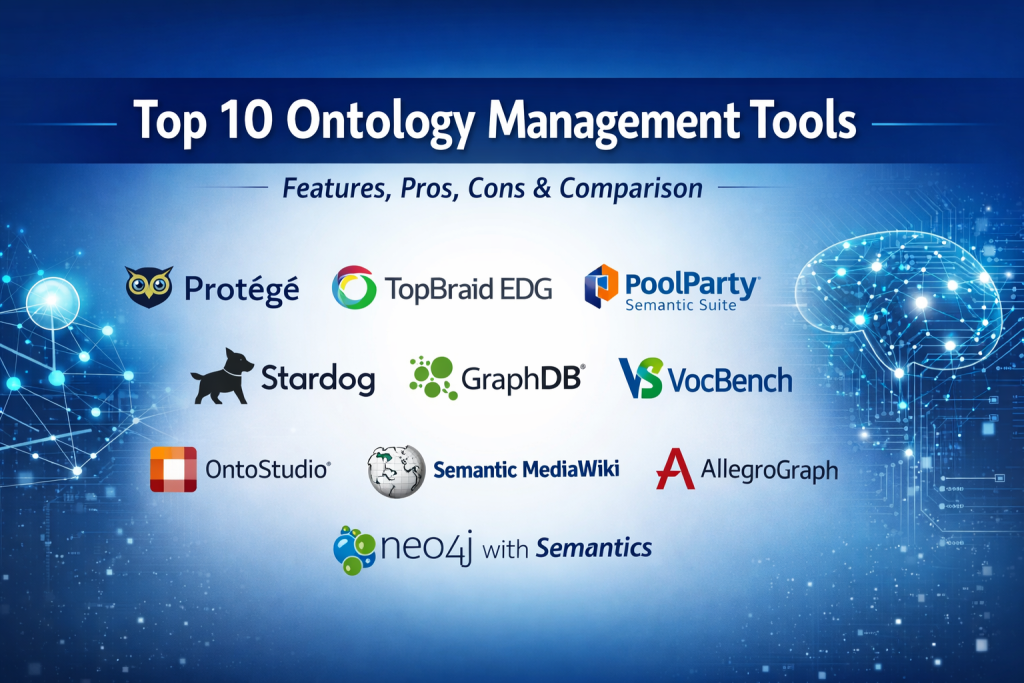
Top 10 Ontology Management Tools
1 — Protégé
Short description:
A widely adopted open-source ontology editor supporting OWL, RDF, and semantic reasoning. Designed for researchers, academics, and enterprise ontology engineers.
Key features
- OWL, RDF, RDFS modeling support
- Plugin-based extensibility
- Integrated reasoners (HermiT, Pellet)
- Class hierarchy and property modeling
- Visualization and validation tools
- Strong standards compliance
Pros
- Free and open source
- Industry-standard in academia and research
- Large plugin ecosystem
Cons
- Steep learning curve for beginners
- Limited enterprise collaboration features
Security & compliance: N/A (desktop-based)
Support & community: Extensive documentation, academic backing, very large global community
2 — TopBraid EDG
Short description:
An enterprise-grade ontology and knowledge graph platform focused on governance, collaboration, and large-scale semantic data management.
Key features
- Web-based ontology modeling
- Built-in governance workflows
- Knowledge graph management
- SHACL-based validation
- Versioning and access control
- Enterprise integrations
Pros
- Strong governance and compliance capabilities
- Scales well for enterprise use
- Excellent semantic standards support
Cons
- Premium pricing
- Requires trained semantic specialists
Security & compliance: SSO, audit logs, role-based access, GDPR support
Support & community: Enterprise-grade support, structured onboarding, professional services
3 — PoolParty Semantic Suite
Short description:
A comprehensive semantic platform combining ontology management, text analytics, and knowledge graph capabilities.
Key features
- Ontology and taxonomy management
- Automated semantic enrichment
- Multilingual support
- Linked data publishing
- Integration with enterprise systems
- Visual modeling tools
Pros
- Strong automation and NLP capabilities
- User-friendly UI
- Excellent for content-heavy organizations
Cons
- Higher cost
- More features than needed for simple ontologies
Security & compliance: GDPR support, enterprise security controls
Support & community: Strong documentation, commercial support, training programs
4 — Stardog
Short description:
A powerful knowledge graph and ontology platform with built-in reasoning, data virtualization, and analytics.
Key features
- OWL reasoning and inference
- Ontology-driven data integration
- Graph analytics
- Version control for ontologies
- SPARQL querying
- Cloud and on-prem support
Pros
- Excellent performance at scale
- Strong reasoning engine
- Enterprise-ready
Cons
- Licensing cost
- Requires graph expertise
Security & compliance: Encryption, role-based access, audit logging
Support & community: Commercial support, good documentation, enterprise user base
5 — GraphDB
Short description:
A semantic graph database with robust ontology management and reasoning capabilities.
Key features
- RDF and OWL support
- Semantic reasoning
- Ontology versioning
- SHACL validation
- Visual graph exploration
- High-performance querying
Pros
- Tight integration of data and ontology
- Reliable reasoning engine
- Scalable architecture
Cons
- UI can feel technical
- Advanced features require paid editions
Security & compliance: Role-based access, encryption options
Support & community: Active community, enterprise support available
6 — VocBench
Short description:
An open-source, web-based collaborative ontology development platform.
Key features
- Collaborative ontology editing
- Role-based workflows
- Version control
- SKOS and OWL support
- Change tracking
- Web-based interface
Pros
- Strong collaboration features
- Open-source flexibility
- Good for distributed teams
Cons
- UI less modern
- Setup complexity
Security & compliance: Role-based permissions, project isolation
Support & community: Academic and open-source community support
7 — OntoStudio
Short description:
A professional ontology engineering environment aimed at enterprise semantic modelers.
Key features
- Advanced ontology modeling
- Reasoning and validation
- Integration with databases
- Visualization tools
- Lifecycle management
- Standards compliance
Pros
- Powerful modeling depth
- Suitable for complex domains
- Enterprise-ready
Cons
- Niche user base
- Commercial licensing
Security & compliance: Enterprise security controls
Support & community: Vendor support, limited public community
8 — Semantic MediaWiki
Short description:
An extension of MediaWiki enabling semantic annotations and lightweight ontology modeling.
Key features
- Semantic annotations
- Ontology-like property definitions
- Collaborative editing
- Queryable knowledge base
- Open-source ecosystem
- Wiki-style UI
Pros
- Easy for non-technical users
- Strong collaboration
- Free and open-source
Cons
- Limited formal ontology expressiveness
- Not ideal for complex reasoning
Security & compliance: Depends on deployment
Support & community: Very active open-source community
9 — AllegroGraph
Short description:
A high-performance graph database supporting semantic reasoning and ontology-driven applications.
Key features
- RDF and OWL support
- Reasoning and inference
- Geospatial and temporal reasoning
- SPARQL queries
- Scalable architecture
- Cloud and on-prem
Pros
- Excellent performance
- Advanced reasoning features
- Mature platform
Cons
- Premium pricing
- Technical learning curve
Security & compliance: Encryption, access control, auditing
Support & community: Commercial support, technical documentation
10 — Neo4j with Semantics
Short description:
A graph database enhanced with semantic modeling using RDF and OWL extensions.
Key features
- Property graph + semantic integration
- Ontology-to-graph mapping
- Visualization tools
- Cypher querying
- Plugin-based semantics
- Large ecosystem
Pros
- Popular graph platform
- Strong visualization
- Flexible architecture
Cons
- Native semantics less strict than RDF stores
- Requires extensions for full ontology support
Security & compliance: Enterprise security options
Support & community: Very large developer community, enterprise support
Comparison Table
| Tool Name | Best For | Platform(s) Supported | Standout Feature | Rating |
|---|---|---|---|---|
| Protégé | Researchers & ontology engineers | Desktop | Open-source OWL editor | N/A |
| TopBraid EDG | Large enterprises | Web, Cloud | Governance-first ontology management | N/A |
| PoolParty | Content-heavy enterprises | Web, Cloud | Automated semantic enrichment | N/A |
| Stardog | Knowledge graph at scale | Cloud, On-prem | Reasoning + data virtualization | N/A |
| GraphDB | Semantic graph storage | Cloud, On-prem | Tight ontology-data integration | N/A |
| VocBench | Collaborative ontology teams | Web | Workflow-driven collaboration | N/A |
| OntoStudio | Advanced semantic modeling | Desktop | Professional ontology engineering | N/A |
| Semantic MediaWiki | Knowledge sharing teams | Web | Wiki-based semantics | N/A |
| AllegroGraph | High-performance reasoning | Cloud, On-prem | Advanced inference | N/A |
| Neo4j with Semantics | Graph-centric teams | Cloud, On-prem | Property graph flexibility | N/A |
Evaluation & Scoring of Ontology Management Tools
| Criteria | Weight | Score (Avg) |
|---|---|---|
| Core features | 25% | 4.5 |
| Ease of use | 15% | 3.8 |
| Integrations & ecosystem | 15% | 4.2 |
| Security & compliance | 10% | 4.0 |
| Performance & reliability | 10% | 4.6 |
| Support & community | 10% | 4.3 |
| Price / value | 15% | 3.7 |
Which Ontology Management Tool Is Right for You?
- Solo users & researchers: Protégé, Semantic MediaWiki
- SMBs: PoolParty, GraphDB
- Mid-market: Stardog, Neo4j with Semantics
- Enterprise: TopBraid EDG, AllegroGraph
Budget-conscious teams should favor open-source tools, while premium solutions suit organizations needing governance, scalability, and compliance. Choose feature depth if reasoning and inference matter, or ease of use for business-facing collaboration.
Frequently Asked Questions (FAQs)
1. What is an ontology in simple terms?
An ontology defines concepts and relationships so systems and people share the same understanding of data.
2. How is an ontology different from a taxonomy?
Taxonomies are hierarchical; ontologies include rich relationships and rules.
3. Do I need semantic expertise to use these tools?
Most advanced tools require some knowledge, though user-friendly options exist.
4. Are ontology tools only for AI projects?
No, they are also used for data integration, governance, and search.
5. Can ontology tools scale to enterprise data volumes?
Yes, enterprise-grade platforms are designed for large-scale deployments.
6. Are open-source tools reliable?
Yes, many are industry standards with strong communities.
7. Do these tools support collaboration?
Most enterprise tools provide workflows, roles, and versioning.
8. How long does implementation take?
From days for small projects to months for enterprise initiatives.
9. Are ontology tools expensive?
Costs vary widely—from free open-source to premium enterprise licenses.
10. What is a common mistake when adopting ontology tools?
Underestimating the need for governance and domain expertise.
Conclusion
Ontology Management Tools are foundational for semantic data, AI reasoning, and knowledge-driven systems. The right tool depends on scale, expertise, governance needs, and budget. There is no universal winner—only the best fit for your specific goals. Choosing carefully ensures your ontology becomes a long-term asset rather than a maintenance burden.

Find Trusted Cardiac Hospitals
Compare heart hospitals by city and services — all in one place.
Explore Hospitals
Excellent guide! Choosing the right ontology management tool can be a complex process, and this post does a fantastic job of simplifying it. I particularly appreciate the focus on features like collaboration and reasoning capabilities, which are so critical for scaling semantic projects. This is a great resource for any data architect or knowledge engineer.