
Introduction
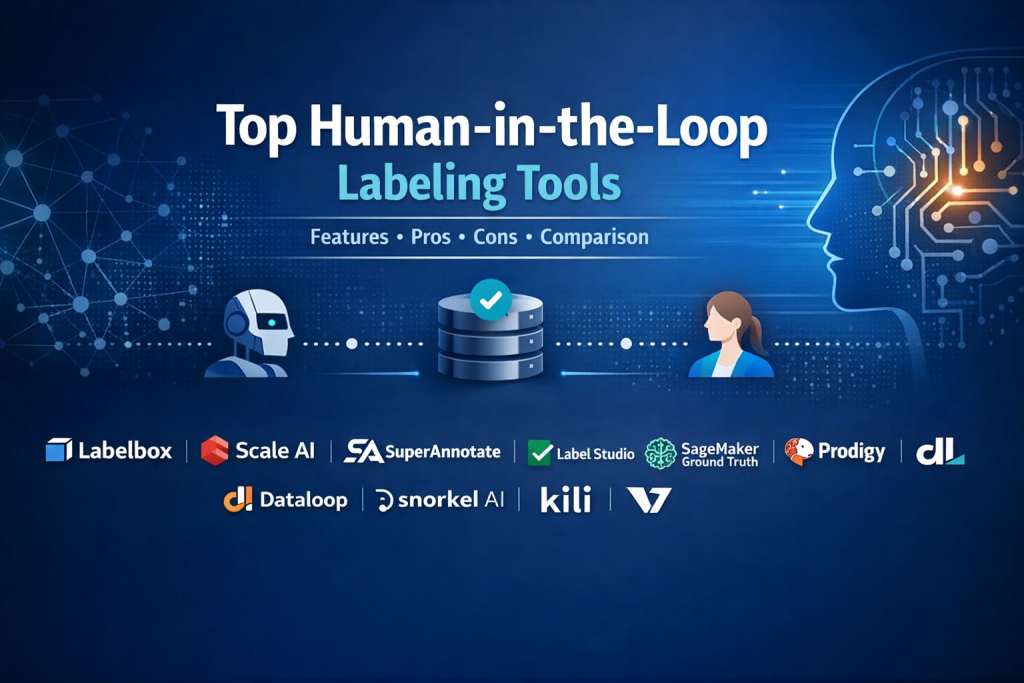
Human-in-the-Loop (HITL) labeling tools are platforms that combine machine assistance with human judgment to create high-quality labeled datasets for artificial intelligence and machine learning models. Instead of relying purely on automation or fully manual annotation, these tools introduce humans at critical decision points—reviewing, correcting, validating, and improving model outputs.
HITL labeling has become essential as AI systems move into high-stakes, real-world environments such as healthcare, finance, autonomous systems, and enterprise analytics. In these domains, errors in training data can lead to biased, unsafe, or unreliable models. Human oversight ensures accuracy, context awareness, and continuous learning loops.
Common real-world use cases include:
- Computer vision annotation for autonomous driving and surveillance
- NLP labeling for chatbots, search, and document intelligence
- Speech and audio transcription
- Model retraining, error correction, and active learning workflows
When choosing a Human-in-the-Loop labeling tool, users should evaluate:
- Supported data types (text, image, video, audio, multimodal)
- Workflow automation and quality control mechanisms
- Scalability and collaboration features
- Security, compliance, and deployment flexibility
- Integration with ML pipelines and MLOps tools
Best for:
Human-in-the-Loop labeling tools are ideal for ML engineers, data scientists, AI product teams, enterprises, research labs, and regulated-industry organizations that require high-quality, auditable, and continuously improving datasets.
Not ideal for:
They may be unnecessary for small experiments, synthetic-data-only projects, or low-risk prototypes where automated labeling or weak supervision is sufficient.
Top 10 Human-in-the-Loop Labeling Tools
1 — Labelbox
Short description:
An enterprise-grade data labeling and training data platform designed for computer vision, NLP, and multimodal AI workflows.
Key features:
- Image, video, text, and geospatial annotation
- Active learning and model-assisted labeling
- Custom workflows with review and consensus stages
- Quality metrics and inter-annotator agreement
- Workforce management and role-based access
- Dataset versioning and audit trails
Pros:
- Strong enterprise-level workflow customization
- Excellent support for computer vision use cases
- Scales well with large labeling teams
Cons:
- Premium pricing for advanced features
- Learning curve for complex workflows
Security & compliance:
SSO, encryption at rest and in transit, audit logs, SOC 2, GDPR support
Support & community:
Comprehensive documentation, enterprise onboarding, dedicated support
2 — Scale AI
Short description:
A managed data engine combining automation and expert human reviewers for high-accuracy AI training data.
Key features:
- Human-verified labeling at scale
- Active learning pipelines
- Support for text, image, video, 3D, and sensor data
- Automated quality assurance
- Custom task orchestration
- High-volume workforce management
Pros:
- Extremely high annotation accuracy
- Handles complex and safety-critical datasets
Cons:
- Less self-service compared to tooling platforms
- Expensive for small teams
Security & compliance:
SOC 2, GDPR, ISO-aligned controls, secure data handling
Support & community:
White-glove enterprise support, limited open community
3 — SuperAnnotate
Short description:
A collaborative annotation platform focused on fast, accurate computer vision labeling with human review loops.
Key features:
- Image and video annotation
- Annotation automation with human correction
- Quality control dashboards
- Collaboration and task assignment
- Dataset versioning
- API and SDK access
Pros:
- User-friendly interface
- Strong productivity tools for CV teams
Cons:
- Limited NLP compared to vision focus
- Advanced automation requires configuration
Security & compliance:
SSO, encryption, GDPR support
Support & community:
Good documentation, responsive customer support
4 — Label Studio
Short description:
An open-source data labeling platform offering flexible, human-in-the-loop annotation for multiple data types.
Key features:
- Supports text, image, audio, video, time-series
- Fully customizable labeling interfaces
- ML-assisted pre-labeling
- Review and approval workflows
- Self-hosted or managed options
- Plugin ecosystem
Pros:
- Highly flexible and extensible
- Strong open-source community
Cons:
- Enterprise features require paid edition
- Requires setup and maintenance
Security & compliance:
Varies by deployment; self-hosted controls available
Support & community:
Active open-source community, commercial support available
5 — Amazon SageMaker Ground Truth
Short description:
A managed HITL labeling service integrated into the AWS machine learning ecosystem.
Key features:
- Built-in human review workflows
- Active learning and automated labeling
- Integration with SageMaker pipelines
- Private and vendor workforce options
- Quality sampling and audit features
- Scalable cloud infrastructure
Pros:
- Seamless AWS ecosystem integration
- Scales automatically with workloads
Cons:
- AWS lock-in
- UI flexibility is limited
Security & compliance:
AWS security model, IAM, encryption, compliance certifications
Support & community:
AWS documentation, enterprise support plans
6 — Prodigy
Short description:
A developer-focused annotation tool optimized for NLP workflows and active learning loops.
Key features:
- Scriptable annotation workflows
- Active learning and model feedback loops
- Tight integration with NLP pipelines
- Real-time human correction
- Local deployment support
- Custom labeling recipes
Pros:
- Extremely fast for NLP iteration
- Highly customizable for engineers
Cons:
- Minimal UI for non-technical users
- Limited enterprise governance features
Security & compliance:
Varies by deployment; local-first approach
Support & community:
Strong documentation, developer-centric community
7 — Dataloop
Short description:
An end-to-end data management and labeling platform with built-in human-in-the-loop AI operations.
Key features:
- Multimodal data labeling
- Automated pipelines with human checkpoints
- Dataset lifecycle management
- Model monitoring and feedback
- API-driven workflows
- Collaboration and governance tools
Pros:
- Strong MLOps integration
- Unified data and labeling lifecycle
Cons:
- Feature-rich UI can feel complex
- Best suited for mature teams
Security & compliance:
SSO, encryption, GDPR-aligned controls
Support & community:
Enterprise support, structured onboarding
8 — Snorkel AI
Short description:
A data-centric AI platform combining programmatic labeling with targeted human validation.
Key features:
- Weak supervision and labeling functions
- Human review of edge cases
- Data quality and coverage metrics
- Enterprise governance
- Active learning loops
- Integration with ML pipelines
Pros:
- Reduces labeling cost dramatically
- Excellent for large text datasets
Cons:
- Steeper learning curve
- Less suited for pure manual labeling
Security & compliance:
Enterprise-grade security, audit logs, compliance support
Support & community:
Enterprise training, expert consulting available
9 — Kili Technology
Short description:
A modern data labeling tool emphasizing human quality control and annotation productivity.
Key features:
- Image, video, and text annotation
- Quality assurance workflows
- Reviewer consensus scoring
- Active learning support
- API and automation
- Team collaboration features
Pros:
- Strong focus on annotation accuracy
- Clean and intuitive interface
Cons:
- Smaller ecosystem than larger vendors
- Advanced automation still evolving
Security & compliance:
GDPR support, encryption, access controls
Support & community:
Good documentation, responsive customer success
10 — V7
Short description:
A computer-vision-focused annotation platform combining automation with human review.
Key features:
- AI-assisted image and video labeling
- Human validation loops
- Dataset management
- Model performance tracking
- Cloud-native architecture
- Collaboration tools
Pros:
- Fast annotation workflows
- Strong automation for CV teams
Cons:
- Limited NLP capabilities
- Best for vision-centric projects
Security & compliance:
Encryption, access controls, GDPR support
Support & community:
Commercial support, improving documentation
Comparison Table
| Tool Name | Best For | Platform(s) Supported | Standout Feature | Rating |
|---|---|---|---|---|
| Labelbox | Enterprise ML teams | Cloud, API | Workflow customization | N/A |
| Scale AI | High-accuracy datasets | Managed service | Human precision at scale | N/A |
| SuperAnnotate | Computer vision teams | Web, API | CV productivity tools | N/A |
| Label Studio | Flexible labeling needs | Self-hosted, Cloud | Open-source extensibility | N/A |
| SageMaker Ground Truth | AWS users | Cloud | AWS-native HITL | N/A |
| Prodigy | NLP developers | Local, API | Active learning loops | N/A |
| Dataloop | End-to-end AI ops | Cloud, API | Data lifecycle management | N/A |
| Snorkel AI | Large text datasets | Enterprise | Weak supervision | N/A |
| Kili Technology | Quality-focused labeling | Cloud, API | Reviewer consensus | N/A |
| V7 | Vision-first AI teams | Cloud | Automated CV labeling | N/A |
Evaluation & Scoring of Human-in-the-Loop Labeling Tools
| Tool | Core Features (25%) | Ease of Use (15%) | Integrations (15%) | Security (10%) | Performance (10%) | Support (10%) | Value (15%) | Total Score |
|---|---|---|---|---|---|---|---|---|
| Labelbox | 9 | 8 | 8 | 9 | 9 | 9 | 7 | 8.5 |
| Scale AI | 9 | 7 | 7 | 9 | 9 | 9 | 6 | 8.3 |
| Label Studio | 8 | 7 | 8 | 7 | 8 | 8 | 9 | 8.1 |
| Prodigy | 7 | 6 | 7 | 6 | 8 | 7 | 8 | 7.2 |
Which Human-in-the-Loop Labeling Tool Is Right for You?
- Solo users / researchers: Prodigy, Label Studio
- SMBs: Kili Technology, SuperAnnotate
- Mid-market teams: Labelbox, Dataloop
- Enterprise & regulated industries: Scale AI, Snorkel AI, SageMaker Ground Truth
Budget-conscious: Open-source or developer-centric tools
Premium solutions: Managed services and enterprise platforms
Feature depth vs ease of use: Advanced workflows increase power but add complexity
Security & compliance: Essential for healthcare, finance, and government workloads
Frequently Asked Questions (FAQs)
1. What does “human-in-the-loop” mean in labeling?
It means humans review, correct, or validate AI-generated labels to improve accuracy.
2. Are HITL tools better than fully automated labeling?
Yes, especially for complex, ambiguous, or high-risk datasets.
3. Do these tools support active learning?
Most modern platforms integrate active learning to prioritize hard examples.
4. Can HITL tools reduce labeling cost?
Yes, by combining automation with selective human review.
5. Are they suitable for regulated industries?
Many tools support compliance, audit logs, and access controls.
6. Do I need a large team to use them?
No, some tools are designed for individual developers and small teams.
7. Can they integrate with MLOps pipelines?
Most enterprise tools offer APIs and pipeline integrations.
8. What data types are supported?
Commonly text, image, video, audio, and multimodal data.
9. Are open-source tools production-ready?
Yes, with proper deployment and governance.
10. What is the biggest mistake when choosing a tool?
Over-buying complexity instead of matching the tool to actual workflow needs.
Conclusion
Human-in-the-Loop labeling tools play a critical role in building reliable, ethical, and high-performance AI systems. They bridge the gap between automation and human expertise, ensuring data quality where it matters most.
When selecting a tool, focus on data type support, workflow control, scalability, security, and long-term integration with your AI stack. There is no universal winner—the best solution depends on your team size, industry, risk tolerance, and AI maturity level.
Choosing wisely at the data labeling stage can determine the success—or failure—of everything that follows.

Find Trusted Cardiac Hospitals
Compare heart hospitals by city and services — all in one place.
Explore Hospitals
Really insightful post. The way you’ve categorized these tools helps clarify which ones are best for specific use cases—whether it’s computer vision, NLP, or audio. It’s a must-read for anyone looking to optimize their labeling workflows and improve model performance through high-quality human intervention. Very informative!