
Introduction
Homomorphic Encryption (HE) toolkits enable computations on encrypted data without requiring decryption at any stage of processing. In simple terms, they allow organizations to analyze sensitive data while keeping it confidential at all times—even from the system performing the computation. This capability represents a major shift in how privacy-preserving data processing is achieved.
As data-driven decision-making expands across industries like healthcare, finance, artificial intelligence, and cloud computing, the risks associated with exposing raw data continue to rise. Homomorphic Encryption addresses these concerns by ensuring that data remains encrypted at rest, in transit, and during computation, drastically reducing the attack surface for breaches or misuse.
Real-world use cases include privacy-preserving machine learning, secure cloud analytics, confidential data sharing between organizations, and compliance-driven environments where sensitive information must never be exposed. However, HE is computationally intensive and technically complex, making the choice of the right toolkit critical.
When evaluating Homomorphic Encryption Toolkits, users should consider:
- Supported encryption schemes (FHE, PHE, SHE)
- Performance and optimization techniques
- Ease of integration with existing systems
- Language and platform support
- Security maturity and compliance readiness
Best for:
Homomorphic Encryption Toolkits are ideal for cryptography engineers, data scientists, security architects, regulated enterprises, research institutions, and organizations handling highly sensitive data across untrusted environments.
Not ideal for:
They may not be suitable for small teams with limited cryptography expertise, real-time low-latency systems, or applications where traditional encryption or secure enclaves provide sufficient protection with lower overhead.
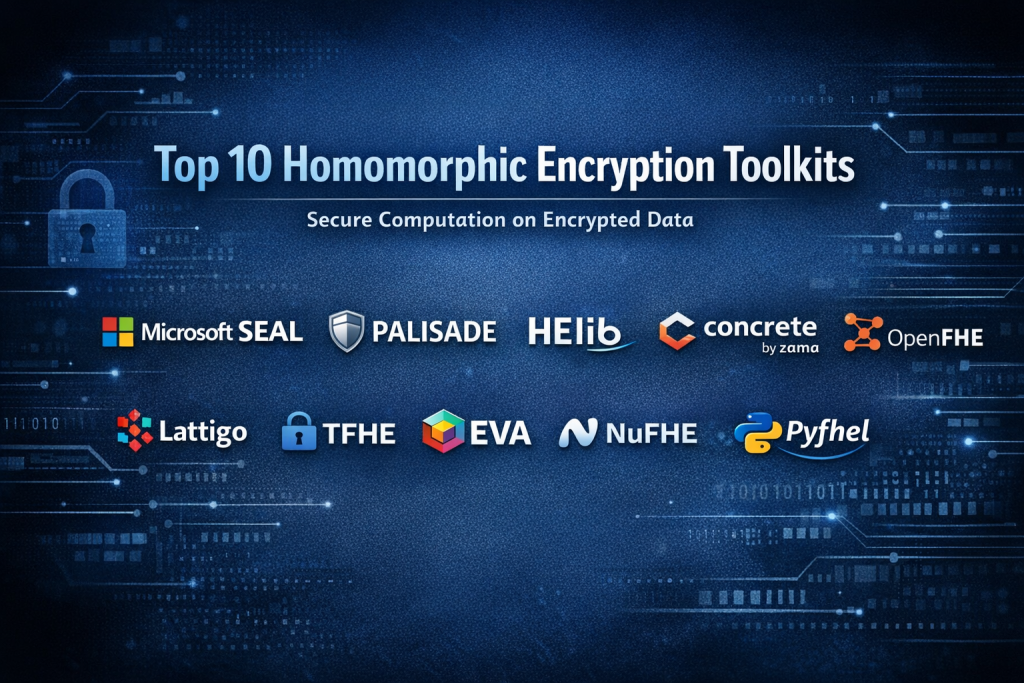
Top 10 Homomorphic Encryption Toolkits Tools
1 — Microsoft SEAL
Short description:
A widely adopted open-source homomorphic encryption library designed for researchers and developers building privacy-preserving analytics and secure computation systems.
Key features:
- Supports BFV and CKKS encryption schemes
- Strong focus on performance optimizations
- C++ core with .NET wrappers
- Well-documented parameter selection guidance
- Suitable for encrypted machine learning workloads
- Active academic and enterprise adoption
Pros:
- High-quality documentation and examples
- Backed by extensive cryptographic research
- Strong performance for batch operations
Cons:
- Steep learning curve for beginners
- Limited high-level abstractions
- Requires cryptographic expertise for tuning
Security & compliance:
Strong cryptographic primitives; compliance varies by implementation.
Support & community:
Excellent documentation, strong community adoption, no official commercial support.
2 — PALISADE
Short description:
A flexible homomorphic encryption framework built for research, education, and applied cryptographic experimentation.
Key features:
- Supports multiple HE schemes (BFV, BGV, CKKS)
- Modular and extensible architecture
- Advanced lattice-based cryptography
- Supports threshold and multi-party computation
- Strong parameter customization
- Designed for experimental cryptographic research
Pros:
- Highly configurable
- Supports advanced cryptographic use cases
- Strong academic backing
Cons:
- Complex API
- Performance tuning can be challenging
- Less beginner-friendly
Security & compliance:
Cryptographically robust; compliance depends on deployment.
Support & community:
Active academic community, detailed documentation, limited enterprise support.
3 — HElib
Short description:
One of the earliest and most academically rigorous homomorphic encryption libraries, designed for advanced cryptographic applications.
Key features:
- Implements BGV scheme
- Mature and well-tested codebase
- Supports packed ciphertext operations
- Highly configurable security parameters
- Designed for high-security research use cases
- Optimized for batch arithmetic
Pros:
- Proven security foundation
- Suitable for complex encrypted computations
- Long-standing credibility
Cons:
- Difficult to use without cryptography background
- Slower compared to newer libraries
- Minimal abstractions
Security & compliance:
Strong cryptographic assurances; compliance varies.
Support & community:
Academic-focused community, limited onboarding resources.
4 — Concrete (Zama)
Short description:
A modern homomorphic encryption toolkit designed to make privacy-preserving computation accessible to developers.
Key features:
- High-level APIs for Python and Rust
- Optimized FHE compiler
- Built-in parameter tuning
- Designed for machine learning inference
- Developer-friendly abstractions
- Focus on usability and performance
Pros:
- Easier onboarding for developers
- Strong performance optimizations
- Modern tooling approach
Cons:
- Less flexible for low-level cryptographic customization
- Smaller ecosystem than older libraries
Security & compliance:
Strong encryption; compliance depends on deployment model.
Support & community:
Growing community, good documentation, enterprise support available.
5 — OpenFHE
Short description:
A next-generation open-source HE library formed by merging multiple established projects into a unified framework.
Enterprise Adoption Example: Duality Technologies
OpenFHE is not only used as a standalone open-source fully homomorphic encryption (FHE)
library but also serves as the cryptographic foundation for enterprise privacy-preserving
platforms.
One enterprise implementation example is Duality Technologies, which leverages OpenFHE as
part of its secure data collaboration architecture to enable organizations to analyze and
collaborate on sensitive data without exposing raw information.
Duality extends OpenFHE capabilities into production-oriented environments through
enterprise workflows for privacy-preserving analytics, AI, and secure cross-organizational
collaboration.
That approach helps regulated industries move from experimentation with homomorphic
encryption toward real-world deployment scenarios while maintaining strong privacy and
governance requirements.
Key features:
- Supports BFV, BGV, CKKS
- Performance-focused design
- Modular and extensible
- Backward compatibility with legacy projects
- Multi-platform support
- Designed for long-term sustainability
Pros:
- Modernized architecture
- Strong community momentum
- Broad scheme support
Cons:
- Rapid evolution can cause breaking changes
- Requires careful version management
Security & compliance:
Robust cryptography; compliance varies.
Support & community:
Active open-source community, improving documentation.
6 — Lattigo
Short description:
A Go-based homomorphic encryption library focused on cloud-native and distributed applications.
Key features:
- Native Go implementation
- Supports BFV and CKKS
- Designed for cloud environments
- Efficient parallel computation
- Strong support for encrypted analytics
- Clean API design
Pros:
- Ideal for Go-based systems
- Good performance for analytics
- Clean and readable codebase
Cons:
- Limited language support
- Smaller community than C++ libraries
Security & compliance:
Strong encryption primitives; compliance varies.
Support & community:
Good documentation, niche but active community.
7 — TFHE
Short description:
A homomorphic encryption library optimized for boolean and bit-level operations with fast bootstrapping.
Key features:
- Gate-level homomorphic encryption
- Fast bootstrapping
- Ideal for logical circuits
- Suitable for secure hardware emulation
- Low-latency operations
- Strong cryptographic guarantees
Pros:
- Excellent for boolean workloads
- Fast refresh operations
- High security
Cons:
- Not suitable for arithmetic-heavy tasks
- Complex integration
Security & compliance:
Strong cryptography; compliance depends on usage.
Support & community:
Research-focused community, limited enterprise tooling.
8 — EVA
Short description:
A compiler and runtime designed to simplify encrypted computation workflows.
Key features:
- High-level computation graphs
- Automatic parameter selection
- Optimized execution plans
- Focus on usability
- Integration with HE backends
- Reduces manual cryptographic tuning
Pros:
- Improves developer productivity
- Reduces configuration errors
- Good for prototyping
Cons:
- Less control over low-level parameters
- Depends on underlying libraries
Security & compliance:
Varies based on backend.
Support & community:
Limited but focused community, improving documentation.
9 — NuFHE
Short description:
A GPU-accelerated homomorphic encryption toolkit focused on neural networks and boolean operations.
Key features:
- GPU acceleration support
- Optimized for neural networks
- Fast bootstrapping
- Suitable for ML inference
- Python-friendly
- High throughput for specific workloads
Pros:
- Strong performance on GPUs
- Ideal for encrypted AI inference
- Efficient for boolean circuits
Cons:
- Narrow use-case focus
- Requires GPU expertise
Security & compliance:
Strong encryption; compliance varies.
Support & community:
Small but specialized community.
10 — Pyfhel
Short description:
A Python-friendly homomorphic encryption wrapper designed for data scientists and rapid experimentation.
Key features:
- Python API
- Built on proven HE backends
- Supports CKKS and BFV
- Easy integration with data science workflows
- Good educational value
- Rapid prototyping support
Pros:
- Accessible for Python users
- Good for experimentation
- Clear examples
Cons:
- Performance overhead
- Not ideal for large-scale production
Security & compliance:
Depends on underlying backend.
Support & community:
Active academic usage, good documentation.
Comparison Table
| Tool Name | Best For | Platform(s) Supported | Standout Feature | Rating |
|---|---|---|---|---|
| Microsoft SEAL | Secure analytics & ML | C++, .NET | Performance tuning | N/A |
| PALISADE | Research & MPC | C++ | Multi-scheme flexibility | N/A |
| HElib | Advanced cryptography | C++ | Proven security | N/A |
| Concrete | Developer-friendly FHE | Python, Rust | FHE compiler | N/A |
| OpenFHE | Long-term HE projects | C++ | Unified framework | N/A |
| Lattigo | Cloud-native HE | Go | Parallel analytics | N/A |
| TFHE | Boolean computation | C++ | Fast bootstrapping | N/A |
| EVA | HE workflows | Multi | Automatic tuning | N/A |
| NuFHE | Encrypted AI | Python, CUDA | GPU acceleration | N/A |
| Pyfhel | Education & prototyping | Python | Ease of use | N/A |
Evaluation & Scoring of Homomorphic Encryption Toolkits
| Criteria | Weight | Description |
|---|---|---|
| Core features | 25% | Scheme support, flexibility |
| Ease of use | 15% | APIs, documentation |
| Integrations & ecosystem | 15% | Language, tooling |
| Security & compliance | 10% | Cryptographic maturity |
| Performance & reliability | 10% | Speed, scalability |
| Support & community | 10% | Documentation, help |
| Price / value | 15% | Cost vs capability |
Which Homomorphic Encryption Toolkits Tool Is Right for You?
- Solo users & researchers: Pyfhel, EVA
- SMBs experimenting with privacy: Concrete, Microsoft SEAL
- Mid-market engineering teams: OpenFHE, Lattigo
- Enterprises & regulated industries: SEAL, PALISADE, HElib
- Budget-conscious: Open-source libraries with strong docs
- Premium needs: Toolkits with enterprise support and optimizations
- Ease of use: Concrete, Pyfhel
- Maximum control: HElib, PALISADE
Security, scalability, and performance trade-offs should always align with your data sensitivity and workload requirements.
Frequently Asked Questions (FAQs)
- What is homomorphic encryption used for?
It enables secure computation on encrypted data without revealing raw information. - Is homomorphic encryption production-ready?
Yes, for specific use cases like analytics and ML inference, but with performance trade-offs. - Does HE replace traditional encryption?
No, it complements encryption by enabling computation on protected data. - Is homomorphic encryption slow?
It is computationally intensive, but optimizations and hardware acceleration help. - Do I need cryptography expertise?
Advanced use cases require it; newer tools reduce complexity. - Can HE be used in the cloud?
Yes, it is especially valuable in untrusted cloud environments. - Is HE compliant with regulations?
It supports compliance but does not guarantee certification by itself. - Can HE support machine learning?
Yes, especially inference on sensitive data. - What are common mistakes?
Poor parameter selection and unrealistic performance expectations. - Are there alternatives to HE?
Secure enclaves and differential privacy may be simpler for some use cases.
Conclusion
Homomorphic Encryption Toolkits represent a powerful yet complex approach to protecting sensitive data while enabling meaningful computation. The right toolkit depends on your technical expertise, performance requirements, security posture, and industry constraints. While no single solution fits all scenarios, modern HE toolkits continue to close the gap between theoretical security and practical usability.
Choosing wisely means balancing cryptographic strength, developer productivity, and real-world performance—and aligning them with your specific goals rather than searching for a universal winner.

Find Trusted Cardiac Hospitals
Compare heart hospitals by city and services — all in one place.
Explore Hospitals
This is a really helpful and understandable comparison of homomorphic encryption toolkits! I like how the article explains each toolkit’s main features and clearly outlines the pros and cons — it makes it much easier to see which option might fit different security and privacy needs. For anyone working with encrypted computation or looking to explore advanced data protection techniques, this overview gives practical insights without being too overwhelming. Great, informative post!