
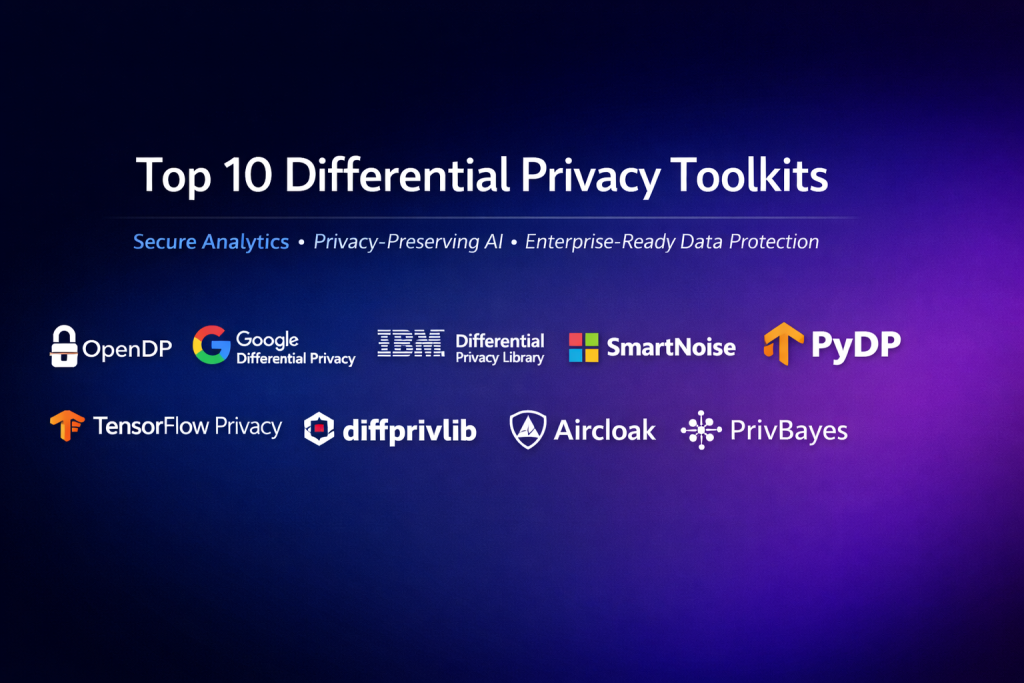
Introduction
Differential Privacy Toolkits are specialized software libraries and platforms designed to analyze, share, or learn from sensitive data while mathematically limiting the risk of individual data leakage. Instead of relying only on access controls or anonymization, differential privacy introduces carefully calibrated statistical noise that protects individuals even against powerful attackers with auxiliary knowledge.
As data-driven decision-making expands across healthcare, finance, AI, government, and consumer technology, privacy regulations and public expectations are becoming stricter. Organizations can no longer afford privacy as an afterthought. Differential privacy has emerged as a gold standard because it provides provable privacy guarantees, not just best-effort masking.
Real-world use cases include:
- Publishing aggregate statistics without exposing individuals
- Training machine learning models on sensitive datasets
- Sharing insights across teams or partners safely
- Complying with privacy regulations while retaining analytical value
When choosing a Differential Privacy Toolkit, buyers should evaluate:
- Supported data types and workflows (SQL, ML, analytics)
- Privacy accounting and ε (epsilon) management
- Ease of integration with existing pipelines
- Performance impact and scalability
- Governance, auditability, and compliance readiness
Best for:
Data scientists, privacy engineers, ML teams, research institutions, enterprises handling sensitive user data, and regulated industries such as healthcare, fintech, telecom, and government.
Not ideal for:
Teams with purely public or non-sensitive data, organizations lacking analytical maturity, or projects where simple aggregation or access control already meets privacy needs.
Top 10 Differential Privacy Toolkits Tools
1 — OpenDP
Short description:
OpenDP is a community-driven initiative providing robust, open-source libraries for building differential privacy into statistical and analytical workflows.
Key features
- Core mathematical primitives for differential privacy
- Strong privacy accounting and composition support
- Language bindings for Python and Rust
- Modular, extensible architecture
- Research-backed algorithms and proofs
- Transparent, peer-reviewed development
Pros
- Strong theoretical foundations
- Open governance and transparency
- Suitable for advanced privacy engineering
Cons
- Steeper learning curve
- Limited out-of-the-box UI tools
Security & compliance: Varies / N/A (library-focused)
Support & community:
Excellent academic and research community, detailed documentation, active open-source contributors.
2 — Google Differential Privacy
Short description:
Google’s Differential Privacy libraries enable privacy-preserving data analysis at scale, originally built for internal production systems.
Key features
- Libraries for SQL-like queries and analytics
- Privacy budget tracking
- Optimized for large-scale datasets
- Proven in real-world deployments
- Strong statistical accuracy guarantees
Pros
- Production-tested at massive scale
- High-quality engineering
- Reliable performance
Cons
- Less beginner-friendly
- Limited visualization tooling
Security & compliance: GDPR-aligned principles, internal-grade security
Support & community:
Good documentation, strong engineering backing, moderate open-source community.
3 — IBM Differential Privacy Library
Short description:
IBM’s Differential Privacy Library focuses on enterprise-grade analytics and machine learning with built-in privacy protection.
Key features
- Privacy-preserving ML model training
- Statistical queries with noise calibration
- Integration with Python data science stack
- Configurable privacy budgets
- Enterprise-friendly APIs
Pros
- Enterprise-oriented design
- Clear ML focus
- Good documentation
Cons
- Smaller community adoption
- Less flexible for custom research
Security & compliance: GDPR-ready, enterprise security practices
Support & community:
Solid documentation, professional support ecosystem, moderate community activity.
4 — Microsoft SmartNoise
Short description:
SmartNoise is Microsoft’s toolkit for releasing privacy-preserving statistics and synthetic data using differential privacy.
Key features
- SQL-based query interface
- Synthetic data generation
- Privacy budget enforcement
- Integration with data platforms
- Designed for data publishers
Pros
- Strong usability for analysts
- Synthetic data capabilities
- Clear governance controls
Cons
- Less flexible for custom ML workflows
- Primarily analytics-focused
Security & compliance: GDPR-aligned, enterprise security standards
Support & community:
Well-documented, backed by Microsoft research, active user base.
5 — PyDP
Short description:
PyDP provides Python bindings for Google’s differential privacy algorithms, targeting data scientists and analysts.
Key features
- Python-native APIs
- Statistical aggregation functions
- Privacy budget management
- Seamless pandas integration
- Lightweight deployment
Pros
- Easy for Python users
- Fast integration into notebooks
- Reuses proven algorithms
Cons
- Limited beyond Python
- Fewer advanced controls
Security & compliance: Varies / N/A
Support & community:
Good documentation, active Python data science users.
6 — TensorFlow Privacy
Short description:
TensorFlow Privacy enables differentially private machine learning by extending TensorFlow training workflows.
Key features
- DP-SGD optimizer
- Privacy accounting for ML models
- Scales to deep learning workloads
- Strong research validation
- Integrates with TensorFlow ecosystem
Pros
- Best-in-class DP for ML
- Proven academic backing
- High scalability
Cons
- Requires ML expertise
- Not suited for simple analytics
Security & compliance: Supports GDPR-aligned ML practices
Support & community:
Large ML community, strong documentation, active research updates.
7 — Diffprivlib
Short description:
Diffprivlib is IBM’s Python library for adding differential privacy to classical data science and ML tasks.
Key features
- Scikit-learn compatible models
- Statistical queries
- Privacy budget control
- Educational-friendly APIs
- Easy experimentation
Pros
- Very approachable
- Strong learning resource
- Python-first design
Cons
- Limited enterprise tooling
- Performance constraints at scale
Security & compliance: Varies / N/A
Support & community:
Good documentation, educational adoption, moderate community.
8 — Aircloak
Short description:
Aircloak is an enterprise platform delivering automated anonymization with differential privacy concepts under the hood.
Key features
- SQL query interface
- Automated noise injection
- Built-in access control
- Audit logging
- Enterprise deployment models
Pros
- Minimal DP expertise required
- Strong governance features
- Enterprise-ready
Cons
- Less transparent algorithms
- Premium pricing
Security & compliance: GDPR-focused, audit logs, enterprise security
Support & community:
Professional enterprise support, limited open community.
9 — PrivBayes
Short description:
PrivBayes is a research-driven tool for generating synthetic datasets using differential privacy.
Key features
- Bayesian network modeling
- Synthetic data generation
- Strong privacy guarantees
- Research-proven accuracy
- Suitable for data sharing
Pros
- High-quality synthetic data
- Strong academic backing
- Ideal for data publishing
Cons
- Research-oriented
- Limited production tooling
Security & compliance: Varies / N/A
Support & community:
Academic community, research papers, limited enterprise support.
10 — Tumult Analytics
Short description:
Tumult Analytics is an enterprise-focused differential privacy platform for safely analyzing sensitive data.
Key features
- End-to-end DP analytics workflows
- Privacy budget governance
- Scalable query engine
- Compliance reporting
- Enterprise deployment support
Pros
- Enterprise-grade usability
- Strong compliance alignment
- Excellent support
Cons
- Commercial pricing
- Less flexible for research use
Security & compliance: GDPR, SOC 2–aligned practices
Support & community:
High-quality enterprise support, professional onboarding.
Comparison Table
| Tool Name | Best For | Platform(s) Supported | Standout Feature | Rating |
|---|---|---|---|---|
| OpenDP | Privacy engineers | Python, Rust | Mathematical rigor | N/A |
| Google Differential Privacy | Large-scale analytics | C++, Python | Production-proven scale | N/A |
| IBM Differential Privacy Library | Enterprise analytics | Python | Enterprise ML focus | N/A |
| Microsoft SmartNoise | Data publishing | SQL, Python | Synthetic data | N/A |
| PyDP | Python analysts | Python | Easy Python integration | N/A |
| TensorFlow Privacy | ML teams | TensorFlow | DP-SGD for ML | N/A |
| Diffprivlib | Learners & analysts | Python | scikit-learn compatibility | N/A |
| Aircloak | Enterprises | Platform-based | Automated anonymization | N/A |
| PrivBayes | Researchers | Python | Synthetic data accuracy | N/A |
| Tumult Analytics | Regulated enterprises | Platform-based | Governance & compliance | N/A |
Evaluation & Scoring of Differential Privacy Toolkits
| Criteria | Weight | Avg Score |
|---|---|---|
| Core features | 25% | High |
| Ease of use | 15% | Medium |
| Integrations & ecosystem | 15% | Medium |
| Security & compliance | 10% | High |
| Performance & reliability | 10% | High |
| Support & community | 10% | Medium |
| Price / value | 15% | Medium |
Which Differential Privacy Toolkits Tool Is Right for You?
- Solo users & researchers: OpenDP, Diffprivlib, PrivBayes
- SMBs: PyDP, Microsoft SmartNoise
- Mid-market: IBM Differential Privacy Library, TensorFlow Privacy
- Enterprise: Tumult Analytics, Aircloak
Budget-conscious teams should prefer open-source libraries, while compliance-driven enterprises benefit from managed platforms. ML-heavy workflows favor TensorFlow Privacy, while analytics-heavy environments lean toward SmartNoise or Tumult.
Frequently Asked Questions (FAQs)
- Is differential privacy better than anonymization?
Yes. It provides mathematical guarantees, while anonymization can often be reversed. - Do these tools work with machine learning?
Some do. TensorFlow Privacy and IBM libraries are ML-focused. - Is differential privacy required by law?
Not always, but it helps meet GDPR and similar regulations. - Does DP reduce data accuracy?
Yes, slightly. The goal is balancing accuracy and privacy. - What is epsilon (ε)?
It measures privacy loss; lower values mean stronger privacy. - Are open-source tools safe for enterprises?
Yes, when properly governed and audited. - Can DP be applied to real-time analytics?
Yes, but performance tuning is required. - Is DP suitable for small datasets?
It can be challenging due to noise impact. - Do I need a privacy expert to use DP?
Advanced tools benefit from expertise, but some platforms abstract complexity. - What is the biggest mistake teams make?
Ignoring privacy budget management.
Conclusion
Differential Privacy Toolkits are becoming essential for organizations that want to extract value from sensitive data without compromising trust. The tools vary widely—from open-source research libraries to enterprise-grade platforms—but all aim to deliver provable privacy guarantees.
The most important factors are use case alignment, ease of integration, privacy governance, and organizational maturity. There is no single “best” toolkit. The right choice depends on whether you prioritize research flexibility, machine learning depth, operational simplicity, or regulatory compliance.
By clearly understanding your needs, data sensitivity, and long-term goals, you can confidently select a Differential Privacy Toolkit that protects individuals while still enabling meaningful insights.

Find Trusted Cardiac Hospitals
Compare heart hospitals by city and services — all in one place.
Explore Hospitals
