
Introduction
Open Banking Platforms are technology solutions that allow secure, permission-based sharing of financial data between banks and third-party providers through standardized APIs. Instead of locking customer data inside traditional banking systems, open banking empowers individuals and businesses to control, share, and use their financial information across apps and services—safely and transparently.
Open banking has become critical as financial services shift toward digital-first experiences, real-time payments, and embedded finance. From instant account verification to smart lending decisions and automated payments, these platforms are now the backbone of modern fintech innovation.
Real-world use cases include:
- Account aggregation for personal finance apps
- Instant bank-based payments and pay-by-bank
- Creditworthiness and affordability checks
- Fraud detection and transaction monitoring
- Embedded finance inside non-banking apps
When choosing an open banking platform, buyers should evaluate API coverage, bank connectivity, security, regulatory compliance, scalability, ease of integration, and total cost of ownership. The right choice depends on geography, business model, and regulatory exposure.
Best for:
Product managers, fintech startups, digital banks, payment providers, lenders, SaaS platforms, and enterprises building financial features into their products.
Not ideal for:
Organizations with no need for bank integrations, offline-only financial operations, or businesses operating entirely outside regulated financial ecosystems.
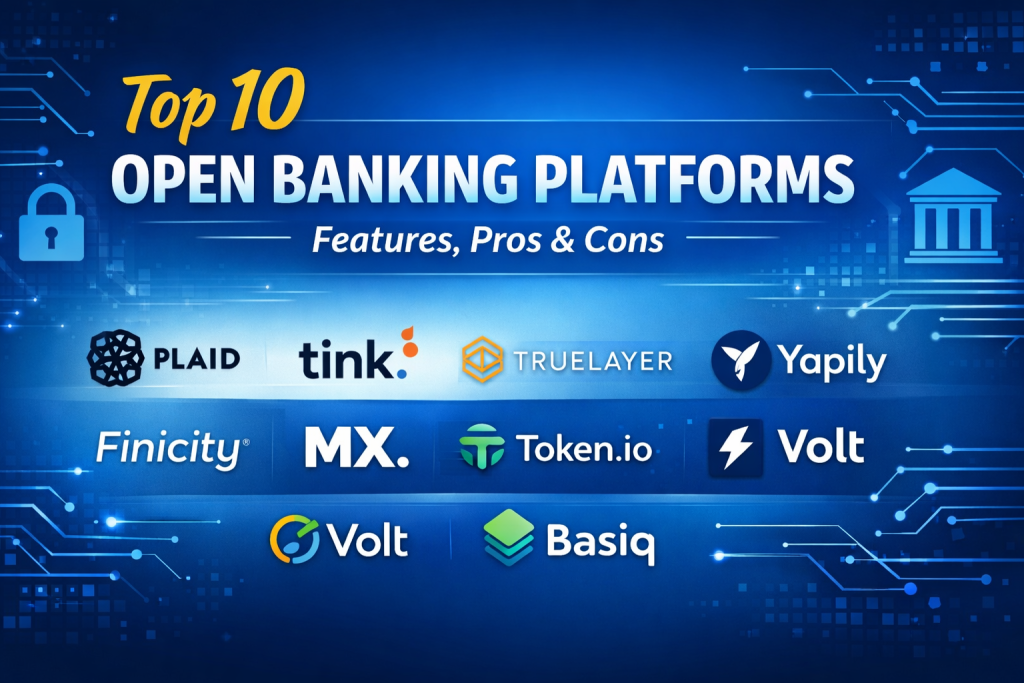
Top 10 Open Banking Platforms Tools
1 — Plaid
Short description:
A leading open banking data platform enabling secure access to consumer financial data, widely used by fintech apps and digital wallets.
Key features
- Bank account aggregation
- Real-time balance and transaction data
- Identity and income verification
- Payment initiation support
- Fraud and risk signals
- Developer-friendly APIs
Pros
- Broad bank coverage in key markets
- Excellent developer experience
Cons
- Premium pricing at scale
- Limited customization for niche use cases
Security & compliance:
Encryption in transit and at rest, GDPR support, SOC 2-aligned controls.
Support & community:
Strong documentation, active developer community, enterprise support available.
2 — Tink
Short description:
A Europe-focused open banking platform offering data enrichment, payments, and financial insights for banks and fintechs.
Key features
- PSD2-compliant APIs
- Account aggregation across EU banks
- Payment initiation services
- Data categorization and enrichment
- Risk and affordability insights
- Scalable enterprise architecture
Pros
- Deep European bank coverage
- Advanced analytics capabilities
Cons
- Less suitable outside Europe
- More complex onboarding
Security & compliance:
PSD2, GDPR, strong customer authentication, enterprise-grade controls.
Support & community:
High-quality documentation, strong enterprise onboarding, dedicated account teams.
3 — TrueLayer
Short description:
An open banking payments platform specializing in real-time pay-by-bank and data access.
Key features
- Instant bank payments
- Account and transaction data APIs
- Strong authentication flows
- Developer-first SDKs
- High availability infrastructure
Pros
- Excellent payment performance
- Clear API design
Cons
- Limited analytics depth
- Smaller ecosystem than larger players
Security & compliance:
PSD2 compliant, strong encryption, audit-ready logging.
Support & community:
Responsive support, clear docs, growing developer ecosystem.
4 — Yapily
Short description:
An API-first open banking connectivity platform enabling access to bank data and payments across regions.
Key features
- Unified bank API layer
- Account data and payment initiation
- Strong error handling
- Multi-country coverage
- Event-based notifications
Pros
- Flexible integration model
- Transparent pricing approach
Cons
- UI tools are minimal
- Requires technical expertise
Security & compliance:
PSD2, GDPR, secure authentication, compliance-first design.
Support & community:
Good technical documentation, onboarding assistance, enterprise SLAs.
5 — Open Banking Limited
Short description:
The UK’s official open banking standard-setter and ecosystem enabler.
Key features
- UK open banking standards
- API specifications and governance
- Security and consent frameworks
- Certification processes
- Ecosystem interoperability
Pros
- Regulatory authority backing
- Industry-wide adoption
Cons
- Not a commercial SaaS platform
- Limited direct tooling
Security & compliance:
UK regulatory-grade security, strong customer authentication.
Support & community:
Extensive documentation, ecosystem working groups, industry collaboration.
6 — Finicity
Short description:
A financial data access platform focused on lending, credit, and income verification.
Key features
- Income and employment verification
- Transaction-level data access
- Credit decisioning support
- Consumer permission management
- Scalable APIs
Pros
- Strong lending-focused capabilities
- Trusted by financial institutions
Cons
- Narrower non-lending use cases
- Slower innovation pace
Security & compliance:
SOC-aligned controls, encryption, regulatory-grade data handling.
Support & community:
Enterprise-focused support, detailed onboarding resources.
7 — MX Technologies
Short description:
A data-driven open banking platform emphasizing financial insights and user experience.
Key features
- Data aggregation and normalization
- Financial categorization
- Personal financial management tools
- Analytics dashboards
- API-first architecture
Pros
- Strong UX and insights
- Clean data presentation
Cons
- Regional limitations
- Pricing less transparent
Security & compliance:
Data encryption, privacy-first design, industry compliance standards.
Support & community:
Good documentation, enterprise onboarding, customer success teams.
8 — Token.io
Short description:
A payment-centric open banking platform enabling secure account-to-account transactions.
Key features
- Pay-by-bank infrastructure
- Payment orchestration APIs
- Consent management
- Multi-bank connectivity
- High transaction reliability
Pros
- Strong payments focus
- Lower transaction costs
Cons
- Limited data enrichment
- Less suited for analytics-heavy use
Security & compliance:
PSD2 compliant, strong encryption, audit-ready systems.
Support & community:
Developer documentation, enterprise support options.
9— Volt
Short description:
A real-time payments platform leveraging open banking rails.
Key features
- Instant bank payments
- Merchant-focused APIs
- Settlement monitoring
- High uptime infrastructure
- Scalable payment flows
Pros
- Fast payment confirmation
- Simple integration model
Cons
- Data access features are limited
- Narrow product scope
Security & compliance:
PSD2 alignment, encryption, operational monitoring.
Support & community:
Commercial onboarding, responsive merchant support.
10 — Basiq
Short description:
An open banking platform serving the Asia-Pacific region with strong data access capabilities.
Key features
- Bank and financial data aggregation
- Data enrichment and categorization
- Consent management
- Regional regulatory alignment
- Flexible APIs
Pros
- Strong APAC coverage
- Clean API structure
Cons
- Smaller global footprint
- Limited payments tooling
Security & compliance:
Regional regulatory compliance, encryption, privacy-first approach.
Support & community:
Solid documentation, onboarding help, growing partner ecosystem.
Comparison Table
| Tool Name | Best For | Platform(s) Supported | Standout Feature | Rating |
|---|---|---|---|---|
| Plaid | Fintech apps & wallets | Web, API | Broad bank coverage | N/A |
| Tink | European banks & fintechs | API | Data enrichment | N/A |
| TrueLayer | Pay-by-bank payments | API | Real-time payments | N/A |
| Yapily | Custom integrations | API | Unified connectivity | N/A |
| Open Banking Limited | UK ecosystem | Standards | Regulatory authority | N/A |
| Finicity | Lenders & credit firms | API | Income verification | N/A |
| MX Technologies | Financial insights | API, Web | UX-focused data | N/A |
| Token.io | A2A payments | API | Payment orchestration | N/A |
| Volt | Merchants | API | Instant settlement | N/A |
| Basiq | APAC fintechs | API | Regional strength | N/A |
Evaluation & Scoring of Open Banking Platforms
| Criteria | Weight | Score Focus |
|---|---|---|
| Core features | 25% | Data access, payments, coverage |
| Ease of use | 15% | API clarity, onboarding |
| Integrations & ecosystem | 15% | Bank reach, partners |
| Security & compliance | 10% | Regulatory readiness |
| Performance & reliability | 10% | Uptime, latency |
| Support & community | 10% | Docs, SLAs |
| Price / value | 15% | ROI and scalability |
Which Open Banking Platforms Tool Is Right for You?
- Solo users & startups: Prefer developer-friendly APIs with transparent pricing and fast onboarding.
- SMBs: Look for platforms offering both data and payments with minimal operational overhead.
- Mid-market: Prioritize reliability, analytics, and regional coverage.
- Enterprise: Focus on compliance, scalability, SLAs, and dedicated support.
Budget-conscious teams may trade advanced analytics for lower transaction costs, while premium buyers often value compliance depth and performance guarantees. Always align tool choice with integration complexity, regulatory exposure, and growth plans.
Frequently Asked Questions (FAQs)
1. What is open banking in simple terms?
It allows customers to securely share bank data with third-party apps they trust.
2. Are open banking platforms safe?
Yes, when compliant with regulations and using encryption and consent-based access.
3. Do I need regulatory approval to use open banking APIs?
It depends on your role and region; some platforms handle compliance for you.
4. Can open banking replace card payments?
In many cases, pay-by-bank can reduce costs and improve settlement speed.
5. How long does integration take?
From days for basic APIs to weeks for enterprise-grade deployments.
6. Is open banking only for fintech startups?
No, enterprises, retailers, and SaaS platforms increasingly use it.
7. What are common implementation mistakes?
Ignoring consent UX, underestimating compliance, and poor error handling.
8. Does open banking work globally?
Coverage varies widely by country and regulation.
9. How is pricing usually structured?
Based on API calls, active users, or transaction volume.
10. Are there alternatives to open banking?
Screen scraping exists but is less secure and increasingly discouraged.
Conclusion
Open banking platforms have become foundational infrastructure for modern financial products. They enable smarter decisions, faster payments, and better customer experiences—while maintaining security and regulatory compliance.
The most important factors when choosing a platform are coverage, reliability, security, ease of integration, and long-term scalability. There is no single universal winner—the best open banking platform is the one that aligns most closely with your business model, geography, and growth strategy.

Find Trusted Cardiac Hospitals
Compare heart hospitals by city and services — all in one place.
Explore Hospitals
Thank you for sharing this detailed overview. As the financial industry moves toward more collaborative and API-driven ecosystems, understanding the top open banking platforms becomes essential. This post serves as a fantastic roadmap for fintech professionals and developers alike. Very informative and well-structured!