
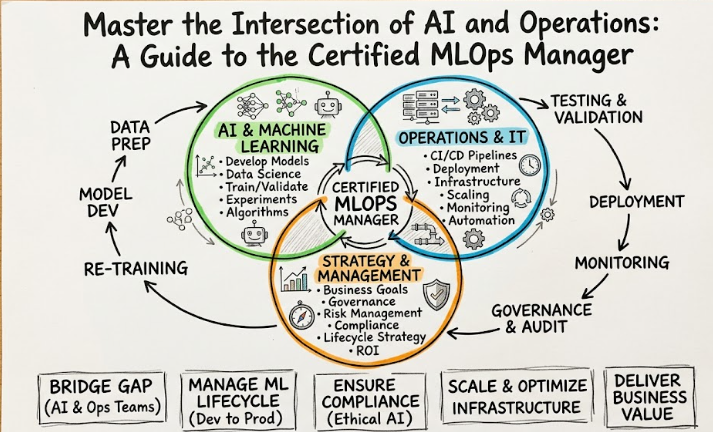
The transition from experimental machine learning to production-grade artificial intelligence has created a significant gap in the engineering world. Many organizations struggle to move models out of notebooks and into scalable, reliable environments. This guide is designed for professionals looking to bridge that gap by pursuing the Certified MLOps Manager program. Whether you are coming from a DevOps background or a data science field, understanding the operational lifecycle of machine learning is no longer optional. This certification serves as a blueprint for managing complex AI lifecycles within the modern enterprise.
By following this guide, engineers and technical leaders can gain a clear understanding of the MLOps landscape. The curriculum provided by AIOps School ensures that the technical rigor required for production AI is met with operational excellence. This guide will help you navigate the various tracks, understand the career implications, and decide how to integrate these skills into your existing professional toolkit. It is specifically crafted for those who want to move beyond the “hype” of AI and focus on the hard engineering reality of maintaining intelligent systems at scale.
What is the Certified MLOps Manager?
The Certified MLOps Manager is a professional validation that confirms an individual’s ability to oversee the entire machine learning lifecycle. Unlike traditional data science certifications that focus heavily on model architecture, this program emphasizes the “Ops” in MLOps. It addresses the challenges of continuous integration, continuous delivery, and continuous training (CI/CD/CT) for machine learning models. It represents a shift in thinking from treating ML as a research project to treating it as a core software product that requires monitoring, governance, and reliability.
This certification exists because enterprises have realized that building a model is only 10% of the journey; the other 90% is infrastructure and maintenance. The program is designed to align with modern engineering workflows, including GitOps, containerization, and cloud-native practices. It focuses on real-world production environments where data drift, model decay, and resource management are daily challenges. By achieving this certification, a professional demonstrates they can manage the intersection of data engineering, machine learning, and DevOps.
Who Should Pursue Certified MLOps Manager?
This program is highly beneficial for DevOps engineers and Site Reliability Engineers (SREs) who are increasingly being tasked with managing AI workloads. As companies move their AI models to the cloud, the need for platform engineers who understand the specific requirements of GPUs and distributed training grows. Data professionals, including data engineers and data scientists, will also find this valuable as it provides them with the operational language needed to collaborate effectively with IT and operations teams.
For engineering managers and technical leaders, the certification provides the strategic framework necessary to build and lead MLOps teams. It helps them understand how to allocate resources, manage technical debt in ML systems, and ensure compliance with data regulations. Beginners with a strong foundation in Linux and Python can use this as a roadmap to enter one of the fastest-growing niches in the tech industry. Globally, and specifically within the rapidly evolving tech hubs in India, this certification is becoming a benchmark for high-stakes AI engineering roles.
Why Certified MLOps Manager is Valuable in the Current Era and Beyond
The demand for MLOps expertise is skyrocketing as enterprise adoption of AI moves from the “experimental” phase to the “integrated” phase. Organizations are no longer satisfied with models that only work on a data scientist’s laptop; they require systems that can scale to millions of users. The Certified MLOps Manager program provides the longevity professionals need by focusing on core principles rather than just fleeting tools. This ensures that even as specific libraries change, your understanding of the underlying operational architecture remains solid.
Investing time in this certification offers a significant return on career investment because it positions you at the high-value intersection of multiple disciplines. It helps you stay relevant as traditional software engineering roles evolve to include more data-driven components. Companies are actively seeking professionals who can reduce the time-to-market for AI products while maintaining high reliability and low costs. This certification proves you have the skills to handle these complex requirements, making you an indispensable asset to any modern engineering organization.
Certified MLOps Manager Certification Overview
The Certified MLOps Manager program is delivered via the official course page and is hosted on the AIOps School platform. The program is structured to accommodate different levels of expertise, ranging from those new to the field to seasoned veterans looking to formalize their experience. The assessment approach is designed to be practical, often involving case studies or scenario-based questions that mimic real-world production failures and deployment challenges. This ensures that the certification holds weight in the eyes of hiring managers who prioritize practical ability.
Ownership of the learning process remains with the student, but the structure provided by the platform offers a clear path toward mastery. The certification covers various domains, including data versioning, model monitoring, automated testing for ML, and infrastructure as code (IaC) for AI. It is not just about passing an exam; it is about adopting a mindset of continuous improvement and operational rigor. The structure is modular, allowing professionals to build their knowledge incrementally while gaining recognized credentials at each stage.
Certified MLOps Manager Certification Tracks & Levels
The certification is divided into three primary levels: Foundation, Professional, and Advanced. The Foundation level introduces the core concepts of the ML lifecycle and the basic components of an MLOps pipeline. It is ideal for those transitioning from other engineering disciplines who need to understand how ML differs from traditional software. The Professional level dives deeper into automation, orchestration, and the integration of ML pipelines with existing DevOps tools like Jenkins, GitLab, or GitHub Actions.
The Advanced level is reserved for those who wish to specialize in complex areas such as distributed training at scale, multi-cloud MLOps, and advanced model governance. There are also specialization tracks that allow you to align the certification with your specific career path, such as focusing on the security aspects or the financial optimization of ML infrastructure. These tracks ensure that whether you are an SRE focused on uptime or a FinOps practitioner focused on cloud costs, there is a relevant path for your career progression.
Complete Certified MLOps Manager Certification Table
| Track | Level | Who it’s for | Prerequisites | Skills Covered | Recommended Order |
| Core MLOps | Foundation | Beginners, Junior Engineers | Basic Python & Linux | ML Lifecycle, Data Versioning | 1 |
| Core MLOps | Professional | DevOps/Data Engineers | Foundation Level | CI/CD for ML, Orchestration | 2 |
| Core MLOps | Advanced | Tech Leads, Architects | Professional Level | Scaling ML, Governance, Drift | 3 |
| ML Security | Professional | Security Engineers | Foundation Level | Model Security, Data Privacy | 4 (Optional) |
| ML FinOps | Professional | FinOps/Managers | Foundation Level | GPU Cost Optimization | 5 (Optional) |
Detailed Guide for Each Certified MLOps Manager Certification
Certified MLOps Manager – Foundation Level
What it is
This certification validates a candidate’s understanding of the fundamental principles of MLOps. It ensures you know the vocabulary, the stages of the ML lifecycle, and how to differentiate between standard software development and machine learning operations.
Who should take it
This is suitable for junior developers, data analysts, or traditional DevOps engineers who are new to machine learning. It is for anyone who needs a solid starting point before moving into technical implementation.
Skills you’ll gain
- Understanding the CRISP-DM and ML lifecycle phases.
- Basic knowledge of data versioning and model registries.
- Familiarity with MLOps tools and cloud AI services.
- Ability to identify common bottlenecks in ML deployments.
Real-world projects you should be able to do
- Setup a basic automated data ingestion pipeline.
- Create a simple model versioning system using Git and DVC.
- Document a model deployment workflow for a small team.
Preparation plan
- 7-14 Days: Focus on the theoretical definitions and the overall flow of MLOps.
- 30 Days: Complete the official coursework and experiment with one versioning tool.
- 60 Days: Not typically required for this level, but useful for deep-diving into case studies.
Common mistakes
- Treating ML code like standard application code without considering data.
- Ignoring the importance of data quality at the start of the pipeline.
Best next certification after this
- Same-track option: Certified MLOps Manager – Professional.
- Cross-track option: Certified SRE Professional.
- Leadership option: Technical Team Lead Certification.
Certified MLOps Manager – Professional Level
What it is
This level validates the ability to build and maintain automated ML pipelines. It focuses on the integration of various tools to create a seamless flow from data preparation to model monitoring in a production environment.
Who should take it
Current DevOps engineers, data engineers, or SREs who are responsible for the actual deployment and scaling of machine learning models within their organizations.
Skills you’ll gain
- Implementing CI/CD specifically for machine learning (CI/CD/CT).
- Using containerization (Docker/Kubernetes) for ML workloads.
- Setting up automated monitoring for model and data drift.
- Managing model pipelines with tools like Kubeflow or MLflow.
Real-world projects you should be able to do
- Build a fully automated pipeline that retrains a model when data drift is detected.
- Deploy a model to a Kubernetes cluster with auto-scaling capabilities.
- Implement a centralized logging and monitoring system for multiple ML models.
Preparation plan
- 7-14 Days: Review containerization and basic Kubernetes if not already known.
- 30 Days: Work through hands-on labs involving CI/CD tools and MLflow.
- 60 Days: Build a full end-to-end project and troubleshoot common deployment errors.
Common mistakes
- Over-engineering the pipeline for simple models.
- Failing to set up proper alerting for model performance degradation.
Best next certification after this
- Same-track option: Certified MLOps Manager – Advanced.
- Cross-track option: Certified DevSecOps Professional.
- Leadership option: Engineering Manager Certification.
Certified MLOps Manager – Advanced Level
What it is
The Advanced level validates expertise in high-scale, enterprise-grade MLOps. It covers complex topics like distributed training, high-availability ML systems, and strict regulatory governance for AI.
Who should take it
Senior engineers, principal architects, and technical leaders who are designing the MLOps strategy for large organizations or highly regulated industries.
Skills you’ll gain
- Designing multi-cloud and hybrid MLOps architectures.
- Implementing advanced security and compliance for AI models.
- Optimizing high-performance computing (HPC) and GPU resources.
- Leading organizational change to adopt MLOps culture.
Real-world projects you should be able to do
- Design a globally distributed ML deployment strategy with low-latency serving.
- Create a governance framework that satisfies GDPR or HIPAA for AI products.
- Optimize cloud infrastructure to reduce ML training costs by 30% or more.
Preparation plan
- 7-14 Days: Deep dive into enterprise architecture patterns and compliance requirements.
- 30 Days: Case study analysis and complex infrastructure design exercises.
- 60 Days: Mentoring others and implementing a production-grade strategy in a sandbox.
Common mistakes
- Focusing too much on technology and not enough on team culture and processes.
- Underestimating the cost of data movement and storage at scale.
Best next certification after this
- Same-track option: Specialized AI Architect.
- Cross-track option: Certified Cloud Architect.
- Leadership option: Director of Engineering or CTO track.
Choose Your Learning Path
DevOps Path
The DevOps path focuses on bringing the established rigors of software engineering to the world of machine learning. Professionals on this path will prioritize automation, infrastructure as code, and robust CI/CD pipelines tailored for ML artifacts. You will learn how to integrate tools like Jenkins or GitHub Actions with model training scripts and model registries. This path ensures that ML models are treated with the same deployment standards as any other microservice. It is ideal for those who want to be the bridge between data science teams and the operations department.
DevSecOps Path
The DevSecOps path emphasizes the security and integrity of the machine learning lifecycle. As AI becomes a target for adversarial attacks and data poisoning, security-focused MLOps becomes critical. Professionals here will learn how to secure data pipelines, implement access controls for sensitive datasets, and scan for vulnerabilities in ML libraries. You will also focus on the ethical and compliance side of AI, ensuring that models meet legal standards for privacy. This path is perfect for security professionals who want to specialize in the burgeoning field of AI security.
SRE Path
The SRE path for MLOps focuses on the reliability, availability, and performance of ML systems in production. Site Reliability Engineers will apply their expertise in error budgets, monitoring, and incident response to the unique challenges of model serving. This includes managing GPU utilization, handling high-concurrency inference requests, and ensuring that model retraining doesn’t crash production systems. You will learn how to set up Service Level Objectives (SLOs) specifically for AI performance. This path is for those who enjoy the challenge of keeping complex, high-traffic systems running smoothly.
AIOps Path
AIOps focuses on using artificial intelligence to improve traditional IT operations. Professionals in this path learn how to implement ML models that can predict system failures, automate root cause analysis, and optimize resource allocation. While MLOps is about managing ML, AIOps is about using ML as a tool for the broader infrastructure. You will work with large streams of log data, metrics, and traces to build “self-healing” systems. This is a great path for those who want to stay in infrastructure but want to use the latest AI tools to do their jobs more effectively.
MLOps Path
The pure MLOps path is a deep dive into the operationalization of machine learning models themselves. It focuses heavily on the technical nuances of data versioning, model drift detection, and automated retraining loops. You will become an expert in the “Three Pillars of MLOps”: Data, Model, and Code. This path is designed for those who want to work closely with data scientists to turn their research into scalable products. It requires a balance of software engineering skills and a fundamental understanding of how machine learning models behave over time.
DataOps Path
DataOps is the foundation upon which successful MLOps is built. This path focuses on the quality, speed, and reliability of the data pipelines that feed machine learning models. Professionals here will learn about data orchestration, automated data testing, and data governance. You will ensure that the data being used for training and inference is accurate, timely, and compliant with organizational standards. This path is ideal for data engineers who want to move beyond simple ETL and into the complex world of supporting production AI.
FinOps Path
The FinOps path addresses the massive costs associated with training and running machine learning models at scale. Cloud bills for GPU clusters and large-scale data storage can spiral out of control without proper management. Professionals on this path will learn how to monitor ML-related costs, optimize resource scheduling, and implement cost-allocation tags for AI projects. You will work to ensure that the organization is getting the best ROI on its AI investments. This path is perfect for those with a mix of technical and financial interests who want to manage the business side of AI.
Role → Recommended Certified MLOps Manager Certifications
| Role | Recommended Certifications |
| DevOps Engineer | Foundation, Professional |
| SRE | Professional, Advanced |
| Platform Engineer | Foundation, Professional |
| Cloud Engineer | Foundation, Professional |
| Security Engineer | Foundation, Professional (Security Track) |
| Data Engineer | Foundation, Professional (DataOps Track) |
| FinOps Practitioner | Foundation, Professional (FinOps Track) |
| Engineering Manager | Foundation, Advanced |
Next Certifications to Take After Certified MLOps Manager
Same Track Progression
Once you have completed the core levels of the Certified MLOps Manager, the next logical step is to dive into deep specializations. This might include certifications focused on specific cloud providers’ AI stacks, such as AWS Machine Learning Speciality or Azure AI Engineer Associate. By staying within the track, you become a subject matter expert who can handle the most complex technical challenges your organization faces. This depth of knowledge often leads to roles like Principal MLOps Engineer or AI Infrastructure Architect.
Cross-Track Expansion
Broadening your skills by moving into adjacent tracks is a highly effective way to become a more versatile professional. If you have mastered MLOps, taking a DevSecOps or SRE certification can help you understand the broader context in which your ML models reside. This cross-pollination of skills makes you a “T-shaped” professional—someone with deep expertise in one area and broad knowledge in others. It allows you to participate in higher-level architectural discussions and lead cross-functional teams more effectively.
Leadership & Management Track
For those who want to move away from individual contribution and into leadership, the next certifications should focus on management and strategy. This could include PMP for project management, or specialized Engineering Leadership certifications that focus on building high-performing technical teams. Understanding the business value of AI and how to communicate it to non-technical stakeholders is key. This path leads to roles such as Head of AI Operations, Director of Engineering, or even Chief Technology Officer.
Training & Certification Support Providers for Certified MLOps Manager
DevOpsSchool
DevOpsSchool is a leading provider of technical training that focuses on practical, hands-on learning for modern engineering roles. They offer a wide range of courses that complement the MLOps curriculum, including Docker, Kubernetes, and various CI/CD tools. Their instructors are typically industry veterans who bring real-world experience into the classroom. This provider is particularly strong for those who prefer live, instructor-led sessions and a structured community environment.
Cotocus
Cotocus specializes in high-end technical training and consulting for cloud-native technologies and automation. They provide deep-dive workshops that help professionals bridge the gap between theoretical knowledge and production implementation. Their focus is on the latest industry trends and ensuring that students are prepared for the challenges of modern enterprise environments. They are a great choice for teams looking for customized training solutions tailored to their specific tech stack.
Scmgalaxy
Scmgalaxy is a community-driven platform that has been a staple in the DevOps world for many years. They offer a vast library of tutorials, blog posts, and training programs focused on configuration management and software supply chains. For MLOps professionals, their resources on GitOps and version control are particularly valuable. It is an excellent resource for self-paced learners who want to stay updated on the latest tools and best practices.
BestDevOps
BestDevOps focuses on providing curated training paths for engineers who want to excel in automation and reliability. They offer certifications and courses that are designed to be concise and highly relevant to current job market demands. Their approach is to cut through the noise and focus on the skills that actually matter in a day-to-day job. They are a solid choice for busy professionals who need to upskill quickly and effectively.
devsecopsschool.com
This provider is dedicated to the integration of security into the DevOps lifecycle, which is a critical component of advanced MLOps. Their curriculum covers everything from secure coding practices to automated security testing in the pipeline. For those pursuing the security track within MLOps, this is an essential resource. They provide the specialized knowledge needed to protect AI models and the sensitive data they process.
sreschool.com
SRESchool focuses on the principles and practices of Site Reliability Engineering. Their training is invaluable for MLOps professionals who need to ensure the high availability and performance of their AI systems. They teach the math and methodology behind SLIs, SLOs, and error budgets. This provider helps engineers transition from a reactive mindset to a proactive, data-driven approach to system reliability.
aiopsschool.com
AIOps School is the primary hosting platform for the Certified MLOps Manager program and is a hub for all things related to AI in operations. They provide a comprehensive ecosystem of learning materials, from foundational courses to advanced specializations. Their focus is specifically on the intersection of artificial intelligence and traditional IT operations. It is the go-to destination for anyone looking to build a serious career in the MLOps or AIOps space.
dataopsschool.com
DataOps School focuses on the critical data engineering side of the AI equation. They offer training on building resilient data pipelines, data quality management, and data governance. Since MLOps is heavily dependent on high-quality data, the skills taught here are a fundamental prerequisite for any successful MLOps implementation. They provide the technical depth needed to manage data as a first-class citizen in the engineering world.
finopsschool.com
FinOps School addresses the often-overlooked area of cloud cost management and optimization. Their training is essential for those who need to manage the significant financial resources required for large-scale machine learning projects. They teach engineers how to speak the language of finance and how to implement technical changes that result in real-world cost savings. This is a key resource for any senior leader or technical architect.
Frequently Asked Questions (General)
- How difficult is the Certified MLOps Manager exam?
The difficulty depends on your background; DevOps professionals find the automation easy but the ML concepts hard, while data scientists face the opposite. Generally, it is considered moderately challenging. - How long does it take to prepare for the certification?
Most professionals spend between 30 to 60 days preparing, depending on their existing familiarity with Python, Linux, and containerization. - Are there any mandatory prerequisites?
There are no formal gatekeepers, but a strong understanding of the Linux command line and basic Python programming is highly recommended. - Is the certification recognized globally?
Yes, the concepts taught are industry-standard, and the certification is recognized by major tech hubs and enterprises worldwide. - What is the ROI of getting this certification?
Professionals often see significant salary increases and access to more specialized, higher-level roles in the AI and platform engineering sectors. - Can I take the exam online?
Yes, the certification is designed to be accessible globally through the official hosting platform. - How often do I need to recertify?
The industry moves fast, so recertification or continuing education credits are typically required every two to three years to ensure your skills remain current. - What tools will I learn to use?
You will gain exposure to a wide range of tools, including Docker, Kubernetes, MLflow, DVC, and various CI/CD platforms. - Does this certification cover specific cloud providers?
While the principles are cloud-agnostic, the training often uses major providers like AWS, Azure, or GCP for practical labs and examples. - Is this certification suitable for managers?
Yes, it provides a “Manager” track specifically designed for those who need to oversee teams and strategy rather than write every line of code. - How does this differ from a Data Science certification?
Data science focuses on model building and statistics; MLOps focuses on the deployment, monitoring, and scaling of those models in production. - What kind of support is available during the course?
The support providers listed above offer varying levels of mentorship, community forums, and hands-on lab assistance to help you succeed.
FAQs on Certified MLOps Manager
- What is the core focus of the Certified MLOps Manager?The program focuses on the technical and process-oriented aspects of managing machine learning models in a production environment. It covers the entire lifecycle from data ingestion and versioning to model deployment, monitoring, and automated retraining.
- How does this certification help with career growth?It validates your ability to handle one of the most complex areas of modern engineering. By bridging the gap between data science and operations, you become a rare and valuable asset who can lead AI initiatives from a practical perspective.
- What is the difference between the Foundation and Professional levels?The Foundation level is about understanding the “what” and “why” of MLOps, focusing on concepts and vocabulary. The Professional level is about the “how,” involving hands-on implementation of pipelines and automation.
- Is hands-on experience required to pass?While you can learn the theory, the Professional and Advanced levels strongly emphasize practical skills. Completing real-world projects and labs is the best way to ensure success in the assessment.
- Does the program cover model ethics and governance?Yes, especially at the Advanced level, where topics like bias detection, data privacy, and regulatory compliance (like GDPR) are integrated into the MLOps strategy.
- Can I skip the Foundation level?If you have significant experience in both DevOps and basic Machine Learning, you may be able to jump to the Professional level, but the Foundation level is recommended to ensure no conceptual gaps exist.
- How does MLOps relate to SRE?MLOps applies SRE principles—like monitoring, alerting, and automation—specifically to machine learning systems. It treats ML models as software that requires high availability and reliability.
- Why choose this certification over others?This program is specifically designed for the “Manager” and “Engineer” roles within the operations side of AI, providing a unique focus that many general AI courses lack.
Final Thoughts: Is Certified MLOps Manager Worth It?
As an engineer or manager with years of experience, you know that the “next big thing” in tech often comes with a lot of noise. However, MLOps is not a passing trend; it is the inevitable evolution of software engineering as data becomes the central driver of business value. The Certified MLOps Manager program is a pragmatic, no-nonsense path to mastering this evolution. It doesn’t just teach you how to use a specific tool; it teaches you how to think about the entire lifecycle of an intelligent system.
In the real world, the people who succeed are those who can bridge silos and solve complex, multi-disciplinary problems. This certification gives you the tools to do exactly that. Whether you are looking to secure your current role or move into a high-growth field, the investment in MLOps expertise is one of the smartest career moves you can make today. It is about becoming the professional who knows not just how to build the future, but how to keep it running reliably and efficiently.

Find Trusted Cardiac Hospitals
Compare heart hospitals by city and services — all in one place.
Explore Hospitals
Helpful and inspiring article on the growing field of MLOps. It clearly explains how AI and operations come together in modern careers.