
Introduction
AI Inventory Rebalancing Tools are advanced software platforms that help organizations maintain optimal inventory levels across warehouses, stores, and distribution centers using AI-driven analytics. These tools predict stock shortages or surpluses, recommend reallocation, and optimize replenishment to minimize holding costs and stockouts. By leveraging machine learning and predictive analytics, businesses can ensure inventory is efficiently balanced in real time across their supply chain.
In 2026, businesses face more complex inventory challenges due to multi-channel retail, global supply networks, and fluctuating consumer demand. Manual approaches are no longer sufficient. AI inventory rebalancing provides real-time insights, reduces waste, and improves service levels, making it crucial for modern supply chain operations.
Real-world use cases include:
- Automatically redistributing stock between stores and warehouses based on predicted demand.
- Identifying slow-moving or excess inventory for liquidation or promotion.
- Predicting stockouts and recommending preemptive replenishment.
- Balancing inventory in e-commerce and omnichannel retail environments.
- Integrating with ERP and warehouse management systems for real-time decision-making.
- Reducing safety stock while maintaining service levels.
Evaluation criteria buyers should consider:
- Forecast accuracy and predictive capabilities
- Real-time inventory monitoring
- Integration with ERP, WMS, and TMS systems
- Scalability for multi-warehouse operations
- AI model transparency and explainability
- Security and compliance (SSO, encryption, audit logs)
- Observability and cost/latency metrics
- Guardrails for model-driven recommendations
- Deployment flexibility (cloud, hybrid, on-prem)
- Ease of use and interface clarity
- Vendor reliability and support
- Pricing and ROI considerations
Best for: Supply chain managers, inventory planners, large retailers, e-commerce platforms, and logistics service providers.
Not ideal for: Small businesses with limited SKUs, low transaction volume, or fully outsourced inventory management.
What’s Changed in AI Inventory Rebalancing Tools in 2026+
- Advanced AI models using agentic workflows for automated inventory redistribution.
- Integration of multimodal inputs (POS data, warehouse IoT sensors, e-commerce trends).
- Real-time prediction and optimization across multiple warehouses.
- Enhanced evaluation and testing frameworks for model reliability.
- Guardrails to prevent overstocking or misallocation decisions.
- Enterprise-grade privacy and data residency controls.
- Cost and latency optimization for large-scale multi-site operations.
- Observability dashboards tracking inventory movement, alerts, and resource utilization.
- Integration-ready APIs for ERP, WMS, TMS, and e-commerce platforms.
- Predictive analytics to anticipate demand spikes and supply disruptions.
- Explainable AI to justify stock rebalancing recommendations.
- Automated exception alerts and human-in-loop approval workflows.
Quick Buyer Checklist (Scan-Friendly)
- Data privacy & retention compliance
- Model choice: hosted, BYO, open-source, multi-model routing
- Real-time demand & inventory prediction
- RAG/connectors: ERP/WMS/TMS integrations
- Evaluation/testing: regression, offline tests, human review
- Guardrails: policy checks, anomaly prevention
- Latency & cost optimization
- Auditability & admin controls
- Scalability for multi-site operations
- Alerting and notification customization
- Explainable AI outputs for decisions
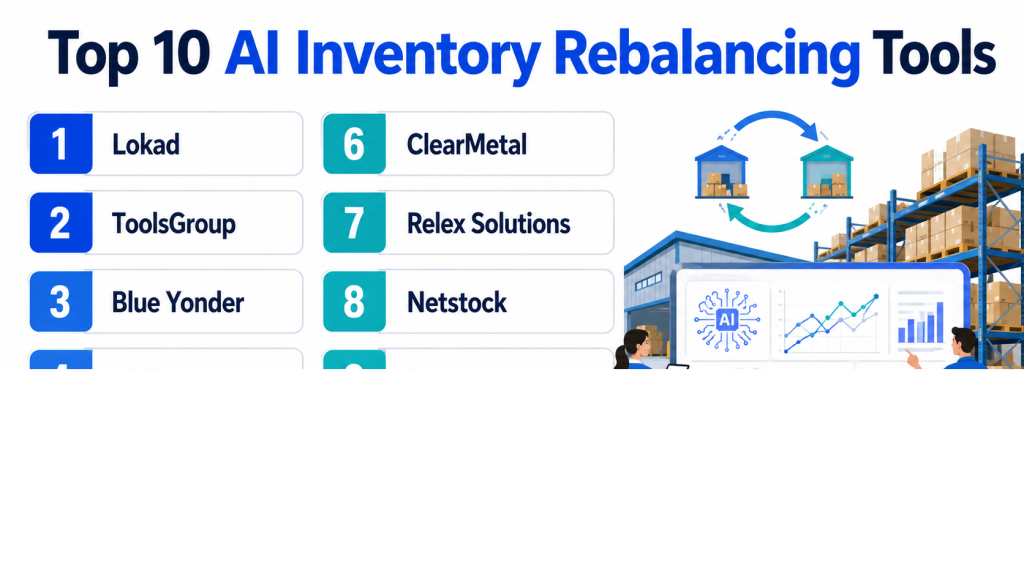
Top 10 AI Inventory Rebalancing Tools
#1 — Lokad
One-line verdict: Best for large retailers and e-commerce operators needing accurate, predictive inventory rebalancing.
Short description: Lokad leverages machine learning to forecast demand, detect inventory anomalies, and recommend stock movements across warehouses and stores.
Standout Capabilities
- Predictive inventory demand forecasting
- Multi-warehouse stock optimization
- Real-time exception alerts
- Sales and promotions impact simulation
- Multi-scenario supply planning
- Integration with major ERP and WMS platforms
- Explainable recommendations for inventory managers
AI-Specific Depth
- Model support: Proprietary / BYO optional
- RAG / knowledge integration: ERP, POS, and WMS connectors
- Evaluation: Regression and offline tests
- Guardrails: Policy checks and anomaly detection
- Observability: Latency, cost, and performance metrics
Pros
- Highly accurate forecasts
- Robust multi-site rebalancing
- Flexible scenario simulations
Cons
- Premium pricing
- Initial setup complexity
- Learning curve for small teams
Security & Compliance
- SSO, RBAC, encryption
- Data retention policies
- Certifications: Not publicly stated
Deployment & Platforms
- Cloud / Hybrid
- Web dashboards
Integrations & Ecosystem
- APIs and SDKs for ERP, WMS
- POS connectors
- Extensible workflow automation
Pricing Model
- Tiered subscription, usage-based
- Not publicly stated
Best-Fit Scenarios
- Large retail chains
- E-commerce operations
- Multi-warehouse distribution
#2 — ToolsGroup
One-line verdict: Ideal for global enterprises requiring automated inventory balancing with AI-driven demand sensing.
Short description: ToolsGroup provides demand forecasting and inventory optimization, combining machine learning with replenishment automation.
Standout Capabilities
- Demand sensing and predictive analytics
- Multi-echelon inventory optimization
- Automated replenishment recommendations
- SLA compliance monitoring
- Simulation of inventory scenarios
AI-Specific Depth
- Model support: Proprietary
- RAG / knowledge integration: ERP and WMS connectors
- Evaluation: Regression, offline, human review
- Guardrails: Policy enforcement
- Observability: Performance and latency dashboards
Pros
- Strong predictive capabilities
- Supports global multi-echelon networks
- Automated inventory actions
Cons
- Expensive for smaller operations
- Requires trained supply chain staff
- Complex initial configuration
Security & Compliance
- Encryption, audit logging
- Not publicly stated for certifications
Deployment & Platforms
- Cloud / Hybrid
- Web dashboards
Integrations & Ecosystem
- APIs and ERP/WMS connectors
- Workflow automation
- Custom scenario simulations
Pricing Model
- Subscription-based, enterprise tiers
- Not publicly stated
Best-Fit Scenarios
- Global retail operations
- Multi-warehouse supply chains
- High-volume e-commerce
#3 — Blue Yonder
One-line verdict: Best for enterprises needing AI-powered inventory optimization integrated with real-time demand data.
Short description: Blue Yonder combines predictive analytics with automated inventory rebalancing and replenishment recommendations.
Standout Capabilities
- Real-time inventory monitoring
- Predictive stock movement analysis
- Automated replenishment and redistribution
- Integration with POS and ERP
- Exception management dashboards
AI-Specific Depth
- Model support: Proprietary ML / BYO optional
- RAG / knowledge integration: ERP, POS, TMS connectors
- Evaluation: Regression and human-in-the-loop
- Guardrails: Safety thresholds and policy checks
- Observability: Dashboards with alerts and KPIs
Pros
- Real-time decision-making
- Enterprise-grade analytics
- Multi-system integration
Cons
- High cost
- Implementation complexity
- Requires trained personnel
Security & Compliance
- SSO, encryption, audit logs
- Data retention management
- Certifications: Not publicly stated
Deployment & Platforms
- Cloud / Hybrid
- Web dashboards
Integrations & Ecosystem
- APIs for ERP, WMS, POS
- Workflow automation
- Extensible connector library
Pricing Model
- Tiered subscription, usage-based
- Not publicly stated
Best-Fit Scenarios
- Large retailers
- Omni-channel operations
- Multi-location inventory management
#4 — o9 Solutions
One-line verdict: Enterprise solution for AI-driven inventory and supply chain planning with predictive exception handling.
Short description: o9 Solutions provides an integrated platform for inventory forecasting, rebalancing, and operational scenario simulations.
Standout Capabilities
- Predictive stock allocation
- Demand-driven replenishment
- Multi-warehouse optimization
- Real-time analytics dashboards
- Simulation of supply chain scenarios
AI-Specific Depth
- Model support: Proprietary / BYO optional
- RAG / knowledge integration: ERP and WMS connectors
- Evaluation: Regression, offline tests, human review
- Guardrails: Policy checks and anomaly detection
- Observability: Performance and cost metrics
Pros
- Comprehensive enterprise capabilities
- Predictive and prescriptive insights
- Supports complex networks
Cons
- High setup effort
- Expensive for SMBs
- Steep learning curve
Security & Compliance
- SSO, RBAC, encryption
- Certifications: Not publicly stated
Deployment & Platforms
- Cloud / Hybrid
- Web dashboards
Integrations & Ecosystem
- API connectors for ERP/WMS
- Extensible workflows
- Scenario simulation tools
Pricing Model
- Enterprise subscription
- Not publicly stated
Best-Fit Scenarios
- Large global enterprises
- Complex multi-echelon networks
- High-volume e-commerce
#5 — E2open
One-line verdict: Suitable for multi-tier supply chains needing AI-enabled inventory rebalancing and exception management.
Short description: E2open combines predictive analytics, demand sensing, and inventory redistribution across multi-tier supply networks.
Standout Capabilities
- Multi-echelon inventory optimization
- Real-time demand sensing
- Automated stock redistribution
- Exception and alert management
- Integration with ERP/WMS and TMS
AI-Specific Depth
- Model support: Proprietary ML
- RAG / knowledge integration: ERP/WMS/TMS connectors
- Evaluation: Regression and human-in-loop
- Guardrails: Policy thresholds for rebalancing
- Observability: Dashboards with KPIs and alerts
Pros
- Enterprise-grade analytics
- Supports complex supply chains
- Predictive and prescriptive insights
Cons
- Premium pricing
- Requires trained personnel
- Integration effort
Security & Compliance
- Encryption, SSO, audit logs
- Certifications: Not publicly stated
Deployment & Platforms
- Cloud / Hybrid
- Web dashboards
Integrations & Ecosystem
- ERP, WMS, TMS connectors
- Workflow automation
- API access
Pricing Model
- Tiered subscription
- Not publicly stated
Best-Fit Scenarios
- Global retail supply chains
- Multi-tier distribution
- High-volume operations
#6 — ClearMetal
One-line verdict: Best for companies leveraging real-time supply chain data for AI-driven inventory balancing.
Short description: ClearMetal uses predictive analytics to optimize inventory and reduce stockouts, integrating real-time supply chain data feeds.
Standout Capabilities
- Real-time inventory visibility
- Predictive stock balancing
- Exception detection and alerting
- Scenario simulation
- Integration with ERP, WMS
AI-Specific Depth
- Model support: Proprietary ML
- RAG / knowledge integration: ERP/WMS connectors
- Evaluation: Regression testing, human review
- Guardrails: Policy checks
- Observability: Dashboards with cost/performance metrics
Pros
- Real-time insights
- AI-driven recommendations
- Multi-system integration
Cons
- Enterprise pricing
- Setup complexity
- Requires trained staff
Security & Compliance
- SSO, encryption, audit logs
- Certifications: Not publicly stated
Deployment & Platforms
- Cloud / Hybrid
- Web dashboards
Integrations & Ecosystem
- ERP/WMS connectors
- API and SDK access
- Extensible workflows
Pricing Model
- Tiered subscription
- Not publicly stated
Best-Fit Scenarios
- E-commerce and retail chains
- Multi-warehouse networks
- Inventory-heavy operations
#7 — Relex Solutions
One-line verdict: Ideal for retailers requiring AI-powered inventory planning and stock redistribution.
Short description: Relex Solutions combines predictive analytics with automated inventory rebalancing and replenishment for retail operations.
Standout Capabilities
- Predictive demand forecasting
- Automatic stock redistribution
- Real-time alerts for exceptions
- Integration with POS and ERP
- Scenario simulation dashboards
AI-Specific Depth
- Model support: Proprietary
- RAG / knowledge integration: ERP/WMS connectors
- Evaluation: Offline tests, regression
- Guardrails: Policy checks for rebalancing
- Observability: Performance and cost dashboards
Pros
- Retail-focused optimization
- Automated exception handling
- Multi-channel inventory insights
Cons
- Implementation complexity
- Premium pricing
- Requires trained staff
Security & Compliance
- SSO, encryption, RBAC
- Certifications: Not publicly stated
Deployment & Platforms
- Cloud / Hybrid
- Web dashboards
Integrations & Ecosystem
- ERP, WMS, POS connectors
- API and SDK support
- Workflow automation
Pricing Model
- Tiered subscription
- Not publicly stated
Best-Fit Scenarios
- Retail chains
- Omni-channel operations
- High SKU variety
#8 — Netstock
One-line verdict: Suitable for SMBs and mid-market retailers seeking AI-assisted inventory rebalancing.
Short description: Netstock offers automated inventory recommendations, alerts for excess or low stock, and AI-driven rebalancing for SMBs.
Standout Capabilities
- Stock optimization for SMBs
- Predictive reorder recommendations
- Exception alerts for low/high stock
- Integration with ERP
- Simple dashboards for operations
AI-Specific Depth
- Model support: Proprietary ML
- RAG / knowledge integration: ERP connectors
- Evaluation: Human review and regression
- Guardrails: Threshold checks
- Observability: Dashboards
Pros
- Easy to deploy
- Cost-effective for SMBs
- Simplified dashboards
Cons
- Limited multi-warehouse support
- Smaller enterprise features
- Less advanced predictive modeling
Security & Compliance
- Encryption, RBAC
- Certifications: Not publicly stated
Deployment & Platforms
- Cloud
- Web dashboards
Integrations & Ecosystem
- ERP connectors
- API access
- Workflow automation
Pricing Model
- Subscription-based
- Not publicly stated
Best-Fit Scenarios
- Small retailers
- Single/multi-location SMBs
- Basic inventory optimization
#9 — Slimstock
One-line verdict: Best for distributors seeking AI-driven inventory balancing across multiple warehouses.
Short description: Slimstock provides predictive demand and stock rebalancing recommendations to reduce safety stock and optimize warehouse levels.
Standout Capabilities
- Multi-warehouse stock optimization
- Predictive demand forecasting
- Automated replenishment recommendations
- Exception alerts and KPIs
- ERP/WMS integration
AI-Specific Depth
- Model support: Proprietary ML
- RAG / knowledge integration: ERP/WMS connectors
- Evaluation: Regression tests
- Guardrails: Policy thresholds
- Observability: Dashboards with metrics
Pros
- Multi-warehouse support
- Predictive inventory balancing
- ERP integration
Cons
- Enterprise pricing
- Implementation effort
- Learning curve
Security & Compliance
- SSO, encryption, audit logs
- Certifications: Not publicly stated
Deployment & Platforms
- Cloud / Hybrid
- Web dashboards
Integrations & Ecosystem
- ERP and WMS connectors
- Workflow automation
- API access
Pricing Model
- Subscription-based
- Not publicly stated
Best-Fit Scenarios
- Wholesale distributors
- Multi-warehouse operations
- Inventory-heavy supply chains
#10 — Relex AI SMB
One-line verdict: Lightweight AI inventory balancing tool for SMB retailers with multi-channel operations.
Short description: Relex AI SMB combines predictive analytics with simple dashboards for inventory rebalancing and exception monitoring.
Standout Capabilities
- SMB-focused inventory optimization
- Predictive demand forecasts
- Exception alerts for overstock/understock
- Multi-channel support
- Integration with POS and ERP
AI-Specific Depth
- Model support: Proprietary
- RAG / knowledge integration: ERP/POS connectors
- Evaluation: Regression and human review
- Guardrails: Threshold-based checks
- Observability: Basic dashboards
Pros
- Easy setup
- Cost-effective for SMBs
- Predictive insights for small networks
Cons
- Limited multi-warehouse functionality
- Less advanced analytics
- Smaller support network
Security & Compliance
- Encryption, RBAC
- Certifications: Not publicly stated
Deployment & Platforms
- Cloud
- Web dashboards
Integrations & Ecosystem
- POS and ERP connectors
- API access
- Workflow automation
Pricing Model
- Subscription-based
- Not publicly stated
Best-Fit Scenarios
- SMB retailers
- Multi-channel operations
- Basic inventory rebalancing
Comparison Table
| Tool Name | Best For | Deployment | Model Flexibility | Strength | Watch-Out | Public Rating |
|---|---|---|---|---|---|---|
| Lokad | Large retail | Cloud / Hybrid | Proprietary / BYO | Accurate predictive analytics | Costly | N/A |
| ToolsGroup | Global enterprises | Cloud / Hybrid | Proprietary | Multi-echelon optimization | High setup effort | N/A |
| Blue Yonder | Enterprise | Cloud / Hybrid | Proprietary / BYO | Real-time optimization | Expensive | N/A |
| o9 Solutions | Enterprise | Cloud / Hybrid | Proprietary / BYO | Multi-scenario planning | Steep learning curve | N/A |
| E2open | Multi-tier supply chain | Cloud / Hybrid | Proprietary | Predictive & prescriptive insights | Premium pricing | N/A |
| ClearMetal | Real-time inventory | Cloud / Hybrid | Proprietary | Real-time insights | Enterprise pricing | N/A |
| Relex Solutions | Retail | Cloud / Hybrid | Proprietary | Automated rebalancing | Setup complexity | N/A |
| Netstock | SMBs | Cloud | Proprietary | Easy-to-deploy | Limited multi-warehouse | N/A |
| Slimstock | Distributors | Cloud / Hybrid | Proprietary | Multi-warehouse balancing | Learning curve | N/A |
| Relex AI SMB | SMBs | Cloud | Proprietary | Simple dashboards | Limited advanced analytics | N/A |
Scoring & Evaluation (Transparent Rubric)
Scores are relative, weighted based on predictive accuracy, integrations, AI reliability, guardrails, cost, and ease of use.
| Tool | Core | Reliability/Eval | Guardrails | Integrations | Ease | Perf/Cost | Security/Admin | Support | Weighted Total |
|---|---|---|---|---|---|---|---|---|---|
| Lokad | 9 | 9 | 8 | 9 | 8 | 8 | 8 | 8 | 8.7 |
| ToolsGroup | 8 | 9 | 8 | 8 | 7 | 8 | 8 | 7 | 8.0 |
| Blue Yonder | 8 | 9 | 8 | 9 | 7 | 8 | 8 | 7 | 8.1 |
| o9 Solutions | 8 | 8 | 8 | 8 | 7 | 7 | 8 | 7 | 7.8 |
| E2open | 8 | 9 | 8 | 9 | 7 | 7 | 8 | 7 | 8.0 |
| ClearMetal | 8 | 8 | 8 | 8 | 7 | 7 | 7 | 7 | 7.7 |
| Relex Solutions | 8 | 8 | 8 | 8 | 7 | 7 | 7 | 7 | 7.7 |
| Netstock | 7 | 7 | 7 | 6 | 9 | 8 | 7 | 7 | 7.3 |
| Slimstock | 8 | 8 | 8 | 8 | 7 | 7 | 7 | 7 | 7.7 |
| Relex AI SMB | 7 | 7 | 7 | 6 | 9 | 8 | 7 | 7 | 7.3 |
Top 3 for Enterprise: Lokad, Blue Yonder, ToolsGroup
Top 3 for SMB: Netstock, Relex AI SMB, Slimstock
Top 3 for Developers: Relex AI SMB, Netstock, ClearMetal
Which AI Inventory Rebalancing Tool Is Right for You?
Solo / Freelancer
- Lightweight SaaS like Netstock or Relex AI SMB
- Focus on single warehouse or small SKU count
- Low setup effort and simple dashboards
SMB
- Netstock, Relex AI SMB, Slimstock
- Affordable subscription, basic multi-channel support
- Easy integration with POS/ERP
Mid-Market
- Blue Yonder or Relex Solutions
- Multi-warehouse inventory optimization
- Moderate customization and advanced dashboards
Enterprise
- Lokad, ToolsGroup, o9 Solutions
- Predictive, prescriptive AI for multi-echelon networks
- Advanced scenario simulation and compliance reporting
Regulated industries
- ToolsGroup or o9 Solutions
- Audit-ready reporting and guardrails
- Multi-tier, multi-location visibility
Budget vs premium
- SMBs: Netstock, Relex AI SMB
- Premium: Lokad, Blue Yonder, ToolsGroup
- Evaluate ROI based on SKU count and operational complexity
Build vs buy
- Build possible with BYO or open-source ML integrations (Varies / N/A)
- Buy preferred for enterprise-scale multi-warehouse operations
Implementation Playbook (30 / 60 / 90 Days)
30 days: Pilot on select SKUs/warehouses, set success metrics, integrate with ERP/WMS.
60 days: Harden AI evaluation, guardrails, exception alerts, and staff training.
90 days: Optimize cost, latency, and predictive thresholds, scale across all locations, monitor KPI performance.
Common Mistakes & How to Avoid Them
- Ignoring model evaluation and regression tests
- Over-automation without human review
- Unmanaged data retention policies
- Lack of dashboard observability
- Underestimating integration complexity
- Cost spikes during peak season
- Vendor lock-in without abstraction
- Not updating AI models regularly
- Poor threshold configuration
- Single data source dependency
- Ignoring exception alerts
- Insufficient training for staff
- Not simulating scenarios before rollout
FAQs
1- What data do AI inventory rebalancing tools require?
Point-of-sale, ERP, warehouse, demand history, supplier lead times, and IoT sensor data feed the AI models.
2- Can I use BYO or open-source models?
Some tools allow BYO or open-source ML, but most enterprise tools use proprietary AI.
3- How is data privacy maintained?
Tools implement encryption, SSO/RBAC, and enterprise data residency policies.
4- Can these tools handle multi-warehouse operations?
Yes, enterprise tools like Lokad and Blue Yonder optimize across multiple warehouses and regions.
5- Are real-time recommendations possible?
Yes, modern platforms provide near real-time insights and exception alerts.
6- How is predictive accuracy evaluated?
Regression tests, offline simulations, and human review ensure reliability.
7- Are guardrails included to prevent overstocking?
Yes, policy thresholds, scenario simulations, and anomaly detection prevent misallocation.
8- What integrations are supported?
ERP, WMS, POS, API/SDK access, webhooks, and e-commerce platforms.
9- What deployment options exist?
Cloud, hybrid, or on-premise depending on tool and organization.
10- How scalable are these tools?
Enterprise solutions scale across multiple warehouses, SKUs, and geographies.
11- Do these tools support scenario simulations?
Yes, scenario-based inventory simulations are common for planning.
12- What’s the typical pricing model?
Usage-based, tiered subscriptions, enterprise contracts; exact pricing varies.
Conclusion
AI Inventory Rebalancing Tools provide actionable insights for optimal stock allocation, reducing costs, and avoiding stockouts. Selection depends on company size, SKU complexity, multi-warehouse networks, and budget. SMBs may favor Netstock or Relex AI SMB, while large enterprises benefit from Lokad, Blue Yonder, or ToolsGroup. Implementing AI effectively requires careful evaluation, integration planning, and continuous monitoring.

Find Trusted Cardiac Hospitals
Compare heart hospitals by city and services — all in one place.
Explore Hospitals