
Introduction
AI Computer Vision Loss Prevention refers to systems that use artificial intelligence to analyze visual data — from cameras, sensors, and video feeds — to detect loss, theft, fraud, and operational exceptions in real time. These tools help organizations prevent shrinkage, reduce operational risk, and enhance safety and compliance by identifying risky behaviors before they translate into losses.
In 2026, loss prevention powered by computer vision is essential across retail stores, warehouses, logistics hubs, and self‑checkout environments. AI vision systems can process billions of visual frames, correlate them with point‑of‑sale (POS) events, and surface actionable alerts to reduce shrinkage and improve operational efficiency.
Real‑world use cases include:
- Detecting shoplifting and suspicious behavior
- Preventing self‑checkout fraud and mis‑scans
- Monitoring compliance with safety and SOPs
- Tracking inventory movement through shelf and dock cameras
- Identifying employee‑related fraud or errors
- Detecting unsafe behaviors or safety violations
Evaluation criteria buyers should use:
- Detection accuracy and latency
- Real‑time alerting and automated responses
- Scalability to multi‑camera, multi‑site deployments
- Integration with POS, ERP, access control, and security systems
- Support for multimodal inputs (sensors, RFID, POS linkage)
- Guardrails to reduce false positives
- Privacy and compliance (GDPR/CCPA)
- Observability of AI decisions and performance metrics
- Ease of deployment and operational tuning
- Evaluations, retraining, and performance monitoring
Best for: Retail loss prevention teams, security operations centers, warehouse operations, logistics providers, and enterprises with large physical footprints.
Not ideal for: Small locations lacking video infrastructure or minimal shrinkage risk, or environments without historically labeled data to tune AI models.
What’s Changed in AI Computer Vision Loss Prevention in 2026+
- Real‑time multi‑camera monitoring with low‑latency alerts
- Multimodal fusion combining video, POS events, RFID, and motion sensors
- Hybrid AI models (open‑source + proprietary) for robust generalization
- Guardrails & bias mitigation to reduce false positives and protected class errors
- Predictive anomaly detection that anticipates loss before confirmation
- Automated response workflows (alerts to staff, lockout triggers)
- Cloud‑edge hybrid deployment for low latency & centralized management
- Observability dashboards showing model confidence, error rates, and token/compute metrics
- Privacy‑first features: face obfuscation, retention controls, data minimization
- Integration with Loss Prevention Systems (LPS), ERP, and POS
- Scenario simulation and training tools for customizing detection logic
- AI evaluation & retraining toolchains to maintain accuracy over time
Quick Buyer Checklist (Scan‑Friendly)
- Evaluate detection accuracy for theft, fraud, and safety violations
- Confirm real‑time alerting and automated responses
- Check multi‑camera and multi‑site scalability
- Review integration with POS/ERP security systems
- Assess guardrails to reduce false positives and protect privacy
- Validate privacy & compliance controls (GDPR, CCPA)
- Ensure observability dashboards for performance and metrics
- Evaluate ease of deployment and tuning
- Confirm model evaluation, retraining, and audit trails
- Check extensibility via APIs or SDKs
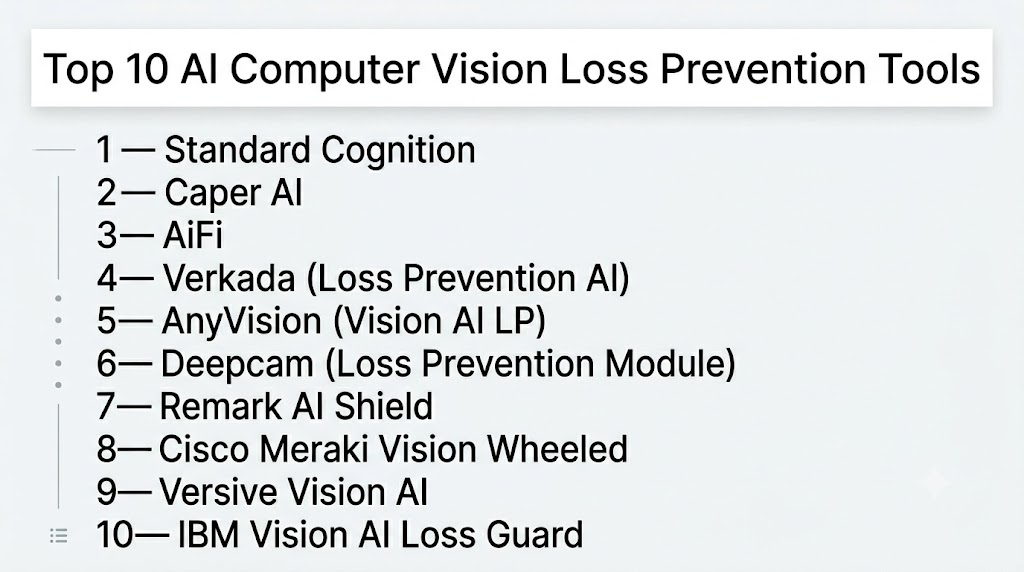
Top 10 AI Computer Vision Loss Prevention Tools
#1 — Standard Cognition
One‑line verdict: Autonomous AI vision platform designed to prevent theft and enable checkout‑free experiences at scale.
Short description: Standard Cognition uses computer vision across multiple cameras and sensors to detect customer actions, link them to POS events, and surface real‑time alerts for loss prevention and operational insight.
Standout Capabilities
- Real‑time detection of suspicious behavior
- Autonomous checkout support
- Multi‑camera tracking per store
- Integrated POS event linkage
- Alerting to staff or security systems
- Analytics dashboards with loss metrics
- Scenario tooling for behavior patterns
AI‑Specific Depth
- Model support: Proprietary computer vision
- RAG / knowledge integration: POS, ERP, IoT sensors
- Evaluation: Behavior pattern validation, regression testing
- Guardrails: Alert thresholds, confidence cutoffs
- Observability: Model performance, false positive rates
Pros
- Real‑time autonomous detection
- Strong multi‑camera support
- Tight POS integration
Cons
- High initial deployment cost
- Requires camera and sensor infrastructure
- Complexity for small operations
Security & Compliance
SSO, encryption; Certifications: Not publicly stated
Deployment & Platforms
Cloud + edge system, Web dashboards
Integrations & Ecosystem
POS, ERP, security system APIs
Pricing Model
Enterprise subscription
Best‑Fit Scenarios
- Checkout‑free retail deployments
- Large retail chains
- Multi‑store loss prevention
#2 — Caper AI
One‑line verdict: Best for retailers combining AI vision with self‑checkout fraud detection and loss prevention.
Short description: Caper AI leverages computer vision to monitor self‑checkout areas, detect mis‑scans, and prevent internal and external fraud in real time.
Standout Capabilities
- AI‑driven product recognition at self‑checkout
- Real‑time alerts for mis‑scans and shrinkage
- Integration with POS and shelf sensors
- Analytics on self‑checkout loss patterns
- Staff notifications and reporting
- Scenario testing for heuristics
- Multi‑store dashboards
AI‑Specific Depth
- Model support: Proprietary vision models
- RAG / knowledge integration: POS systems & weight sensors
- Evaluation: Real‑time accuracy monitoring
- Guardrails: Fraud confidence thresholds
- Observability: Shrinkage metrics, latency dashboards
Pros
- Reduces self‑checkout shrinkage
- Quick integration with POS
- Easy reporting
Cons
- Limited scope outside self‑checkout
- SMB deployment costs
- Camera installation required
Security & Compliance
Encryption, SSO; Certifications: Not publicly stated
Deployment & Platforms
Cloud + edge, Web
Integrations & Ecosystem
POS, security systems, shelf sensors
Pricing Model
SaaS subscription
Best‑Fit Scenarios
- Self‑checkout environments
- Grocery & convenience stores
- Mid‑market retail
#3 — AiFi
One‑line verdict: Suited for large retailers needing autonomous AI vision for loss and operational monitoring.
Short description: AiFi provides an AI computer vision platform that tracks customer and product movement, detects suspicious actions, and surfaces alerts tied to enterprise loss prevention.
Standout Capabilities
- Autonomous store monitoring
- Multi‑camera tracking
- Product removal & shelf interactions
- Integration with POS events
- Loss alerts and analytics
- Scenario testing environments
- Staff notification system
AI‑Specific Depth
- Model support: Proprietary AI
- RAG / knowledge integration: POS, ERP
- Evaluation: Regression and scenario validation
- Guardrails: False positive calibration
- Observability: KPI dashboards
Pros
- Scales across large footprints
- Strong detection accuracy
- Multimodal integration
Cons
- High infrastructure requirement
- Enterprise pricing
- Setup complexity
Security & Compliance
Encryption, SSO; Certifications: Not publicly stated
Deployment & Platforms
Cloud + edge processing
Integrations & Ecosystem
POS, ERP, building sensors
Pricing Model
Enterprise SaaS
Best‑Fit Scenarios
- Large retail operations
- Warehouse shrinkage reduction
- Omni‑channel loss prevention
#4 — Verkada (Loss Prevention AI)
One‑line verdict: Excellent choice for organizations wanting integrated hardware + AI vision for loss and safety.
Short description: Verkada’s AI loss prevention combines security cameras with on‑device and cloud vision analytics to detect theft, suspicious behavior, and safety risks across sites.
Standout Capabilities
- On‑device AI analytics
- Real‑time alerts via mobile & web
- Multi‑camera view stitching
- Facial blurring for privacy
- Behavior analytics for theft & trespass
- Integration with access control
- Custom detection rules
AI‑Specific Depth
- Model support: Proprietary embedded vision models
- RAG / knowledge integration: POS, access systems
- Evaluation: Accuracy tracking & alert logging
- Guardrails: Privacy filters & detection thresholds
- Observability: Performance & alert heatmaps
Pros
- Integrated hardware + software
- Easy deployment
- Privacy features
Cons
- Hardware cost
- Limited advanced scenario simulation
- SMB cost barrier
Security & Compliance
Encryption at rest/in transit, RBAC; Certifications: Not publicly stated
Deployment & Platforms
Cloud + edge hardware
Integrations & Ecosystem
POS, access control, security systems
Pricing Model
Hardware + subscription
Best‑Fit Scenarios
- Corporate campuses
- Retail & warehouse sites
- Safety compliance monitoring
#5 — AnyVision (Vision AI LP)
One‑line verdict: Suited for enterprises needing advanced facial and object recognition for loss prevention.
Short description: AnyVision leverages deep learning vision to track individuals, behaviors, and assets to detect suspicious movements and enforce compliance.
Standout Capabilities
- Real‑time object and person tracking
- Behavior pattern detection
- Threat alerts and risk scoring
- Privacy masks & compliance controls
- Multi‑site dashboards
- Integration with access control & POS data
AI‑Specific Depth
- Model support: Proprietary deep vision AI
- RAG / knowledge integration: POS, ERP, sensor networks
- Evaluation: Backtesting, model drift monitoring
- Guardrails: Ethical filters & false positive mitigation
- Observability: Detection confidence metrics
Pros
- High‑fidelity object/person tracking
- Strong analytics & scoring
- Privacy features
Cons
- Enterprise pricing
- Specialist training required
- Hardware dependencies
Security & Compliance
Encryption, RBAC; Certifications: Not publicly stated
Deployment & Platforms
Cloud + edge
Integrations & Ecosystem
POS, ERP, access control
Pricing Model
Enterprise SaaS + edge system
Best‑Fit Scenarios
- High‑value retail
- Security sensitive sites
- Asset tracking
#6 — Deepcam (Loss Prevention Module)
One‑line verdict: Great for mid‑market retailers seeking AI detection with flexible deployment.
Short description: Deepcam uses computer vision to detect theft, suspicious motion, and safety violations with scalable deployment options.
Standout Capabilities
- Real‑time motion & behavior detection
- Suspicious act alerts
- Safety violation tracking
- Multi‑camera support
- Analytics dashboards
- Guardrail configuration
AI‑Specific Depth
- Model support: Proprietary vision models
- RAG / knowledge integration: POS linkage optional
- Evaluation: Real‑time metrics and false positive analysis
- Guardrails: Confidence thresholds, zone rules
- Observability: Detection latency and accuracy
Pros
- Flexible deployment
- Mid‑market pricing
- Strong detection accuracy
Cons
- Smaller ecosystem than enterprise tools
- Basic scenario simulation
- Integration effort needed
Security & Compliance
Encryption; Certifications: Not publicly stated
Deployment & Platforms
Cloud, On‑prem, Edge
Integrations & Ecosystem
POS, security systems
Pricing Model
Subscription
Best‑Fit Scenarios
- Mid‑market retail
- Warehouse monitoring
- Safety compliance
#7 — Remark AI Shield
One‑line verdict: Best for retailers seeking AI anomaly detection and compliance control via vision analytics.
Short description: Remark AI Shield uses machine vision to detect suspicious behavior, unattended object detection, safety violations, and irregular movement patterns.
Standout Capabilities
- Behavior anomaly detection
- Unattended object alerts
- Motion pattern analytics
- Integrated guardrails to reduce false triggers
- Multi‑site dashboards
AI‑Specific Depth
- Model support: Proprietary AI
- RAG / knowledge integration: Sensor networks, POS integration optional
- Evaluation: Anomaly scoring, drift monitoring
- Guardrails: Confidence thresholds, zone controls
- Observability: Alert trends & heatmaps
Pros
- Strong anomaly detection
- Safety and loss insights
- Multi‑camera tracking
Cons
- Limited POS correlation
- Less enterprise integration than top tools
- Requires camera infrastructure
Security & Compliance
Encryption; Certifications: Not publicly stated
Deployment & Platforms
Cloud + edge
Integrations & Ecosystem
Camera networks, sensors
Pricing Model
Subscription
Best‑Fit Scenarios
- Retail locations
- Distribution centers
- Safety monitoring
#8 — Cisco Meraki Vision Wheeled
One‑line verdict: Ideal for distributed enterprises needing integrated security + AI loss prevention.
Short description: Meraki Vision combines smart cameras with cloud AI analytics to monitor loss, unauthorized access, and operational compliance.
Standout Capabilities
- Smart camera analytics
- Object & motion detection
- Integrated cloud dashboards
- Layered security alerts
- Multi‑site visibility
- User‑defined detection zones
AI‑Specific Depth
- Model support: Proprietary cloud vision models
- RAG / knowledge integration: Network logs, security systems
- Evaluation: Detection accuracy dashboards
- Guardrails: Zone rules & confidence filters
- Observability: Cloud analytics
Pros
- Integrated security + AI vision
- Easy deployment for distributed sites
- Scalable dashboards
Cons
- Less specialized loss prevention logic
- Hardware required
- Higher subscription fees
Security & Compliance
Enterprise‑grade encryption; Certifications: Not publicly stated
Deployment & Platforms
Cloud + Meraki cameras
Integrations & Ecosystem
Network systems, security tools
Pricing Model
Hardware + subscription
Best‑Fit Scenarios
- Multi‑site deployments
- Security operations + LP insights
- Enterprise campuses
#9 — Versive Vision AI
One‑line verdict: Strong anomaly and fraud detection for retail, logistics, and industrial settings.
Short description: Versive Vision uses AI vision and contextual data to detect patterns indicative of loss, fraud, or safety violations.
Standout Capabilities
- Pattern anomaly detection
- Contextual risk scoring
- Integration with POS & ERP
- Alerts and staff notifications
- Scenario simulation
- Multi‑camera support
AI‑Specific Depth
- Model support: Proprietary & open‑source hybrid
- RAG / knowledge integration: POS, ERP, sensor feeds
- Evaluation: Model drift controls
- Guardrails: Confidence thresholds, policy filters
- Observability: Risk scoring dashboards
Pros
- Strong risk scoring
- Flexible integration
- Anomaly and fraud detection
Cons
- Enterprise setup
- Requires data engineering support
- Advanced tuning needed
Security & Compliance
Encryption; Certifications: Not publicly stated
Deployment & Platforms
Cloud, Web
Integrations & Ecosystem
POS, ERP, sensor networks
Pricing Model
Enterprise subscription
Best‑Fit Scenarios
- Retail & logistics
- Enterprise loss prevention
- Safety and compliance
#10 — IBM Vision AI Loss Guard
One‑line verdict: Excellent for enterprises requiring integrated AI vision with advanced analytics and compliance features.
Short description: IBM Vision AI Loss Guard uses cognitive vision models to detect theft, safety exceptions, and operational anomalies, with enterprise governance and analytics.
Standout Capabilities
- Cognitive vision detection
- Real‑time alerts and staff workflows
- Safety violation detection
- Compliance guardrails
- Integration with enterprise systems
- Model explainability dashboards
- Scenario and simulation tools
AI‑Specific Depth
- Model support: Proprietary + open AI libraries
- RAG / knowledge integration: POS, ERP, IoT sensors
- Evaluation: Evaluation harness, drift detection
- Guardrails: Compliance rules and thresholds
- Observability: Analytics, explainability
Pros
- Enterprise AI governance
- Real‑time detection
- Advanced analytics
Cons
- Cost and complexity
- Deployment time
- Requires trained AI ops
Security & Compliance
SSO, RBAC, encryption; Certifications: Not publicly stated
Deployment & Platforms
Cloud, Hybrid
Integrations & Ecosystem
ERP, POS, IoT sensors, security systems
Pricing Model
Enterprise subscription
Best‑Fit Scenarios
- Large retail chains
- Enterprise loss prevention ops
- Safety compliance requirements
Comparison Table
| Tool Name | Best For | Deployment | Model Flexibility | Strength | Watch‑Out | Public Rating |
|---|---|---|---|---|---|---|
| Standard Cognition | Retail LP | Cloud + edge | Proprietary | Autonomous loss detection | High cost | N/A |
| Caper AI | Self‑checkout | Cloud | Proprietary | Self‑checkout fraud | Limited scope | N/A |
| AiFi | Large retailers | Cloud + edge | Proprietary | Autonomous vision | Deployment complexity | N/A |
| Verkada Vision | Security + LP | Cloud + hardware | Proprietary | Integrated security | Hardware cost | N/A |
| AnyVision | High‑value retail | Cloud + edge | Proprietary | Person/object tracking | Specialist setup | N/A |
| Deepcam | Mid‑market | Cloud/on‑prem/edge | Proprietary | Flexible deployment | Less advanced analytics | N/A |
| Remark AI Shield | Anomaly detection | Cloud + edge | Proprietary | Behavior anomalies | Limited POS integration | N/A |
| Cisco Meraki Vision | Distributed sites | Cloud + hardware | Proprietary | Security integration | Less LP focus | N/A |
| Versive Vision AI | Retail & logistics | Cloud | Hybrid | Contextual risk scoring | Enterprise overhead | N/A |
| IBM Vision AI Loss Guard | Enterprise | Cloud/Hybrid | Proprietary + open | AI governance & analytics | Complex/expensive | N/A |
Scoring & Evaluation
| Tool | Core | Reliability/Eval | Guardrails | Integrations | Ease | Perf/Cost | Security/Admin | Support | Weighted Total |
|---|---|---|---|---|---|---|---|---|---|
| Standard Cognition | 9 | 9 | 8 | 8 | 6 | 7 | 8 | 7 | 8.0 |
| Caper AI | 8 | 8 | 7 | 8 | 7 | 7 | 7 | 7 | 7.4 |
| AiFi | 9 | 9 | 8 | 8 | 6 | 7 | 8 | 7 | 8.0 |
| Verkada Vision | 8 | 8 | 8 | 8 | 8 | 7 | 8 | 7 | 7.9 |
| AnyVision | 9 | 9 | 8 | 8 | 6 | 7 | 8 | 7 | 8.0 |
| Deepcam | 7 | 7 | 7 | 7 | 8 | 7 | 7 | 7 | 7.2 |
| Remark AI Shield | 8 | 7 | 8 | 7 | 7 | 7 | 7 | 7 | 7.3 |
| Meraki Vision | 8 | 8 | 7 | 8 | 8 | 7 | 8 | 7 | 7.8 |
| Versive Vision AI | 8 | 8 | 8 | 8 | 6 | 7 | 8 | 7 | 7.7 |
| IBM Vision AI Loss Guard | 9 | 9 | 9 | 9 | 6 | 7 | 8 | 7 | 8.1 |
Top 3 for Enterprise: IBM Vision AI Loss Guard, Standard Cognition, AiFi
Top 3 for Mid‑Market: Caper AI, Verkada Vision, Meraki Vision
Top 3 for Anomaly & Risk: AnyVision, Versive Vision AI, Remark AI Shield
Which AI Computer Vision Loss Prevention Tool Is Right for You?
Solo / Freelancer
- Deepcam: Flexible, mid‑market friendly
- Caper AI: Self‑checkout shrink reduction
SMB
- Caper AI: Cost‑effective for low‑complexity sites
- Deepcam: Flexible deployment choices
Mid‑Market
- Verkada Vision: Integrated security + loss prevention
- Meraki Vision: Distributed sites with cloud simplicity
Enterprise
- IBM Vision AI Loss Guard: Governance, analytics, compliance
- Standard Cognition: Autonomous loss detection at scale
- AiFi: Large retail autonomous monitoring
Regulated Industries (Finance/Healthcare/Public Sector)
- IBM Vision AI Loss Guard: Compliance & audit readiness
- AnyVision: Strong privacy controls & risk analysis
Budget vs Premium
- Budget: Caper AI, Deepcam, Meraki Vision
- Premium: IBM Vision AI, Standard Cognition, AiFi
Build vs Buy
- Build: Only if you have in‑house AI/vision engineering
- Buy: Recommended for most organizations to reduce risk and operational overhead
Implementation Playbook (30 / 60 / 90 Days)
30 Days:
- Connect camera feeds & POS/ERP event integration
- Configure detection zones and loss rules
- Define alert workflows
60 Days:
- Validate alerts and reduce false positives
- Integrate guardrails & staff workflows
- Train operations team on dashboards
90 Days:
- Monitor LP KPIs (shrink, false alarms, response time)
- Fine‑tune AI models with retraining
- Scale across sites and channels
Common Mistakes & How to Avoid Them
- Ignoring camera placement quality
- Not tuning guardrails & thresholds
- Over‑automation without human review
- Lack of integration with POS/ERP
- Failing to monitor false positives
- Neglecting privacy compliance
- Not retraining models regularly
- Relying on single camera views
- Ignoring multi‑modal data fusion (sensors + vision)
- Inadequate staff alert workflows
- Underestimating infrastructure requirements
- Poor observability of AI performance
FAQs
1‑ What is AI Computer Vision Loss Prevention?
It’s the use of AI to analyze video & visual data to detect loss, theft, fraud, and operational risk.
2‑ How accurate are these systems?
Accuracy varies; enterprise tools have high precision with guardrails and retraining frameworks.
3‑ Do these integrate with POS/ERP?
Yes — most provide APIs or connectors for POS and ERP systems.
4‑ Can these reduce self‑checkout theft?
Yes — self‑checkout fraud is a core use case for many vision LP tools.
5‑ Are these tools scalable?
Enterprise platforms scale to hundreds of cameras and sites.
6‑ What data privacy features exist?
Face obfuscation, retention controls, role‑based access, and GDPR/CCPA compliance.
7‑ Do they provide analytics dashboards?
Yes — real‑time KPIs, alert trends, and performance metrics are standard.
8‑ What guardrails help reduce false alarms?
Confidence thresholds, zoned detection, behavior filters, and human validation loops.
9‑ Are these suitable for warehouses?
Yes — warehouses use vision to detect shrinkage, unsafe behavior, and compliance breaches.
10‑ Is hardware required?
Most systems require cameras; some include integrated hardware options.
11‑ Can models be retrained?
Yes — enterprise tools support retraining pipelines and evaluation frameworks.
12‑ Do these work offline?
Hybrid edge/cloud deployments allow low‑latency detection even with intermittent connectivity.
Conclusion
AI Computer Vision Loss Prevention tools in 2026 go beyond traditional security cameras. They predict, detect, and prevent loss by combining AI vision with POS, ERP, and operational data. Choosing the right solution depends on your scale, complexity, integration needs, and compliance requirements. Start by shortlisting tools, run pilot deployments, validate alerts and false‑positive rates, and then scale across all sites. Continuous monitoring and retraining will keep your loss prevention strategies effective and efficient.

Find Trusted Cardiac Hospitals
Compare heart hospitals by city and services — all in one place.
Explore Hospitals
The article mentions observability dashboards and model metrics, but it stays at a conceptual level. In practice, observability for computer vision loss prevention is far more complex than traditional SaaS monitoring.
What’s missing is multi-layer observability correlation:
Most vendors expose “accuracy dashboards,” but not:
Without these, debugging shrinkage spikes becomes forensic work rather than an operational workflow.
The article focuses on “detecting theft behavior,” but production systems need:
Missing engineering layer:
Detection is easy; reconstruction is what determines correctness.