
Introduction
AI Cart Abandonment Prediction is a category of tools that leverages artificial intelligence to identify when customers are likely to leave items in their shopping carts without completing a purchase. These tools analyze session data, browsing patterns, purchase history, and real-time user behavior to predict abandonment and trigger interventions like personalized messages, discounts, or notifications.
In 2026, e-commerce has become highly competitive, multi-channel, and customer-experience-focused. Predictive AI models are essential for recovering lost sales and optimizing conversions across web, mobile, and social platforms.
Real-world use cases include:
- Predicting potential abandoned carts in real time.
- Sending automated emails, SMS, or push notifications to recover sales.
- Offering dynamic incentives such as discounts or free shipping.
- Segmenting customers for personalized marketing campaigns.
- Optimizing checkout flow to reduce friction.
- Measuring campaign effectiveness to improve ROI.
Evaluation criteria for buyers:
- Predictive accuracy and AI model reliability.
- Integration with e-commerce platforms, CRMs, and marketing automation.
- Real-time dashboards and observability.
- Guardrails for AI decisions (e.g., message frequency, incentive limits).
- Privacy and data residency compliance.
- Multi-channel support (web, mobile, social).
- Cost and latency optimization.
- Deployment flexibility (cloud, hybrid, on-prem).
- Ease of use and team adoption.
- Automation and personalization depth.
Best for: E-commerce managers, digital marketers, CRM teams, and mid-to-large online retailers seeking predictive insights and revenue recovery.
Not ideal for: Small retailers with low traffic volumes or simple checkout flows where manual follow-ups suffice.
What’s Changed in AI Cart Abandonment Prediction in 2026+
- Agentic AI can autonomously trigger recovery actions across channels.
- Multimodal data support: clickstreams, session recordings, heatmaps.
- Integration with omnichannel marketing workflows including push, SMS, and in-app messaging.
- Advanced privacy: on-device inference, retention policies, and data residency controls.
- Observability dashboards now track latency, token usage, and predictive confidence.
- Improved evaluation: offline validation, regression testing, and A/B experiments.
- Guardrails to prevent over-personalization or over-incentivization.
- BYO model or hybrid deployment options for enterprise flexibility.
- Adaptive segmentation and personalized incentive campaigns.
- Automated orchestration of retries, escalation, and incentive logic.
Quick Buyer Checklist
- Data privacy & retention: GDPR, CCPA compliance.
- Model choice: Hosted, BYO, or open-source.
- Integration support: E-commerce platforms, CRM, marketing automation.
- Evaluation: Regression tests, A/B testing, human review.
- Guardrails: Messaging frequency, incentive thresholds.
- Latency & cost: Real-time vs batch processing.
- Auditability & admin controls: RBAC, SSO, activity logs.
- Vendor lock-in risk: Flexibility for multi-channel campaigns.
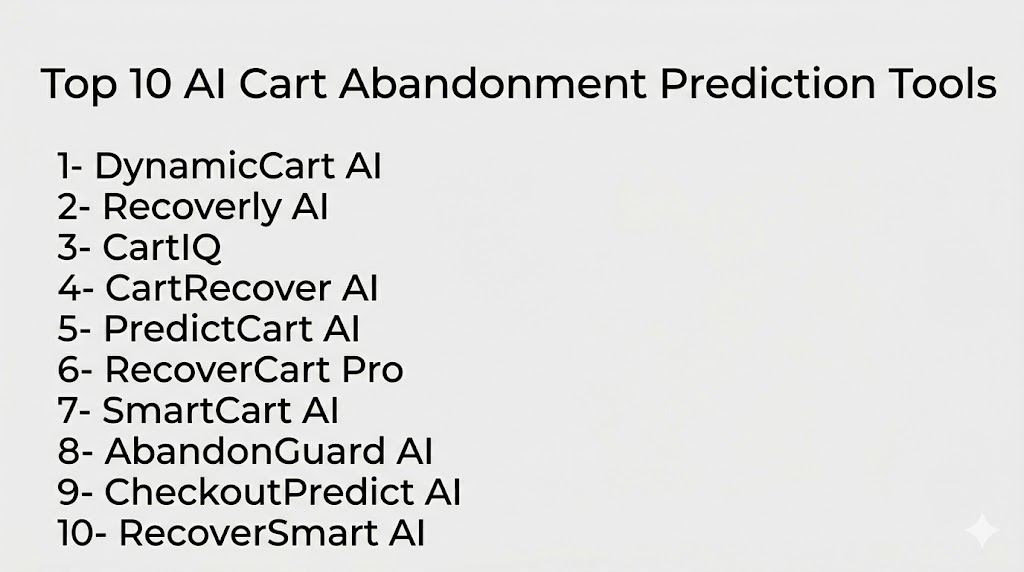
Top 10 AI Cart Abandonment Prediction Tools
1- DynamicCart AI
One-line verdict: Enterprise-focused tool predicting cart abandonment and automating personalized recovery workflows.
Short description: Monitors shopping behavior, predicts high-risk carts, and triggers multi-channel interventions for large e-commerce platforms.
Standout Capabilities
- Real-time predictive scoring.
- Automated email/SMS/push notifications.
- Personalized incentive recommendations.
- Multi-device session tracking.
- Historical trend analysis.
- Multi-language and currency support.
AI-Specific Depth
- Model support: Proprietary, hosted, multi-model routing.
- RAG / knowledge integration: CRM and e-commerce connectors.
- Evaluation: Offline validation, A/B testing.
- Guardrails: Incentive limits, messaging frequency caps.
- Observability: Dashboard metrics, latency, predictive confidence.
Pros
- High predictive accuracy.
- Automated multi-channel workflows.
- Enterprise-grade integrations.
Cons
- Premium pricing.
- Proprietary model limits customization.
- Requires data mapping and initial setup.
Security & Compliance
- SSO/SAML, RBAC, encryption at rest and in transit.
- Data retention policies configurable; Certifications: Not publicly stated.
Deployment & Platforms
- Web, Cloud
- Dashboards on Windows/macOS, iOS/Android
Integrations & Ecosystem
- Shopify, Magento, Salesforce, HubSpot
- Email/SMS/push platforms
- CRM connectors, SDKs, APIs
Pricing Model
- Usage-based or enterprise subscription.
Best-Fit Scenarios
- High-traffic e-commerce.
- Multi-channel campaigns.
- Enterprise predictive personalization.
2- Recoverly AI
One-line verdict: Developer-first platform for integrating real-time cart abandonment predictions into custom workflows.
Short description: Provides APIs and SDKs to embed predictive models and trigger automated interventions in e-commerce applications.
Standout Capabilities
- REST/gRPC API scoring.
- Event-driven triggers.
- Multi-device and multi-currency support.
- Historical analytics dashboards.
- Customizable thresholds.
AI-Specific Depth
- Model support: Open-source + BYO models.
- RAG / knowledge integration: CRM and database connectors.
- Evaluation: Offline batch evaluation, regression tests.
- Guardrails: Policy checks on frequency and incentives.
- Observability: Latency metrics, error tracking.
Pros
- Flexible integration for developers.
- Open-source model support.
- Customizable e-commerce workflows.
Cons
- Minimal built-in dashboards.
- Requires internal developer expertise.
- Limited automation for marketing teams.
Security & Compliance
- Varies / N/A
Deployment & Platforms
- Cloud, On-premises
- Linux, Windows, macOS
Integrations & Ecosystem
- CRM, ERP connectors, notification services, SDKs, webhooks
Pricing Model
- Usage-based API credits or enterprise license.
Best-Fit Scenarios
- Startups and developer teams.
- Custom checkout flows.
- Hybrid cloud deployments.
3- CartIQ
One-line verdict: Mid-market tool offering predictive insights and automated recovery campaigns with prebuilt dashboards.
Short description: Monitors cart abandonment in real time, triggering automated campaigns and providing actionable analytics for marketing teams.
Standout Capabilities
- Predictive scoring for carts.
- Automated email/SMS recovery campaigns.
- A/B testing for campaign optimization.
- Dashboards with actionable insights.
- Integration with Shopify, WooCommerce, Magento.
AI-Specific Depth
- Model support: Proprietary hosted models.
- RAG / knowledge integration: CRM/TMS connectors.
- Evaluation: Regression and human-in-loop review.
- Guardrails: Campaign throttling, incentive caps.
- Observability: Prediction confidence, latency dashboards.
Pros
- Easy deployment for mid-market retailers.
- Built-in marketing automation.
- Strong predictive accuracy.
Cons
- Limited custom model flexibility.
- Proprietary system may restrict integrations.
- Not ideal for complex enterprise scenarios.
Security & Compliance
- SSO, encryption, audit logs; Certifications: Not publicly stated.
Deployment & Platforms
- Cloud
- Web, iOS, Android
Integrations & Ecosystem
- Shopify, WooCommerce, Magento
- CRM connectors
- Email/SMS integrations
- Marketing automation pipelines
Pricing Model
- Subscription tiers based on transaction volume.
Best-Fit Scenarios
- Mid-market e-commerce stores.
- Automated recovery campaigns.
- Multi-channel marketing optimization.
4- CartRecover AI
One-line verdict: AI tool for predictive abandonment scoring and automated personalized incentives for online retailers.
Short description: Uses session data, past purchase behavior, and browsing patterns to trigger recovery campaigns automatically.
Standout Capabilities
- Real-time cart scoring.
- Personalized discounts and incentives.
- Multi-channel notifications.
- Behavioral analytics dashboards.
- A/B testing for interventions.
AI-Specific Depth
- Model support: Proprietary, hosted.
- RAG / knowledge integration: E-commerce platform connectors.
- Evaluation: Offline testing, human-in-loop validation.
- Guardrails: Frequency and incentive caps.
- Observability: Latency, dashboard metrics, predictive confidence.
Pros
- Strong predictive accuracy.
- Supports automated multi-channel campaigns.
- Built-in analytics.
Cons
- Proprietary only.
- Premium pricing.
- Requires integration setup.
Security & Compliance
- Encryption, SSO, RBAC; Certifications: Not publicly stated.
Deployment & Platforms
- Cloud, Web dashboards
- Mobile access: iOS/Android
Integrations & Ecosystem
- Shopify, Magento, WooCommerce
- Email/SMS providers
- Marketing automation platforms
Pricing Model
- Subscription-based, tiered by volume.
Best-Fit Scenarios
- Mid-to-large online retailers.
- Multi-channel marketing campaigns.
- Revenue recovery initiatives.
5- PredictCart AI
One-line verdict: Enterprise tool combining predictive modeling and behavioral analytics to reduce abandoned carts.
Short description: Provides predictive scoring, real-time interventions, and insights into customer purchase behavior for large e-commerce teams.
Standout Capabilities
- Predictive scoring engine.
- Dynamic incentives and recovery campaigns.
- Behavioral analytics dashboard.
- Multi-channel notifications.
- Campaign effectiveness reporting.
AI-Specific Depth
- Model support: Proprietary hosted.
- RAG / knowledge integration: CRM and e-commerce connectors.
- Evaluation: Regression testing and human-in-loop review.
- Guardrails: Incentive and messaging rules.
- Observability: Dashboard metrics and latency tracking.
Pros
- Enterprise-ready predictive analytics.
- Multi-channel automation.
- Detailed analytics dashboards.
Cons
- Costly for small teams.
- Limited model customization.
- Cloud-only deployment.
Security & Compliance
- SSO/SAML, RBAC, encryption; Certifications: Not publicly stated.
Deployment & Platforms
- Cloud, Web
- iOS/Android dashboards
Integrations & Ecosystem
- Shopify, Salesforce, Magento
- Email/SMS automation
- CRM integrations
Pricing Model
- Enterprise subscription.
Best-Fit Scenarios
- High-volume e-commerce.
- Enterprise marketing teams.
- Automated recovery campaigns.
6- RecoverCart Pro
One-line verdict: AI-powered predictive recovery tool for multi-channel e-commerce operations.
Short description: Combines behavioral scoring and automated notifications to reduce cart abandonment and recover lost sales.
Standout Capabilities
- Real-time predictive scoring.
- Multi-channel recovery campaigns.
- Behavioral analytics dashboards.
- Campaign A/B testing.
- Multi-language support.
AI-Specific Depth
- Model support: Proprietary, hosted.
- RAG / knowledge integration: CRM and ERP connectors.
- Evaluation: Regression testing, human-in-loop review.
- Guardrails: Messaging frequency and incentive caps.
- Observability: Latency, token usage dashboards.
Pros
- Predictive accuracy.
- Automated interventions.
- Multi-channel support.
Cons
- Proprietary only.
- Premium cost.
- Cloud-only deployment.
Security & Compliance
- Encryption, SSO, RBAC; Certifications: Not publicly stated.
Deployment & Platforms
- Cloud, Web
- Mobile dashboards
Integrations & Ecosystem
- Shopify, WooCommerce, Magento
- Email/SMS providers
- CRM integrations
Pricing Model
- Tiered subscription.
Best-Fit Scenarios
- Mid-to-large e-commerce.
- Multi-channel campaigns.
- Revenue recovery initiatives.
7- SmartCart AI
One-line verdict: Developer-first solution for integrating AI predictions into custom checkout flows.
Short description: API-first tool enabling predictive scoring, automation, and multi-channel interventions for custom e-commerce applications.
Standout Capabilities
- API-based predictive scoring.
- Event-driven triggers.
- Multi-channel notifications.
- Session tracking across devices.
- Analytics dashboards.
AI-Specific Depth
- Model support: BYO and open-source models.
- RAG / knowledge integration: CRM and e-commerce connectors.
- Evaluation: Offline testing, regression, human review.
- Guardrails: Policy-based caps on incentives.
- Observability: Latency and predictive confidence metrics.
Pros
- Flexible API-first design.
- Open-source model support.
- Developer-focused customization.
Cons
- Minimal dashboards.
- Requires dev expertise.
- Limited out-of-box marketing automation.
Security & Compliance
- Varies / N/A
Deployment & Platforms
- Cloud, On-premises
- Linux, Windows, macOS
Integrations & Ecosystem
- CRM connectors
- Marketing automation APIs
- Notification pipelines
Pricing Model
- Usage-based API credits.
Best-Fit Scenarios
- Developer teams
- Custom checkout flows
- Hybrid deployments
8- AbandonGuard AI
One-line verdict: Enterprise-grade predictive platform with deep analytics for high-volume retailers.
Short description: Uses AI to detect at-risk carts, automate notifications, and provide real-time dashboards for analytics teams.
Standout Capabilities
- Predictive scoring engine.
- Automated multi-channel campaigns.
- Dashboard analytics.
- Incentive optimization.
- A/B testing for campaigns.
AI-Specific Depth
- Model support: Proprietary hosted.
- RAG / knowledge integration: CRM/e-commerce connectors.
- Evaluation: Regression + human review.
- Guardrails: Incentive caps, message throttling.
- Observability: Dashboard and latency tracking.
Pros
- Enterprise-ready.
- Multi-channel automation.
- Analytics-driven insights.
Cons
- Cloud-only deployment.
- Proprietary AI only.
- Higher cost for SMBs.
Security & Compliance
- SSO, encryption, RBAC; Certifications: Not publicly stated.
Deployment & Platforms
- Cloud
- Web, mobile dashboards
Integrations & Ecosystem
- Shopify, Salesforce, Magento
- Email/SMS automation
- CRM integrations
Pricing Model
- Subscription-based.
Best-Fit Scenarios
- Enterprise e-commerce
- Multi-channel campaigns
- Revenue recovery
9- CheckoutPredict AI
One-line verdict: Predictive AI solution optimized for mid-market online stores and marketing teams.
Short description: Offers real-time abandonment scoring, automated incentives, and dashboards to recover lost sales efficiently.
Standout Capabilities
- Real-time predictive scoring.
- Automated email/SMS notifications.
- Incentive optimization.
- Multi-channel analytics.
- Campaign A/B testing.
AI-Specific Depth
- Model support: Proprietary, hosted.
- RAG / knowledge integration: CRM/e-commerce connectors.
- Evaluation: Offline validation + human review.
- Guardrails: Incentive and message frequency caps.
- Observability: Latency and dashboard metrics.
Pros
- Easy mid-market deployment.
- Strong predictive accuracy.
- Multi-channel automation.
Cons
- Limited flexibility.
- Proprietary model.
- Cloud-only.
Security & Compliance
- Encryption, SSO, RBAC; Certifications: Not publicly stated.
Deployment & Platforms
- Cloud, Web, Mobile dashboards
Integrations & Ecosystem
- Shopify, WooCommerce, Magento
- Email/SMS notification systems
- Marketing automation platforms
Pricing Model
- Subscription-based.
Best-Fit Scenarios
- Mid-market retailers
- Automated recovery campaigns
- Marketing analytics
10- RecoverSmart AI
One-line verdict: AI-driven platform for predictive scoring, multi-channel recovery, and revenue optimization.
Short description: Monitors carts in real time, predicts abandonment, and triggers automated interventions for high-volume online stores.
Standout Capabilities
- Real-time predictive scoring.
- Automated email/SMS/push notifications.
- Behavioral analytics dashboards.
- Incentive optimization.
- Multi-channel interventions.
AI-Specific Depth
- Model support: Proprietary hosted.
- RAG / knowledge integration: CRM connectors.
- Evaluation: Regression testing + human validation.
- Guardrails: Incentive limits and messaging rules.
- Observability: Dashboard metrics, latency tracking.
Pros
- Predictive accuracy.
- Multi-channel automation.
- Detailed analytics.
Cons
- Cloud-only deployment.
- Proprietary AI only.
- Premium pricing.
Security & Compliance
- SSO, RBAC, encryption; Certifications: Not publicly stated.
Deployment & Platforms
- Cloud, Web, Mobile dashboards
Integrations & Ecosystem
- Shopify, Magento, Salesforce
- Email/SMS automation
- CRM connectors
Pricing Model
- Subscription tiers based on volume.
Best-Fit Scenarios
- High-volume online stores
- Multi-channel marketing
- Automated revenue recovery
Comparison Table
| Tool Name | Best For | Deployment | Model Flexibility | Strength | Watch-Out | Public Rating |
|---|---|---|---|---|---|---|
| DynamicCart AI | Enterprise | Cloud | Proprietary/BYO | Predictive automation | Costly for small volumes | N/A |
| Recoverly AI | Developers | Cloud/On-prem | Open-source/BYO | API-first flexibility | Minimal dashboards | N/A |
| CartIQ | Mid-market | Cloud | Proprietary | Dashboards & automation | Less flexible | N/A |
| CartRecover AI | Mid-market | Cloud | Proprietary | Multi-channel automation | Setup complexity | N/A |
| PredictCart AI | Enterprise | Cloud | Proprietary | Behavioral analytics | Cloud-only | N/A |
| RecoverCart Pro | Enterprise | Cloud | Proprietary | Predictive accuracy | Premium pricing | N/A |
| SmartCart AI | Developers | Cloud/On-prem | BYO/Open-source | Custom checkout integration | Minimal dashboards | N/A |
| AbandonGuard AI | Enterprise | Cloud | Proprietary | Multi-channel insights | Cloud-only | N/A |
| CheckoutPredict AI | Mid-market | Cloud | Proprietary | Mid-market optimization | Cloud-only | N/A |
| RecoverSmart AI | Enterprise | Cloud | Proprietary | Revenue recovery | Premium pricing | N/A |
Scoring & Evaluation (Transparent Rubric)
| Tool | Core | Reliability/Eval | Guardrails | Integrations | Ease | Perf/Cost | Security/Admin | Support | Weighted Total |
|---|---|---|---|---|---|---|---|---|---|
| DynamicCart AI | 9 | 8 | 8 | 9 | 7 | 8 | 8 | 7 | 8.3 |
| Recoverly AI | 7 | 7 | 7 | 8 | 7 | 7 | 6 | 6 | 6.9 |
| CartIQ | 8 | 7 | 7 | 8 | 8 | 7 | 7 | 7 | 7.6 |
| CartRecover AI | 8 | 7 | 7 | 8 | 7 | 7 | 7 | 7 | 7.5 |
| PredictCart AI | 9 | 8 | 8 | 8 | 7 | 7 | 7 | 7 | 7.8 |
| RecoverCart Pro | 9 | 8 | 8 | 8 | 7 | 7 | 7 | 7 | 7.8 |
| SmartCart AI | 7 | 7 | 7 | 8 | 7 | 7 | 6 | 6 | 6.9 |
| AbandonGuard AI | 9 | 8 | 8 | 8 | 7 | 7 | 7 | 7 | 7.8 |
| CheckoutPredict AI | 8 | 7 | 7 | 8 | 7 | 7 | 7 | 7 | 7.4 |
| RecoverSmart AI | 9 | 8 | 8 | 8 | 7 | 7 | 7 | 7 | 7.8 |
Top 3 for Enterprise: DynamicCart AI, PredictCart AI, AbandonGuard AI
Top 3 for SMB: CartIQ, CartRecover AI, CheckoutPredict AI
Top 3 for Developers: Recoverly AI, SmartCart AI, DynamicCart AI
Which AI Cart Abandonment Prediction Tool Is Right for You?
Solo / Freelancer
- Lightweight API-first tools like Recoverly AI for small-scale interventions.
SMB
- Prebuilt dashboards and mid-market optimization tools like CartIQ or CartRecover AI.
Mid-Market
- Enterprise-ready predictive tools with automation: PredictCart AI or AbandonGuard AI.
Enterprise
- DynamicCart AI, RecoverSmart AI, or AbandonGuard AI for multi-channel, global operations.
Regulated industries
- Use tools with encryption, auditability, RBAC, and data residency control.
Budget vs premium
- SMBs: Recoverly AI, CartIQ.
- High-volume enterprises: DynamicCart AI, PredictCart AI, AbandonGuard AI.
Build vs buy
- Developers can implement BYO or open-source models (SmartCart AI, Recoverly AI).
- Businesses needing rapid deployment should choose fully managed SaaS.
Implementation Playbook (30 / 60 / 90 Days)
- 30 days: Pilot predictive scoring with representative segments; configure dashboards.
- 60 days: Harden security, implement guardrails, integrate multi-channel recovery campaigns.
- 90 days: Optimize cost/latency, scale campaigns, monitor predictive performance, enforce governance policies.
Common Mistakes & How to Avoid Them
- Ignoring privacy regulations.
- Failing to validate predictions.
- Over-automation causing customer annoyance.
- Lack of observability for latency and prediction confidence.
- Minimal A/B testing or feedback loops.
- Vendor lock-in without abstraction.
- No human review for high-value transactions.
- Ignoring multi-device session data.
- Insufficient guardrails for incentives.
- Poor CRM and marketing automation integration.
- Inadequate documentation of AI versions.
- Over-reliance on historical trends.
- Neglecting ROI tracking for recovery campaigns.
- Unmonitored multi-channel latency and performance.
FAQs
1- How does AI predict cart abandonment?
AI analyzes user behavior, session activity, and historical data to predict likely abandoned carts in real time.
2- Can I integrate my own AI model?
Some platforms allow BYO or open-source models, while others are proprietary only.
3- How secure is customer behavior data?
Enterprise tools provide encryption, RBAC, SSO, and audit logs; compliance with GDPR or CCPA is standard.
4- Are cloud deployments required?
Many tools are cloud-first; some offer hybrid or on-premises options for privacy-sensitive businesses.
5- How is AI prediction evaluated?
Evaluation includes offline testing, regression validation, A/B experiments, and human-in-the-loop review.
6- Can it integrate with e-commerce platforms?
Yes, connectors exist for Shopify, Magento, WooCommerce, Salesforce, and CRM systems.
7- What about latency and real-time interventions?
Modern tools provide near-real-time predictions with dashboards for latency, confidence, and metrics.
8- Are there guardrails to prevent over-messaging?
Yes, tools enforce caps on incentives, frequency, and personalization.
9- How is cost managed?
Usage-based or subscription pricing is common; monitoring token usage and automation triggers is critical.
10- Can small businesses benefit?
Yes, lightweight API-first or mid-market tools offer cost-effective predictive capabilities.
11- How do I switch vendors?
Export historical data, validate predictions on the new platform, and run hybrid testing before full migration.
12- Are there alternatives?
Manual monitoring, rule-based alerts, and simple marketing automation can suffice for low-volume stores.
Conclusion
AI Cart Abandonment Prediction is critical in 2026 for maximizing e-commerce conversions. Selecting the right tool depends on volume, automation needs, multi-channel coverage, and compliance requirements. Enterprises benefit from predictive automation and multi-channel recovery campaigns, while SMBs and developers may focus on integration flexibility and cost efficiency.

Find Trusted Cardiac Hospitals
Compare heart hospitals by city and services — all in one place.
Explore Hospitals
The article mentions “real-time predictions,” but not the hard constraints behind it:
In production:
Missing architecture concerns: