
Introduction
AI Chat Commerce Assistants are intelligent conversational agents designed to interact with customers, answer queries, guide purchase decisions, and complete transactions through natural language interfaces. These assistants operate within chat widgets, messaging apps, voice interfaces, and omnichannel commerce ecosystems, blending generative AI with real‑time commerce data to deliver personalized shopping experiences.
In 2026, AI chat commerce assistants are no longer novelty tools — they are customer expectations. With digital shopping dominated by mobile, social, and conversational touchpoints, brands are integrating AI assistants to reduce friction, increase conversions, elevate customer satisfaction, and reduce support costs. Modern assistants combine intent classification, product discovery, recommendation logic, inventory awareness, and secure checkout orchestration.
Real‑world use cases include:
- Guided shopping: Helping customers find products through natural queries (e.g., “show me red dresses under $100”).
- Order support: Tracking order status, facilitating returns/exchanges, and answering policy questions.
- Upsell & cross‑sell: Recommending complementary products during commerce conversations.
- Checkout assistance: Completing cart interactions and payment flows inside a chat UI.
- Post‑purchase engagement: Suggesting accessories, warranties, or replenishment reminders.
- Multilingual support: Conversing in multiple languages for global audiences.
Evaluation criteria for buyers:
- Natural language understanding and conversational fluency
- Integration with product catalogs, inventory systems, and checkout flows
- Personalization and contextual recommendations
- Omnichannel channel support (web chat, SMS, social, voice)
- Guardrails to prevent hallucinations and ensure accurate commerce information
- Observability and analytics for performance and failed intents
- Privacy, data residency, and compliance controls
- Deployment flexibility and model customization
- Support for secure payments and sensitive workflows
- Cost efficiency, latency, and scalability
Best for: E‑commerce brands, marketplace platforms, retail chains, D2C companies, and customer experience teams.
Not ideal for: Very small single‑product stores or non‑digital channels where conversational commerce is unnecessary.
What’s Changed in AI Chat Commerce Assistants in 2026+
- Conversational task orchestration: Assistants can manage multi‑step purchase flows end‑to‑end, including promotions, inventory checks, and payment authentication.
- Multimodal input support: Customers can send images, voice, or screenshots to assist with discovery and support.
- Agentic workflows: The assistant can proactively suggest actions (e.g., “Would you like to see matching accessories?”) rather than only respond.
- Guardrails & safety: Enhanced hallucination guards and commerce‑specific policy constraints to prevent inaccurate or risky suggestions.
- Model routing & cost optimization: High‑speed intent detection pipelines combined with deeper generative reasoning only when needed.
- Observability dashboards: Trace routes from customer input to decision paths, intent accuracy, latency, and resolution metrics.
- BYO model support: Enterprises can bring proprietary embeddings or models optimized for brand tone and product taxonomies.
- Privacy and compliance: Configurable retention, data residency, consent management, and audit logs for regulated markets.
- Contextual personalization: Profile‑aware recommendations that respect privacy preferences with opt‑in signals.
- RAG (retrieval‑augmented generation): Integrating catalog data, FAQs, policies, and transaction history into responses.
Quick Buyer Checklist
- ☐ Supports product catalog, inventory, SKU lookups, pricing rules
- ☐ Secure checkout integration with payment providers
- ☐ Conversational intent coverage: browse, browse suggestions, support, returns
- ☐ Multichannel delivery: web chat, mobile app, SMS/MMS, social messaging
- ☐ Guardrails for commerce accuracy and fraud mitigation
- ☐ Observability: trace logs, performance dashboards, cost metrics
- ☐ Model flexibility: BYO & open‑source model support or hosted options
- ☐ Privacy & compliance: consent management, retention controls
- ☐ Evaluation tooling: regression tests, human review, content validation
- ☐ Personalization: preference‑based suggestions
- ☐ Vendor lock‑in risk mitigation
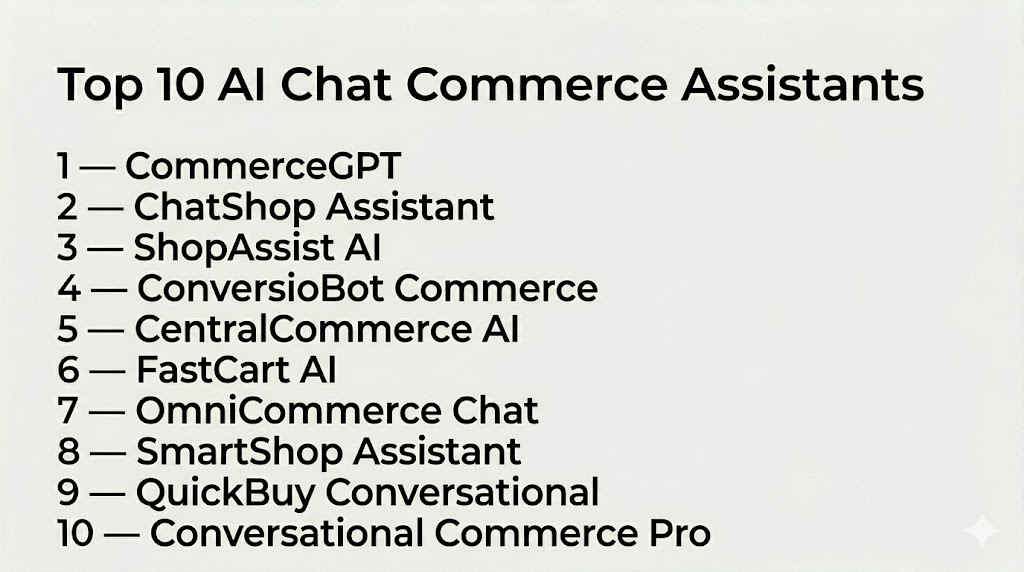
Top 10 AI Chat Commerce Assistants
1 — CommerceGPT
One‑line verdict: Enterprise‑grade AI commerce assistant with full purchase orchestration and deep integration into omnichannel stacks.
Short description:
CommerceGPT blends large language models with real‑time product catalog and checkout systems to deliver guided shopping, support inquiries, and secure order placement at scale.
Standout Capabilities
- Guided discovery with natural language queries
- Secure in‑chat checkout orchestration
- Real‑time inventory and pricing integration
- Personalized recommendations based on profile and behavior
- Multilingual support for global audiences
- Promotions & coupon logic embedded in conversation
AI‑Specific Depth
- Model support: Proprietary with optional BYO pipelines
- RAG / knowledge integration: Deep integration with catalog and CRM knowledge
- Evaluation: A/B tests with intent accuracy metrics
- Guardrails: Commerce policy enforcement and hallucination suppression
- Observability: Trace logs, latency, cost dashboards
Pros
- End‑to‑end commerce conversation support
- Strong enterprise integration
- Personalization and multilingual capabilities
Cons
- Higher enterprise cost
- More complex setup
- Proprietary model dependency
Security & Compliance
SSO/SAML, RBAC, encryption, audit logs; certifications: Not publicly stated
Deployment & Platforms
Cloud, Hybrid; Web, iOS/Android SDKs
Integrations & Ecosystem
Product catalog APIs
Inventory & pricing connectors
Payment provider integrations
CRM & loyalty platform connectors
Webhook events and webhook routing
Pricing Model
Subscription with usage tiers; Not publicly stated
Best‑Fit Scenarios
- Large omnichannel retailers
- Enterprise marketplaces
- Global brands needing multilingual commerce
2 — ChatShop Assistant
One‑line verdict: Flexible AI assistant with strong developer tools for customized commerce journeys.
Short description:
ChatShop Assistant offers a platform for teams to build tailored commerce chat experiences with APIs, SDKs, and webhook workflows.
Standout Capabilities
- API‑centric architecture for custom flows
- Support for SMS, web chat, social platforms
- Webhooks for event‑based commerce triggers
- Conversational cart and recommendation workflows
- Developer toolkit with testing harness
AI‑Specific Depth
- Model support: Hosted & BYO open models
- RAG / knowledge integration: Connectors to structured commerce knowledge
- Evaluation: Regression suite and schema tests
- Guardrails: Configurable rule engine
- Observability: Logs and latency metrics
Pros
- Highly customizable
- BYO support
- Flexible channel deployment
Cons
- Less turnkey for non‑technical teams
- Requires engineering investment
- Fewer pre‑built commerce templates
Security & Compliance
Encryption, RBAC, audit logs; certifications: Not publicly stated
Deployment & Platforms
Cloud; SDKs for mobile and web
Integrations & Ecosystem
E‑commerce platform APIs
Messaging channels
Custom webhook workflows
Dev SDKs
Pricing Model
Usage‑based API tiers; Not publicly stated
Best‑Fit Scenarios
- Tech teams building tailored commerce assistants
- Marketplaces with complex logic
- Multichannel engagement workflows
3 — ShopAssist AI
One‑line verdict: Business‑user friendly assistant with guided commerce flows and automated support features.
Short description:
ShopAssist AI combines intuitive setup with built‑in commerce conversation templates for product discovery, returns, and FAQs.
Standout Capabilities
- Template library for commerce intents
- Automated support for returns & policies
- One‑click product suggestions from inventory
- Intent analytics dashboard
- Built‑in promotions & upsell triggers
AI‑Specific Depth
- Model support: Proprietary
- RAG / knowledge integration: Product & FAQ knowledge base
- Evaluation: Human‑in‑the‑loop validation
- Guardrails: Policy enforcement rules
- Observability: Session logs & performance charts
Pros
- Quick to deploy
- Business‑friendly configuration
- Built‑in commerce intents
Cons
- Limited BYO models
- Less flexible for custom logic
- Mid‑tier pricing
Security & Compliance
Encryption and RBAC; certifications: Not publicly stated
Deployment & Platforms
Cloud; Web portals
Integrations & Ecosystem
Commerce platforms
CRM connectors
Webhooks for alerts
Pricing Model
Subscription; Not publicly stated
Best‑Fit Scenarios
- Mid‑market retailers
- Direct‑to‑consumer stores
- Customer service teams
4 — ConversioBot Commerce
One‑line verdict: Real‑time conversational commerce assistant optimized for mobile storefronts and chat widgets.
Short description:
ConversioBot Commerce focuses on immersive mobile commerce chats with fast responses, product cards, and cart integration.
Standout Capabilities
- Instant product card generation
- Mobile‑optimized UI for chat widgets
- Cart editing inside conversation
- Quick order tracking queries
- Context switching between support & commerce
AI‑Specific Depth
- Model support: Proprietary + lightweight models
- RAG / knowledge integration: Product data connect
- Evaluation: Usage trend monitoring
- Guardrails: Output templates for commerce safety
- Observability: Latency & session analytics
Pros
- Great mobile UX
- Commerce + support flows
- Fast responses
Cons
- Limited deep integration
- BYO support varies
- Less robust analytics
Security & Compliance
Encryption; certifications: Not publicly stated
Deployment & Platforms
Cloud; Web & mobile SDKs
Integrations & Ecosystem
Chat widgets
Payment connectors
Pricing Model
Tiered usage; Not publicly stated
Best‑Fit Scenarios
- Mobile commerce apps
- Small‑medium marketplaces
- Conversational shopping pilots
5 — CentralCommerce AI
One‑line verdict: AI assistant with powerful context retention and session memory for long‑term commerce interactions.
Short description:
CentralCommerce AI excels at handling long, stateful conversations where customers return to prior carts, wishlists, and preferences.
Standout Capabilities
- Persistent session memory across visits
- Context‑aware recommender logic
- Adaptive intent prioritization
- Wishlists & preferences in chat
- Cross‑session analytics
AI‑Specific Depth
- Model support: Proprietary
- RAG / knowledge integration: Dynamic product context store
- Evaluation: Session‑level accuracy metrics
- Guardrails: Memory retention policies
- Observability: Context trace metrics
Pros
- Personalized long‑term engagement
- Rich contextual recommendations
- Session continuity
Cons
- More complex memory management
- Higher compute costs
- Limited BYO
Security & Compliance
Data retention controls, RBAC, encryption; certifications: Not publicly stated
Deployment & Platforms
Cloud; Web SDKs
Integrations & Ecosystem
Wishlist & CRM systems
Shopping history APIs
Analytics connectors
Pricing Model
Subscription; Not publicly stated
Best‑Fit Scenarios
- Brands needing personalized repeat interactions
- Loyalty & CRM‑driven commerce
- Custom session analytics
6 — FastCart AI
One‑line verdict: Lightweight chat assistant focused on rapid checkout and simplified browsing.
Short description:
FastCart AI is optimized for commerce experiences that emphasize speed — fast product discovery, cart actions, and checkout paths.
Standout Capabilities
- Simplified browse by category intents
- Quick cart creation from chat
- One‑step checkout prompts
- Real‑time stock checks
- Suggested alternatives if out of stock
AI‑Specific Depth
- Model support: Hosted lightweight models
- RAG / knowledge integration: Catalog access
- Evaluation: A/B cart completion tests
- Guardrails: Commerce rule enforcement
- Observability: Conversion analytics
Pros
- Very fast replies
- Simple commerce flow
- Easy to integrate
Cons
- Limited personalization
- Not built for complex logic
- Limited BYO
Security & Compliance
Encryption; certifications: Not publicly stated
Deployment & Platforms
Cloud; Web SDK
Integrations & Ecosystem
E‑commerce APIs
Cart & checkout connectors
Pricing Model
Usage‑based; Not publicly stated
Best‑Fit Scenarios
- High‑velocity retail
- Quick cart championing
- Limited product catalogs
7 — OmniCommerce Chat
One‑line verdict: Omnichannel assistant bridging chat, SMS, email, and social commerce interactions.
Short description:
OmniCommerce Chat syncs conversation state across channels, allowing customers to bounce from web chat to SMS to social apps seamlessly.
Standout Capabilities
- Cross‑channel session continuity
- SMS & social messaging commerce
- Push notification follow‑ups
- Unified analytics across touchpoints
- Recommendation logic for omnichannel campaigns
AI‑Specific Depth
- Model support: Proprietary
- RAG / knowledge integration: Unified commerce knowledge graph
- Evaluation: Cross‑channel accuracy metrics
- Guardrails: Channel policy constraints
- Observability: Unified trace logs
Pros
- Seamless cross‑channel state
- Great for social commerce
- Unified analytics
Cons
- Complex to configure
- Enterprise pricing
- Limited BYO
Security & Compliance
RBAC, encryption; certifications: Not publicly stated
Deployment & Platforms
Cloud; Web, SMS, social connectors
Integrations & Ecosystem
Social messaging platforms
Commerce systems
Analytics hubs
Pricing Model
Subscription; Not publicly stated
Best‑Fit Scenarios
- Multi‑touch commerce experiences
- Social selling
- Brands with global audiences
8 — SmartShop Assistant
One‑line verdict: Balanced assistant with strong analytics and performance dashboards for chat commerce operations.
Short description:
SmartShop Assistant blends conversational commerce capabilities with comprehensive analytics for business teams.
Standout Capabilities
- Intent performance dashboards
- Conversation outcome metrics
- Commerce funnel analytics
- Top issue alerts
- Custom segment reporting
AI‑Specific Depth
- Model support: Proprietary
- RAG / knowledge integration: Catalog & policy data
- Evaluation: Regression & drift detection
- Guardrails: Policy rules
- Observability: Full analytics dashboards
Pros
- Great analytics focus
- Improves operational decision‑making
- Balanced feature set
Cons
- Mid‑range customization
- Limited BYO support
- Dashboard complexity
Security & Compliance
Encryption, RBAC, audit logs; certifications: Not publicly stated
Deployment & Platforms
Cloud; Web
Integrations & Ecosystem
Commerce APIs
Analytics trackers
Reporting tools
Pricing Model
Subscription; Not publicly stated
Best‑Fit Scenarios
- Commerce ops teams
- Conversion optimization focus
- Brands needing insights
9 — QuickBuy Conversational
One‑line verdict: Simple AI commerce assistant focused on fast product lookup and recommendation cards.
Short description:
QuickBuy Conversational emphasizes discovery and recommendations, pulling product info into tidy card formats.
Standout Capabilities
- Product card generation
- Intent detection for browse & recommend
- Suggested related products
- Cart prefill prompts
- Quick semantic search
AI‑Specific Depth
- Model support: Hosted proprietary
- RAG / knowledge integration: Catalog sync
- Evaluation: Intent accuracy checks
- Guardrails: Commerce rule templates
- Observability: Basic logs
Pros
- Easy and quick to deploy
- Clean UI focus
- Great for discovery
Cons
- No checkout orchestration
- Limited personalization
- No BYO
Security & Compliance
Encryption; certifications: Not publicly stated
Deployment & Platforms
Cloud; Web
Integrations & Ecosystem
Product catalog APIs
Pricing Model
Subscription; Not publicly stated
Best‑Fit Scenarios
- Small shops
- Discovery‑focused interactions
- Lightweight commerce bots
10 — Conversational Commerce Pro
One‑line verdict: Feature‑rich assistant for enterprise with deep personalization and loyalty integration.
Short description:
Conversational Commerce Pro blends AI chat with loyalty systems, offers, personalized deals, and high‑value conversion logic.
Standout Capabilities
- Loyalty & reward integration
- Personalized offers
- SKU‑level availability checks
- Conversational deals & bundles
- Secure checkout incentives
AI‑Specific Depth
- Model support: Proprietary
- RAG / knowledge integration: Loyalty & catalog knowledge
- Evaluation: Retention & purchase accuracy tests
- Guardrails: Offer policy constraints
- Observability: Performance & incentive analytics
Pros
- Powerful personalization
- Loyalty‑driven commerce
- Incentive optimization
Cons
- Enterprise pricing
- Complexity
- Limited BYO
Security & Compliance
SSO/SAML, encryption, retention policies; certifications: Not publicly stated
Deployment & Platforms
Cloud; Web, SDKs
Integrations & Ecosystem
Loyalty systems
Commerce platforms
Push notifications
Pricing Model
Enterprise subscription; Not publicly stated
Best‑Fit Scenarios
- Loyalty‑focused brands
- High‑value customer segments
- Incentive‑heavy commerce
Comparison Table
| Tool Name | Best For | Deployment | Model Flexibility | Strength | Watch‑Out | Public Rating |
|---|---|---|---|---|---|---|
| CommerceGPT | Enterprise commerce | Cloud/Hybrid | Proprietary/BYO | End‑to‑end flows | Higher cost | N/A |
| ChatShop Assistant | Custom builders | Cloud | Hosted/BYO | API flexibility | Dev resources needed | N/A |
| ShopAssist AI | Quick deploy | Cloud | Proprietary | Commerce templates | Mid pricing | N/A |
| ConversioBot Commerce | Mobile commerce | Cloud | Proprietary/Light | Mobile optimized | Limited depth | N/A |
| CentralCommerce AI | Personalized sessions | Cloud | Proprietary | Context memory | Compute cost | N/A |
| FastCart AI | Fast checkout | Cloud | Hosted | Speed & simplicity | Limited personalization | N/A |
| OmniCommerce Chat | Omnichannel commerce | Cloud | Proprietary | Cross‑channel state | Complexity | N/A |
| SmartShop Assistant | Analytics ops | Cloud | Proprietary | Analytics dashboards | Limited BYO | N/A |
| QuickBuy Conversational | Discovery focus | Cloud | Proprietary | Simple deploy | No checkout | N/A |
| Conversational Commerce Pro | Loyalty & incentives | Cloud | Proprietary | Loyalty integration | Enterprise focus | N/A |
Scoring & Evaluation
Scoring is comparative; weighted totals reflect overall commerce conversation readiness.
| Tool | Core | Reliability/Eval | Guardrails | Integrations | Ease | Perf/Cost | Security/Admin | Support | Weighted Total |
|---|---|---|---|---|---|---|---|---|---|
| CommerceGPT | 9 | 9 | 9 | 9 | 7 | 7 | 8 | 7 | 8.3 |
| ChatShop Assistant | 8 | 8 | 8 | 9 | 8 | 8 | 7 | 6 | 7.9 |
| ShopAssist AI | 8 | 8 | 8 | 8 | 8 | 7 | 7 | 7 | 7.8 |
| ConversioBot Commerce | 7 | 7 | 7 | 7 | 8 | 8 | 7 | 6 | 7.2 |
| CentralCommerce AI | 8 | 8 | 8 | 8 | 7 | 7 | 7 | 7 | 7.7 |
| FastCart AI | 6 | 7 | 7 | 7 | 9 | 9 | 6 | 6 | 7.0 |
| OmniCommerce Chat | 8 | 8 | 8 | 8 | 7 | 7 | 7 | 6 | 7.6 |
| SmartShop Assistant | 7 | 8 | 8 | 8 | 8 | 8 | 7 | 7 | 7.7 |
| QuickBuy Conversational | 6 | 7 | 7 | 6 | 9 | 8 | 6 | 6 | 6.9 |
| Conversational Commerce Pro | 9 | 8 | 9 | 8 | 7 | 7 | 8 | 7 | 8.0 |
Top 3 for Enterprise: CommerceGPT, Conversational Commerce Pro, ChatShop Assistant
Top 3 for SMB: FastCart AI, QuickBuy Conversational, ShopAssist AI
Top 3 for Developers: ChatShop Assistant, CommerceGPT, CentralCommerce AI
Which AI Chat Commerce Assistant Is Right for You?
Solo / Freelancer
Simple commerce needs with minimal complexity align well with QuickBuy Conversational or FastCart AI — fast deployment, lightweight flows, and quick discovery support.
SMB
Retailers with moderate traffic should consider ShopAssist AI or FastCart AI for built‑in templates or SmartShop Assistant for analytics focused commerce optimization.
Mid‑Market
Brands needing deeper analytics and personalization can deploy CentralCommerce AI or SmartShop Assistant to balance insights and engagement.
Enterprise
Omnichannel commerce with global audiences and secure checkout needs are best served by CommerceGPT or Conversational Commerce Pro with deep integration, personalization, and loyalty system support.
Regulated industries (finance/healthcare/public sector)
Prioritize assistants with strong compliance controls, audit logs, and privacy features like CommerceGPT and ChatShop Assistant.
Budget vs Premium
Low‑cost or lightweight options suit early commerce experimentation, while premium solutions deliver full purchase orchestration and enterprise governance.
Build vs Buy
If you have strong developer resources and customized logic needs, ChatShop Assistant is an excellent build choice; for turnkey commerce chat, premium assistants with prebuilt flows deliver faster value.
Implementation Playbook (30 / 60 / 90 Days)
30 Days:
- Define primary commerce intents and channels
- Integrate product catalog, inventory, and pricing APIs
- Pilot with basic discovery and order query workflows
60 Days:
- Expand to checkout orchestration and secure payment integration
- Implement guardrails and evaluation tests
- Set up observability dashboards and analytics
90 Days:
- Optimize personalization and session memory
- Add loyalty and recommendation logic
- Scale across channels and regions with performance monitoring
Common Mistakes & How to Avoid Them
- Failing to integrate real‑time product data
- Ignoring guardrails against hallucinations
- Not testing secure checkout flows thoroughly
- Neglecting observability and performance tracking
- Underestimating conversation context retention
- Relying only on out‑of‑the‑box responses without tuning
- Ignoring privacy and retention requirements
- Not measuring conversion impact
- Over‑automating without fallback to human support
- Choosing assistants without multichannel delivery
- Lack of BYO model options for flexibility
- No regression tests after model updates
- Not segmenting user intents accurately
FAQs
1 — What is an AI chat commerce assistant?
An intelligent conversational agent integrated with commerce systems to interact with customers, guide purchases, and orchestrate transactions.
2 — Can AI commerce assistants complete purchases?
Yes, modern assistants can securely route users to checkout or complete transactions inside a chat interface.
3 — How do they integrate with inventory systems?
Through APIs or connectors that expose real‑time SKU, stock, and pricing data.
4 — Is secure payment supported?
Secure payment integration depends on the assistant and platform; many support tokenized or third‑party checkout flows.
5 — Can they handle returns and support queries?
Yes, most include support intents for returns, refunds, and order status.
6 — Do they support multiple languages?
Leading tools offer multilingual capabilities depending on model support.
7 — How is personalization achieved?
Through session memory, profile data, and preference signals tied to user accounts.
8 — Are these assistants secure?
Security varies; evaluation should include encryption, RBAC, consent management, and audit logs.
9 — Can I use my own AI model?
Some platforms support BYO models; others rely on proprietary engines.
10 — How do I measure success?
Track conversion rates, cart completion, average order value lift, support deflection, and latency metrics.
11 — Do they work on social channels?
Yes, omnichannel platforms like OmniCommerce Chat support social messaging and SMS.
12 — What’s the difference between conversational commerce and chatbot?
Conversational commerce focuses on purchase outcomes, secure checkout flows, and product recommendations, whereas general chatbots may be informational only.
Conclusion
AI Chat Commerce Assistants have become mission‑critical for brands that want to merge conversational experiences with revenue outcomes. With 2026‑era advancements in model routing, guardrails, observability, payment integration, and personalization, these tools are transforming digital commerce

Find Trusted Cardiac Hospitals
Compare heart hospitals by city and services — all in one place.
Explore Hospitals
The article mentions evaluation and observability, but only at a surface level (dashboards, metrics, intent accuracy).
What is missing is commerce-specific evaluation frameworks, such as:
Without these, “evaluation tooling” becomes just analytics, not reliability engineering.