
Introduction
AI Translation for Government Services refers to the use of artificial intelligence systems to translate speech, text, and multimedia content across multiple languages in public sector environments. These systems enable governments to communicate with citizens in their native languages through digital portals, call centers, emergency systems, legal workflows, and public service platforms.
In 2026 and beyond, this capability has become a core pillar of digital governance. Governments are increasingly expected to provide inclusive, multilingual, and real-time services, while also maintaining strict standards around privacy, accuracy, and compliance. Traditional human translation models cannot scale efficiently across large populations and 24/7 service expectations, which is why AI-driven translation has become essential.
Modern AI translation platforms combine speech recognition, neural machine translation, and large language models to deliver contextual, real-time multilingual communication. They are now widely used in citizen service chatbots, emergency response systems, immigration processing, healthcare communication, and legal interpretation workflows.
Key real-world use cases include:
- Multilingual citizen service portals for public documents and forms
- Emergency alerts and disaster response communication in multiple languages
- Real-time interpretation for government helplines and call centers
- Immigration and visa application processing support systems
- Courtroom transcription and legal translation assistance
- Public healthcare communication and telemedicine support
- Education outreach programs in regional and indigenous languages
Key evaluation criteria for governments:
- Language coverage and dialect support
- Real-time latency and streaming performance
- Data privacy, residency, and retention controls
- Accuracy in legal and domain-specific terminology
- Integration with existing government IT systems
- Audit logs and traceability for compliance
- On-premise or hybrid deployment options
- Cost efficiency at national-scale workloads
- Human-in-the-loop correction capabilities
- Security and identity management controls
Best for: Government agencies, public service departments, municipal administrations, healthcare systems, and national digital identity programs that require scalable multilingual communication.
Not ideal for: Small teams or individuals who only need occasional translation without compliance, security, or large-scale infrastructure requirements.
What’s Changed in AI Translation for Government Services in 2026+
AI translation systems in the public sector have evolved significantly:
- Transition from basic translation APIs to agentic multilingual communication systems
- Increased use of real-time speech-to-speech translation pipelines
- Adoption of LLM-enhanced contextual translation for legal and administrative content
- Growing emphasis on data sovereignty and regional hosting requirements
- Expansion of on-device translation for offline or rural government services
- Integration of evaluation frameworks for translation accuracy monitoring
- Use of multi-model routing (ASR + translation + summarization layers)
- Improved handling of low-resource and indigenous languages
- Increased focus on bias mitigation in multilingual AI models
- Adoption of audit-ready translation logs for compliance reporting
- Emergence of AI copilots for government agents and call center staff
- Stronger emphasis on security-by-design for sensitive citizen data
Quick Buyer Checklist (Government Procurement View)
Before selecting an AI translation platform, governments should evaluate:
- Language coverage (including regional dialects)
- Real-time streaming capability for voice translation
- On-premise, cloud, or hybrid deployment options
- Data residency and sovereign cloud support
- Security controls (encryption, IAM, RBAC)
- Audit logging and traceability features
- Integration with legacy government systems
- Accuracy in legal, healthcare, and policy terminology
- Model transparency and evaluation tools
- Vendor lock-in risk and export flexibility
- Cost per translated character/minute
- Support for offline or low-connectivity environments
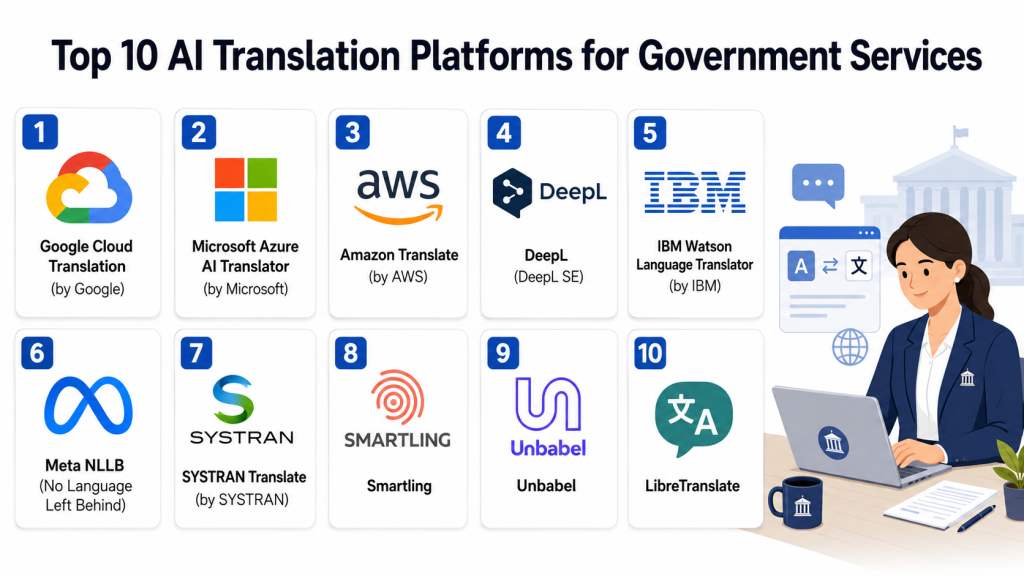
Top 10 AI Translation Platforms for Government Services
#1 — Google Cloud Translation (by Google)
One-line verdict: Best for global-scale multilingual government translation infrastructure.
Short description:
Google Cloud Translation provides neural machine translation services supporting a wide range of global languages. It is widely used in digital public services and multilingual content systems.
Standout Capabilities
- Real-time text translation at scale
- Auto language detection
- Custom translation models for domain adaptation
- Integration with speech and video pipelines
- Large language coverage for global populations
- High-throughput API infrastructure
AI-Specific Depth
- Model support: Proprietary neural translation models
- RAG / knowledge integration: Limited via external systems
- Evaluation: Basic confidence scoring available
- Guardrails: Content filtering depends on surrounding ecosystem
- Observability: API-level monitoring and logs
Pros
- Extremely scalable infrastructure
- Strong multilingual coverage
- Reliable global performance
Cons
- Limited customization for legal/government tone
- Requires engineering integration
Security & Compliance
- Enterprise-grade cloud security by default
- IAM controls supported
- Data residency options available in select regions
Deployment & Platforms
- Cloud-based API service
Integrations & Ecosystem
- Integrates with other Google Cloud services
- Can connect with speech and AI pipelines
- API-first architecture
Pricing Model
Usage-based per character or request volume
Best-Fit Scenarios
- National citizen portals
- Multilingual public websites
- Large-scale document translation
#2 — Microsoft Azure AI Translator (by Microsoft)
One-line verdict: Best for government ecosystems already using enterprise Microsoft infrastructure.
Short description:
Microsoft Azure Translator enables real-time multilingual translation across text, speech, and applications, commonly used in enterprise and public sector systems.
Standout Capabilities
- Real-time translation APIs
- Speech translation integration
- Custom translation models
- Multilingual chatbot support
- Integration with enterprise apps
- Batch document translation
AI-Specific Depth
- Model support: Proprietary Microsoft neural models
- RAG / knowledge integration: Limited, requires external setup
- Evaluation: Confidence scoring available
- Guardrails: Azure ecosystem-based controls
- Observability: Monitoring via Azure services
Pros
- Strong enterprise ecosystem integration
- Reliable multilingual performance
- Good government adoption
Cons
- Complex setup for non-Azure environments
- Limited transparency in model behavior
Security & Compliance
- Strong enterprise compliance posture
- RBAC, encryption, audit logs
- Government cloud options available in some regions
Deployment & Platforms
- Cloud-based (Azure)
- Hybrid options available
Integrations & Ecosystem
- Microsoft Teams
- Power Platform
- Government workflow systems
Pricing Model
Usage-based subscription model
Best-Fit Scenarios
- Government digital transformation projects
- Public service chatbots
- Enterprise citizen communication systems
#3 — Amazon Translate (by AWS)
One-line verdict: Best for scalable translation pipelines in AWS-powered government systems.
Short description:
Amazon Translate provides neural machine translation for real-time and batch workloads, designed for scalable multilingual applications.
Standout Capabilities
- Real-time translation APIs
- Batch document translation
- Language detection
- Custom terminology support
- Integration with contact center systems
- Scalable cloud infrastructure
AI-Specific Depth
- Model support: AWS proprietary translation models
- RAG / knowledge integration: External integration required
- Evaluation: Basic confidence scoring
- Guardrails: AWS ecosystem-based policies
- Observability: CloudWatch metrics available
Pros
- Highly scalable infrastructure
- Strong AWS ecosystem integration
- Reliable for large workloads
Cons
- Requires AWS expertise
- Limited customization for domain-heavy translation
Security & Compliance
- IAM, encryption, audit logging
- Government-grade compliance via AWS setup
Deployment & Platforms
- Cloud-native (AWS)
Integrations & Ecosystem
- AWS Lambda
- Amazon Connect
- Government data pipelines
Pricing Model
Pay-per-character usage
Best-Fit Scenarios
- National contact centers
- Government cloud-native systems
- High-volume translation workloads
#4 — DeepL (DeepL SE)
One-line verdict: Best for high-quality natural language translation in formal government documents.
Short description:
DeepL provides advanced neural translation known for high linguistic accuracy and natural phrasing, especially in European languages.
Standout Capabilities
- High-quality document translation
- API for enterprise integration
- Context-aware translation engine
- Strong European language performance
- Glossary-based customization
AI-Specific Depth
- Model support: Proprietary neural translation models
- RAG / knowledge integration: Limited
- Evaluation: Internal quality scoring
- Guardrails: Limited transparency
- Observability: Not publicly stated
Pros
- Excellent translation fluency
- Strong document handling
- High user trust in accuracy
Cons
- Limited language coverage vs hyperscalers
- Less control for government customization
Security & Compliance
- Enterprise security features available
- Compliance details vary
Deployment & Platforms
- Cloud API + web tools
Integrations & Ecosystem
- Document processing tools
- API-based integrations
Pricing Model
Tiered subscription and API usage
Best-Fit Scenarios
- Legal document translation
- Administrative paperwork
- European government services
#5 — IBM Watson Language Translator (by IBM)
One-line verdict: Best for regulated environments requiring enterprise AI governance.
Short description:
IBM Watson Language Translator provides AI-based translation services designed for enterprise and regulated industries.
Standout Capabilities
- Neural machine translation APIs
- Custom model training
- Domain-specific translation tuning
- Enterprise integration support
- Multilingual content processing
AI-Specific Depth
- Model support: IBM proprietary models
- RAG / knowledge integration: Limited
- Evaluation: Enterprise evaluation tools available
- Guardrails: Strong enterprise policy controls
- Observability: IBM cloud monitoring tools
Pros
- Strong enterprise governance
- Suitable for regulated sectors
- Customization options available
Cons
- Less widely adopted than hyperscalers
- Smaller ecosystem
Security & Compliance
- Enterprise-grade controls
- RBAC, audit logs, encryption
- Government compliance support varies
Deployment & Platforms
- Cloud-based (IBM Cloud)
Integrations & Ecosystem
- IBM Watson ecosystem
- Enterprise workflow systems
Pricing Model
Enterprise contract-based pricing
Best-Fit Scenarios
- Regulated government departments
- Legal translation workflows
- Compliance-heavy systems
#6 — Meta NLLB (No Language Left Behind)
One-line verdict: Best open-source multilingual translation model for low-resource languages.
Short description:
Meta’s NLLB project provides open-source translation models designed to support underrepresented languages globally.
Standout Capabilities
- Supports many low-resource languages
- Open-source model availability
- Research-driven translation improvements
- Offline deployment possible
- Custom fine-tuning support
AI-Specific Depth
- Model support: Open-source LLM translation models
- RAG / knowledge integration: Requires external systems
- Evaluation: External evaluation required
- Guardrails: Not built-in
- Observability: Developer-defined
Pros
- Excellent for language inclusivity
- No vendor lock-in
- Highly customizable
Cons
- Requires technical expertise
- No enterprise support layer
Security & Compliance
- Depends on deployment environment
Deployment & Platforms
- Self-hosted / cloud / hybrid
Integrations & Ecosystem
- Python ML ecosystems
- Custom government AI systems
Pricing Model
Open-source (infrastructure cost only)
Best-Fit Scenarios
- Rural language translation systems
- Research institutions
- Custom government AI projects
#7 — SYSTRAN Translate (by SYSTRAN)
One-line verdict: Best for secure enterprise and government-grade translation workflows.
Short description:
SYSTRAN provides machine translation solutions with strong focus on secure enterprise and government deployments.
Standout Capabilities
- Secure translation environments
- Custom domain adaptation
- Multilingual document translation
- On-premise deployment support
- Industry-specific language models
AI-Specific Depth
- Model support: Proprietary + custom models
- RAG / knowledge integration: Limited
- Evaluation: Enterprise tools available
- Guardrails: Strong security filters
- Observability: Enterprise dashboards
Pros
- Strong government use focus
- On-premise deployment options
- High customization
Cons
- Smaller ecosystem
- Less modern UX compared to hyperscalers
Security & Compliance
- Strong enterprise security posture
- On-premise deployment for sensitive data
Deployment & Platforms
- Cloud + on-premise + hybrid
Integrations & Ecosystem
- Government IT systems
- Enterprise document workflows
Pricing Model
Enterprise licensing
Best-Fit Scenarios
- Defense and public sector
- High-security translation needs
- On-prem deployments
#8 — Smartling
One-line verdict: Best for multilingual content management and localization workflows.
Short description:
Smartling provides translation management systems for enterprises and public sector communication.
Standout Capabilities
- Translation management platform
- Workflow automation
- Human + AI hybrid translation
- Content localization pipelines
- API integrations
AI-Specific Depth
- Model support: Mixed AI + human translation
- RAG / knowledge integration: Workflow-based
- Evaluation: Human review pipelines
- Guardrails: Content governance tools
- Observability: Workflow analytics
Pros
- Strong localization workflows
- Hybrid translation quality
- Enterprise scalability
Cons
- Not pure AI translation engine
- Higher operational complexity
Security & Compliance
- Enterprise-grade governance
- Role-based access controls
Deployment & Platforms
- Cloud-based platform
Integrations & Ecosystem
- CMS systems
- Enterprise content platforms
Pricing Model
Subscription + enterprise tiers
Best-Fit Scenarios
- Government communication portals
- Public websites
- Localization-heavy workflows
#9 — Unbabel
One-line verdict: Best for human + AI hybrid translation in citizen service workflows.
Short description:
Unbabel combines AI translation with human review to deliver high-quality multilingual communication.
Standout Capabilities
- AI + human translation pipeline
- Customer support multilingual workflows
- Quality assurance layers
- Real-time support translation
- API integrations
AI-Specific Depth
- Model support: Hybrid AI + human models
- RAG / knowledge integration: Limited
- Evaluation: Human QA layer
- Guardrails: Human moderation
- Observability: Workflow analytics
Pros
- High-quality translations
- Human validation improves accuracy
- Good for citizen services
Cons
- Slower than pure AI systems
- Higher operational cost
Security & Compliance
- Enterprise security features
- Compliance varies by deployment
Deployment & Platforms
- Cloud-based
Integrations & Ecosystem
- Customer support systems
- Government service desks
Pricing Model
Usage + human review cost
Best-Fit Scenarios
- Citizen support centers
- Public service chat systems
- High-accuracy translation workflows
#10 — LibreTranslate
One-line verdict: Best open-source lightweight translation engine for self-hosted government systems.
Short description:
LibreTranslate is an open-source translation API suitable for privacy-sensitive or offline government deployments.
Standout Capabilities
- Self-hosted translation API
- Lightweight architecture
- Offline deployment capability
- Multi-language support
- Custom model integration potential
AI-Specific Depth
- Model support: Open-source translation models
- RAG / knowledge integration: External systems required
- Evaluation: Developer-defined
- Guardrails: None built-in
- Observability: Minimal
Pros
- Fully self-hostable
- No vendor lock-in
- Privacy-friendly
Cons
- Limited accuracy vs enterprise tools
- Requires technical setup and maintenance
Security & Compliance
- Depends on deployment environment
- Suitable for air-gapped systems
Deployment & Platforms
- Self-hosted / on-premise
Integrations & Ecosystem
- Custom government systems
- API-based integrations
Pricing Model
Open-source (infrastructure cost only)
Best-Fit Scenarios
- Offline government systems
- Privacy-sensitive environments
- Low-cost translation infrastructure
Comparison Table
| Tool Name | Best For | Deployment | Model Flexibility | Strength | Watch-Out | Public Rating |
|---|---|---|---|---|---|---|
| Google Translate | Global scale | Cloud | Proprietary | Language coverage | Limited customization | N/A |
| Microsoft Translator | Enterprise gov systems | Cloud/Hybrid | Proprietary | Ecosystem integration | Complexity | N/A |
| Amazon Translate | AWS workloads | Cloud | Proprietary | Scalability | AWS dependency | N/A |
| DeepL | Document translation | Cloud | Proprietary | Linguistic quality | Limited languages | N/A |
| IBM Watson | Regulated sectors | Cloud | Proprietary | Governance | Smaller ecosystem | N/A |
| Meta NLLB | Open-source translation | Self-hosted | Open-source | Low-resource languages | Requires setup | N/A |
| SYSTRAN | Secure government use | Hybrid | Proprietary | Security focus | Smaller ecosystem | N/A |
| Smartling | Localization workflows | Cloud | Hybrid | Workflow management | Not pure AI engine | N/A |
| Unbabel | Citizen support translation | Cloud | Hybrid | Human + AI accuracy | Slower workflows | N/A |
| LibreTranslate | Offline systems | Self-hosted | Open-source | Privacy-first | Lower accuracy | N/A |
Scoring & Evaluation (Government-Focused Rubric)
This scoring reflects suitability for government-scale translation systems, including accuracy, governance, and scalability.
| Tool | Core | Reliability | Guardrails | Integrations | Ease | Perf/Cost | Security/Admin | Support | Weighted Total |
|---|---|---|---|---|---|---|---|---|---|
| 9 | 9 | 7 | 9 | 8 | 8 | 8 | 8 | 8.3 | |
| Microsoft | 9 | 9 | 8 | 9 | 7 | 8 | 9 | 9 | 8.4 |
| AWS | 8 | 9 | 7 | 9 | 7 | 8 | 9 | 8 | 8.1 |
| DeepL | 8 | 8 | 6 | 7 | 9 | 8 | 7 | 7 | 7.6 |
| IBM | 8 | 8 | 8 | 8 | 7 | 7 | 9 | 8 | 7.9 |
| NLLB | 8 | 7 | 6 | 7 | 6 | 9 | 6 | 7 | 7.2 |
| SYSTRAN | 8 | 8 | 8 | 7 | 7 | 7 | 9 | 8 | 7.8 |
| Smartling | 8 | 8 | 7 | 8 | 8 | 7 | 8 | 8 | 7.9 |
| Unbabel | 8 | 9 | 8 | 8 | 8 | 6 | 8 | 8 | 7.8 |
| LibreTranslate | 7 | 6 | 5 | 6 | 6 | 9 | 6 | 6 | 6.7 |
Top 3 for Enterprise Government
- Microsoft Azure Translator
- Google Cloud Translation
- AWS Translate
Top 3 for SMB/Public Organizations
- DeepL
- Smartling
- Unbabel
Top 3 for Developers/Open Systems
- Meta NLLB
- LibreTranslate
- Amazon Translate
Which AI Translation Tool Is Right for Government Services?
Solo / Small Government Offices
Best fit: DeepL, LibreTranslate
Focus on simplicity, document translation, and cost efficiency.
SMB / Municipal Governments
Best fit: Smartling, Unbabel, Microsoft Translator
Focus on service delivery and multilingual communication.
Mid-Market / Regional Governments
Best fit: AWS Translate, Google Translate, IBM Watson
Focus on scalability and integration.
Enterprise / National Governments
Best fit: Microsoft Azure Translator, Google Cloud Translation, AWS Translate
Focus on security, compliance, and infrastructure scale.
Regulated Government Sectors
Best fit: IBM Watson, SYSTRAN, Microsoft Azure Translator
Focus on governance, auditability, and deployment control.
Build vs Buy Decision
- Build: Meta NLLB, LibreTranslate
- Buy: Google, Microsoft, AWS enterprise systems
DIY is suitable when language sovereignty or offline control is required. Managed services are better for scale and reliability.
Implementation Playbook (30 / 60 / 90 Days)
30 Days: Pilot
- Test 2–3 translation engines
- Evaluate accuracy across key languages
- Benchmark latency for real-time use
- Define success metrics (accuracy, cost, speed)
60 Days: Security & Evaluation
- Implement data privacy controls
- Add audit logging for translation requests
- Build evaluation dataset for government terminology
- Test multilingual chatbot workflows
90 Days: Scale & Governance
- Deploy across departments
- Introduce model routing or fallback systems
- Optimize cost per translation unit
- Establish governance and compliance reporting
Common Mistakes & How to Avoid Them
- Ignoring regional language requirements
- Using one model for all government workflows
- Not testing legal or medical terminology accuracy
- Lack of human review in critical workflows
- Poor handling of offline or rural environments
- Underestimating data privacy requirements
- No evaluation framework for translation quality
- Vendor lock-in without abstraction layer
- Not planning for multilingual scalability
- Ignoring dialect and cultural differences
- Over-reliance on cloud-only systems
- Missing audit logs for compliance
- No fallback system for translation failures
- Ignoring cost scaling at national level
FAQs
What is AI translation in government services?
It is the use of AI systems to translate speech and text across multiple languages for public sector communication and services.
Is AI translation accurate enough for government use?
It is highly accurate for general communication, but legal and medical use cases often require human validation.
Can these systems support regional languages?
Yes, but coverage varies. Open-source models often help with low-resource languages.
Is citizen data safe in translation systems?
It depends on the vendor. Government-grade systems offer encryption and data residency controls.
Can governments use open-source translation tools?
Yes, tools like Meta NLLB and LibreTranslate are widely used for sovereign deployments.
Do these platforms work in real time?
Yes, most modern systems support real-time speech and text translation.
What is the biggest limitation of AI translation?
Context understanding in legal or complex administrative language.
Can AI replace human translators in government?
Not fully. Human review is still required for critical workflows.
What is the cost factor?
Usage volume (characters or audio minutes) is the primary cost driver.
Do these tools support offline environments?
Some open-source and hybrid systems support offline deployment.
What is vendor lock-in in translation systems?
It refers to dependency on a single provider’s ecosystem, making migration difficult.
How do governments evaluate translation quality?
Using accuracy metrics, human review, and domain-specific testing.
Conclusion
AI Translation for Government Services is becoming a foundational layer of modern digital governance. It enables inclusive communication, improves citizen access, and reduces operational costs while supporting multilingual populations at scale.The best solution depends on context: hyperscalers dominate enterprise infrastructure, open-source tools support sovereignty and customization, and hybrid platforms offer balanced workflows for public services.

Find Trusted Cardiac Hospitals
Compare heart hospitals by city and services — all in one place.
Explore Hospitals