📌 The Complete End-to-End Big Data Workflow – Ultimate Tool List
Below is a comprehensive list of tools for building a full big data architecture covering every stage, ensuring nothing is missed.
📌 Step 1: Data Ingestion (Real-time & Batch)
| Category | Tool | Description |
|---|---|---|
| Message Queue / Event Streaming | Apache Kafka | High-throughput distributed message broker for real-time streaming. |
| Apache Pulsar | Alternative to Kafka, multi-tier pub-sub messaging. | |
| ETL (Extract, Transform, Load) | Apache NiFi | Automates the flow of data between systems. |
| Airbyte | Open-source data integration tool for moving data from APIs & databases. | |
| Fivetran | Cloud-based ETL service for automated data pipelines. | |
| Talend | Enterprise ETL tool with data integration capabilities. | |
| Apache Flume | Collects and transfers log data to HDFS, Kafka. | |
| Change Data Capture (CDC) | Debezium | Captures changes in databases for streaming data pipelines. |
| Maxwell | Streams MySQL binlog events to Kafka or other destinations. |
✅ Best Choice: Kafka for streaming, NiFi/Airbyte for ETL, and Debezium for database changes.
📌 Step 2: Data Storage (Data Lake & Warehouses)
| Category | Tool | Description |
|---|---|---|
| Distributed File System (HDFS Alternative) | Apache HDFS | Hadoop’s distributed file storage. |
| Ceph | Cloud-native distributed object storage. | |
| MinIO | Open-source alternative to AWS S3 for object storage. | |
| Cloud Storage | AWS S3 | Scalable cloud object storage. |
| Google Cloud Storage (GCS) | Object storage for big data workloads. | |
| NoSQL Databases | Apache Cassandra | Distributed NoSQL database for high availability. |
| MongoDB | Document-oriented NoSQL database. | |
| Columnar Databases | Apache HBase | Column-family NoSQL storage (like Google’s Bigtable). |
| Google BigTable | Managed columnar database for real-time workloads. | |
| Data Warehouses | Amazon Redshift | Cloud data warehouse for structured data analytics. |
| Google BigQuery | Serverless cloud data warehouse for massive-scale querying. | |
| Snowflake | Cloud-native data warehouse with separation of compute & storage. |
✅ Best Choice: HDFS/S3 for raw storage, Cassandra for real-time, and BigQuery/Snowflake for analytics.
📌 Step 3: Data Processing & Compute
| Category | Tool | Description |
|---|---|---|
| Batch Processing | Apache Spark | In-memory processing for big data (batch & real-time). |
| Apache Hadoop (MapReduce) | Disk-based batch processing, slower than Spark. | |
| Real-time Processing | Apache Flink | Low-latency stream processing. |
| Apache Storm | Older real-time processing engine. | |
| Kafka Streams | Lightweight stream processing for Kafka. | |
| SQL Query Engines | Apache Hive | SQL-like queries on Hadoop. |
| Apache Drill | Schema-free SQL engine for JSON, Parquet, ORC files. | |
| Trino (Presto) | Distributed SQL engine for querying large datasets. |
✅ Best Choice: Spark for batch, Flink for streaming, Trino for SQL-based analytics.
📌 Step 4: Data Querying & Interactive Analysis
| Category | Tool | Description |
|---|---|---|
| Interactive SQL Querying | Apache Superset | Open-source BI tool for visualizing and querying big data. |
| Metabase | Simple, user-friendly BI and analytics tool. | |
| Google Data Studio | Cloud-based BI tool for Google ecosystem. | |
| OLAP & Analytics | Apache Druid | Fast OLAP engine for sub-second analytics. |
| ClickHouse | Open-source columnar database for real-time analytics. |
✅ Best Choice: Superset for visualization, Druid for real-time analytics.
📌 Step 5: Data Monitoring & Observability
| Category | Tool | Description |
|---|---|---|
| Monitoring & Metrics | Prometheus | Time-series monitoring for infrastructure and services. |
| Grafana | Dashboarding and visualization for Prometheus/Kafka/Spark metrics. | |
| Logging & Search Analytics | Elasticsearch | Search and analyze log data. |
| Logstash | Log pipeline processing (ELK stack). | |
| Fluentd | Alternative to Logstash, lightweight log collector. | |
| Graylog | Centralized log management and analysis. |
✅ Best Choice: Prometheus for monitoring, Elasticsearch for logs.
📌 Step 6: Machine Learning & AI
| Category | Tool | Description |
|---|---|---|
| ML for Big Data | MLlib (Spark ML) | Machine learning library for Spark. |
| TensorFlow on Spark | Deep learning with Spark integration. | |
| MLOps & Model Deployment | Kubeflow | Kubernetes-based ML model deployment. |
| MLflow | Model tracking and deployment framework. |
✅ Best Choice: Spark ML for big data ML, MLflow for model tracking.
📌 Step 7: Workflow Orchestration & Job Scheduling
| Category | Tool | Description |
|---|---|---|
| Workflow Scheduling | Apache Airflow | Best tool for scheduling ETL pipelines. |
| Apache Oozie | Hadoop workflow scheduler. | |
| Dagster | Modern data orchestration alternative to Airflow. |
✅ Best Choice: Airflow for general workflows, Dagster for modern data ops.
🔥 Final Big Data Workflow (Best Tech Stack)
| Stage | Best Tools |
|---|---|
| Data Ingestion | Kafka, NiFi, Airbyte, Debezium |
| Data Storage | HDFS, S3, Cassandra, BigQuery, Snowflake |
| Data Processing | Spark (batch), Flink (real-time), Trino (SQL) |
| Data Querying | Presto, Hive, Druid |
| Data Visualization | Superset, Grafana |
| Data Monitoring | Prometheus, Elasticsearch |
| Machine Learning | MLlib, TensorFlow on Spark, MLflow |
| Orchestration | Airflow, Dagster |
🚀 Final Thoughts
- 🔹 If you’re streaming real-time data, use Kafka + Flink + Druid/Superset.
- 🔹 If you need batch analytics, use Spark + Hadoop + Trino.
- 🔹 If you want a modern cloud solution, use BigQuery + Airbyte + Superset.
- 🔹 If you’re running ML on big data, use Spark ML + MLflow.
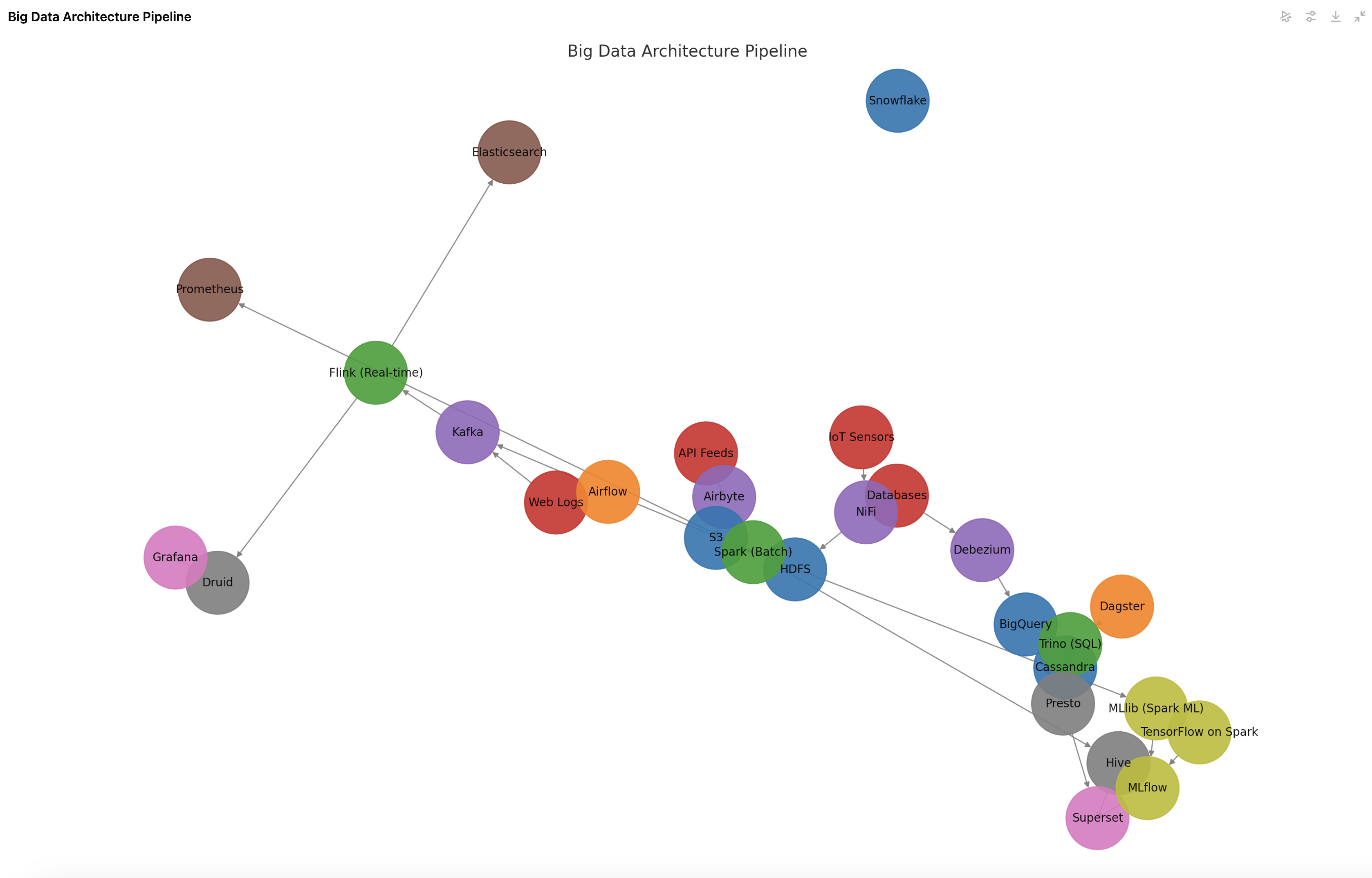
Here is the detailed architecture diagram of the Big Data Pipeline. It visually represents the data flow across ingestion, storage, processing, querying, visualization, monitoring, machine learning, and orchestration stages.
📌 How to Read the Diagram
- Data Sources: Incoming data from Web Logs, Databases, IoT Sensors, API Feeds.
- Data Ingestion: Kafka (real-time), NiFi, Airbyte, and Debezium (ETL and CDC tools) collect the data.
- Data Storage: HDFS, S3, Cassandra, BigQuery, and Snowflake store raw data.
- Data Processing:
- Spark processes batch data.
- Flink processes real-time data streams.
- Trino enables SQL-based querying on structured data.
- Data Querying & Analysis: Presto, Hive, and Druid allow complex queries.
- Data Visualization: Superset & Grafana for dashboarding and insights.
- Monitoring & Logging: Prometheus tracks system metrics, Elasticsearch logs real-time events.
- Machine Learning:
- Spark MLlib & TensorFlow on Spark for large-scale ML.
- MLflow tracks models and outputs to dashboards.
- Orchestration: Airflow and Dagster automate workflows.
This end-to-end pipeline ensures smooth handling of real-time and batch data with advanced analytics, visualization, and machine learning. 🚀

I’m Rajesh Kumar, a DevOps, SRE, DevSecOps, Cloud, and Platform Engineering expert passionate about sharing practical knowledge, real-world experiences, and industry best practices. I have worked at Cotocus and regularly write about technology, travel, investing, health, product reviews, and digital marketing through my various platforms.
I publish technical articles at DevOps School, travel stories at Holiday Landmark, stock market insights at Stocks Mantra, health and fitness guidance at My Medic Plus, product reviews at TrueReviewNow, and SEO and digital marketing strategies at Wizbrand.
Find Trusted Cardiac Hospitals
Compare heart hospitals by city and services — all in one place.
Explore Hospitals