
Introduction
Active Learning Tooling refers to a class of software platforms and frameworks designed to make machine learning model training more efficient by intelligently selecting the most valuable data points for labeling and learning. Instead of training models on massive, randomly labeled datasets, active learning tools help teams focus only on the data that matters most—samples that reduce uncertainty, improve accuracy faster, and lower annotation costs.
In modern AI and data-driven organizations, active learning has become critical. Data labeling is expensive, time-consuming, and often the biggest bottleneck in AI projects. Active learning tooling helps solve this by combining human expertise with model-driven sampling strategies, enabling faster iteration cycles and better model performance with less data.
Real-world use cases include:
- Computer vision annotation for autonomous driving and medical imaging
- NLP model training for chatbots, document classification, and sentiment analysis
- Fraud detection and anomaly detection in finance
- Recommendation systems and personalization engines
When choosing an active learning tool, users should evaluate sampling strategies, annotation workflows, integration with ML pipelines, scalability, usability, and security. The right tooling can reduce labeling costs by 30–70% while improving model accuracy and time-to-production.
Best for:
Active Learning Tooling is best suited for data scientists, ML engineers, AI researchers, annotation teams, and organizations building custom ML models—especially mid-market and enterprise teams dealing with large or complex datasets.
Not ideal for:
Teams using only off-the-shelf AI models, very small datasets, or rule-based systems may not need full-fledged active learning tooling. In such cases, simpler annotation tools or pre-trained APIs may be more cost-effective.
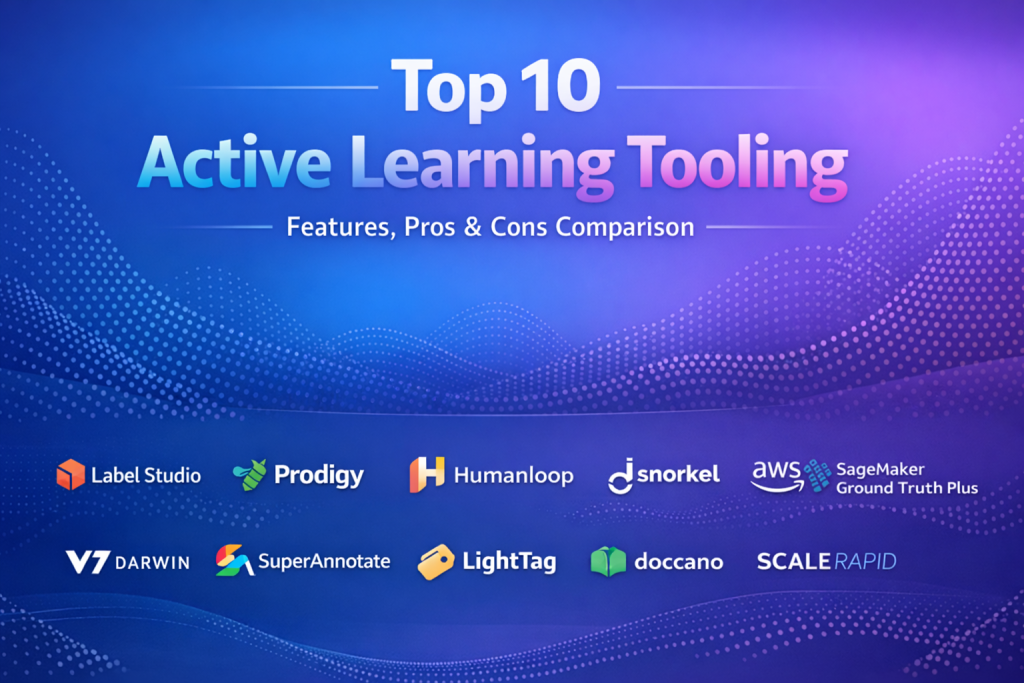
Top 10 Active Learning Tooling Tools
1 — Label Studio
Short description:
An open and flexible data labeling platform with built-in support for active learning workflows, designed for ML teams and researchers.
Key features
- Active learning loop integration with model predictions
- Supports text, image, audio, video, and time-series data
- Custom labeling interfaces and templates
- Model-assisted labeling and confidence-based sampling
- Workflow automation and versioning
- On-premise and self-hosted deployment options
Pros
- Highly flexible and extensible
- Strong open-source community
Cons
- Requires technical setup for advanced workflows
- UI may feel complex for non-technical users
Security & compliance
SSO, RBAC, encryption at rest (varies by deployment), GDPR-ready
Support & community
Strong documentation, active open-source community, enterprise support available
2 — Prodigy
Short description:
A scriptable, developer-focused active learning annotation tool built for NLP and computer vision tasks.
Key features
- Built-in uncertainty sampling and model-in-the-loop workflows
- Python-native API for full customization
- Real-time learning and feedback loops
- Optimized for NLP use cases
- Lightweight and fast annotation interface
Pros
- Extremely efficient for expert annotators
- Tight integration with ML pipelines
Cons
- Limited UI customization
- Not ideal for large annotation teams
Security & compliance
Local deployment, encryption depends on infrastructure, GDPR-ready
Support & community
Excellent documentation, smaller but expert-driven community
3 — Humanloop
Short description:
An active learning and evaluation platform focused on improving AI systems with human feedback.
Key features
- Human-in-the-loop workflows
- Active learning for LLM and ML systems
- Prompt versioning and evaluation
- Model comparison and feedback analysis
- Collaboration and review workflows
Pros
- Excellent for LLM-based systems
- Strong focus on feedback quality
Cons
- Less suited for raw data annotation
- Premium pricing
Security & compliance
SSO, encryption, audit logs, GDPR, SOC 2 (varies by plan)
Support & community
Strong onboarding, responsive enterprise support
4 — Snorkel Flow
Short description:
A programmatic labeling and active learning platform designed for enterprise-scale ML development.
Key features
- Weak supervision and labeling functions
- Active learning with uncertainty estimation
- Data-centric AI workflows
- Integration with major ML frameworks
- Scalable enterprise architecture
Pros
- Reduces manual labeling dramatically
- Enterprise-ready scalability
Cons
- Steep learning curve
- Higher cost
Security & compliance
SSO, RBAC, audit logs, SOC 2, GDPR
Support & community
Enterprise-grade support, structured documentation
5 — Amazon SageMaker Ground Truth Plus
Short description:
A managed data labeling and active learning service integrated into the AWS ecosystem.
Key features
- Built-in active learning workflows
- Managed human labeling and automation
- Integration with SageMaker training pipelines
- Scalable cloud-native infrastructure
- Quality control and audit trails
Pros
- Seamless AWS integration
- Highly scalable
Cons
- Vendor lock-in
- Cost can grow quickly
Security & compliance
IAM, encryption, audit logs, SOC, ISO, GDPR
Support & community
Extensive documentation, enterprise-grade support
6 — V7 Darwin
Short description:
A computer vision-focused annotation and active learning platform for image and video datasets.
Key features
- Active learning-based dataset curation
- Auto-annotation with model assistance
- Versioned datasets and experiments
- Collaboration tools for teams
- High-performance video annotation
Pros
- Excellent CV-specific tooling
- Clean and modern UI
Cons
- Limited NLP support
- Pricing may be high for small teams
Security & compliance
SSO, encryption, GDPR, SOC 2
Support & community
Strong onboarding, responsive customer support
7 — SuperAnnotate
Short description:
An enterprise annotation platform with active learning capabilities for large-scale AI projects.
Key features
- Active learning-powered sampling
- AI-assisted labeling
- Team collaboration and QA workflows
- Supports CV and NLP tasks
- Dataset analytics and monitoring
Pros
- Enterprise-ready workflows
- High-quality annotation controls
Cons
- Learning curve for new users
- Costly for small projects
Security & compliance
SSO, RBAC, SOC 2, GDPR
Support & community
Dedicated customer success, training resources
8 — LightTag
Short description:
A text-focused annotation and active learning platform designed for NLP teams.
Key features
- Active learning for text classification and NER
- Model-in-the-loop annotation
- Collaboration and review workflows
- Annotation analytics and dashboards
- API-based integration
Pros
- Excellent for NLP workflows
- User-friendly for linguists
Cons
- Limited computer vision support
- Smaller ecosystem
Security & compliance
SSO, encryption, GDPR
Support & community
Good documentation, responsive support
9 — Doccano
Short description:
An open-source annotation platform with basic active learning integrations.
Key features
- Text classification and sequence labeling
- Model-assisted annotation
- REST APIs for integration
- Lightweight deployment
- Open-source flexibility
Pros
- Free and open-source
- Simple to deploy
Cons
- Limited built-in active learning strategies
- Minimal enterprise features
Security & compliance
Varies / N/A (self-hosted)
Support & community
Community-driven support, limited enterprise help
10 — Scale Rapid
Short description:
An active learning-powered data curation and labeling solution for enterprise ML teams.
Key features
- Uncertainty-based sampling
- Human-in-the-loop pipelines
- High-quality annotation workflows
- Dataset analytics
- Large-scale project management
Pros
- High annotation accuracy
- Strong enterprise workflows
Cons
- Premium pricing
- Less customization for developers
Security & compliance
SOC 2, GDPR, encryption, audit logs
Support & community
Dedicated enterprise support and SLAs
Comparison Table
| Tool Name | Best For | Platform(s) Supported | Standout Feature | Rating |
|---|---|---|---|---|
| Label Studio | Flexible ML teams | Web, Self-hosted | Open active learning loops | N/A |
| Prodigy | NLP developers | Local, Web | Scriptable active learning | N/A |
| Humanloop | LLM teams | Web | Human feedback loops | N/A |
| Snorkel Flow | Enterprises | Cloud, On-prem | Weak supervision | N/A |
| SageMaker GT+ | AWS users | Cloud | Managed active learning | N/A |
| V7 Darwin | Computer vision | Web | Dataset versioning | N/A |
| SuperAnnotate | Large teams | Web, Cloud | QA workflows | N/A |
| LightTag | NLP teams | Web | Text-focused active learning | N/A |
| Doccano | Open-source users | Self-hosted | Lightweight setup | N/A |
| Scale Rapid | Enterprise AI | Cloud | High-quality annotation | N/A |
Evaluation & Scoring of Active Learning Tooling
| Criteria | Weight | Notes |
|---|---|---|
| Core features | 25% | Sampling strategies, model-in-loop |
| Ease of use | 15% | UI, onboarding, workflows |
| Integrations & ecosystem | 15% | ML frameworks, APIs |
| Security & compliance | 10% | Enterprise readiness |
| Performance & reliability | 10% | Scalability and stability |
| Support & community | 10% | Docs, SLAs |
| Price / value | 15% | ROI vs cost |
Which Active Learning Tooling Tool Is Right for You?
- Solo users & researchers: Prodigy, Doccano
- SMBs: Label Studio, LightTag
- Mid-market teams: V7 Darwin, Humanloop
- Enterprises: Snorkel Flow, Scale Rapid, SageMaker
Budget-conscious teams should prioritize open-source and flexible tools.
Premium solutions offer scalability, compliance, and managed workflows.
Choose feature depth if handling complex datasets; prioritize ease of use for fast onboarding.
Ensure the tool fits your ML stack, data volume, and compliance requirements.
Frequently Asked Questions (FAQs)
- What is active learning in machine learning?
Active learning is a technique where models select the most informative data points for labeling. - How does active learning reduce labeling costs?
By focusing only on uncertain or high-impact samples instead of labeling everything. - Do I need active learning for small datasets?
Not usually; benefits increase with dataset size and complexity. - Is active learning only for supervised learning?
Primarily yes, but it can support semi-supervised workflows. - Can non-technical users use active learning tools?
Some tools are user-friendly, but many require ML expertise. - Are these tools suitable for LLMs?
Yes, especially tools focused on human feedback and evaluation. - What are common mistakes with active learning?
Poor sampling strategy and lack of human QA. - Is open-source active learning safe for enterprises?
It can be, with proper security controls and self-hosting. - How long does implementation take?
From days (simple setups) to weeks (enterprise deployments). - Can active learning be combined with automation?
Yes, most modern platforms support hybrid workflows.
Conclusion
Active Learning Tooling has become a foundational component of modern AI development, enabling teams to build better models with less data, lower cost, and faster iteration cycles. The most important factors when choosing a tool are sampling quality, integration with your ML stack, usability, and security readiness.
There is no universal best tool. The right choice depends on your team size, data type, budget, and maturity of your ML workflows. By aligning tooling with your real-world needs, active learning can become a powerful competitive advantage rather than a complexity burden.

Find Trusted Cardiac Hospitals
Compare heart hospitals by city and services — all in one place.
Explore Hospitals
