
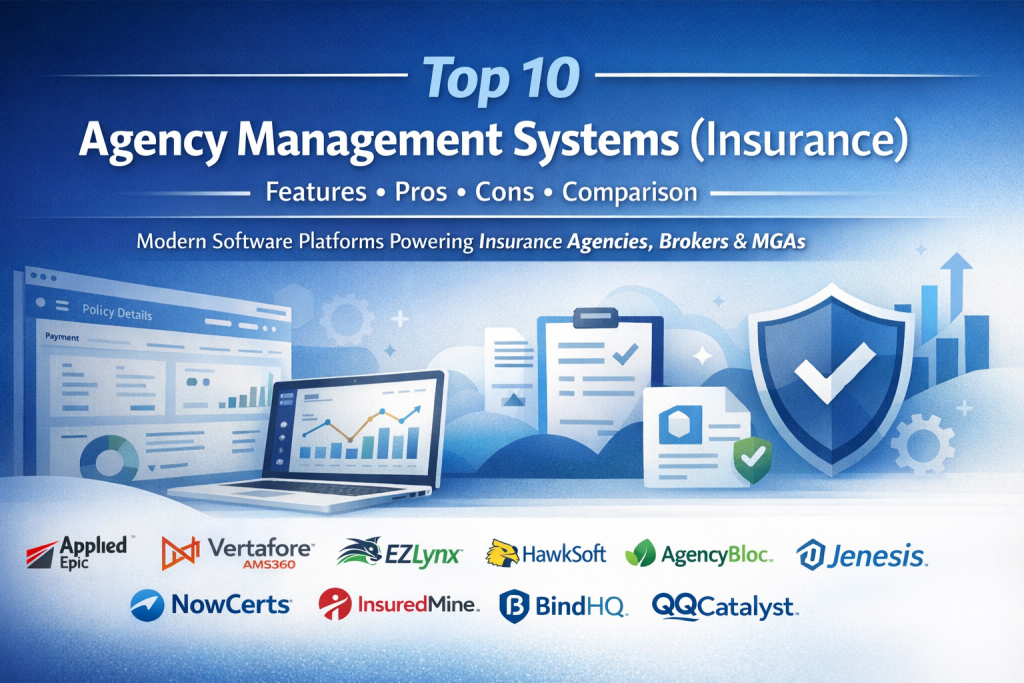
Introduction
Agency Management Systems (AMS) for insurance are centralized platforms designed to manage the daily operations of insurance agencies—from client records and policy administration to commissions, accounting, renewals, and compliance. In a highly regulated and relationship-driven industry, these systems act as the operational backbone that keeps agencies efficient, compliant, and scalable.
The importance of an AMS has grown significantly as agencies face increasing policy complexity, multi-carrier operations, digital customer expectations, and stricter regulatory oversight. Manual processes, spreadsheets, or disconnected tools simply cannot keep up with today’s volume and accuracy demands.
Real-world use cases include managing thousands of active policies, tracking commissions across multiple carriers, automating renewals, handling endorsements, supporting audits, and enabling agents to deliver faster, more personalized service.
When choosing an Agency Management System, buyers should evaluate policy lifecycle management, accounting depth, integrations with carriers and CRMs, ease of use, reporting capabilities, security standards, scalability, and vendor support quality.
Best for:
Agency Management Systems (Insurance) tools are best suited for independent insurance agencies, brokerages, MGAs, wholesalers, and enterprise insurance firms that manage multiple carriers, high policy volumes, and commission structures.
Not ideal for:
Solo agents with very low transaction volumes, startups still validating their business model, or agencies operating with a single carrier may find a full AMS excessive and may prefer lighter CRM-based alternatives.
Top 10 Agency Management Systems (Insurance) Tools
1 — Applied Epic
Short description:
A comprehensive, enterprise-grade AMS designed for mid-to-large insurance agencies and brokerages with complex workflows.
Key features:
- End-to-end policy lifecycle management
- Advanced commission and accounting tools
- Carrier connectivity and download automation
- CRM and document management integration
- Custom reporting and analytics
- Role-based access controls
Pros:
- Extremely powerful and scalable
- Strong carrier integration ecosystem
Cons:
- Steep learning curve
- Higher cost compared to SMB tools
Security & compliance:
SSO, encryption, audit logs, SOC-aligned controls
Support & community:
Dedicated enterprise support, training programs, large user community
2 — Vertafore AMS360
Short description:
A robust AMS tailored for independent agencies seeking deep accounting and carrier connectivity.
Key features:
- Policy, claims, and billing management
- Integrated accounting and commissions
- Carrier download and real-time sync
- Workflow automation
- Compliance-ready reporting
Pros:
- Strong financial management
- Well-established market presence
Cons:
- Interface feels dated to some users
- Implementation can be time-consuming
Security & compliance:
Encryption, role-based access, compliance reporting
Support & community:
Professional onboarding, customer support, user forums
3 — EZLynx
Short description:
A cloud-based AMS focused on ease of use and speed for growing independent agencies.
Key features:
- Policy management and renewals
- Integrated CRM and marketing tools
- Real-time comparative rating
- Document storage
- Automation workflows
Pros:
- User-friendly interface
- Faster onboarding
Cons:
- Limited enterprise-level customization
- Accounting features less advanced
Security & compliance:
Cloud encryption, access controls
Support & community:
Strong onboarding support, knowledge base
4 — HawkSoft
Short description:
A modern AMS known for flexibility and workflow customization for independent agencies.
Key features:
- Custom workflows and task automation
- Policy and client management
- Integrated document management
- Reporting dashboards
- Accounting integrations
Pros:
- Highly customizable
- Intuitive user experience
Cons:
- Limited native carrier downloads
- Some features require add-ons
Security & compliance:
Encryption, audit tracking
Support & community:
Responsive support team, active user base
5 — AgencyBloc
Short description:
An AMS built specifically for health, life, and benefits insurance agencies.
Key features:
- Enrollment and policy tracking
- Commission management
- CRM and lead tracking
- Compliance reporting
- Carrier integrations
Pros:
- Purpose-built for health insurance
- Strong compliance tools
Cons:
- Not ideal for P&C agencies
- Limited UI customization
Security & compliance:
HIPAA-aligned controls, encryption
Support & community:
Dedicated onboarding, healthcare-focused support
6 — Jenesis
Short description:
A cost-effective AMS designed for small to mid-sized agencies.
Key features:
- Policy and client management
- Accounting and commissions
- Task automation
- Document storage
- Reporting tools
Pros:
- Affordable pricing
- Simple and straightforward
Cons:
- Fewer integrations
- Less suitable for large agencies
Security & compliance:
Standard security controls, role-based access
Support & community:
Helpful customer support, smaller community
7 — NowCerts
Short description:
A cloud-native AMS focusing on automation and commission accuracy.
Key features:
- Automated commission reconciliation
- Policy lifecycle tracking
- CRM and task management
- Document automation
- Reporting dashboards
Pros:
- Strong commission handling
- Modern cloud architecture
Cons:
- Learning curve for advanced automation
- Limited enterprise reporting
Security & compliance:
Encryption, secure cloud hosting
Support & community:
Good documentation, responsive support
8 — InsuredMine
Short description:
A CRM-first AMS hybrid aimed at sales-driven agencies.
Key features:
- Sales pipeline and lead management
- Policy tracking
- Customer engagement automation
- Reporting and analytics
- Integration-friendly API
Pros:
- Strong sales enablement
- Easy to use
Cons:
- Limited accounting depth
- Less suited for complex agencies
Security & compliance:
Cloud security, access controls
Support & community:
Growing community, onboarding assistance
9 — BindHQ
Short description:
A modern AMS designed for commercial lines and specialty insurance.
Key features:
- Commercial policy management
- Workflow automation
- Custom reporting
- Carrier integration
- Scalable architecture
Pros:
- Excellent for complex commercial policies
- Modern UI
Cons:
- Not ideal for personal lines
- Higher cost
Security & compliance:
Enterprise-grade security, audit logs
Support & community:
Dedicated support, enterprise onboarding
10 — QQCatalyst
Short description:
A lightweight AMS tailored for small independent agencies.
Key features:
- Client and policy management
- Basic accounting
- Reporting tools
- Carrier connectivity
- Cloud access
Pros:
- Easy to adopt
- Affordable
Cons:
- Limited customization
- Not scalable for large agencies
Security & compliance:
Standard security measures
Support & community:
Customer support and training resources
Comparison Table
| Tool Name | Best For | Platform(s) Supported | Standout Feature | Rating |
|---|---|---|---|---|
| Applied Epic | Enterprise agencies | Web, Cloud | Enterprise scalability | N/A |
| Vertafore AMS360 | Independent agencies | Web | Accounting depth | N/A |
| EZLynx | Growing SMB agencies | Cloud | Ease of use | N/A |
| HawkSoft | Custom workflows | Desktop, Cloud | Workflow flexibility | N/A |
| AgencyBloc | Health & benefits | Cloud | Compliance tools | N/A |
| Jenesis | Small agencies | Desktop, Cloud | Affordability | N/A |
| NowCerts | Commission-heavy agencies | Cloud | Automation | N/A |
| InsuredMine | Sales-driven agencies | Cloud | CRM strength | N/A |
| BindHQ | Commercial insurance | Cloud | Commercial focus | N/A |
| QQCatalyst | Small independents | Cloud | Simplicity | N/A |
Evaluation & Scoring of Agency Management Systems (Insurance)
| Criteria | Weight | Score Range |
|---|---|---|
| Core features | 25% | 1–10 |
| Ease of use | 15% | 1–10 |
| Integrations & ecosystem | 15% | 1–10 |
| Security & compliance | 10% | 1–10 |
| Performance & reliability | 10% | 1–10 |
| Support & community | 10% | 1–10 |
| Price / value | 15% | 1–10 |
Which Agency Management Systems (Insurance) Tool Is Right for You?
- Solo users: Lightweight tools with basic policy tracking and CRM
- SMBs: Cloud-based AMS with automation and affordability
- Mid-market agencies: Systems with accounting depth and integrations
- Enterprise firms: Highly scalable platforms with advanced compliance
Budget-conscious teams may favor simpler platforms, while premium solutions deliver deeper analytics, automation, and long-term scalability. Agencies with strict regulatory requirements should prioritize security certifications, audit logs, and access controls.
Frequently Asked Questions (FAQs)
- What is an insurance AMS?
A centralized system for managing policies, clients, accounting, and agency operations. - How long does implementation take?
Anywhere from a few weeks to several months depending on complexity. - Are cloud-based AMS secure?
Yes, when vendors follow strong encryption and compliance standards. - Do AMS tools replace CRMs?
Some do; others integrate with dedicated CRM platforms. - Can small agencies use enterprise AMS?
They can, but costs and complexity may outweigh benefits. - What is the biggest mistake when choosing an AMS?
Ignoring scalability and future growth needs. - Do these tools support multiple carriers?
Most leading AMS platforms do. - Is training required?
Yes, especially for feature-rich systems. - Can AMS help with compliance audits?
Yes, through reporting, logs, and documentation. - Is there one “best” AMS?
No—each agency’s needs determine the best fit.
Conclusion
Agency Management Systems (Insurance) play a critical role in modern insurance operations. The right system improves efficiency, ensures compliance, strengthens customer relationships, and supports growth.
Rather than searching for a universal winner, agencies should focus on alignment with their size, complexity, budget, and long-term strategy. When chosen thoughtfully, an AMS becomes not just software—but a competitive advantage.

Find Trusted Cardiac Hospitals
Compare heart hospitals by city and services — all in one place.
Explore Hospitals
This guide on the top 10 agency management systems for insurance agencies is extremely helpful because it goes beyond simple tool listing and actually breaks down features, pros, cons, and ideal use cases in a structured way. By highlighting areas like policy administration, claims handling, integrations, automation, and reporting, it gives agency owners and IT leaders a clear lens to evaluate whether a platform fits their operational and compliance needs. What stands out most is the comparative approach, which helps readers understand trade-offs such as cost vs. scalability, customization vs. ease of use, and on-premise vs. cloud deployment options instead of assuming one “best” tool for everyone. Anyone planning a new AMS implementation or replacement project can use this article as a practical starting point to shortlist vendors, frame internal requirements, and ask smarter questions during demos and RFPs.