
Introduction
AI dubbing tools are transforming how audio and video content is localized for global audiences. Instead of relying on time-consuming studio recordings, voice actors, and manual synchronization, AI dubbing uses advanced speech synthesis, translation, and voice-cloning technologies to automatically generate natural-sounding voiceovers in multiple languages.
This shift is important because video has become the dominant communication format across marketing, education, entertainment, and enterprise training. Audiences expect content in their native language, with accurate pronunciation, natural pacing, and emotional tone. AI dubbing tools make this scalable, affordable, and fast—without sacrificing quality.
Why AI Dubbing Tools Matter
- Accelerate global content distribution
- Reduce localization and production costs
- Ensure consistent voice and brand tone
- Enable rapid updates and re-dubbing at scale
Common Real-World Use Cases
- Marketing videos and product explainers
- Online courses and e-learning platforms
- Media & entertainment localization
- Corporate training and internal communications
- Social media and creator content
What to Look for When Choosing an AI Dubbing Tool
- Voice quality & realism
- Language coverage and accents
- Lip-sync and timing accuracy
- Editing and control options
- Scalability and integrations
- Security and compliance
- Support and learning resources
Best for:
Content creators, marketers, media studios, ed-tech platforms, enterprises with global audiences, and fast-growing startups that need multilingual reach without large localization teams.
Not ideal for:
Projects requiring artistic voice acting, highly emotional film dubbing, or strict union-regulated productions where human voice actors are mandatory.
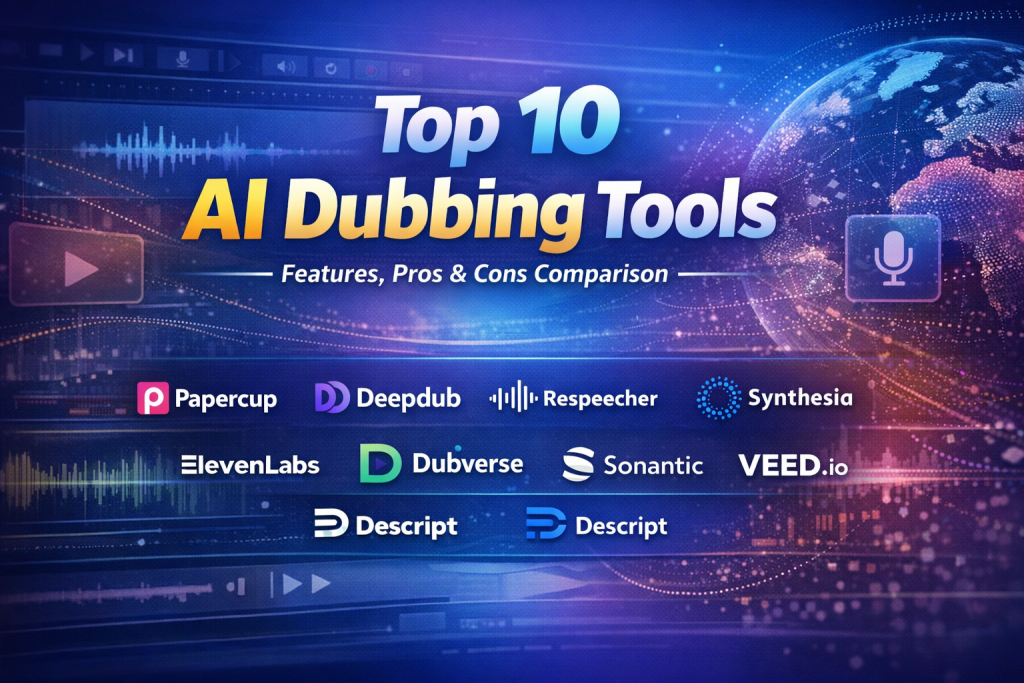
Top 10 AI Dubbing Tools
1 — Papercup
Short description:
An enterprise-focused AI dubbing platform known for broadcast-quality voices and strong media localization capabilities.
Key features
- Human-like neural voices
- Automated speech-to-speech translation
- Timing and cadence optimization
- Studio-grade audio output
- Editorial review workflow
- Multi-language scaling
Pros
- High realism suitable for professional media
- Strong quality control workflows
Cons
- Enterprise pricing
- Limited self-serve options
Security & compliance: SOC 2, GDPR
Support & community: Dedicated enterprise support, onboarding specialists
2 — Deepdub
Short description:
Designed for entertainment and film industries, focusing on emotional and expressive AI voices.
Key features
- Emotion-aware speech synthesis
- Voice consistency across episodes
- Multi-language dubbing
- Script adaptation tools
- Studio collaboration features
Pros
- Excellent emotional tone
- Film-grade output quality
Cons
- Longer turnaround times
- Less suitable for short-form content
Security & compliance: GDPR
Support & community: High-touch support, limited public documentation
3 — Respeecher
Short description:
A premium AI voice cloning and dubbing solution used in high-profile media productions.
Key features
- Ultra-realistic voice cloning
- Language-agnostic voice transfer
- Ethical voice licensing
- Studio-grade outputs
- Custom voice models
Pros
- Exceptional realism
- Strong ethical framework
Cons
- Not self-serve
- Higher production costs
Security & compliance: Varies by project
Support & community: White-glove production support
4 — Synthesia
Short description:
An all-in-one AI video creation platform with built-in dubbing and voiceover capabilities.
Key features
- AI voice dubbing in multiple languages
- Avatar-based video creation
- Script-to-video workflow
- Voice customization
- Cloud-based editing
- Team collaboration
Pros
- Extremely easy to use
- Fast multilingual video creation
Cons
- Less control over fine voice nuances
- Avatar-centric approach may not fit all brands
Security & compliance: SOC 2, GDPR
Support & community: Strong documentation, enterprise support plans
5 — Lovo
Short description:
A creator-friendly AI voice and dubbing tool focused on speed and accessibility.
Key features
- Large voice library
- Multi-language dubbing
- Text-to-speech editing
- Emotion controls
- Audio export options
Pros
- Affordable for individuals
- Quick learning curve
Cons
- Limited enterprise controls
- Not optimized for long-form media
Security & compliance: GDPR
Support & community: Tutorials, email support
6 — ElevenLabs
Short description:
Known for industry-leading voice realism and natural intonation.
Key features
- Advanced voice synthesis
- Multi-language voice generation
- Voice cloning
- API access
- Real-time dubbing experiments
Pros
- Very natural voice quality
- Flexible API usage
Cons
- Dubbing workflow still evolving
- Limited enterprise tooling
Security & compliance: GDPR, encryption in transit
Support & community: Active community, growing documentation
7 — Dubverse
Short description:
A fast, cloud-based AI dubbing tool designed for marketing and social content.
Key features
- Automated video translation
- Multi-language voiceovers
- Subtitle and dubbing sync
- Simple web editor
- Rapid exports
Pros
- Speed and simplicity
- Good for social media teams
Cons
- Voice realism varies
- Fewer advanced controls
Security & compliance: GDPR
Support & community: Chat support, onboarding guides
8 — Sonantic
Short description:
An expressive AI voice platform used in games, film, and interactive media.
Key features
- Emotion-rich voice synthesis
- Real-time rendering
- Multilingual voices
- API-driven workflows
- Fine emotional control
Pros
- Highly expressive output
- Ideal for storytelling
Cons
- Requires technical expertise
- Limited turnkey dubbing workflows
Security & compliance: Varies
Support & community: Developer-focused documentation
9 — Veed
Short description:
A browser-based video editor with AI dubbing and voice translation features.
Key features
- Auto-dubbing and translation
- Subtitle generation
- Timeline editing
- Cloud collaboration
- Social-ready exports
Pros
- Beginner-friendly
- All-in-one editing
Cons
- Voice quality less premium
- Limited enterprise depth
Security & compliance: GDPR
Support & community: Knowledge base, community tutorials
10 — Descript
Short description:
An AI-powered audio and video editor with overdub and voice replacement capabilities.
Key features
- AI voice cloning
- Script-based editing
- Multi-language voiceovers
- Podcast and video workflows
- Collaboration tools
Pros
- Excellent for editors and podcasters
- Unique text-based editing
Cons
- Not dedicated solely to dubbing
- Voice realism depends on training
Security & compliance: SOC 2, GDPR
Support & community: Strong community, tutorials, email support
Comparison Table
| Tool Name | Best For | Platform(s) Supported | Standout Feature | Rating |
|---|---|---|---|---|
| Papercup | Enterprise media | Cloud / API | Broadcast-quality voices | N/A |
| Deepdub | Film & TV | Managed service | Emotional dubbing | N/A |
| Respeecher | Premium productions | Studio workflows | Ultra-realistic cloning | N/A |
| Synthesia | Corporate videos | Web | All-in-one AI video | N/A |
| Lovo | Creators | Web | Large voice library | N/A |
| ElevenLabs | Developers | API / Web | Voice realism | N/A |
| Dubverse | Marketing teams | Web | Fast localization | N/A |
| Sonantic | Games & film | API | Emotional control | N/A |
| Veed | Social creators | Web | Simple editing | N/A |
| Descript | Editors | Desktop / Cloud | Text-based editing | N/A |
Evaluation & Scoring of AI Dubbing Tools
| Tool | Core Features (25%) | Ease of Use (15%) | Integrations (15%) | Security (10%) | Performance (10%) | Support (10%) | Price/Value (15%) | Total |
|---|---|---|---|---|---|---|---|---|
| Papercup | 23 | 12 | 13 | 9 | 9 | 9 | 10 | 85 |
| Synthesia | 21 | 14 | 12 | 9 | 8 | 8 | 11 | 83 |
| ElevenLabs | 22 | 13 | 14 | 7 | 9 | 8 | 9 | 82 |
| Deepdub | 24 | 10 | 11 | 8 | 9 | 8 | 7 | 77 |
| Descript | 19 | 14 | 12 | 8 | 8 | 9 | 10 | 80 |
Which AI Dubbing Tool Is Right for You?
- Solo users & creators: Lovo, Veed, Descript
- SMBs & marketing teams: Dubverse, Synthesia
- Mid-market companies: ElevenLabs, Descript
- Enterprise & media studios: Papercup, Deepdub, Respeecher
Budget-conscious: Creator-focused platforms
Premium quality: Enterprise and studio-grade solutions
Ease of use: All-in-one video tools
Scalability & APIs: Developer-friendly platforms
Security needs: Enterprise-focused vendors
Frequently Asked Questions (FAQs)
- Are AI dubbing voices realistic?
Yes, modern neural voices sound highly natural, especially for informational content. - Can AI dubbing replace human voice actors?
For many use cases, yes—but not always for emotional cinema. - How many languages are typically supported?
Anywhere from 10 to 70+, depending on the platform. - Is AI dubbing expensive?
Costs vary widely—from affordable creator plans to enterprise pricing. - Can I edit the dubbed audio?
Most tools allow text-based or timeline editing. - Does AI dubbing support lip-sync?
Some advanced tools offer automated lip-sync adjustments. - Is it secure for enterprise use?
Leading tools support encryption, GDPR, and SOC 2. - Can AI dubbing be updated later?
Yes, one of its biggest advantages is easy re-dubbing. - Do I need technical skills?
No for most tools; APIs require development expertise. - What’s the biggest mistake buyers make?
Choosing voice quality alone without considering workflow and scalability.
Conclusion
AI dubbing tools have matured into reliable, scalable solutions for global content distribution. The most important factors are voice quality, workflow efficiency, language coverage, and security. There is no single best tool—only the best fit for your specific goals, audience, and scale. By aligning your needs with the right platform, AI dubbing can unlock faster growth and truly global reach.

Find Trusted Cardiac Hospitals
Compare heart hospitals by city and services — all in one place.
Explore Hospitals