
Introduction
Airline Reservation Systems (ARS) are the digital backbone of modern aviation operations. These systems manage flight schedules, seat inventory, pricing, ticketing, passenger records, and distribution across multiple sales channels. From searching flights and reserving seats to managing changes, cancellations, and loyalty programs, airline reservation systems ensure that airlines can sell the right seat to the right passenger at the right time.
In today’s highly competitive aviation industry, an efficient reservation system is not optional—it is mission-critical. Airlines rely on these platforms to optimize revenue, reduce manual errors, improve customer experience, and maintain operational accuracy across global markets. Travel agents, online travel agencies, and corporate travel managers also depend on these systems for real-time availability and pricing.
Key real-world use cases include:
- Managing flight inventory and dynamic pricing
- Issuing and modifying passenger tickets
- Integrating with global distribution systems (GDS)
- Supporting loyalty programs and ancillary revenue
- Ensuring regulatory compliance and auditability
When choosing an airline reservation system, buyers should evaluate scalability, integration capabilities, real-time performance, security standards, ease of use, and long-term cost efficiency. The right system must align with airline size, route complexity, and growth plans.
Best for:
Airline reservation systems are best suited for commercial airlines, regional carriers, charter operators, aviation startups, travel agencies, tour operators, and corporate travel departments that require reliable, real-time booking and passenger management.
Not ideal for:
These systems may be excessive for very small operators with manual booking processes, private aircraft owners with limited passengers, or organizations that only need basic scheduling without ticketing or distribution capabilities.
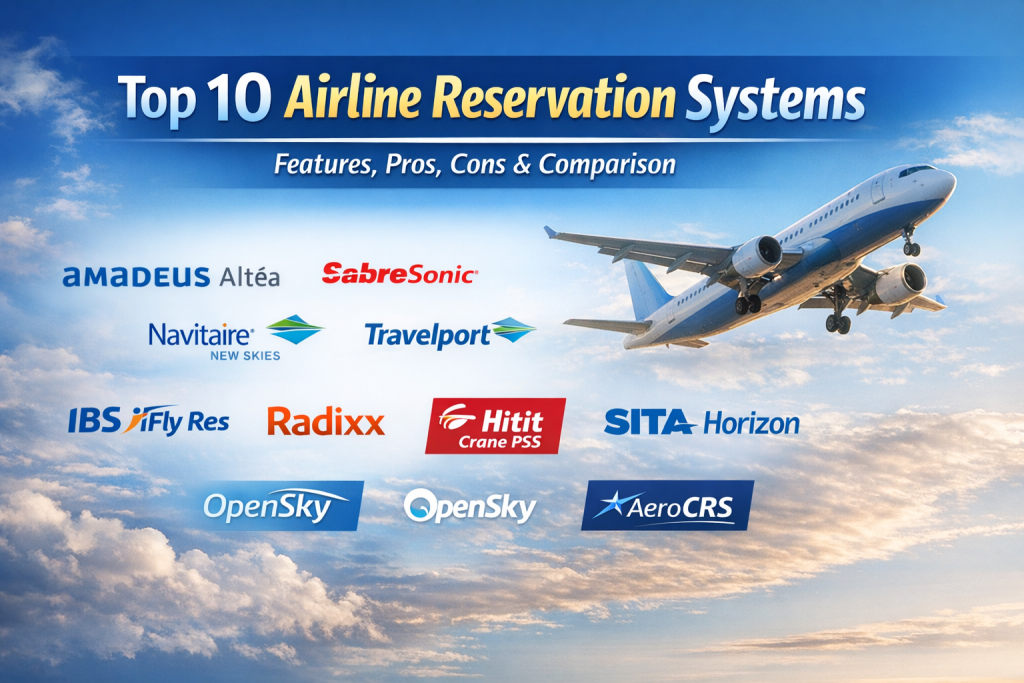
Top 10 Airline Reservation Systems Tools
1 — Amadeus Altéa Suite
Short description:
Amadeus Altéa is a comprehensive airline IT platform designed for full-service and network airlines managing complex operations and global distribution.
Key features:
- Centralized passenger service system (PSS)
- Real-time inventory and availability management
- Advanced pricing and revenue optimization
- Loyalty and frequent flyer program support
- Multi-channel distribution capabilities
- Operational disruption and rebooking tools
Pros:
- Highly scalable for global airlines
- Strong ecosystem and industry adoption
- Robust analytics and reporting
Cons:
- High implementation and licensing costs
- Requires specialized training
- Complex configuration for smaller airlines
Security & compliance:
Enterprise-grade security, encryption, GDPR compliance, ISO standards, audit logs, SSO support.
Support & community:
Extensive documentation, enterprise onboarding, dedicated account management, strong industry community.
2 — SabreSonic Passenger Service System
Short description:
SabreSonic is a well-established reservation and passenger service system serving airlines of all sizes worldwide.
Key features:
- Flight booking and inventory control
- Passenger name record (PNR) management
- Revenue management integration
- Disruption recovery tools
- Multi-currency and multi-language support
- Seamless GDS connectivity
Pros:
- Trusted global reputation
- Strong reliability and uptime
- Broad partner integrations
Cons:
- Legacy UI in some modules
- Customization can be time-consuming
- Premium pricing model
Security & compliance:
SOC-aligned controls, encryption, GDPR support, audit trails.
Support & community:
24/7 enterprise support, structured onboarding, global user base.
3— Navitaire New Skies
Short description:
Navitaire New Skies is designed primarily for low-cost and hybrid airlines focusing on agility and ancillary revenue.
Key features:
- Cloud-based reservation platform
- Ancillary sales optimization
- Dynamic pricing and bundling
- Mobile-first booking support
- Integrated departure control system
- Real-time reporting dashboards
Pros:
- Excellent for low-cost carrier models
- Faster deployment compared to legacy systems
- Strong focus on retailing
Cons:
- Limited for complex network carriers
- Fewer customization options
- Reporting depth may vary
Security & compliance:
Cloud security standards, encryption, GDPR compliance.
Support & community:
Vendor-led onboarding, responsive support, growing airline community.
4 — Travelport Airline Solutions
Short description:
Travelport provides airline reservation and distribution tools optimized for connectivity with travel agencies and partners.
Key features:
- Inventory and fare management
- GDS distribution capabilities
- NDC-ready architecture
- Agency and partner integrations
- Schedule and availability publishing
- Data-driven insights
Pros:
- Strong agency network reach
- NDC-focused innovation
- Flexible distribution options
Cons:
- Less comprehensive as a standalone PSS
- Requires integration with other systems
- Custom development may be needed
Security & compliance:
Industry-standard security, encryption, GDPR alignment.
Support & community:
Good documentation, partner-based support model, industry forums.
5 — IBS iFly Res
Short description:
iFly Res by IBS Software is a modern reservation system catering to full-service and hybrid airlines.
Key features:
- Passenger service and reservation management
- Dynamic offer and order management
- Loyalty program integration
- Multi-channel sales support
- Advanced analytics and dashboards
- Disruption management tools
Pros:
- Modern architecture
- Strong airline-specific workflows
- Good scalability for growing airlines
Cons:
- Smaller ecosystem compared to major players
- Implementation requires careful planning
- Limited out-of-the-box templates
Security & compliance:
ISO-certified processes, encryption, GDPR compliance, audit logging.
Support & community:
Enterprise support, structured onboarding, aviation-focused user base.
6 — Radixx Passenger Service System
Short description:
Radixx PSS is a cost-effective airline reservation platform popular with regional and low-cost carriers.
Key features:
- Reservation and inventory control
- Fare and ancillary management
- Departure control system
- Agent and web booking tools
- API-based integrations
- Operational reporting
Pros:
- Affordable pricing
- Flexible modular design
- Faster deployment cycles
Cons:
- UI less polished than premium systems
- Limited advanced analytics
- Smaller support ecosystem
Security & compliance:
Standard encryption, role-based access, compliance varies by deployment.
Support & community:
Vendor-led support, adequate documentation, niche airline community.
7 — Hitit Crane PSS
Short description:
Crane PSS by Hitit is an all-in-one airline reservation and passenger service solution for regional and network carriers.
Key features:
- End-to-end passenger service system
- Revenue management integration
- Loyalty and CRM modules
- Schedule and inventory management
- Airport operations support
- Data analytics tools
Pros:
- Comprehensive feature coverage
- Competitive pricing
- Flexible deployment options
Cons:
- Limited brand recognition globally
- Fewer third-party integrations
- Learning curve for new users
Security & compliance:
GDPR-compliant, encryption, audit logs, enterprise access controls.
Support & community:
Dedicated airline support teams, onboarding assistance, regional user base.
8 — SITA Horizon Passenger Services
Short description:
SITA Horizon offers airline reservation and passenger management as part of a broader aviation IT ecosystem.
Key features:
- Cloud-native passenger service platform
- Modular architecture
- Seamless airport system integration
- Real-time passenger data management
- Disruption handling tools
- Analytics and insights
Pros:
- Strong airport and airline integration
- Cloud scalability
- Aviation-focused innovation
Cons:
- Less mature as a standalone reservation tool
- Customization may require vendor support
- Pricing transparency varies
Security & compliance:
Aviation-grade security, GDPR, ISO standards, strong data protection.
Support & community:
Enterprise support, aviation industry expertise, growing community.
9 — OpenSky Airline Reservation System
Short description:
OpenSky is a flexible airline reservation platform designed for charter airlines and mid-sized carriers.
Key features:
- Flight scheduling and inventory control
- Ticketing and passenger management
- Charter and scheduled flight support
- API-based integrations
- Customizable workflows
- Reporting and analytics
Pros:
- High flexibility
- Suitable for niche airline models
- Lower entry cost
Cons:
- Limited global distribution reach
- Smaller development roadmap
- Fewer automation features
Security & compliance:
Varies by deployment, standard encryption, role-based controls.
Support & community:
Direct vendor support, limited but focused user community.
10 — AeroCRS Airline Reservation Platform
Short description:
AeroCRS is a lightweight reservation system suitable for small airlines, charter operators, and aviation startups.
Key features:
- Online booking engine
- Inventory and pricing control
- Agent management tools
- Multi-currency support
- Simple reporting dashboards
- API connectivity
Pros:
- Easy to use
- Affordable pricing
- Quick setup and onboarding
Cons:
- Not suitable for large airlines
- Limited advanced revenue tools
- Basic analytics
Security & compliance:
Standard security measures, encryption, compliance varies.
Support & community:
Responsive support, clear documentation, small user base.
Comparison Table
| Tool Name | Best For | Platform(s) Supported | Standout Feature | Rating |
|---|---|---|---|---|
| Amadeus Altéa | Large network airlines | Web, Cloud | Full PSS ecosystem | N/A |
| SabreSonic | Global airlines | Web, Cloud | Reliability and reach | N/A |
| Navitaire New Skies | Low-cost carriers | Cloud | Ancillary revenue focus | N/A |
| Travelport | Distribution-heavy airlines | Web | Strong agency connectivity | N/A |
| IBS iFly Res | Growing airlines | Cloud | Modern retailing model | N/A |
| Radixx PSS | Regional airlines | Web, Cloud | Cost-effective modularity | N/A |
| Hitit Crane | Network carriers | Web, Cloud | All-in-one PSS | N/A |
| SITA Horizon | Airlines + airports | Cloud | Aviation ecosystem integration | N/A |
| OpenSky | Charter airlines | Web | Flexible workflows | N/A |
| AeroCRS | Small operators | Web | Ease of use | N/A |
Evaluation & Scoring of Airline Reservation Systems
| Criteria | Weight | Key Considerations |
|---|---|---|
| Core features | 25% | Inventory, ticketing, pricing, PNR |
| Ease of use | 15% | UI, learning curve, workflows |
| Integrations & ecosystem | 15% | GDS, APIs, partners |
| Security & compliance | 10% | Encryption, GDPR, audits |
| Performance & reliability | 10% | Uptime, latency |
| Support & community | 10% | Onboarding, documentation |
| Price / value | 15% | ROI, scalability |
Which Airline Reservation Systems Tool Is Right for You?
- Solo or small operators: Lightweight tools like AeroCRS or OpenSky offer affordability and simplicity.
- SMBs and regional airlines: Radixx, Hitit, or IBS iFly Res provide balance between features and cost.
- Mid-market airlines: Navitaire and SITA Horizon support growth and retail-focused strategies.
- Enterprise airlines: Amadeus and Sabre remain unmatched for global scale and complexity.
Budget-conscious buyers should prioritize modular systems, while premium buyers may invest in full-service platforms. Airlines needing rapid scalability and integrations should favor cloud-native architectures. Strong security and compliance are essential for carriers operating in regulated markets.
Frequently Asked Questions (FAQs)
1. What is an airline reservation system?
It is software that manages flight bookings, ticketing, passenger data, and inventory.
2. Are airline reservation systems cloud-based?
Many modern systems are cloud-native, though some legacy platforms remain hybrid.
3. Do small airlines need complex systems?
Not always. Smaller airlines benefit from lightweight, easy-to-use platforms.
4. How long does implementation take?
It can range from a few weeks to several months depending on complexity.
5. Are these systems secure?
Most enterprise systems follow strict security and compliance standards.
6. Can reservation systems integrate with mobile apps?
Yes, most provide APIs for web and mobile integrations.
7. Do they support loyalty programs?
Many mid to enterprise-level systems include loyalty management modules.
8. Are pricing models flexible?
Pricing varies from subscription-based to transaction-based models.
9. What are common mistakes when choosing a system?
Underestimating scalability needs and ignoring integration requirements.
10. Can systems support future growth?
Cloud-based and modular systems are best for long-term scalability.
Conclusion
Airline reservation systems play a critical role in the success of modern airlines by ensuring operational accuracy, revenue optimization, and customer satisfaction. From lightweight tools for small operators to enterprise-grade platforms for global carriers, the market offers solutions for every need.
The most important factors when choosing an airline reservation system are scalability, integration capability, security, ease of use, and long-term value. There is no single “best” system for everyone—the right choice depends on airline size, business model, budget, and future growth plans. Selecting wisely ensures smoother operations today and resilience for tomorrow’s aviation challenges.

Find Trusted Cardiac Hospitals
Compare heart hospitals by city and services — all in one place.
Explore Hospitals