
Introduction
Application Lifecycle Management (ALM) Suites are integrated platforms designed to manage the entire lifecycle of an application—from initial idea and requirements gathering to development, testing, deployment, maintenance, and eventual retirement. Unlike standalone tools that handle only one phase (such as bug tracking or CI/CD), ALM suites bring people, processes, and tools together in a single, traceable system.
In today’s fast-moving software environment, organizations face growing complexity: distributed teams, faster release cycles, strict compliance requirements, and increasing customer expectations. ALM suites help address these challenges by providing end-to-end visibility, governance, and collaboration across the software delivery pipeline.
Why ALM Suites Are Important
- Ensure traceability from requirements to code, tests, and releases
- Improve cross-team collaboration between business, development, and QA
- Reduce project risk through early defect detection and governance
- Support compliance with industry regulations and audit requirements
Real-World Use Cases
- Large enterprises managing complex, regulated software projects
- Agile and DevOps teams seeking alignment between planning and delivery
- Organizations modernizing legacy systems with structured governance
- Product companies coordinating multiple releases and platforms
Evaluation Criteria When Choosing an ALM Suite
When evaluating ALM tools, buyers should focus on:
- End-to-end coverage (requirements, development, testing, release)
- Ease of use and learning curve
- Integration capabilities with DevOps and third-party tools
- Security, compliance, and audit readiness
- Scalability for future growth
- Total cost of ownership
Best for:
ALM suites are ideal for mid-market to enterprise organizations, regulated industries (finance, healthcare, aerospace), and teams that need strong governance, traceability, and cross-functional collaboration.
Not ideal for:
Solo developers, very small startups, or teams needing only a single lightweight function (such as simple issue tracking) may find full ALM suites too complex or expensive for their needs.
Top 10 Application Lifecycle Management (ALM) Suites Tools
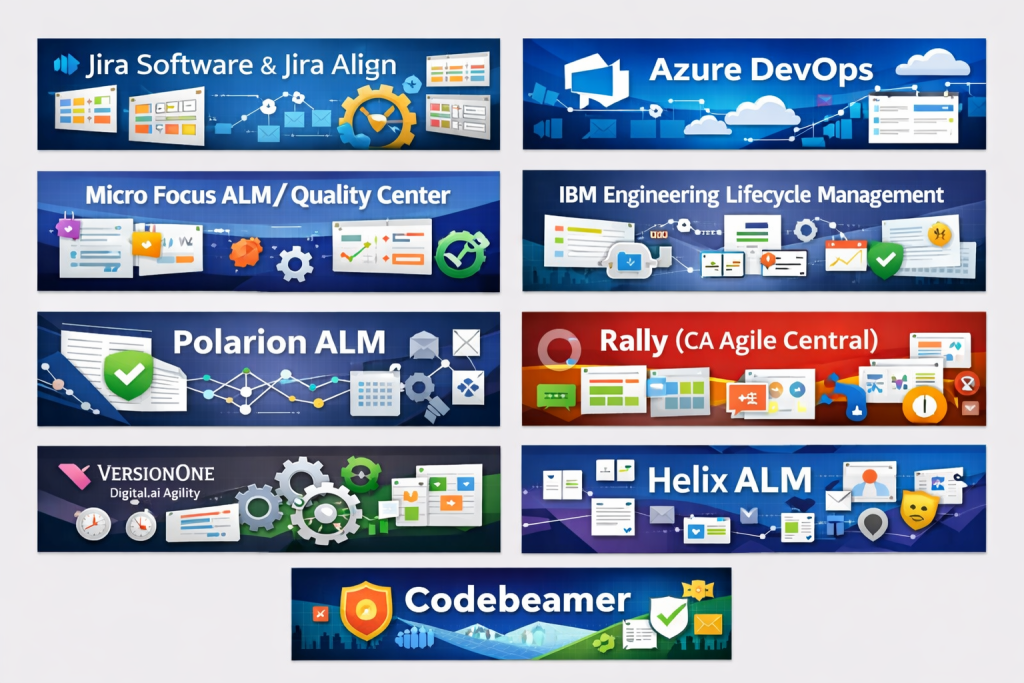
1 — Jira Software + Jira Align
Short description:
A widely adopted ALM ecosystem combining agile project management with enterprise-level portfolio planning. Designed for agile, DevOps, and large-scale enterprises.
Key features:
- Agile boards (Scrum and Kanban)
- Backlog and sprint management
- Advanced reporting and dashboards
- Integration with CI/CD pipelines
- Enterprise portfolio planning via Jira Align
- Extensive marketplace integrations
Pros:
- Highly flexible and customizable
- Massive ecosystem and community
Cons:
- Can become complex at scale
- Configuration requires expertise
Security & compliance:
SSO, role-based access, audit logs, GDPR support, SOC 2 (varies by deployment)
Support & community:
Extensive documentation, large global community, strong enterprise support options
2 — Azure DevOps
Short description:
An end-to-end ALM platform by Microsoft covering planning, development, testing, and deployment, tightly integrated with the Microsoft ecosystem.
Key features:
- Boards for work tracking
- Repos for source control
- Pipelines for CI/CD
- Test Plans for QA management
- Artifacts for package management
- Deep integration with cloud services
Pros:
- Strong CI/CD and DevOps capabilities
- Excellent integration with enterprise tools
Cons:
- Best experience within Microsoft stack
- UI can feel overwhelming initially
Security & compliance:
Enterprise-grade security, encryption, SSO, ISO and SOC compliance
Support & community:
Strong documentation, enterprise support, active developer community
3 — IBM Engineering Lifecycle Management
Short description:
A robust ALM suite designed for complex, regulated, and large-scale engineering projects.
Key features:
- Requirements management
- Change and configuration management
- Test and quality management
- Traceability across lifecycle
- Advanced reporting
- Compliance support
Pros:
- Excellent for regulated industries
- Strong traceability and governance
Cons:
- High cost
- Steep learning curve
Security & compliance:
Strong compliance support (ISO, FDA, aerospace standards)
Support & community:
Enterprise-grade support, extensive documentation, smaller user community
4 — Micro Focus ALM / Quality Center
Short description:
A traditional ALM platform focused on test management, quality assurance, and enterprise governance.
Key features:
- Test planning and execution
- Defect management
- Requirements traceability
- Release management
- Reporting and analytics
- Integration with DevOps tools
Pros:
- Mature and stable platform
- Strong test management features
Cons:
- UI feels dated
- Slower innovation pace
Security & compliance:
Role-based access, audit logs, enterprise security controls
Support & community:
Enterprise support available, moderate community activity
5 — Siemens Polarion ALM
Short description:
An enterprise ALM solution focused on traceability, compliance, and collaborative development.
Key features:
- Requirements and change management
- Test and quality management
- Real-time collaboration
- End-to-end traceability
- Custom workflows
- Compliance reporting
Pros:
- Excellent traceability
- Strong compliance reporting
Cons:
- Premium pricing
- Requires structured processes
Security & compliance:
Supports ISO, automotive, and medical compliance standards
Support & community:
Strong enterprise support, detailed documentation
6 — Broadcom Rally (CA Agile Central)
Short description:
An agile-focused ALM platform built for scaling agile practices across large organizations.
Key features:
- Agile planning and tracking
- Portfolio management
- Dependency tracking
- Metrics and analytics
- Program-level visibility
- Customizable dashboards
Pros:
- Strong agile scaling support
- Good enterprise reporting
Cons:
- Less suited for non-agile teams
- Configuration complexity
Security & compliance:
Enterprise security standards, role-based access
Support & community:
Professional support available, moderate community
7 — VersionOne (Digital.ai Agility)
Short description:
An ALM platform designed to support enterprise agile and DevOps transformations.
Key features:
- Agile and scaled agile planning
- Portfolio and program management
- Metrics and value stream tracking
- Integration with DevOps tools
- Backlog and release planning
Pros:
- Strong agile governance
- Good visibility for leadership
Cons:
- Limited test management
- Learning curve for new users
Security & compliance:
Enterprise-grade security, compliance varies by deployment
Support & community:
Enterprise support, good training resources
8 — PTC Windchill RV&S
Short description:
A lifecycle management platform focused on complex product and software development environments.
Key features:
- Requirements and change management
- Workflow automation
- Traceability across artifacts
- Reporting and analytics
- Integration with product lifecycle tools
Pros:
- Strong for complex engineering projects
- High configurability
Cons:
- Expensive
- Requires expert administration
Security & compliance:
Supports industry compliance standards, strong access controls
Support & community:
Enterprise support, smaller but specialized community
9 — Helix ALM
Short description:
A modular ALM suite suitable for organizations needing flexibility and traceability.
Key features:
- Requirements management
- Test case management
- Issue and defect tracking
- Traceability matrices
- Custom workflows
Pros:
- Modular and flexible
- Good traceability features
Cons:
- Limited ecosystem
- UI can feel basic
Security & compliance:
Role-based security, audit support
Support & community:
Responsive support, smaller community
10 — Codebeamer
Short description:
A modern ALM platform designed for regulated and safety-critical industries.
Key features:
- Requirements and risk management
- Test and quality assurance
- End-to-end traceability
- Compliance reporting
- Collaborative workflows
Pros:
- Excellent for safety-critical projects
- Strong compliance support
Cons:
- High learning curve
- Premium pricing
Security & compliance:
Supports ISO, IEC, automotive, and medical standards
Support & community:
Enterprise support, focused professional community
Comparison Table
| Tool Name | Best For | Platform(s) Supported | Standout Feature | Rating |
|---|---|---|---|---|
| Jira Software + Align | Agile & enterprise teams | Web, Cloud | Massive ecosystem | N/A |
| Azure DevOps | DevOps-centric organizations | Web, Cloud | Integrated CI/CD | N/A |
| IBM ELM | Regulated enterprises | Web, On-prem | Deep traceability | N/A |
| Micro Focus ALM | QA-heavy enterprises | Web, On-prem | Test management | N/A |
| Polarion ALM | Compliance-driven teams | Web | Real-time traceability | N/A |
| Rally | Scaled agile | Web | Agile metrics | N/A |
| VersionOne | Enterprise agile | Web | Portfolio planning | N/A |
| Windchill RV&S | Complex engineering | Web, On-prem | Workflow control | N/A |
| Helix ALM | Flexible ALM needs | Web | Modular design | N/A |
| Codebeamer | Safety-critical projects | Web | Compliance depth | N/A |
Evaluation & Scoring of Application Lifecycle Management (ALM) Suites
| Criteria | Weight | Avg Score |
|---|---|---|
| Core features | 25% | High |
| Ease of use | 15% | Medium |
| Integrations & ecosystem | 15% | High |
| Security & compliance | 10% | High |
| Performance & reliability | 10% | High |
| Support & community | 10% | Medium |
| Price / value | 15% | Medium |
Which Application Lifecycle Management (ALM) Suites Tool Is Right for You?
- Solo users / small teams: Lightweight tools may be better than full ALM suites
- SMBs: Look for modular ALM solutions with reasonable pricing
- Mid-market: Balanced tools with integrations and governance
- Enterprises: Full ALM suites with compliance, scalability, and portfolio management
Budget-conscious teams should prioritize modular or cloud-based offerings, while premium buyers can invest in compliance-heavy enterprise suites.
Choose feature depth if governance matters more, or ease of use if adoption speed is critical.
Frequently Asked Questions (FAQs)
- What is an ALM suite?
An ALM suite manages the full software lifecycle from planning to retirement. - Is ALM only for large enterprises?
Mostly yes, but some modular tools suit mid-sized teams. - How is ALM different from DevOps tools?
ALM covers governance and traceability, while DevOps focuses on delivery speed. - Do ALM tools support agile?
Most modern ALM suites support agile and hybrid models. - Are ALM suites expensive?
Enterprise ALM tools can be costly, especially with compliance features. - Can ALM tools integrate with CI/CD?
Yes, most integrate with popular CI/CD pipelines. - Do ALM tools support compliance audits?
Many offer built-in traceability and audit reporting. - How long does ALM implementation take?
It can range from weeks to months depending on complexity. - Is training required?
Usually yes, especially for enterprise-grade ALM tools. - Can ALM replace multiple tools?
Yes, ALM suites often replace separate planning, QA, and tracking tools.
Conclusion
Application Lifecycle Management (ALM) Suites play a critical role in delivering high-quality, compliant, and scalable software. They bring structure, visibility, and governance to increasingly complex development environments.
There is no single best ALM tool for everyone. The right choice depends on your organization’s size, industry, budget, compliance needs, and development maturity. By focusing on core features, integrations, usability, and long-term scalability, teams can select an ALM suite that truly supports their software strategy and business goals.

Find Trusted Cardiac Hospitals
Compare heart hospitals by city and services — all in one place.
Explore Hospitals
This article provides a very clear, practical overview of Application Lifecycle Management (ALM) suites by explaining not just what they are, but when they actually make sense compared to lighter-weight tools. The emphasis on end-to-end traceability—from requirements through tests and releases—plus governance and compliance is especially relevant for regulated or safety-critical environments where audits and standards (ISO, medical, automotive, aerospace) are non‑negotiable. The tool-by-tool breakdown (Jira + Align, Azure DevOps, IBM ELM, Polarion, Codebeamer, etc.) with pros, cons, security posture, and “best for” guidance helps readers quickly map platforms to their team size, tech stack, and industry rather than chasing a one-size-fits-all recommendation. It is also useful that the article calls out that full ALM suites may be overkill for solo developers or very small startups, which sets realistic expectations around cost, complexity, and the need for training and structured processes.