
Introduction
Application Security Testing (SAST/DAST) platforms are specialized tools designed to identify security vulnerabilities in software applications before attackers can exploit them. Static Application Security Testing (SAST) analyzes source code, bytecode, or binaries without executing the application, while Dynamic Application Security Testing (DAST) tests running applications by simulating real-world attacks. Modern platforms increasingly combine SAST, DAST, and related capabilities into unified solutions that integrate seamlessly with development and DevOps workflows.
These platforms are critical because application-layer attacks remain one of the most common causes of data breaches. Vulnerabilities such as SQL injection, cross-site scripting (XSS), insecure authentication, and misconfigurations often slip into production due to fast release cycles and complex architectures. SAST/DAST platforms help teams detect these issues early, reduce remediation costs, and meet regulatory requirements.
Common real-world use cases include securing web and mobile applications, protecting APIs, validating third-party code, enabling DevSecOps practices, and supporting compliance audits. When evaluating tools in this category, buyers should consider detection accuracy, false positives, CI/CD integration, language and framework support, scalability, reporting depth, and total cost of ownership.
Best for:
Security engineers, DevSecOps teams, software developers, compliance teams, startups building cloud-native apps, SMBs modernizing security practices, and enterprises managing large application portfolios in regulated industries.
Not ideal for:
Teams with no in-house development, extremely small projects where manual reviews suffice, or environments requiring only network-level security testing rather than application-layer protection.
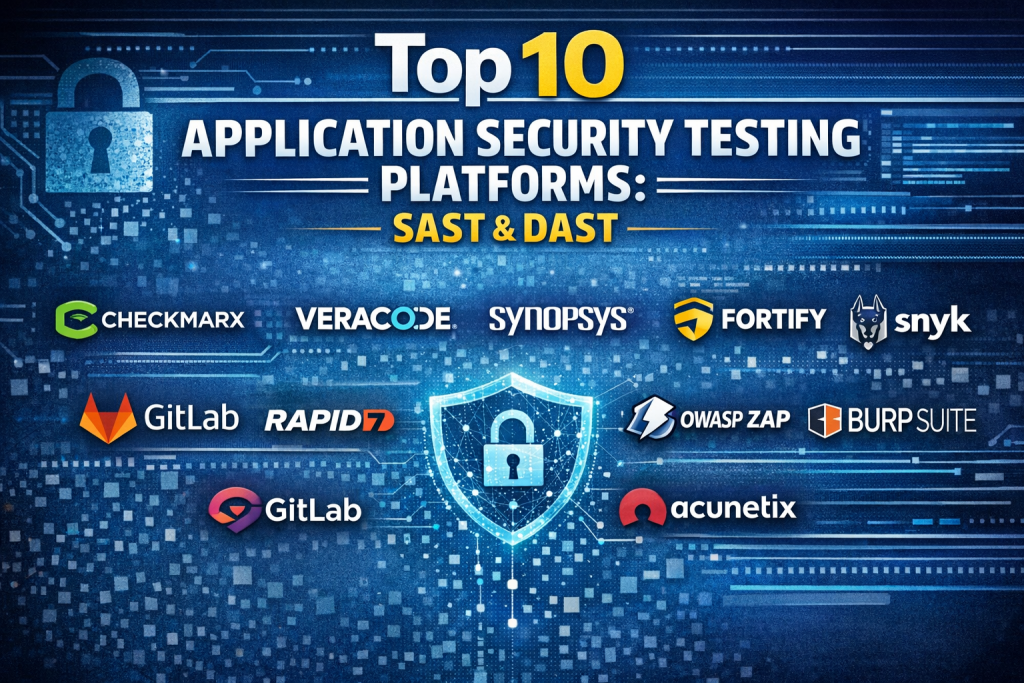
Top 10 Application Security Testing (SAST/DAST) Platforms Tools
1 — Checkmarx
Short description:
A comprehensive application security platform focused on deep static analysis and developer-friendly remediation workflows, widely adopted in large enterprises.
Key features
- Advanced SAST with broad language support
- Integrated DAST and interactive testing options
- IDE and CI/CD pipeline integrations
- Risk-based vulnerability prioritization
- Customizable security policies
- Detailed remediation guidance
- Enterprise-scale reporting
Pros
- High detection accuracy for complex codebases
- Strong enterprise governance features
Cons
- Initial setup can be complex
- Premium pricing for full feature set
Security & compliance:
SSO, role-based access, encryption, audit logs, SOC 2, ISO standards support.
Support & community:
Extensive documentation, enterprise onboarding, dedicated support teams.
2 — Veracode
Short description:
A cloud-native application security testing platform offering SAST, DAST, and software composition analysis in a unified service.
Key features
- Cloud-based SAST and DAST scanning
- Software composition analysis (SCA)
- Policy-driven risk management
- Developer training modules
- CI/CD and IDE integrations
- Scalable SaaS architecture
Pros
- Minimal infrastructure management
- Strong compliance reporting
Cons
- Limited customization compared to on-prem tools
- Can be costly at scale
Security & compliance:
SOC 2, ISO 27001, GDPR support, encryption, audit logs.
Support & community:
Well-documented platform, enterprise support, active knowledge base.
3 — Synopsys (Coverity)
Short description:
A powerful static and dynamic testing suite designed for enterprises needing deep code analysis and compliance assurance.
Key features
- Industry-leading SAST engine
- DAST and interactive testing support
- Open source risk analysis
- DevOps pipeline integration
- Advanced analytics and dashboards
Pros
- Excellent for complex, safety-critical code
- Strong compliance alignment
Cons
- Steep learning curve
- Resource-intensive scans
Security & compliance:
ISO, SOC 2, GDPR support, audit trails.
Support & community:
Enterprise-grade support, detailed technical documentation.
4 — Fortinet (Fortify)
Short description:
A mature application security testing platform known for robust static analysis and enterprise governance.
Key features
- High-accuracy SAST
- DAST and runtime testing options
- Centralized vulnerability management
- IDE and CI/CD integrations
- Policy enforcement and reporting
Pros
- Proven enterprise reliability
- Strong governance capabilities
Cons
- UI feels dated to some users
- Licensing complexity
Security & compliance:
SSO, encryption, audit logs, compliance-ready reports.
Support & community:
Enterprise support with structured onboarding.
5— Snyk
Short description:
A developer-first security platform combining SAST, DAST-like testing, and open source dependency scanning.
Key features
- Developer-centric SAST
- Open source and container scanning
- IDE and Git integration
- Automated fix suggestions
- Continuous monitoring
Pros
- Excellent developer adoption
- Fast onboarding
Cons
- Less deep DAST capabilities
- Advanced features require higher tiers
Security & compliance:
SOC 2, GDPR alignment, secure authentication.
Support & community:
Strong community, good documentation, responsive support.
6 — GitLab (GitLab Security)
Short description:
An integrated DevSecOps platform with built-in SAST and DAST for teams using GitLab CI/CD.
Key features
- Native SAST and DAST pipelines
- Dependency and container scanning
- Unified DevOps workflows
- Merge request security reports
- Policy enforcement
Pros
- Seamless CI/CD integration
- Single-platform simplicity
Cons
- Best suited for GitLab users only
- Limited standalone flexibility
Security & compliance:
SSO, audit logs, compliance frameworks supported.
Support & community:
Large open-source community, enterprise support plans.
7 — Rapid7 (InsightAppSec)
Short description:
A dynamic-focused application security testing solution emphasizing real-world attack simulation.
Key features
- Advanced DAST scanning
- API security testing
- Attack replay and validation
- Cloud-native architecture
- Centralized risk dashboard
Pros
- Strong real-world attack coverage
- Easy deployment
Cons
- Limited static analysis depth
- Focused more on runtime testing
Security & compliance:
SOC 2, encryption, audit logging.
Support & community:
Clear documentation, responsive enterprise support.
8 — OWASP ZAP
Short description:
An open-source DAST tool widely used for baseline web application security testing.
Key features
- Automated and manual DAST scanning
- Extensible plugin ecosystem
- API testing support
- Community-driven updates
Pros
- Free and open source
- Strong community backing
Cons
- Requires manual tuning
- Limited enterprise reporting
Security & compliance:
Varies / N/A.
Support & community:
Large global community, extensive documentation.
9 — Acunetix
Short description:
A dynamic application security scanner focused on web applications and APIs.
Key features
- High-speed DAST scanning
- API and SPA testing
- Automated crawling
- Vulnerability proof-of-concept
Pros
- Easy to use
- Strong DAST accuracy
Cons
- Limited SAST features
- Less suited for large enterprises
Security & compliance:
SSO, encryption, compliance reporting available.
Support & community:
Good documentation, commercial support.
10 — Burp Suite
Short description:
A popular security testing toolkit combining automated scanning with powerful manual testing tools.
Key features
- DAST scanning engine
- Manual testing proxy tools
- API testing capabilities
- Extensible plugins
- Advanced reporting
Pros
- Highly flexible
- Industry-standard for testers
Cons
- Manual effort required
- Not fully automated for DevSecOps
Security & compliance:
Varies by edition, basic audit logging.
Support & community:
Strong security community, extensive learning resources.
Comparison Table
| Tool Name | Best For | Platform(s) Supported | Standout Feature | Rating |
|---|---|---|---|---|
| Checkmarx | Enterprise SAST | Web, Cloud, CI/CD | Deep static analysis | N/A |
| Veracode | Cloud-first teams | SaaS | Unified security service | N/A |
| Synopsys Coverity | Safety-critical apps | On-prem / Cloud | High-precision SAST | N/A |
| Fortify | Governance-heavy orgs | Hybrid | Policy enforcement | N/A |
| Snyk | Developer-first teams | Cloud | Auto-fix suggestions | N/A |
| GitLab Security | DevSecOps pipelines | Cloud / Self-hosted | Native CI/CD security | N/A |
| Rapid7 InsightAppSec | Runtime testing | Cloud | Attack simulation | N/A |
| OWASP ZAP | Baseline DAST | Cross-platform | Open source | N/A |
| Acunetix | Web & API apps | Cloud / On-prem | Fast DAST scans | N/A |
| Burp Suite | Manual testing | Desktop | Testing flexibility | N/A |
Evaluation & Scoring of Application Security Testing (SAST/DAST) Platforms
| Criteria | Weight | Notes |
|---|---|---|
| Core features | 25% | Depth of SAST/DAST, accuracy |
| Ease of use | 15% | Developer adoption, UI |
| Integrations & ecosystem | 15% | CI/CD, IDEs, cloud |
| Security & compliance | 10% | Certifications, controls |
| Performance & reliability | 10% | Scan speed, scalability |
| Support & community | 10% | Documentation, support |
| Price / value | 15% | ROI vs features |
Which Application Security Testing (SAST/DAST) Platforms Tool Is Right for You?
- Solo users & small teams: Open-source or lightweight tools with low overhead.
- SMBs: Cloud-native platforms balancing automation and cost.
- Mid-market: Tools with strong CI/CD integration and reporting.
- Enterprise: Comprehensive platforms with governance, compliance, and scalability.
Budget-conscious teams may prioritize ease of use and SaaS delivery, while premium buyers should focus on detection depth and compliance alignment. Integration needs, regulatory requirements, and application complexity should guide final selection.
Frequently Asked Questions (FAQs)
- What is the difference between SAST and DAST?
SAST analyzes code without execution, while DAST tests running applications. - Do I need both SAST and DAST?
Yes, combining both provides broader coverage across development and runtime. - Are these tools suitable for CI/CD?
Most modern platforms integrate directly into CI/CD pipelines. - How accurate are automated scans?
Accuracy varies; tuning and validation reduce false positives. - Do open-source tools replace commercial ones?
They help with basics but lack enterprise governance. - Are these platforms cloud-ready?
Most support cloud-native and containerized apps. - How long does implementation take?
From hours for SaaS tools to weeks for enterprise deployments. - Do they support API testing?
Most modern DAST tools include API security testing. - What about compliance reporting?
Enterprise tools provide audit-ready reports. - Is developer training included?
Some platforms include built-in secure coding training.
Conclusion
Application Security Testing (SAST/DAST) platforms are essential for protecting modern software from increasingly sophisticated threats. The right solution improves code quality, reduces risk, and supports compliance without slowing development. There is no single “best” platform for everyone—the ideal choice depends on team size, budget, integration needs, and security maturity. By aligning tool capabilities with real business requirements, organizations can build secure applications with confidence.

Find Trusted Cardiac Hospitals
Compare heart hospitals by city and services — all in one place.
Explore Hospitals
