
Introduction
Asset Performance Management (APM – Industrial) refers to a category of industrial software that helps organizations monitor, analyze, and optimize the performance, reliability, and lifecycle of physical assets such as machines, equipment, plants, and infrastructure. These tools combine asset data, condition monitoring, predictive analytics, and maintenance strategies to reduce unplanned downtime and extend asset life.
In today’s industrial environments—manufacturing, energy, oil & gas, chemicals, utilities, and heavy engineering—equipment failures are costly. Even a few hours of unexpected downtime can lead to production losses, safety risks, regulatory penalties, and reputational damage. APM platforms address this by moving organizations from reactive and preventive maintenance toward predictive and prescriptive maintenance.
Key real-world use cases include:
- Predicting equipment failures before they occur
- Optimizing maintenance schedules based on actual asset condition
- Improving asset reliability and availability
- Reducing maintenance costs and spare parts inventory
- Supporting regulatory compliance and audits
When choosing an APM solution, buyers should evaluate:
- Condition monitoring and predictive analytics depth
- Integration with existing systems (ERP, EAM, CMMS, historians)
- Scalability across sites and asset classes
- Ease of use for engineers and operators
- Security, compliance, and enterprise readiness
- Total cost of ownership and long-term value
Best for:
APM tools are ideal for maintenance managers, reliability engineers, plant managers, operations leaders, and digital transformation teams in asset-intensive industries. Medium to large enterprises with complex equipment fleets gain the highest ROI.
Not ideal for:
Small businesses with limited physical assets, low equipment criticality, or purely manual operations may find full-scale APM platforms excessive. In such cases, simpler CMMS or maintenance tracking tools may be more suitable.
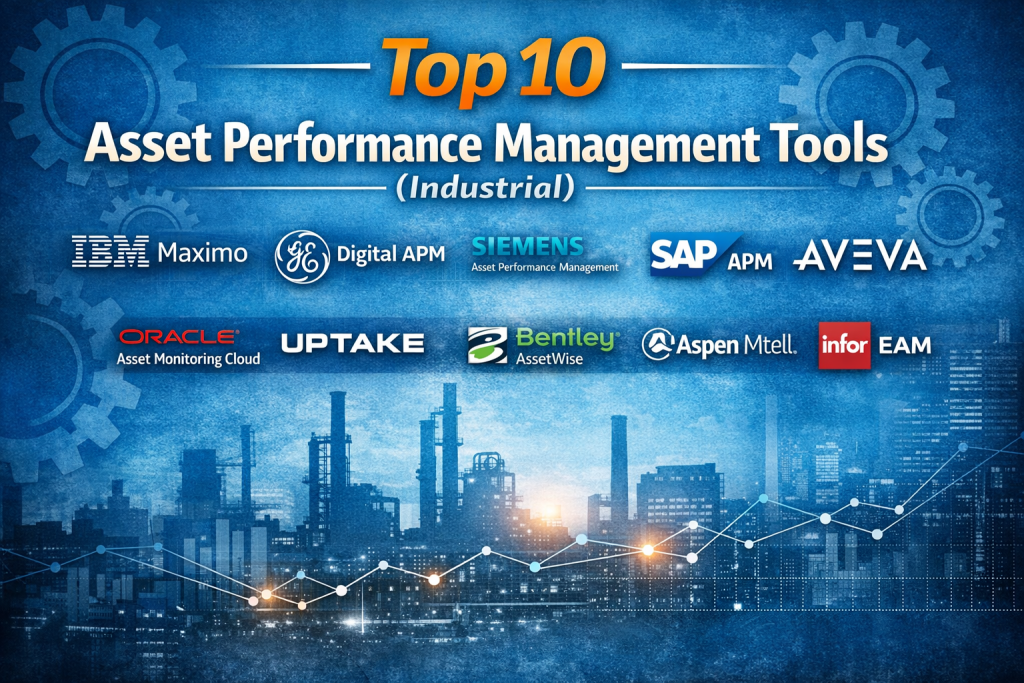
Top 10 Asset Performance Management (APM – Industrial) Tools
1 — IBM Maximo
Short description:
A market-leading enterprise APM and EAM platform designed for large, asset-intensive organizations requiring deep analytics, scalability, and governance.
Key features:
- Advanced predictive maintenance and AI-driven insights
- Asset health monitoring and lifecycle management
- Integration with IoT sensors and historians
- Work order optimization and maintenance planning
- Risk-based inspection and failure analysis
- Strong integration with ERP and enterprise systems
Pros:
- Extremely robust and enterprise-proven
- Strong AI and analytics capabilities
Cons:
- Complex implementation and configuration
- Higher cost and resource requirements
Security & compliance:
Enterprise-grade security, role-based access, encryption, audit logs, GDPR support, ISO-aligned controls.
Support & community:
Extensive documentation, global enterprise support, strong partner ecosystem.
2 — GE Digital APM
Short description:
An advanced industrial APM solution focused on predictive analytics, reliability engineering, and operational risk management.
Key features:
- Predictive failure analytics and asset health scoring
- Reliability-centered maintenance (RCM) workflows
- Digital twin modeling for critical assets
- Risk-based inspection planning
- Integration with historians and control systems
Pros:
- Strong analytics depth for complex assets
- Well-suited for heavy industry and utilities
Cons:
- Steep learning curve for new users
- Best value realized at scale
Security & compliance:
Enterprise security controls, encryption, audit trails, regulatory-ready features.
Support & community:
Professional services-driven onboarding, enterprise customer support.
3 — Siemens Asset Performance Management
Short description:
A comprehensive APM suite tightly integrated with Siemens’ industrial and automation ecosystem.
Key features:
- Condition monitoring and diagnostics
- Predictive maintenance with AI models
- Digital twin-based asset insights
- Integration with Siemens automation systems
- Maintenance strategy optimization
Pros:
- Excellent fit for Siemens-centric environments
- Strong engineering-grade analytics
Cons:
- Less flexible outside Siemens ecosystem
- Implementation complexity
Security & compliance:
Industrial-grade security, role-based access, compliance-ready.
Support & community:
Strong enterprise support and engineering documentation.
4 — SAP Asset Performance Management
Short description:
An APM solution built on SAP’s enterprise platform, ideal for organizations already using SAP ERP and EAM.
Key features:
- Asset health indicators and predictive insights
- Integration with SAP S/4HANA and EAM
- Maintenance planning and execution alignment
- Real-time analytics and dashboards
- Risk and failure analysis
Pros:
- Seamless integration with SAP landscape
- Strong data governance and reporting
Cons:
- Best suited for SAP-centric organizations
- Customization may require SAP expertise
Security & compliance:
Enterprise-grade SAP security, compliance-ready, audit logging.
Support & community:
Large global support ecosystem, extensive documentation.
5 — AVEVA APM
Short description:
A flexible APM platform focused on asset reliability, condition monitoring, and industrial analytics.
Key features:
- Predictive analytics and asset health modeling
- Integration with historians and SCADA systems
- Failure mode and effects analysis (FMEA)
- Visualization and reporting tools
- Multi-site asset monitoring
Pros:
- Strong visualization and analytics
- Flexible deployment options
Cons:
- Requires careful configuration
- Analytics maturity varies by use case
Security & compliance:
Standard enterprise security, encryption, access controls.
Support & community:
Good documentation, strong industrial user base.
6 — Oracle Asset Monitoring Cloud
Short description:
A cloud-based APM offering leveraging Oracle’s IoT and analytics capabilities.
Key features:
- Real-time asset condition monitoring
- Predictive maintenance alerts
- Integration with Oracle ERP and SCM
- Cloud-native scalability
- Automated anomaly detection
Pros:
- Strong cloud and ERP integration
- Scalable for distributed assets
Cons:
- Limited customization outside Oracle ecosystem
- Best suited for Oracle customers
Security & compliance:
Cloud security controls, encryption, compliance-ready.
Support & community:
Enterprise cloud support and documentation.
7 — Uptake APM
Short description:
An AI-first APM platform focused on predictive insights and operational intelligence.
Key features:
- Machine learning-based failure prediction
- Asset health and performance dashboards
- Prescriptive maintenance recommendations
- Integration with industrial data sources
- Industry-specific models
Pros:
- Strong AI and data science focus
- Actionable insights for operations teams
Cons:
- Requires quality data inputs
- Smaller ecosystem than legacy vendors
Security & compliance:
Enterprise-grade security, encryption, access controls.
Support & community:
Dedicated onboarding, responsive enterprise support.
8 — Bentley AssetWise
Short description:
An APM solution optimized for infrastructure-heavy industries such as transportation, utilities, and construction.
Key features:
- Asset lifecycle and reliability management
- Digital twin integration for infrastructure assets
- Condition assessment and risk analysis
- Engineering data management
- Long-term asset planning
Pros:
- Excellent for infrastructure-scale assets
- Strong engineering data handling
Cons:
- Less focused on discrete manufacturing
- Complex setup for smaller teams
Security & compliance:
Enterprise security and compliance features.
Support & community:
Strong engineering community, enterprise support.
9 — Aspen Mtell
Short description:
A predictive maintenance-focused APM tool known for advanced machine learning models.
Key features:
- Failure prediction using advanced analytics
- Asset health monitoring
- Root cause analysis
- Integration with industrial data systems
- Minimal data science effort required
Pros:
- High prediction accuracy
- Faster time-to-value
Cons:
- Narrower scope compared to full APM suites
- Focused mainly on prediction
Security & compliance:
Standard enterprise security features.
Support & community:
Specialized support, strong analytics expertise.
10 — Infor EAM APM
Short description:
An APM solution tightly integrated with Infor’s EAM platform for maintenance-driven organizations.
Key features:
- Asset condition and performance monitoring
- Predictive maintenance integration
- Work order optimization
- Mobile maintenance support
- Analytics and reporting
Pros:
- Strong maintenance execution alignment
- Good usability for technicians
Cons:
- Less advanced AI than top-tier platforms
- Best value when used with Infor EAM
Security & compliance:
Enterprise security controls, audit logging.
Support & community:
Good documentation, enterprise customer support.
Comparison Table
| Tool Name | Best For | Platform(s) Supported | Standout Feature | Rating |
|---|---|---|---|---|
| IBM Maximo | Large enterprises | Cloud / On-prem | AI-driven asset insights | N/A |
| GE Digital APM | Heavy industry | Cloud / Hybrid | Predictive analytics depth | N/A |
| Siemens APM | Siemens users | Hybrid | Digital twin integration | N/A |
| SAP APM | SAP environments | Cloud | ERP-native integration | N/A |
| AVEVA APM | Process industries | Hybrid | Visualization & analytics | N/A |
| Oracle Asset Monitoring | Oracle users | Cloud | IoT-native monitoring | N/A |
| Uptake APM | Data-driven teams | Cloud | AI-first predictions | N/A |
| Bentley AssetWise | Infrastructure assets | Hybrid | Infrastructure lifecycle focus | N/A |
| Aspen Mtell | Predictive use cases | Hybrid | High-accuracy prediction | N/A |
| Infor EAM APM | Maintenance teams | Cloud / Hybrid | Maintenance execution | N/A |
Evaluation & Scoring of Asset Performance Management (APM – Industrial)
| Evaluation Criteria | Weight | Score (Avg) |
|---|---|---|
| Core features | 25% | High |
| Ease of use | 15% | Medium |
| Integrations & ecosystem | 15% | High |
| Security & compliance | 10% | High |
| Performance & reliability | 10% | High |
| Support & community | 10% | Medium |
| Price / value | 15% | Medium |
Which Asset Performance Management (APM – Industrial) Tool Is Right for You?
- Solo users / SMBs: Consider lighter APM or CMMS solutions with basic predictive features.
- Mid-market: Look for cloud-based APM with strong integrations and reasonable implementation effort.
- Enterprise: Full-suite platforms like IBM, SAP, or GE provide scalability and governance.
Budget-conscious: Focus on modular, cloud-native platforms.
Premium solutions: Choose enterprise-grade platforms with AI, digital twins, and deep analytics.
Feature depth vs ease of use: Advanced platforms offer power but require training.
Integration needs: ERP and historian integration is critical for large organizations.
Security & compliance: Regulated industries should prioritize auditability and access control.
Frequently Asked Questions (FAQs)
- What is industrial APM?
It is software that optimizes asset reliability, performance, and maintenance using analytics. - How is APM different from CMMS?
APM focuses on prediction and optimization, while CMMS focuses on work orders and scheduling. - Does APM require IoT sensors?
Not always, but sensors significantly improve predictive accuracy. - How long does implementation take?
From weeks for cloud tools to months for enterprise deployments. - Is APM suitable for small plants?
Yes, but lighter solutions may offer better ROI. - What industries benefit most?
Manufacturing, energy, utilities, oil & gas, chemicals, and infrastructure. - Does APM reduce maintenance costs?
Yes, by preventing failures and optimizing maintenance timing. - Are APM tools cloud-based?
Most modern platforms support cloud, hybrid, or on-prem deployments. - How accurate are predictions?
Accuracy depends on data quality, asset criticality, and model maturity. - What is the biggest mistake buyers make?
Underestimating data readiness and change management.
Conclusion
Asset Performance Management (APM – Industrial) platforms play a critical role in reducing downtime, improving reliability, and extending asset life. The right solution depends on asset complexity, data maturity, integration needs, and organizational scale.
Rather than searching for a single “best” tool, organizations should focus on alignment with business goals, ease of adoption, and long-term value. When chosen carefully, APM becomes a strategic enabler for operational excellence and industrial resilience.

Find Trusted Cardiac Hospitals
Compare heart hospitals by city and services — all in one place.
Explore Hospitals
Nice article! I like how you explained the pros and cons of each APM tool — super helpful for comparing and choosing the right one. 😊