
Introduction
Blockchain platforms are foundational technologies that enable organizations and developers to build decentralized applications (dApps), smart contracts, and distributed systems where trust is established through code, cryptography, and consensus rather than intermediaries. Unlike traditional databases controlled by a single authority, blockchain platforms maintain shared, tamper-resistant ledgers across multiple participants.
The importance of blockchain platforms has grown rapidly as industries seek greater transparency, security, automation, and resilience. From financial services and supply chains to healthcare, gaming, and government systems, blockchain platforms are redefining how data, value, and digital ownership are managed.
Real-world use cases include:
- Digital payments and cross-border settlements
- Smart contracts and automated workflows
- Supply chain tracking and provenance
- Digital identity and access management
- Tokenization of assets and NFTs
When choosing a blockchain platform, users should evaluate scalability, security, ecosystem maturity, developer experience, governance model, and cost structure. The right platform balances technical capability with long-term sustainability.
Best for:
Blockchain platforms are ideal for developers, startups, enterprises, financial institutions, Web3 companies, and governments looking to build secure, transparent, and decentralized solutions at scale.
Not ideal for:
They may not be suitable for very small projects with simple data needs, teams lacking technical expertise, or use cases where a traditional centralized database is faster, cheaper, and sufficient.
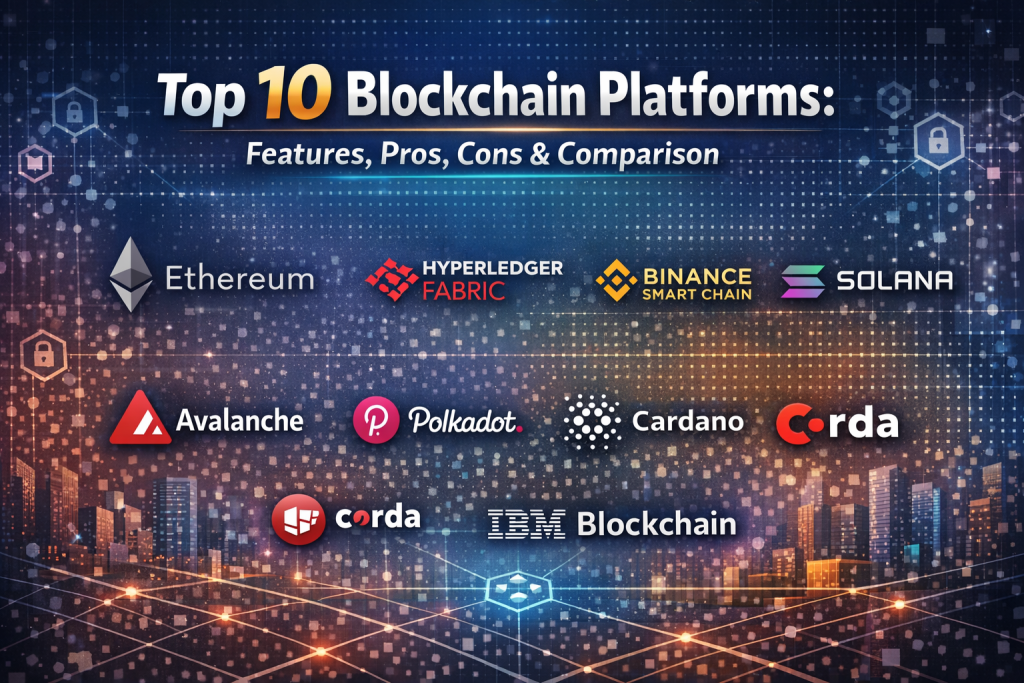
Top 10 Blockchain Platforms Tools
1 — Ethereum
Short description:
Ethereum is the most widely adopted smart-contract blockchain, powering thousands of decentralized applications across finance, gaming, and digital identity.
Key features
- Smart contracts using Solidity
- Massive dApp and DeFi ecosystem
- Proof-of-stake consensus
- Layer-2 scalability solutions
- NFT and token standards (ERC-20, ERC-721)
- Strong tooling and frameworks
Pros
- Largest developer community
- Battle-tested and highly trusted
Cons
- Gas fees can be unpredictable
- Base layer scalability limits
Security & compliance:
Strong cryptography, decentralized validation, public auditability; compliance depends on application design.
Support & community:
Extensive documentation, global developer community, enterprise support via partners.
2 — Hyperledger Fabric
Short description:
Hyperledger Fabric is a permissioned blockchain framework designed for enterprise use cases requiring privacy and control.
Key features
- Permissioned network architecture
- Modular consensus mechanisms
- Private channels for data confidentiality
- Smart contracts (chaincode)
- Enterprise-grade identity management
- High transaction throughput
Pros
- Excellent for regulated industries
- Strong data privacy controls
Cons
- Complex setup and maintenance
- Smaller public ecosystem
Security & compliance:
Enterprise-grade security, role-based access, audit logs; aligns well with GDPR and ISO needs.
Support & community:
Backed by major enterprises, strong documentation, professional support available.
3 — Binance Smart Chain
Short description:
Binance Smart Chain offers fast, low-cost smart contracts with Ethereum compatibility.
Key features
- EVM compatibility
- Low transaction fees
- High throughput
- Strong DeFi ecosystem
- Interoperability with Binance Chain
Pros
- Cost-effective deployment
- Fast transaction confirmation
Cons
- More centralized governance
- Heavy reliance on Binance ecosystem
Security & compliance:
Standard blockchain cryptography; compliance varies by application.
Support & community:
Active developer community, good documentation, strong ecosystem momentum.
4 — Solana
Short description:
Solana focuses on ultra-high performance and low latency for applications requiring speed.
Key features
- Proof-of-History consensus
- Extremely high throughput
- Low transaction costs
- NFT and gaming focus
- Single global state
Pros
- Very fast transactions
- Excellent for real-time apps
Cons
- Network stability concerns historically
- Higher hardware requirements
Security & compliance:
Strong cryptography; public chain compliance depends on usage.
Support & community:
Growing developer base, improving documentation, active ecosystem.
5 — Polygon
Short description:
Polygon provides scaling and interoperability solutions for Ethereum.
Key features
- Layer-2 scaling
- Ethereum compatibility
- Low gas fees
- Multiple scaling technologies
- Strong enterprise adoption
Pros
- Reduces Ethereum congestion
- Easy migration for Ethereum apps
Cons
- Depends on Ethereum security model
- Complexity with multiple solutions
Security & compliance:
Inherits Ethereum security; compliance varies by implementation.
Support & community:
Strong developer community and documentation.
6 — Avalanche
Short description:
Avalanche is a highly scalable blockchain with customizable subnetworks.
Key features
- Subnets for custom blockchains
- High throughput and low latency
- EVM compatibility
- Energy-efficient consensus
- Flexible governance
Pros
- Enterprise-friendly architecture
- Fast finality
Cons
- Smaller ecosystem than Ethereum
- Learning curve for subnets
Security & compliance:
Strong cryptographic security; compliance depends on subnet design.
Support & community:
Active community, improving enterprise tooling.
7 — Polkadot
Short description:
Polkadot enables multiple blockchains to interoperate securely.
Key features
- Parachain architecture
- Shared security model
- Cross-chain messaging
- On-chain governance
- High scalability
Pros
- Excellent interoperability
- Strong governance model
Cons
- Complex architecture
- Parachain slot costs
Security & compliance:
Shared security with strong cryptography; compliance varies.
Support & community:
Strong research-driven community and documentation.
8 — Cardano
Short description:
Cardano emphasizes peer-reviewed research and formal verification.
Key features
- Proof-of-stake consensus
- Formal verification
- Layered architecture
- Sustainable design
- Academic approach
Pros
- Strong security focus
- Energy efficient
Cons
- Slower feature rollout
- Smaller dApp ecosystem
Security & compliance:
High assurance security model; compliance varies.
Support & community:
Dedicated community, extensive research documentation.
9 — Corda
Short description:
Corda is designed for regulated industries needing private transactions.
Key features
- Point-to-point transactions
- Strong identity framework
- Legal contract alignment
- High performance
- Enterprise integrations
Pros
- Ideal for finance and legal use
- Privacy-first design
Cons
- Not a traditional blockchain
- Limited public use cases
Security & compliance:
Strong compliance orientation, auditability, and identity controls.
Support & community:
Enterprise-focused support and professional services.
10 — IBM Blockchain
Short description:
IBM Blockchain provides enterprise blockchain solutions built on Hyperledger Fabric.
Key features
- Managed blockchain services
- Enterprise integrations
- Governance tools
- High security standards
- Industry-specific solutions
Pros
- Enterprise trust and reliability
- Strong support ecosystem
Cons
- Higher cost
- Less flexibility for small teams
Security & compliance:
Enterprise-grade security, SOC-aligned controls, audit readiness.
Support & community:
Professional enterprise support and onboarding.
Comparison Table
| Tool Name | Best For | Platform(s) Supported | Standout Feature | Rating |
|---|---|---|---|---|
| Ethereum | Public dApps & DeFi | Web, Cloud | Largest ecosystem | N/A |
| Hyperledger Fabric | Enterprises | On-prem, Cloud | Permissioned privacy | N/A |
| Binance Smart Chain | Cost-efficient DeFi | Cloud | Low fees | N/A |
| Solana | High-speed apps | Cloud | Ultra-fast throughput | N/A |
| Polygon | Ethereum scaling | Cloud | Layer-2 efficiency | N/A |
| Avalanche | Custom blockchains | Cloud | Subnets | N/A |
| Polkadot | Interoperability | Cloud | Cross-chain design | N/A |
| Cardano | Secure systems | Cloud | Formal verification | N/A |
| Corda | Regulated finance | On-prem, Cloud | Transaction privacy | N/A |
| IBM Blockchain | Large enterprises | Cloud | Managed services | N/A |
Evaluation & Scoring of Blockchain Platforms
| Criteria | Weight | Evaluation Summary |
|---|---|---|
| Core features | 25% | Smart contracts, consensus, scalability |
| Ease of use | 15% | Tooling, onboarding, documentation |
| Integrations & ecosystem | 15% | dApps, partners, SDKs |
| Security & compliance | 10% | Encryption, audits, governance |
| Performance & reliability | 10% | Throughput, uptime |
| Support & community | 10% | Docs, forums, enterprise support |
| Price / value | 15% | Fees, infrastructure cost |
Which Blockchain Platforms Tool Is Right for You?
- Solo developers: Ethereum, Polygon
- SMBs & startups: Binance Smart Chain, Solana
- Mid-market: Avalanche, Polkadot
- Enterprises: Hyperledger Fabric, Corda, IBM Blockchain
Budget-conscious teams may favor low-fee public chains, while regulated industries should prioritize permissioned platforms with compliance controls.
Frequently Asked Questions (FAQs)
- Are blockchain platforms secure?
Yes, but security depends on design, governance, and smart-contract quality. - Do I need crypto expertise to use blockchain?
Basic understanding helps, but tooling has improved significantly. - Are public blockchains suitable for enterprises?
Yes, for some use cases; others prefer permissioned networks. - What about scalability?
Layer-2 solutions and new consensus models address this. - Are blockchain platforms expensive?
Costs vary based on fees, infrastructure, and scale. - Can blockchain replace databases?
Not always; they serve different purposes. - Is compliance possible on blockchain?
Yes, especially with permissioned platforms. - What industries benefit most?
Finance, supply chain, healthcare, gaming, and government. - How long does implementation take?
From weeks to months, depending on complexity. - Is blockchain future-proof?
The technology continues to evolve rapidly with strong adoption.
Conclusion
Blockchain platforms have matured into powerful, flexible foundations for decentralized and enterprise applications. Each platform excels in different areas—performance, privacy, interoperability, or ecosystem strength.
The most important takeaway is that there is no single “best” blockchain platform for everyone. The right choice depends on your goals, scale, budget, regulatory environment, and technical capabilities. By carefully evaluating these factors, organizations can select a blockchain platform that delivers long-term value and innovation.

Find Trusted Cardiac Hospitals
Compare heart hospitals by city and services — all in one place.
Explore Hospitals
