
Introduction
Chemical Process Simulation Software plays a critical role in modern chemical engineering, process design, and industrial operations. These tools allow engineers and scientists to model, simulate, analyze, and optimize chemical processes digitally before they are built or modified in the real world. By creating virtual representations of reactors, distillation columns, heat exchangers, pipelines, and entire plants, organizations can predict performance, identify bottlenecks, and reduce costly trial-and-error experimentation.
The importance of process simulation has grown significantly with increasing pressure on industries to improve efficiency, reduce energy consumption, enhance safety, and meet strict environmental regulations. From early-stage conceptual design to plant revamps and debottlenecking, simulation tools support better decision-making throughout the process lifecycle.
Key real-world use cases include:
- Designing new chemical plants and process units
- Optimizing energy usage and heat integration
- Scaling up laboratory processes to commercial production
- Evaluating safety scenarios and process risks
- Reducing emissions and improving sustainability performance
When choosing Chemical Process Simulation Software, users should evaluate factors such as thermodynamic accuracy, ease of use, scalability, integration with plant data, security, industry standards support, and total cost of ownership.
Best for:
Chemical engineers, process designers, R&D teams, EPC firms, energy companies, pharmaceutical manufacturers, petrochemical producers, and large industrial enterprises managing complex processes.
Not ideal for:
Small teams with very simple calculations, educational use without advanced modeling needs, or organizations seeking lightweight spreadsheet-based analysis instead of rigorous simulation.
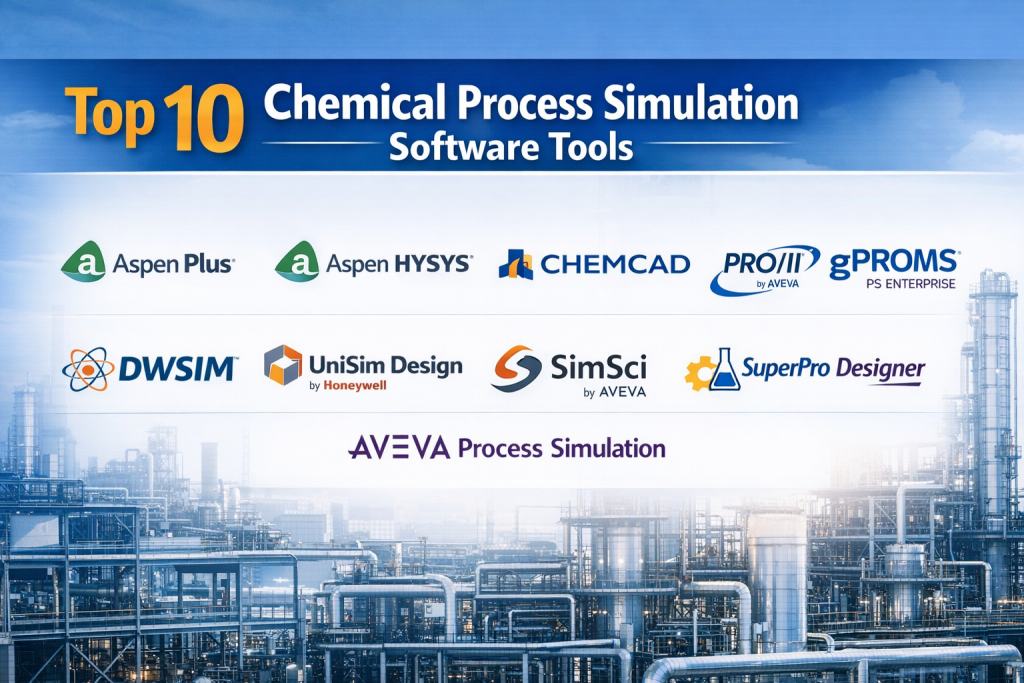
Top 10 Chemical Process Simulation Software Tools
1 — Aspen Plus
Short description:
Aspen Plus is one of the most widely used chemical process simulators, designed for rigorous steady-state modeling of complex chemical and petrochemical systems.
Key features
- Advanced thermodynamic and property methods
- Rigorous distillation, reactor, and separation models
- Energy and utility optimization tools
- Extensive component and reaction databases
- Integration with Aspen’s digital engineering ecosystem
- Custom model development support
Pros
- Industry-leading accuracy and reliability
- Trusted standard for large-scale industrial projects
Cons
- High licensing and maintenance costs
- Steep learning curve for beginners
Security & compliance: Enterprise-grade security, role-based access; compliance varies by deployment.
Support & community: Extensive documentation, strong global user community, premium enterprise support.
2 — Aspen HYSYS
Short description:
Aspen HYSYS specializes in dynamic simulation for oil & gas, refining, and gas processing operations.
Key features
- Steady-state and dynamic simulation
- Gas processing and refinery libraries
- Operator training simulation (OTS)
- Integrated safety and control analysis
- Real-time plant data connectivity
Pros
- Excellent for dynamic and transient analysis
- Strong oil & gas industry focus
Cons
- Less flexible for specialty chemicals
- Premium pricing
Security & compliance: Enterprise SSO and access control; varies by environment.
Support & community: Strong vendor support and professional training programs.
3 — CHEMCAD
Short description:
CHEMCAD is a modular and user-friendly simulator suitable for chemical, pharmaceutical, and specialty process modeling.
Key features
- Intuitive flowsheet-based interface
- Batch and steady-state simulation
- Cost estimation modules
- Customizable unit operations
- Strong thermodynamics library
Pros
- Easier to learn than many competitors
- Flexible licensing options
Cons
- Smaller ecosystem compared to Aspen
- Limited advanced digital twin features
Security & compliance: Standard security controls; compliance varies.
Support & community: Responsive customer support and good documentation.
4 — PRO/II
Short description:
PRO/II is a rigorous steady-state simulator widely used in refining, gas processing, and petrochemical applications.
Key features
- Advanced thermodynamics and equations of state
- Strong distillation and separation modeling
- Integrated heat exchanger design
- Energy optimization capabilities
- Interoperability with engineering tools
Pros
- High accuracy for hydrocarbon systems
- Mature and proven technology
Cons
- User interface feels dated
- Requires experienced users
Security & compliance: Enterprise-ready security; varies by deployment.
Support & community: Solid vendor support and technical resources.
5 — gPROMS
Short description:
gPROMS focuses on advanced process modeling, optimization, and digital twin development.
Key features
- First-principles dynamic modeling
- Optimization and parameter estimation
- Digital twin and predictive analytics
- Batch and continuous process support
- Advanced control integration
Pros
- Extremely powerful for R&D and optimization
- Ideal for digital transformation initiatives
Cons
- Complex setup and modeling effort
- Higher learning curve
Security & compliance: Enterprise security standards; varies by implementation.
Support & community: Strong expert-level support and training resources.
6 — DWSIM
Short description:
DWSIM is an open-source chemical process simulator suitable for education and small-scale industrial use.
Key features
- Steady-state and dynamic simulation
- Open-source and customizable
- Cross-platform support
- Basic thermodynamic models
- Community-driven development
Pros
- Free and transparent
- Active open-source community
Cons
- Limited advanced industrial features
- Smaller component databases
Security & compliance: N/A (local/open-source deployment).
Support & community: Community forums and documentation.
7 — UniSim Design
Short description:
UniSim Design is a high-fidelity simulator focused on oil & gas and petrochemical process design.
Key features
- Steady-state and dynamic simulation
- Integrated control and safety analysis
- Energy and utility optimization
- Operator training simulation
- Asset lifecycle support
Pros
- Strong digital plant lifecycle capabilities
- Excellent dynamic simulation
Cons
- Primarily focused on hydrocarbons
- Enterprise pricing
Security & compliance: Enterprise-level security; varies by deployment.
Support & community: Comprehensive vendor training and support.
8 — SimSci Process Simulation
Short description:
SimSci provides simulation tools for refining, chemicals, and energy industries.
Key features
- Rigorous steady-state simulation
- Heat exchanger and energy analysis
- Refining and petrochemical libraries
- Integration with engineering workflows
- Optimization tools
Pros
- Accurate and stable simulations
- Strong engineering integration
Cons
- Less intuitive interface
- Smaller user community
Security & compliance: Enterprise security standards.
Support & community: Professional support and technical documentation.
9 — SuperPro Designer
Short description:
SuperPro Designer is designed for batch and continuous process simulation in pharma, biotech, and food industries.
Key features
- Batch process modeling
- Economic and cost analysis
- Scheduling and capacity planning
- Environmental impact assessment
- Regulatory reporting support
Pros
- Excellent for bioprocesses
- Strong cost modeling features
Cons
- Limited petrochemical focus
- Less suitable for large continuous plants
Security & compliance: Supports regulatory reporting; security varies.
Support & community: Good documentation and responsive support.
10 — AVEVA Process Simulation
Short description:
AVEVA Process Simulation supports design, optimization, and operational analysis across multiple industries.
Key features
- Steady-state and dynamic modeling
- Energy efficiency optimization
- Integrated digital engineering tools
- Lifecycle data management
- Collaboration and data reuse
Pros
- Strong integration with plant engineering systems
- Scalable enterprise deployment
Cons
- Complex configuration
- Higher cost
Security & compliance: Enterprise-grade security and access control.
Support & community: Enterprise support and structured onboarding.
Comparison Table
| Tool Name | Best For | Platform(s) Supported | Standout Feature | Rating |
|---|---|---|---|---|
| Aspen Plus | Large chemical & petrochemical plants | Windows | Industry-leading thermodynamics | N/A |
| Aspen HYSYS | Oil & gas, dynamic simulation | Windows | Dynamic & OTS simulation | N/A |
| CHEMCAD | Mid-size chemical processes | Windows | Ease of use | N/A |
| PRO/II | Refining & gas processing | Windows | Rigorous hydrocarbon modeling | N/A |
| gPROMS | Optimization & digital twins | Windows | Advanced first-principles modeling | N/A |
| DWSIM | Education & small teams | Cross-platform | Open-source flexibility | N/A |
| UniSim Design | Oil & gas lifecycle | Windows | Digital plant lifecycle | N/A |
| SimSci | Engineering-focused industries | Windows | Engineering integration | N/A |
| SuperPro Designer | Pharma & biotech | Windows | Batch & cost modeling | N/A |
| AVEVA Process Simulation | Enterprise engineering | Windows | End-to-end digital engineering | N/A |
Evaluation & Scoring of Chemical Process Simulation Software
| Evaluation Criteria | Weight | Importance |
|---|---|---|
| Core features | 25% | Accuracy, depth of models |
| Ease of use | 15% | Learning curve, UI |
| Integrations & ecosystem | 15% | Data, tools, workflows |
| Security & compliance | 10% | Enterprise readiness |
| Performance & reliability | 10% | Stability and speed |
| Support & community | 10% | Training and assistance |
| Price / value | 15% | ROI and affordability |
Which Chemical Process Simulation Software Tool Is Right for You?
- Solo users & academics: Open-source or lower-cost tools like DWSIM
- SMBs: CHEMCAD or SuperPro Designer for balanced capability and usability
- Mid-market: PRO/II or UniSim Design for robust modeling
- Enterprise: Aspen Plus, Aspen HYSYS, gPROMS, or AVEVA for scale and accuracy
Budget-conscious users may prioritize ease of use, while advanced organizations benefit from deeper thermodynamics, optimization, and integration. Security, compliance, and scalability become essential as operational complexity increases.
Frequently Asked Questions (FAQs)
- What is chemical process simulation software?
It digitally models chemical processes to analyze performance, safety, and efficiency. - Is it only for large enterprises?
No, tools range from open-source to enterprise-grade solutions. - Do I need coding skills?
Most tools are flowsheet-based; advanced customization may require scripting. - Can it reduce operational costs?
Yes, by optimizing energy, materials, and process efficiency. - Is dynamic simulation necessary?
It is crucial for transient behavior, control, and safety analysis. - Are these tools secure?
Enterprise tools support strong security; open-source depends on deployment. - How long does implementation take?
From days for small models to months for full plant simulations. - Can it integrate with plant data?
Many enterprise tools support real-time data integration. - Are these tools used in pharmaceuticals?
Yes, especially for batch and validation-focused processes. - What is the biggest mistake buyers make?
Choosing overly complex tools without matching internal expertise.
Conclusion
Chemical Process Simulation Software is a foundational technology for modern chemical engineering and industrial operations. The right tool can improve safety, efficiency, sustainability, and profitability across the entire process lifecycle. While some platforms stand out for depth and scale, others excel in usability or affordability.
There is no single “best” solution for everyone. The optimal choice depends on process complexity, industry focus, team expertise, budget, and long-term digital strategy. By carefully evaluating your needs against the strengths of each platform, you can select a solution that delivers lasting value and operational excellence.

Find Trusted Cardiac Hospitals
Compare heart hospitals by city and services — all in one place.
Explore Hospitals