
Introduction
Clinical Terminology Management Tools are specialized software platforms designed to create, manage, map, validate, and govern clinical vocabularies and code systems used across healthcare and life sciences. These tools handle standardized terminologies such as SNOMED CT, ICD, LOINC, RxNorm, and local code sets, ensuring that clinical data is consistent, interoperable, and analytics-ready across systems.
In today’s data-driven healthcare environment, terminology management is no longer optional. Poorly governed terminology leads to data quality issues, interoperability failures, reporting errors, and compliance risks. Whether it’s an EHR capturing diagnoses, a payer processing claims, or a research team aggregating real-world evidence, accurate and harmonized terminology is the backbone of clinical data exchange.
Real-world use cases include:
- Mapping local codes to global standards during EHR migrations
- Supporting regulatory reporting and value-based care programs
- Enabling semantic interoperability for HIEs and FHIR-based APIs
- Powering clinical analytics, AI, and population health initiatives
When choosing a tool in this category, buyers should evaluate:
- Breadth of terminology coverage
- Mapping and version control capabilities
- Governance workflows and auditability
- Integration with EHRs, data platforms, and standards APIs
- Security, compliance, and scalability
Best for:
Clinical informatics teams, health IT vendors, hospitals, payers, CROs, pharmaceutical companies, data platform providers, and enterprises managing complex clinical data ecosystems.
Not ideal for:
Small clinics with minimal reporting needs, organizations using fully managed EHR terminology services, or teams without in-house informatics or data governance requirements.
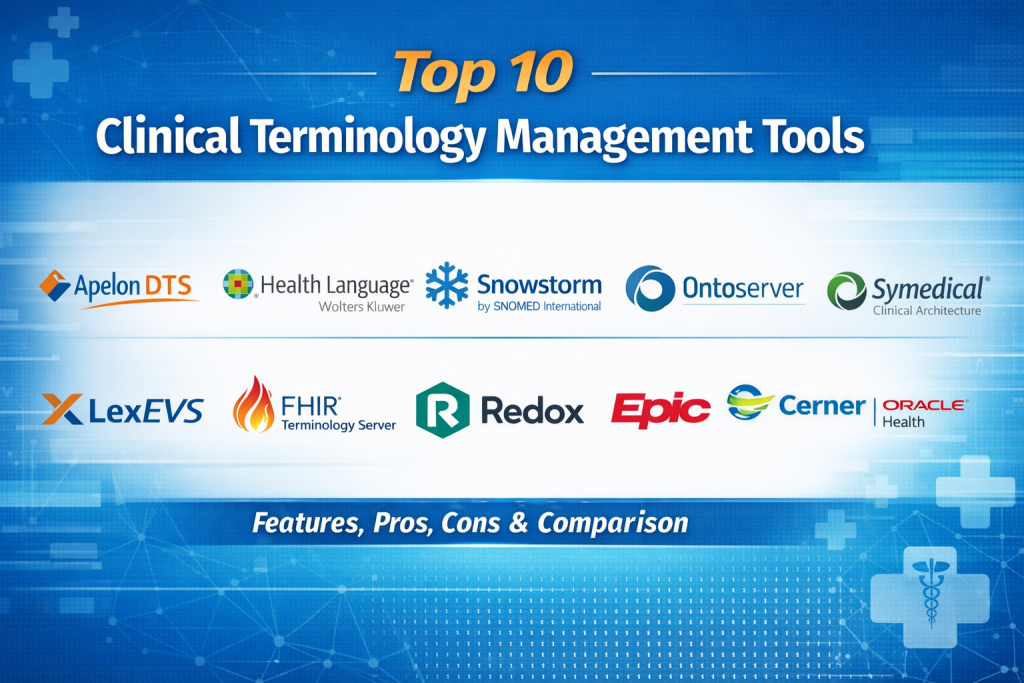
Top 10 Clinical Terminology Management Tools
1 — Apelon DTS
Short description:
A mature, enterprise-grade terminology management platform widely used in healthcare, life sciences, and government settings for large-scale terminology governance.
Key features:
- Centralized terminology repository
- SNOMED CT, ICD, LOINC, RxNorm support
- Advanced mapping and crosswalk tools
- Versioning and change management
- APIs for system integration
- Governance workflows and approvals
Pros:
- Highly robust and proven at scale
- Strong standards coverage
Cons:
- Steep learning curve
- Enterprise pricing may be high
Security & compliance:
HIPAA-aligned, role-based access, audit logs, encryption
Support & community:
Strong enterprise support, professional services, detailed documentation
2 — Health Language (Wolters Kluwer)
Short description:
A comprehensive terminology and content management solution embedded in many EHR and payer systems.
Key features:
- Extensive curated terminology libraries
- Automated updates and normalization
- Clinical concept management
- EHR and claims workflow alignment
- Analytics-ready structured data
Pros:
- Trusted content quality
- Strong payer and provider adoption
Cons:
- Limited customization flexibility
- Premium pricing
Security & compliance:
HIPAA, SOC-aligned controls, enterprise security standards
Support & community:
Dedicated enterprise support, onboarding assistance
3 — Snowstorm by SNOMED International
Short description:
An open-source, SNOMED CT–focused terminology server optimized for interoperability and FHIR-based use cases.
Key features:
- Native SNOMED CT support
- FHIR terminology services
- Versioning and branching
- REST APIs
- Scalable cloud deployments
Pros:
- Open-source and standards-aligned
- Excellent for SNOMED-heavy environments
Cons:
- Limited non-SNOMED coverage
- Requires technical expertise
Security & compliance:
Varies / deployment-dependent
Support & community:
Active open-source community, strong documentation
4 — Ontoserver
Short description:
A commercial-grade FHIR terminology server used for national-scale interoperability programs.
Key features:
- Full FHIR terminology services
- Multi-code system support
- High-performance APIs
- Validation and expansion services
- Version lifecycle management
Pros:
- Excellent FHIR compliance
- Highly performant
Cons:
- Less focus on UI-based governance
- Primarily integration-driven
Security & compliance:
Enterprise-grade security, configurable controls
Support & community:
Vendor-backed support, professional services
5 — Clinical Architecture (Symedical)
Short description:
A terminology and mapping platform focused on data normalization and clinical analytics readiness.
Key features:
- Concept-based data modeling
- Automated mapping tools
- Terminology harmonization
- Analytics-friendly outputs
- Version tracking
Pros:
- Strong analytics orientation
- Reduces downstream data prep
Cons:
- Smaller ecosystem
- Limited out-of-the-box integrations
Security & compliance:
HIPAA-aligned, access controls, audit logging
Support & community:
Responsive vendor support, structured onboarding
6 — LexEVS (Leidos)
Short description:
A high-performance enterprise terminology service used in government and defense healthcare systems.
Key features:
- Large-scale terminology distribution
- High-availability architecture
- API-driven access
- Multi-terminology support
- Governance controls
Pros:
- Extremely scalable
- Proven in mission-critical environments
Cons:
- Limited UI features
- Enterprise-only focus
Security & compliance:
FedRAMP-aligned options, strong audit controls
Support & community:
Enterprise support with SLAs
7— FHIR Terminology Server (General Platforms)
Short description:
FHIR-native terminology servers embedded in modern interoperability stacks.
Key features:
- Code validation and expansion
- FHIR ValueSet and CodeSystem support
- Lightweight deployments
- API-first design
- Cloud scalability
Pros:
- Ideal for API-driven ecosystems
- Easy integration
Cons:
- Limited governance UI
- Often requires customization
Security & compliance:
Varies by implementation
Support & community:
Depends on vendor or open-source variant
8 — Redox (Terminology Services)
Short description:
Primarily an interoperability platform with embedded terminology normalization capabilities.
Key features:
- Code normalization across EHRs
- Mapping to standard vocabularies
- API-based access
- Reduced integration complexity
- Managed updates
Pros:
- Easy adoption
- Reduces integration overhead
Cons:
- Not a full governance platform
- Less control over custom terminology
Security & compliance:
HIPAA, SOC 2, enterprise-grade security
Support & community:
Strong customer success and onboarding
9 — Epic (Terminology Services)
Short description:
Native terminology management embedded within the Epic EHR ecosystem.
Key features:
- Integrated diagnosis and procedure coding
- Automated updates
- EHR-native workflows
- Reporting alignment
- Minimal external integration
Pros:
- Seamless for Epic customers
- No external tooling required
Cons:
- Vendor lock-in
- Limited cross-platform use
Security & compliance:
HIPAA-compliant, enterprise healthcare standards
Support & community:
Epic-led support and training resources
10 — Cerner (Oracle Health)
Short description:
Terminology services integrated into Cerner’s clinical and revenue cycle platforms.
Key features:
- Embedded clinical coding
- Standards alignment
- Automated updates
- Reporting and analytics support
- Integrated governance
Pros:
- Strong EHR integration
- Reliable for Cerner users
Cons:
- Limited external flexibility
- Best suited only for Cerner ecosystems
Security & compliance:
HIPAA, enterprise-grade controls
Support & community:
Vendor-backed enterprise support
Comparison Table
| Tool Name | Best For | Platform(s) Supported | Standout Feature | Rating |
|---|---|---|---|---|
| Apelon DTS | Large enterprises | Web, API | Deep governance & mapping | N/A |
| Health Language | Payers & providers | Cloud | Curated terminology content | N/A |
| Snowstorm | SNOMED-centric teams | API, Cloud | Open-source SNOMED server | N/A |
| Ontoserver | National interoperability | API | FHIR-first performance | N/A |
| Clinical Architecture | Analytics-driven orgs | Web, API | Concept-based normalization | N/A |
| LexEVS | Government systems | API | High availability & scale | N/A |
| FHIR Terminology Servers | API ecosystems | API | Lightweight FHIR services | N/A |
| Redox | Health IT startups | Cloud | Simplified normalization | N/A |
| Epic | Epic hospitals | EHR-native | Seamless integration | N/A |
| Cerner | Cerner hospitals | EHR-native | Embedded terminology | N/A |
Evaluation & Scoring of Clinical Terminology Management Tools
| Tool | Core (25%) | Ease (15%) | Integrations (15%) | Security (10%) | Performance (10%) | Support (10%) | Value (15%) | Total |
|---|---|---|---|---|---|---|---|---|
| Apelon DTS | 23 | 10 | 14 | 9 | 9 | 9 | 10 | 84 |
| Health Language | 22 | 12 | 13 | 9 | 9 | 9 | 9 | 83 |
| Snowstorm | 20 | 11 | 14 | 7 | 8 | 8 | 14 | 82 |
| Ontoserver | 21 | 11 | 15 | 8 | 9 | 8 | 10 | 82 |
| Clinical Architecture | 21 | 12 | 12 | 8 | 8 | 8 | 11 | 80 |
Which Clinical Terminology Management Tool Is Right for You?
- Solo users / small teams: Lightweight FHIR terminology servers or managed interoperability platforms
- SMBs: Cloud-based tools with strong normalization and minimal governance overhead
- Mid-market: Platforms offering both mapping and governance with integration flexibility
- Enterprise: Full-featured solutions like Apelon or Health Language
Budget-conscious: Open-source or embedded EHR services
Premium solutions: Enterprise-grade governance and analytics platforms
Choose deeper features if you manage multiple systems and standards. Choose simplicity if interoperability is your primary goal.
Frequently Asked Questions (FAQs)
- What is clinical terminology management?
It is the process of managing standardized clinical vocabularies to ensure consistent data capture and exchange. - Why is terminology management critical for interoperability?
Without standardized codes, systems cannot reliably exchange or interpret clinical data. - Do all hospitals need a standalone tool?
No. Many rely on EHR-native services unless they integrate multiple systems. - Is SNOMED CT support mandatory?
In many regions and use cases, yes—especially for clinical interoperability. - Can these tools support FHIR APIs?
Most modern platforms offer FHIR terminology services. - How hard is implementation?
Ranges from simple API integration to complex enterprise governance projects. - Are open-source tools reliable?
Yes, when properly supported and maintained. - What’s the biggest mistake buyers make?
Underestimating governance and change management needs. - Do these tools support analytics and AI?
Well-managed terminology significantly improves analytics and AI accuracy. - Is there a single best tool?
No—the best choice depends on scale, ecosystem, and compliance needs.
Conclusion
Clinical Terminology Management Tools are foundational to interoperability, data quality, regulatory compliance, and advanced analytics. While enterprise platforms offer deep governance and control, lighter tools excel in API-driven and FHIR-based environments. The right choice depends on organizational size, technical maturity, and long-term data strategy. There is no universal winner—only the best fit for your specific clinical and operational needs.

Find Trusted Cardiac Hospitals
Compare heart hospitals by city and services — all in one place.
Explore Hospitals
This blog is a valuable comparison because clinical terminology management is the “hidden foundation” behind clean EHR data, accurate coding, safe clinical decision support, and reliable interoperability. The best tools don’t just store code sets—they help healthcare teams map and normalize vocabularies (like SNOMED CT, LOINC, ICD-10, RxNorm), manage versions and updates safely, maintain governance and audit trails, and support crosswalks for analytics and reporting. When comparing options, it’s smart to look at mapping quality, change management workflows, FHIR/HL7 integration readiness, validation rules, role-based access, and how easily clinicians and informatics teams can collaborate—because good terminology control reduces data ambiguity and improves patient-care consistency across systems.