
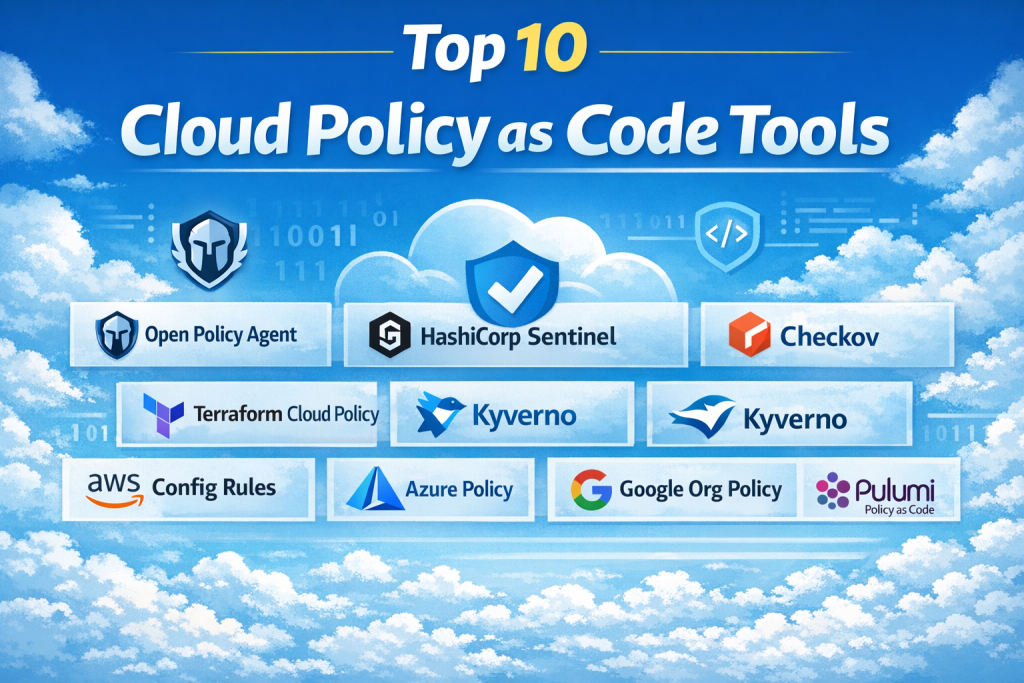
Introduction
Cloud environments have become highly dynamic, distributed, and complex. Infrastructure is now created and modified through code, often across multiple cloud providers, regions, and teams. In this reality, manual governance and security controls simply do not scale. This is where Cloud Policy as Code (PaC) tools play a critical role.
Cloud Policy as Code tools allow organizations to define, manage, test, and enforce cloud governance rules using code. These policies can automatically check whether infrastructure configurations meet security, compliance, cost, and operational standards—before deployment or continuously after changes go live. Instead of relying on human reviews, policies are evaluated programmatically as part of CI/CD pipelines and runtime monitoring.
These tools are widely used to:
- Prevent misconfigurations before they reach production
- Enforce compliance standards consistently
- Reduce security risks and cloud cost waste
- Enable DevOps and platform teams to scale governance without slowing delivery
What to look for when choosing a Cloud Policy as Code tool
When evaluating tools in this category, buyers should focus on:
- Policy language flexibility (Rego, YAML, Python, HCL, etc.)
- Integration with IaC tools like Terraform and Kubernetes
- Pre-deployment and runtime enforcement
- Ease of writing and testing policies
- Security, compliance, and audit capabilities
- Scalability and enterprise readiness
Best for:
Cloud engineers, DevOps teams, platform engineering teams, security teams, and compliance teams managing cloud infrastructure at scale across startups, SMBs, and large enterprises.
Not ideal for:
Small teams with minimal cloud usage, static on-prem environments, or organizations without infrastructure automation may find these tools unnecessary or overly complex.
Top 10 Cloud Policy as Code Tools
1 — Open Policy Agent
Short description:
A general-purpose, open-source policy engine designed for cloud-native and microservices environments, widely adopted across Kubernetes and modern DevOps stacks.
Key features:
- Rego policy language for expressive rule definitions
- Native Kubernetes admission control integration
- Works with CI/CD pipelines and APIs
- Decouples policy decisions from application logic
- Strong ecosystem and CNCF backing
- Supports fine-grained authorization and validation
Pros:
- Extremely flexible and powerful
- Large community and ecosystem
Cons:
- Steep learning curve with Rego
- Requires engineering effort to integrate fully
Security & compliance:
SSO support via integrations, audit logging, enterprise compliance varies by deployment.
Support & community:
Excellent documentation, large open-source community, enterprise support via vendors.
2 — HashiCorp Sentinel
Short description:
A policy framework tightly integrated into HashiCorp’s ecosystem, designed to enforce governance across Terraform, Vault, and Consul workflows.
Key features:
- Deep Terraform and IaC integration
- Fine-grained policy enforcement
- Policy checks at plan and apply stages
- Centralized governance model
- Strong enterprise controls
Pros:
- Seamless with HashiCorp tools
- Strong compliance enforcement
Cons:
- Limited outside HashiCorp ecosystem
- Proprietary licensing
Security & compliance:
SOC 2, encryption, audit logs, enterprise-grade compliance.
Support & community:
High-quality documentation, enterprise support, smaller community than OPA.
3 — Checkov
Short description:
An open-source static analysis tool focused on detecting security and compliance misconfigurations in infrastructure-as-code templates.
Key features:
- Supports Terraform, CloudFormation, Kubernetes
- Built-in security and compliance policies
- CI/CD pipeline integration
- Policy customization
- Fast feedback for developers
Pros:
- Easy to adopt
- Strong out-of-box rules
Cons:
- Limited runtime enforcement
- Less flexible than full policy engines
Security & compliance:
Supports CIS, NIST, PCI-DSS frameworks.
Support & community:
Active community, good documentation, enterprise support available.
4 — Conftest
Short description:
A lightweight testing tool that uses Open Policy Agent to validate configuration files against custom policies before deployment.
Key features:
- Policy testing for IaC and config files
- CLI-based workflow
- Uses Rego policies
- Easy CI/CD integration
- Supports multiple file formats
Pros:
- Simple and fast
- Ideal for shift-left governance
Cons:
- Depends on OPA knowledge
- No native runtime enforcement
Security & compliance:
Varies based on policy definitions.
Support & community:
Good documentation, open-source community support.
5 — Terraform Cloud Policy
Short description:
Built-in policy enforcement for Terraform Cloud and Enterprise, enabling governance directly within Terraform workflows.
Key features:
- Native Sentinel integration
- Policy checks on plans
- Centralized governance
- Role-based access control
- Enterprise-grade scalability
Pros:
- Deep Terraform integration
- Minimal setup
Cons:
- Terraform-only focus
- Enterprise pricing
Security & compliance:
SOC 2, encryption, audit logs.
Support & community:
Strong enterprise support, good documentation.
6 — Kyverno
Short description:
A Kubernetes-native policy engine designed for platform teams seeking simple, YAML-based policy definitions.
Key features:
- No custom policy language required
- Admission control and mutation
- Policy validation and generation
- Kubernetes-native design
- Strong security controls
Pros:
- Easy to learn
- Kubernetes-friendly
Cons:
- Kubernetes-only
- Less flexible than OPA
Security & compliance:
Supports audit logs, RBAC, Kubernetes security standards.
Support & community:
Growing open-source community, solid documentation.
7 — AWS Config Rules
Short description:
A managed AWS service for evaluating resource configurations against predefined or custom compliance rules.
Key features:
- Native AWS integration
- Continuous compliance monitoring
- Managed and custom rules
- Automated remediation
- Audit-ready reports
Pros:
- No infrastructure to manage
- Deep AWS visibility
Cons:
- AWS-only
- Limited flexibility compared to PaC engines
Security & compliance:
SOC, ISO, GDPR, HIPAA depending on AWS setup.
Support & community:
Enterprise AWS support, extensive documentation.
8 — Azure Policy
Short description:
Microsoft’s native policy service for enforcing governance and compliance across Azure resources.
Key features:
- Built-in compliance controls
- Policy initiatives
- Automatic remediation
- Integration with Azure RBAC
- Audit dashboards
Pros:
- Native Azure experience
- Easy setup
Cons:
- Azure-only
- Limited customization depth
Security & compliance:
SOC, ISO, GDPR, HIPAA.
Support & community:
Strong enterprise support, extensive documentation.
9 — Google Organization Policy
Short description:
A Google Cloud service for enforcing organizational constraints across projects and resources.
Key features:
- Organization-wide policies
- Constraint-based enforcement
- Integration with IAM
- Centralized governance
- Low operational overhead
Pros:
- Simple and effective
- Native GCP integration
Cons:
- GCP-only
- Less expressive than PaC engines
Security & compliance:
Google Cloud compliance standards apply.
Support & community:
Enterprise GCP support, good documentation.
10 — Pulumi Policy as Code
Short description:
A policy framework that allows teams to write cloud policies using familiar programming languages.
Key features:
- Policies in TypeScript, Python, Go
- Works with Pulumi IaC
- Pre-deployment enforcement
- Flexible and expressive
- Developer-friendly
Pros:
- No new language to learn
- Strong developer adoption
Cons:
- Pulumi-centric
- Smaller ecosystem
Security & compliance:
Encryption, audit logs, enterprise compliance available.
Support & community:
Good documentation, growing community, enterprise support.
Comparison Table
| Tool Name | Best For | Platform(s) Supported | Standout Feature | Rating |
|---|---|---|---|---|
| Open Policy Agent | Advanced policy control | Multi-cloud, Kubernetes | Rego flexibility | N/A |
| HashiCorp Sentinel | Terraform governance | HashiCorp stack | Native Terraform checks | N/A |
| Checkov | IaC security scanning | Multi-cloud | Built-in compliance rules | N/A |
| Conftest | Policy testing | Multi-platform | Lightweight testing | N/A |
| Terraform Cloud Policy | Terraform users | Terraform Cloud | Native enforcement | N/A |
| Kyverno | Kubernetes teams | Kubernetes | YAML-based policies | N/A |
| AWS Config Rules | AWS governance | AWS | Managed compliance | N/A |
| Azure Policy | Azure governance | Azure | Policy initiatives | N/A |
| Google Org Policy | GCP governance | GCP | Org-wide constraints | N/A |
| Pulumi Policy as Code | Developers | Multi-cloud | Language flexibility | N/A |
Evaluation & Scoring of Cloud Policy as Code Tools
| Criteria | Weight | Description |
|---|---|---|
| Core features | 25% | Policy expressiveness and enforcement |
| Ease of use | 15% | Learning curve and usability |
| Integrations & ecosystem | 15% | CI/CD, IaC, cloud support |
| Security & compliance | 10% | Auditability and standards |
| Performance & reliability | 10% | Scale and consistency |
| Support & community | 10% | Docs and assistance |
| Price / value | 15% | ROI and licensing |
Which Cloud Policy as Code Tool Is Right for You?
- Solo users: Lightweight tools like Checkov or Conftest
- SMBs: OPA with Conftest or Pulumi Policy as Code
- Mid-market: Sentinel, Kyverno, Pulumi
- Enterprise: OPA, Sentinel, native cloud policies
Budget-conscious: Open-source tools
Premium: Enterprise cloud-native services
Feature depth: OPA, Sentinel
Ease of use: Kyverno, cloud-native tools
Frequently Asked Questions (FAQs)
- What is Cloud Policy as Code?
It is the practice of defining governance rules as code to automatically enforce standards. - Is Policy as Code only for security?
No, it also covers cost, reliability, and operational policies. - Do I need Kubernetes to use PaC tools?
No, many tools support IaC and cloud APIs without Kubernetes. - Are open-source tools production-ready?
Yes, many are widely used in large enterprises. - Can these tools prevent deployments?
Yes, policies can block non-compliant changes. - Do they slow down CI/CD?
Minimal impact when implemented correctly. - Are cloud-native policies enough?
For simple needs, yes; complex cases need PaC engines. - How hard is policy maintenance?
Depends on tool and policy complexity. - Can policies be shared across teams?
Yes, most tools support centralized policy management. - What’s the biggest mistake teams make?
Writing overly strict policies without developer buy-in.
Conclusion
Cloud Policy as Code tools are essential for enforcing consistent governance in modern cloud environments. They help organizations scale securely, reduce risk, and maintain compliance without slowing innovation. There is no universal “best” tool—the right choice depends on your cloud platform, team maturity, compliance needs, and budget. Evaluating tools against real-world use cases and organizational goals will lead to the most effective outcome.

Find Trusted Cardiac Hospitals
Compare heart hospitals by city and services — all in one place.
Explore Hospitals
Great article! I like how you explained the pros and cons of each cloud policy‑as‑code tool — makes it much easier to compare and pick the right one. 😊